
As a researcher interested in the field of mechanical engineering, particularly in gear systems, I have conducted a comprehensive analysis of the research and development trends for spiral bevel gears based on the Engineering Index (Ei) database. Spiral bevel gears, including hypoid gears, are critical components in various industries such as automotive, aerospace, and machinery due to their smooth transmission and high load-bearing capacity. This analysis employs bibliometric methods to examine literature from 1985 to 2008, retrieved from Ei, and extends to citation analysis using Scopus up to January 31, 2011. The goal is to provide insights into the evolution of spiral bevel gears research, which can guide future studies and management strategies. Throughout this article, I will emphasize the significance of spiral bevel gears and explore multiple facets of the literature to uncover patterns and opportunities.
The methodology involves querying the Ei database using specific search terms related to spiral bevel gears and hypoid gears. The search strategy was designed to capture a broad range of publications, and the retrieved data was then analyzed quantitatively across various dimensions. To enrich the discussion, I incorporate technical details, formulas, and tables to summarize findings. The analysis covers document types, languages, publication years, geographic distribution, subject categories, author affiliations, top authors, and citation metrics. Additionally, I integrate a visual representation of spiral bevel gears to enhance understanding, as shown below:
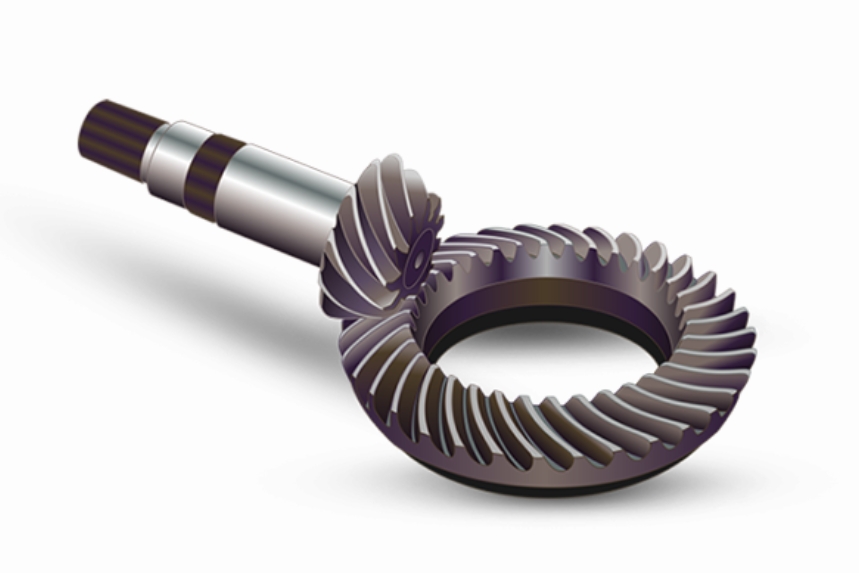
Spiral bevel gears are characterized by their curved teeth, which allow for gradual engagement and reduced noise compared to straight bevel gears. The geometry of spiral bevel gears can be described using mathematical models. For instance, the tooth surface equation for a spiral bevel gear can be expressed in parametric form. Let $$ \mathbf{r}(u, v) $$ represent the position vector of a point on the tooth surface, where $$ u $$ and $$ v $$ are parameters. In a coordinate system aligned with the gear axis, the surface may be defined by:
$$ \mathbf{r}(u, v) = \begin{bmatrix} x(u, v) \\ y(u, v) \\ z(u, v) \end{bmatrix} = \begin{bmatrix} (R \pm u \cos \beta) \cos \theta \\ (R \pm u \cos \beta) \sin \theta \\ u \sin \beta \end{bmatrix} $$
Here, $$ R $$ is the pitch radius, $$ \beta $$ is the spiral angle, and $$ \theta $$ is the angular parameter. The ± sign depends on the hand of the spiral. This equation highlights the complexity involved in designing spiral bevel gears, requiring advanced mathematical and computational tools. The analysis of research literature often revolves around such geometric and kinematic considerations, which are essential for optimizing performance.
From the Ei database, a total of 792 documents were retrieved for the period 1985–2008. These documents include journal articles, conference papers, research reports, and other publications. The distribution across document types is summarized in Table 1. Journal articles constitute the majority, indicating that peer-reviewed journals remain the primary outlet for disseminating high-quality research on spiral bevel gears. Conference papers also play a significant role, reflecting the importance of academic exchanges in advancing this field. This pattern suggests that researchers focusing on spiral bevel gears should prioritize publishing in reputable journals and presenting at conferences to enhance visibility and impact.
| Document Type | Count | Percentage (%) |
|---|---|---|
| Journal Articles | 481 | 60.7 |
| Conference Papers | 129 | 16.3 |
| Research Reports | 22 | 2.8 |
| Conference Proceedings | 8 | 1.0 |
| Other | 152 | 19.2 |
| Total | 792 | 100 |
The language analysis reveals that English is the dominant language for publishing research on spiral bevel gears, accounting for 69.2% of the documents. Chinese is the second most common language, demonstrating the growing contribution of Chinese researchers to the global knowledge base on spiral bevel gears. Other languages like Japanese, German, and Russian appear in smaller proportions, as shown in Table 2. This linguistic distribution underscores the international nature of spiral bevel gears research, but also highlights the need for researchers to publish in English to reach a wider audience. The prevalence of Chinese publications aligns with the increasing investment in engineering research in China, particularly in areas like spiral bevel gears, which are vital for manufacturing and transportation sectors.
| Language | Count | Percentage (%) |
|---|---|---|
| English | 548 | 69.2 |
| Chinese | 140 | 17.8 |
| Japanese | 61 | 7.7 |
| German | 20 | 2.5 |
| Russian | 6 | 0.7 |
| Other | 17 | 2.1 |
| Total | 792 | 100 |
Examining the publication years, the number of documents on spiral bevel gears shows a gradual increase over time, with fluctuations. Table 3 lists the annual counts from 1985 to 2008. The growth trend suggests sustained interest in spiral bevel gears, possibly driven by advancements in computational methods and manufacturing technologies. However, compared to emerging fields like renewable energy, the volume of publications is relatively modest, indicating that spiral bevel gears research is mature but still evolving. The peak in 2008 may reflect increased focus on noise reduction and efficiency in automotive applications, where spiral bevel gears are extensively used.
| Year | Number of Publications |
|---|---|
| 1985 | 29 |
| 1986 | 31 |
| 1987 | 37 |
| 1988 | 21 |
| 1989 | 27 |
| 1990 | 17 |
| 1991 | 36 |
| 1992 | 28 |
| 1993 | 22 |
| 1994 | 44 |
| 1995 | 20 |
| 1996 | 54 |
| 1997 | 24 |
| 1998 | 19 |
| 1999 | 20 |
| 2000 | 20 |
| 2001 | 39 |
| 2002 | 42 |
| 2003 | 39 |
| 2004 | 21 |
| 2005 | 43 |
| 2006 | 37 |
| 2007 | 50 |
| 2008 | 72 |
| Total | 792 |
Geographically, the United States leads in publication output, followed by China, as detailed in Table 4. This distribution reflects the historical strength of U.S. institutions in engineering research and the rapid rise of Chinese academia. The presence of other countries like Japan, Germany, and Canada indicates a global research community focused on spiral bevel gears. For researchers, collaborating with institutions in these regions can foster innovation and knowledge exchange. The data also suggests that spiral bevel gears are a priority in nations with strong automotive and aerospace industries, where these gears are critical for power transmission systems.
| Country/Region | Count | Percentage (%) |
|---|---|---|
| United States | 243 | 30.7 |
| China | 160 | 20.3 |
| Japan | 49 | 6.2 |
| Taiwan (China) | 22 | 2.7 |
| Germany | 19 | 2.4 |
| Canada | 17 | 2.1 |
| Hungary | 15 | 1.9 |
| Other | 267 | 33.7 |
| Total | 792 | 100 |
The subject category analysis, presented in Table 5, shows that spiral bevel gears research spans multiple disciplines. Mechanical parts and design are the most frequent categories, but mathematics, computer applications, numerical methods, and mechanics are also prominent. This interdisciplinary nature is crucial for addressing complex challenges in spiral bevel gears, such as optimizing tooth contact patterns or reducing stress concentrations. For instance, the stress analysis of spiral bevel gears often involves finite element methods, which rely on numerical techniques. A common formula for contact stress in gear teeth is the Hertzian contact stress equation:
$$ \sigma_H = \sqrt{\frac{F}{\pi} \cdot \frac{1}{R_1} + \frac{1}{R_2} \cdot \frac{1 – \nu_1^2}{E_1} + \frac{1 – \nu_2^2}{E_2}} $$
Here, $$ \sigma_H $$ is the maximum contact stress, $$ F $$ is the applied load, $$ R_1 $$ and $$ R_2 $$ are the radii of curvature, $$ E $$ is Young’s modulus, and $$ \nu $$ is Poisson’s ratio. Such formulas are integral to research on spiral bevel gears, highlighting the need for strong foundational knowledge in mechanics and materials science. The prevalence of computer applications underscores the role of simulation software in designing and testing spiral bevel gears, enabling virtual prototyping and performance prediction.
| Subject Category | Count |
|---|---|
| Mechanical Parts | 351 |
| Mechanical Design | 157 |
| Mathematics | 127 |
| Computer Applications | 124 |
| Numerical Methods | 111 |
| Mechanics | 93 |
| Material Strength | 81 |
| Machining Equipment | 68 |
| Mechanical Transmission | 63 |
| Physical Properties | 61 |
Analyzing author affiliations reveals that leading institutions in spiral bevel gears research include government research centers and universities. Table 6 lists the top affiliations based on publication count. These institutions often have dedicated teams working on gear systems, contributing to both theoretical and experimental advancements. For aspiring researchers, targeting collaborations with these organizations can provide access to specialized resources and expertise. The presence of multiple Chinese institutions indicates a concentrated effort in China to advance spiral bevel gears technology, possibly linked to national industrial policies.
| Affiliation | Number of Publications |
|---|---|
| NASA Lewis Research Center | 94 |
| University of Illinois at Chicago | 26 |
| Northwestern Polytechnical University | 16 |
| Henan University of Science and Technology | 12 |
| Central South University | 10 |
| University of Akron | 10 |
| National Chiao Tung University | 9 |
| Tianjin University | 8 |
| Laval University | 8 |
| National Chung Cheng University | 8 |
The top authors in spiral bevel gears research, as shown in Table 7, have made substantial contributions through numerous publications. These individuals often lead research groups and set trends in the field. Their work typically involves developing new design methodologies, such as the local synthesis method for spiral bevel gears, which optimizes tooth geometry for improved performance. The citation impact of these authors is further explored in the Scopus analysis. For researchers, studying the publications of these top authors can provide valuable insights into key topics and techniques in spiral bevel gears research.
| Author | Number of Publications |
|---|---|
| Handschuh, R. F. | 95 |
| Litvin, F. L. | 86 |
| Lewicki, D. G. | 44 |
| Fang, Zongde | 36 |
| Deng, Xiaozhong | 29 |
| Coy, J. J. | 24 |
| Tamura, Hisashi | 16 |
| Fong, Zhang Hua | 15 |
| Gosselin, C. | 15 |
| Ito, Norio | 15 |
Citation analysis using Scopus reveals the most influential publications on spiral bevel gears. Table 8 lists the top 10 cited documents as of January 31, 2011. These papers often appear in high-impact journals and cover topics like computerized design, stress analysis, and manufacturing optimization. The high citation counts indicate their relevance and impact on subsequent research. Notably, several papers focus on integrated approaches combining finite element analysis and geometric modeling, which are essential for advancing spiral bevel gears technology. For example, one highly cited paper presents a method for minimizing surface deviations in spiral bevel gears, which can be mathematically expressed as an optimization problem:
$$ \min_{x} f(x) = \sum_{i=1}^{n} (d_i – \hat{d}_i)^2 $$
Here, $$ f(x) $$ is the objective function representing surface deviation, $$ d_i $$ are measured points, and $$ \hat{d}_i $$ are theoretical points. Such formulations demonstrate the interplay between mathematics and engineering in spiral bevel gears research. The absence of mainland Chinese authors in the top-cited list suggests room for improvement in producing groundbreaking work that garners international attention.
| Year | Authors | Title | Journal | Citation Count |
|---|---|---|---|---|
| 2002 | Argyris, J.; Fuentes, A.; Litvin, F. L. | Computerized integrated approach for design and stress analysis of spiral bevel gears | Computer Methods in Applied Mechanics and Engineering | 61 |
| 1991 | Vijayakar, Sandeep | Combined surface integral and finite element solution for a three-dimensional contact problem | International Journal for Numerical Methods in Engineering | 50 |
| 1985 | Chittenden, R. J.; Dowson, D.; Dunn, J. F.; Taylor, C. M. | Theoretical analysis of the isothermal elastohydrodynamic lubrication of concentrated contacts | Proceedings of the Royal Society of London | 49 |
| 1993 | Litvin, F. L.; Kuan, C., et al. | Minimization of deviations of gear real tooth surfaces determined by coordinate measurements | Journal of Mechanical Design | 39 |
| 1998 | Lin, Ch.-Y.; Tsay, Ch.-B., et al. | Computer-aided manufacturing of spiral bevel and hypoid gears with minimum surface-deviation | Mechanism and Machine Theory | 39 |
| 1987 | Tsai, Y. C.; Chin, P. C. | Surface geometry of straight and spiral bevel gears | Journal of Mechanisms, Transmissions, and Automation in Design | 36 |
| 2006 | Litvin, F. L.; Fuentes, A., et al. | Design, manufacture, stress analysis, and experimental tests of low-noise high endurance spiral bevel gears | Mechanism and Machine Theory | 33 |
| 1994 | Zhang, Y.; Litvin, F. L., et al. | Computerized analysis of meshing and contact of gear real tooth surfaces | Journal of Mechanical Design | 29 |
| 1998 | Gosselin, C.; Nonaka, T., et al. | Identification of the machine settings of real hypoid gear tooth surfaces | Journal of Mechanical Design | 29 |
| 2000 | Fong, Zhang-hua | Mathematical model of universal hypoid generator with supplemental kinematic flank correction motions | Journal of Mechanical Design | 25 |
Based on the analysis, I offer several discussions and recommendations for researchers and management bodies involved in spiral bevel gears studies. Firstly, the field of spiral bevel gears is mature, yet it continues to evolve with technological advancements. The steady growth in publications indicates ongoing interest, but the relatively low volume compared to hot topics suggests that spiral bevel gears may not attract as many new researchers. To revitalize the field, interdisciplinary approaches combining artificial intelligence or additive manufacturing could be explored. For instance, machine learning algorithms might optimize spiral bevel gears design by predicting performance metrics based on historical data.
Secondly, the citation analysis highlights the importance of publishing in high-impact journals. Researchers should aim to produce original work that addresses fundamental challenges in spiral bevel gears, such as noise reduction or weight optimization. Mathematical modeling plays a key role here; for example, the dynamics of spiral bevel gears can be described using differential equations. Consider the equation of motion for a gear pair:
$$ I \ddot{\theta} + c \dot{\theta} + k \theta = T $$
Where $$ I $$ is the moment of inertia, $$ c $$ is damping, $$ k $$ is stiffness, $$ \theta $$ is angular displacement, and $$ T $$ is torque. Such models are essential for simulating vibration and durability of spiral bevel gears. By focusing on rigorous theoretical foundations, researchers can enhance the impact of their work.
Thirdly, geographic and institutional data suggest that collaboration is vital. Researchers in countries like China should strengthen ties with international peers to foster innovation in spiral bevel gears. Management departments at universities and research centers should provide resources for collaborative projects, such as funding for joint laboratories or exchange programs. Additionally, supporting early-career researchers in gaining expertise in mathematics, mechanics, and computer science will ensure a skilled workforce for future spiral bevel gears advancements.
Finally, the dominance of English in publications underscores the need for researchers to communicate findings globally. While publishing in local languages has value, English-language journals remain the primary avenue for international recognition. Therefore, training in scientific writing and presentation should be encouraged. In summary, spiral bevel gears research benefits from a balanced approach that integrates traditional engineering with modern computational tools, and by fostering a collaborative, interdisciplinary environment, the field can continue to contribute significantly to industrial applications.