
In modern mechanical engineering, the manufacturing of spiral bevel gears represents a critical challenge due to their complex geometry and high precision requirements. Spiral bevel gears are fundamental components for transmitting rotational motion between intersecting or skewed axes, offering advantages such as high overlap ratio, substantial load-bearing capacity, smooth operation, and low noise. These gears are extensively used in high-speed and heavy-duty transmissions across industries like aerospace, automotive, engineering machinery, and precision machine tools. However, the traditional manufacturing methods for spiral bevel gears involve iterative trial-cutting, rolling tests, and adjustments to achieve optimal tooth contact patterns, which rely heavily on operator expertise and often result in inconsistent quality, low productivity, and high labor intensity. With advancements in computer technology, numerical control (NC), digital measurement, and high-precision electronic drives, a new pathway has emerged for high-accuracy, efficient, flexible, and digitized gear processing. In this context, we explore the application of a digital closed-loop processing system in the manufacturing of spiral bevel gears, highlighting its transformative impact on precision and efficiency.
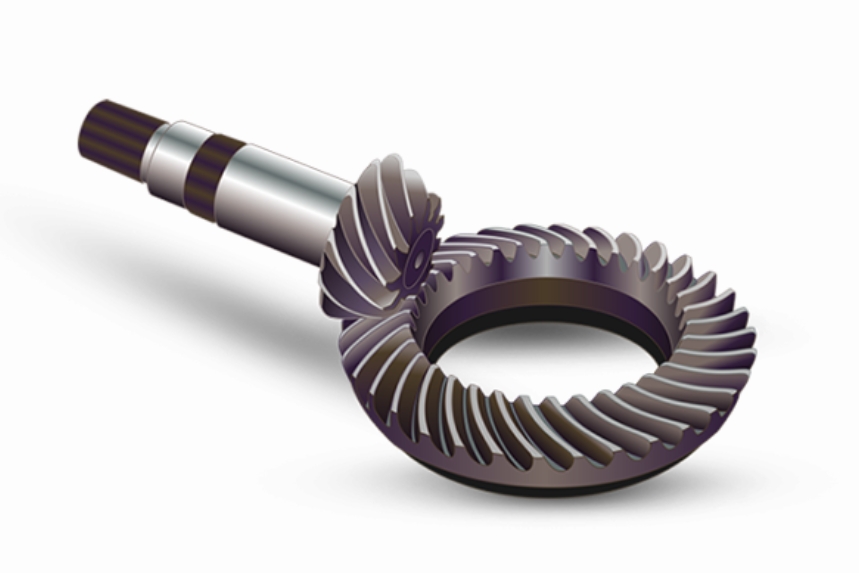
The complexity of spiral bevel gears stems from their spatial localized conjugate point-contact tooth surfaces, where the geometric shape directly influences transmission quality. Traditional approaches necessitate manual interventions, but the digital closed-loop system integrates computers, NC machining centers (e.g., gear milling or grinding machines), and gear measuring centers into a cohesive network. This system enables real-time feedback and correction, fundamentally altering the production paradigm for spiral bevel gears. We will delve into the workflow, advantages, and technical underpinnings of this system, emphasizing how it enhances the consistency and interchangeability of spiral bevel gears.
The traditional process for manufacturing spiral bevel gears typically follows a linear sequence: design calculations yield machine adjustment data, which operators use to set up machines for trial cuts; the cut gears are then tested on rolling testers for contact pattern evaluation; if unsatisfactory, experienced personnel empirically adjust parameters for re-cutting. This cycle repeats until acceptable contact and noise levels are achieved. In contrast, the digital closed-loop system establishes a circular workflow where measurement data directly inform computational corrections, minimizing human judgment. Below, we outline the key steps in this system, supported by tables and formulas to elucidate the technical aspects.
The digital closed-loop processing system for spiral bevel gears comprises several core components: CAD/CAM software for gear design and analysis, NC machine tools (such as grinders or millers), and a gear measuring center (e.g., a coordinate measuring machine). These elements are interconnected via a network, allowing seamless data transfer. The workflow can be summarized in five stages:
- Design Phase: Using specialized software, engineers compute initial machine adjustment parameters based on gear geometry and desired performance. These parameters include radial tool position, machine tilt angles, and rotational settings, which are transmitted to the NC machine.
- Trial Machining: The NC machine produces a trial gear based on the received data.
- Measurement: The trial gear is measured on the gear measuring center, which compares the actual tooth surface against a theoretical model or a master gear. Deviations are quantified as normal errors at multiple points.
- Correction Calculation: Software analyzes the deviation data and calculates precise correction values for the machine parameters.
- Iterative Refinement: Corrected parameters are sent back to the NC machine for re-machining, and the cycle repeats until deviations fall within tolerance.
To illustrate, we present a comparative table of traditional versus digital closed-loop processes for spiral bevel gears:
| Aspect | Traditional Process | Digital Closed-Loop Process |
|---|---|---|
| Workflow | Linear, trial-and-error | Circular, feedback-driven |
| Human Dependency | High (reliant on operator experience) | Low (automated corrections) |
| Quality Consistency | Variable, prone to inconsistencies | High, with repeatable precision |
| Production Efficiency | Low due to multiple iterations | High, with fewer adjustments |
| Interchangeability | Limited, gears are often matched pairs | Excellent, enabling gear互换性 |
| Measurement Basis | Visual inspection of contact patterns | Digital point-cloud analysis |
The superiority of the digital closed-loop system for spiral bevel gears is evident in its ability to stabilize quality and enhance precision. By leveraging high-precision NC machines, the system can achieve surface roughness below 0.6 µm and consistently meet GB6 grade accuracy, which corresponds to AGMA or ISO standards for spiral bevel gears. Moreover, the integration of measurement data reduces adjustment cycles from potentially dozens to just 2-3 iterations, significantly boosting productivity. From a labor perspective, automated data transmission eliminates manual input errors and lowers operator workload, allowing focus on higher-level tasks.
To quantify the geometric aspects of spiral bevel gears, we introduce key formulas that govern their design and manufacturing. The tooth surface of a spiral bevel gear can be modeled using complex mathematical representations, often based on differential geometry or conjugate theory. For instance, the local curvature and pressure angle influence contact patterns. A simplified expression for the tooth surface coordinates in a local coordinate system can be given by:
$$ x(u, v) = R(u) \cos(v) + C_x $$
$$ y(u, v) = R(u) \sin(v) + C_y $$
$$ z(u, v) = P(u) + C_z $$
where \( u \) and \( v \) are parameters defining the surface, \( R(u) \) is the radius function, \( P(u) \) is the lead curve, and \( C_x, C_y, C_z \) are offsets. For spiral bevel gears, the spiral angle \( \beta \) and pressure angle \( \alpha \) are critical. The relationship between machine settings and tooth geometry can be encapsulated in adjustment formulas. For example, the radial tool position \( S \), machine root angle \( \delta \), and ratio of roll \( R_a \) are linked to the gear’s pitch cone geometry. A fundamental equation for the machine setting based on the Gleason method is:
$$ S = \frac{m_t \cdot z}{2 \cos \beta} + \Delta S $$
where \( m_t \) is the transverse module, \( z \) is the number of teeth, \( \beta \) is the spiral angle, and \( \Delta S \) is a correction term. Similarly, the machine tilt angles influence the tooth flank topography. In the digital closed-loop system, these parameters are optimized iteratively using deviation data from measurements.
We now delve into the technical workflow with a detailed example. Consider a spiral bevel gear pair for an automotive rear axle, with parameters: pinion teeth \( z_1 = 8 \), gear teeth \( z_2 = 39 \), module \( m_t = 11.723 \, \text{mm} \), offset \( E = 44.45 \, \text{mm} \), spiral angle \( \beta = 45^\circ \), and pressure angle \( \alpha = 22.5^\circ \). The initial machine adjustment parameters for grinding the pinion concave side are computed via software. These parameters, along with correction values, can be tabulated as follows:
| Parameter | Symbol | Initial Value | First Correction | Second Correction |
|---|---|---|---|---|
| Radial Tool Position | \( S \) | 164.5016 mm | +0.11 mm | +0.01 mm |
| Total Tool Tilt Angle | \( i \) | 16.0012° | 0° | 0° |
| Basic Tool Rotation Angle | \( j \) | 302.8412° | 0° | 0° |
| Vertical Wheel Position | \( E \) | 40.2218 mm | 0 mm | 0 mm |
| Machine Installation Angle | \( \delta \) | 356.9924° | +0.5′ | 0′ |
| Wheel Position Correction | \( X_p \) | -4.5676 mm | -0.13 mm | -0.02 mm |
| Bed Position | \( X_B \) | 40.6443 mm | 0 mm | 0 mm |
| Ratio of Roll | \( R_a \) | 4.6458 | -0.002 | 0 |
| Angular Tool Position | \( q \) | 64.5420° | 0° | 0° |
After the initial grinding, the gear measuring center evaluates the tooth surface by sampling points in a grid pattern, typically dividing the flank into 5×9 segments (45 points) from root to tip and heel to toe. The deviation of each point from the theoretical surface is recorded, with positive values indicating excess material and negative values indicating deficiencies. For the initial trial, the deviation range might be from -0.0357 mm to +0.0192 mm, exceeding tolerance limits. The digital closed-loop system then computes corrections based on these deviations, often using optimization algorithms that minimize the root mean square error. The correction formulas can be expressed as linear adjustments:
$$ \Delta P = K \cdot D $$
where \( \Delta P \) is the parameter correction vector, \( K \) is a sensitivity matrix derived from gear geometry, and \( D \) is the deviation vector from measurement. After applying the first correction, the deviation range reduces, and after the second correction, it falls within ±0.01 mm, ensuring high precision for spiral bevel gears.
The advantages of this system for spiral bevel gears are multifaceted. First, quality stability is enhanced because digital measurements eliminate subjective judgments inherent in visual contact pattern inspections. Spiral bevel gears produced via this method exhibit consistent tooth flank topography across batches, enabling true interchangeability—a crucial factor for mass production in automotive and aerospace sectors. Second, production efficiency improves dramatically; the reduction in trial cycles from 5-10 iterations to 2-3 saves time and resources. Third, labor intensity decreases as operators no longer need to manually interpret contact patterns or guess correction values; instead, software automates these tasks. Additionally, the system facilitates data logging and traceability, which is vital for quality assurance in spiral bevel gear manufacturing.
To further elucidate the technical underpinnings, we discuss the role of the gear measuring center. Modern centers like the Sigma 7 or similar devices use tactile or optical probes to capture dense point clouds on the tooth surface of spiral bevel gears. These points are compared to a reference, which could be a CAD model or a master gear. The comparison yields deviation maps, often visualized as color-coded grids. The mathematical basis for this comparison involves coordinate transformations and surface fitting. For a point \( \mathbf{p}_{\text{actual}} \) on the actual gear, the normal deviation \( d_n \) to the reference surface \( S_{\text{ref}} \) is computed as:
$$ d_n = (\mathbf{p}_{\text{actual}} – \mathbf{p}_{\text{ref}}) \cdot \mathbf{n}_{\text{ref}} $$
where \( \mathbf{p}_{\text{ref}} \) is the closest point on \( S_{\text{ref}} \) and \( \mathbf{n}_{\text{ref}} \) is the unit normal vector. The system aggregates these deviations across the grid to compute statistical measures like peak-to-valley error or standard deviation. This data drives the correction loop, ensuring that spiral bevel gears meet stringent accuracy standards.
Another critical aspect is the NC machine’s capability. High-precision grinders, such as the YK2050 model, incorporate multi-axis control to follow complex tool paths that generate the desired tooth form for spiral bevel gears. The tool path is generated from the machine adjustment parameters, often involving simultaneous motions along linear and rotational axes. The relationship between machine coordinates and gear geometry can be described by kinematic chains, which for a spiral bevel gear grinder might include:
$$ \mathbf{T}_{\text{gear}} = \mathbf{R}_z(\theta) \cdot \mathbf{T}_x(X_B) \cdot \mathbf{R}_y(\delta) \cdot \mathbf{T}_z(E) \cdot \mathbf{R}_x(i) \cdot \mathbf{T}_y(S) \cdot \mathbf{R}_z(j) \cdot \mathbf{T}_{\text{tool}} $$
where \( \mathbf{T} \) and \( \mathbf{R} \) denote translation and rotation matrices, respectively, and variables correspond to adjustment parameters. The digital closed-loop system optimizes these parameters based on measurement feedback, effectively compensating for machine errors or tool wear.
We also consider economic and practical implications. The initial investment in a digital closed-loop system for spiral bevel gears is offset by long-term gains in reduced scrap, lower rework rates, and faster time-to-market. For industries reliant on spiral bevel gears, such as wind turbine gearboxes or helicopter transmissions, the system ensures reliability and performance under demanding conditions. Moreover, the flexibility of digital systems allows for rapid adaptation to design changes, supporting customized or low-volume production of spiral bevel gears without sacrificing quality.
In terms of future trends, the integration of artificial intelligence and machine learning into digital closed-loop systems promises even greater advancements for spiral bevel gear manufacturing. Predictive algorithms could anticipate deviations based on historical data, preemptively adjusting parameters to minimize trials. Additionally, the adoption of in-process measurement—where probes are integrated into the machine tool—could further shorten the feedback loop, enabling real-time corrections during machining of spiral bevel gears. These innovations will continue to push the boundaries of precision and efficiency.
To summarize, the digital closed-loop processing system represents a paradigm shift in the manufacturing of spiral bevel gears. By harmonizing design, machining, and measurement through digital networks, it addresses the limitations of traditional methods, offering unmatched consistency, accuracy, and productivity. As demonstrated through technical examples and formulas, the system leverages computational power to transform empirical art into a science, ensuring that spiral bevel gears meet the ever-rising demands of modern machinery. We anticipate that this approach will become the standard in gear manufacturing, driving innovation across sectors that depend on high-performance spiral bevel gears.
In conclusion, our exploration underscores the transformative potential of digital closed-loop systems for spiral bevel gears. Through detailed workflows, mathematical models, and comparative analyses, we have shown how this technology elevates manufacturing standards. The repeated emphasis on spiral bevel gears throughout this discussion highlights their centrality to advanced mechanical systems, and the digital closed-loop approach ensures they are produced with the precision and reliability required for critical applications. As we move forward, continuous refinement of these systems will further enhance the capabilities of spiral bevel gears, solidifying their role in the future of transmission technology.