
In my years of experience working with automotive drivetrains, I have come to understand that the heart of a vehicle’s rear axle differential often lies in the precise meshing of its spiral bevel gears. The longevity and acoustic performance of these gears are not merely products of sophisticated design and manufacturing quality; they are critically dependent on the meticulous adjustment of the tooth contact pattern during installation. Improper setup invariably leads to excessive noise and premature failure. Therefore, mastering the规律 of how the contact pattern changes with installation adjustments is paramount. This knowledge is the key to unlocking extended service life and whisper-quiet operation. This article delves deep into the theory and practice surrounding spiral bevel gears, with a relentless focus on the contact pattern.
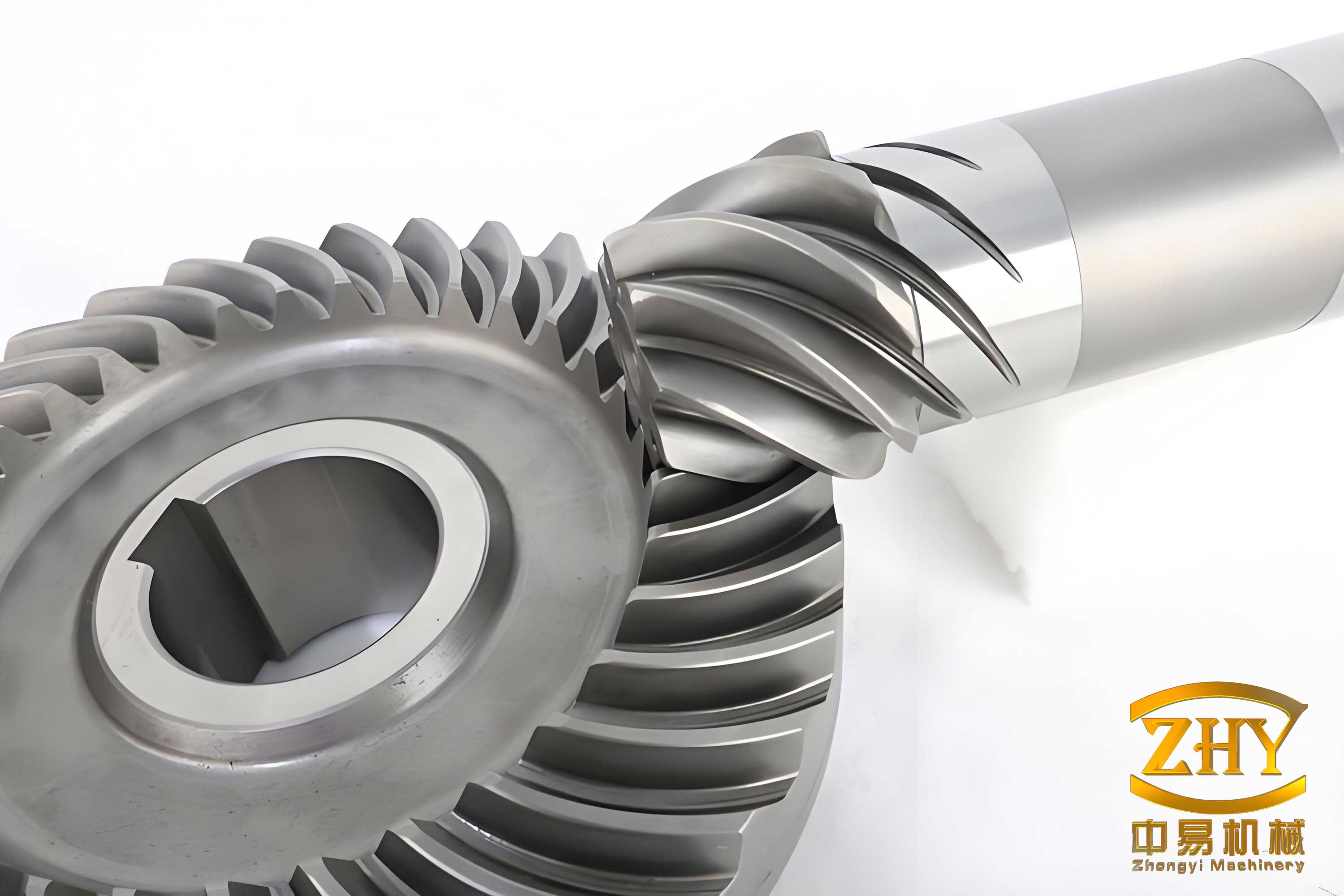
The most common types of spiral bevel gears found in automotive final drives are the Gleason system’s circular arc teeth, the Swiss Oerlikon system’s constant tooth depth and extended epicycloid teeth, and the hypoid gears derived from these systems. The fundamental condition for conical gear transmission is that the pitch cone surfaces of the two gears are tangent, and their vertices coincide. For hypoid gears, due to the offset between axes, the pitch cone vertices do not coincide. Crucially, spiral bevel gears are manufactured, inspected, installed, and used as matched pairs. Inspection primarily involves checking the tooth contact pattern, the variation in backlash, and noise. Among these, the tooth contact pattern is the most vital indicator for assessing the meshing quality of spiral bevel gears.
I. Fundamental Conditions for Correct Meshing of Spiral Bevel Gears
For a pair of meshing spiral bevel gears to function correctly, three basic kinematic and geometric conditions must be met at any point along the path of contact. First, the base pitches of the equivalent spur gears at any transverse section must be equal. This can be expressed as:
$$p_{b1} = p_{b2}$$
where \( p_b = \pi m_t \cos \alpha_t \). Here, \( m_t \) is the transverse module on the back cone at a given cone distance \( R \), and \( \alpha_t \) is the transverse pressure angle at that same point. This equality ensures smooth entry and exit of teeth from mesh.
Second, at any point within the contact zone, the magnitude of the spiral angle must be equal for both gears, but the handedness must be opposite (except for hypoid gears where the relationship is more complex due to offset). This is denoted as:
$$\beta_1 = -\beta_2$$
Typically, the spiral angle referred to is the mean spiral angle at the midpoint of the face width. Third, the radii of curvature of the contacting tooth surfaces must satisfy a specific relationship to ensure localized contact and proper load distribution. For the convex side of the pinion tooth and the concave side of the gear tooth, and vice versa, the following must hold:
$$\rho_{a1} > \rho_{b2} \quad \text{and} \quad \rho_{b1} < \rho_{a2}$$
Here, \( \rho_{a1} \) is the radius of curvature of the pinion’s convex flank, and \( \rho_{b2} \) is that of the gear’s concave flank, and so on. This condition ensures that under load, the contact ellipse develops properly without edge loading.
II. The Tooth Contact Pattern: Requirements and Specifications
The contact pattern is an approximately elliptical area on the tooth flank where metal-to-metal contact occurs during meshing. Its location, size, and shape are the primary subjects of adjustment. The general requirements are based on two principles. First, the location of the unloaded contact pattern should be slightly towards the toe (inner end) from the midpoint of the face width. This positioning anticipates the pattern shift under load. Secondly, the pattern size is graded according to gear precision等级, specified as a percentage of tooth height and face width in standards like AGMA. The requirements differ for driving and coast sides, and for hypoid versus standard spiral bevel gears.
The rationale for the location stems from understanding elastic deformations. Under load, tooth stiffness decreases from toe to heel, and deflection increases from heel to toe. For Gleason-type spiral bevel gears, the loaded contact pattern tends to move towards the heel and expand in both length and height directions. Therefore, the unloaded pattern is adjusted to be slightly towards the toe. For Oerlikon-type gears, the pattern may shift towards the toe under load, so the initial unloaded position is adjusted accordingly. The table below summarizes the general guidelines for unloaded pattern position.
| Gear System | Driving Side (Convex Pinion/Concave Gear) | Coast Side (Concave Pinion/Convex Gear) |
|---|---|---|
| Gleason (Circular Arc) | Centered, slightly towards toe (e.g., 60% from heel, 40% from toe). Pattern should be closer to heel than to toe. | Centered on face width. |
| Oerlikon (Extended Epicycloid) | Centered, slightly towards heel. Distance from heel should be about 1/6 of face width. | Centered on face width. |
During assembly, contact patterns are checked under no-load conditions. The adjustment must account for the expected shift under operational loads. Simultaneously, backlash is adjusted. If a conflict arises between achieving the ideal pattern and the specified backlash, priority must always be given to the contact pattern. Compromising on the pattern to achieve backlash will破坏 the correct conjugate action, accelerating wear and increasing noise.
III.规律 of Contact Pattern Change During Installation Adjustment
Although the ideal relative axial positions of a gear pair are theoretically determined by their design and manufacture, practical adjustments during installation are essential to compensate for manufacturing tolerances and heat treatment distortions. These adjustments primarily involve changing the axial positions of the pinion and the gear, which alters the contact pattern in predictable ways.
The core concept is that axial displacement changes the effective cone distance at which meshing occurs, thereby altering the local transverse module and spiral angle. For a pair of correctly meshing gears with coincident pitch cone vertices, the relationship at any cone distance \( R \) is:
$$m_{t1} \cos \alpha_{t1} = m_{t2} \cos \alpha_{t2}$$
When the pinion is moved axially by a distance \( \Delta A_p \), the pitch cone vertices no longer coincide. If we conceptually adjust the gear axially by a small amount \( \Delta A_g’ \) to maintain tooth contact (ignoring backlash for this kinematic analysis), the meshing point shifts along the face width. At this new point, the cone distances for pinion and gear are different, leading to a mismatch in their local transverse modules. This creates a base pitch discrepancy \( \Delta p_b \).
If the pinion is moved towards its own apex (reducing its mounting distance), the effective cone distance for the pinion at the new contact point increases relative to the gear’s. This makes the pinion’s local module larger. Consequently, the pinion’s base pitch becomes greater than the gear’s at that point (\( p_{b1} > p_{b2} \)). This discrepancy causes the contact to shift towards the pinion’s addendum and the gear’s dedendum—a height-wise change in the pattern. The magnitude of this change is related to the module change \( \Delta m_t \), which itself is a function of the axial displacement along the pitch cone. The relationship can be approximated by considering the geometry. The change in the local cone distance \( \Delta R \) due to an axial shift \( \Delta A \) is \( \Delta R \approx \Delta A \sin \gamma \), where \( \gamma \) is the pitch angle. The module is proportional to the cone distance, so \( \Delta m_t \propto \Delta R \).
Furthermore, the螺旋角 equality \( \beta_1 = -\beta_2 \) is also disturbed because the spiral angle varies along the face width—it is typically larger at the heel and smaller at the toe. Moving the pinion axially changes the point where the mean spiral angle is evaluated, introducing a slight mismatch. This contributes to a length-wise change in the contact pattern, although the height-wise change is more dominant. Therefore, pinion axial adjustment is the primary method for correcting height-wise pattern mislocation (e.g., pattern too high or too low on the tooth profile).
Gear axial adjustment, on the other hand, has a more pronounced effect on the length-wise location of the pattern and on backlash. Due to the large gear ratio in automotive differentials, the gear’s pitch angle \( \Gamma \) is much larger than the pinion’s \( \gamma \). When the gear is moved axially by \( \Delta A_g \), the corresponding movement along its pitch cone is small: \( \Delta R_g \approx \Delta A_g \sin \Gamma \). However, this small movement results in a significant change in backlash \( \Delta j \), given approximately by:
$$\Delta j \approx 2 \Delta A_g \tan \alpha \sin \Gamma$$
where \( \alpha \) is the nominal pressure angle. If the gear is moved away from the pinion, the contact pattern tends to shift towards the heel (outer end) and slightly towards the addendum. The length-wise shift is more noticeable than the height-wise shift. Consequently, in practice, the pinion’s axial position is typically used to control the contact pattern’s height and its general centering, while the gear’s axial position is used to fine-tune the pattern’s length-wise location and, most importantly, to set the prescribed backlash.
IV. Comprehensive Adjustment Methodology and Patterns
Based on the规律 described, I have systematized the adjustment process. The following table provides a diagnostic guide. It correlates the observed unloaded contact pattern on the gear tooth (driving side) with the root cause and prescribes the sequential adjustment steps. Remember, “Move Towards” means reducing the distance between the gears’ working faces, and “Move Away” means increasing it.
| Observed Contact Pattern on Gear | Probable Cause (Kinematic Mismatch) | Recommended Adjustment Sequence | Notes on Backlash |
|---|---|---|---|
| Pattern is too close to the Toe (inner end). | Pinion too far “in” (mounting distance too small) or Gear too far “out”. Effective cone distance mismatch at toe. | First, move the Gear towards the Pinion. If the resulting backlash becomes too small, then move the Pinion away from the Gear. | Adjust gear first for pattern, then pinion for backlash. |
| Pattern is too close to the Heel (outer end). | Pinion too far “out” (mounting distance too large) or Gear too far “in”. | First, move the Gear away from the Pinion. If the resulting backlash becomes too large, then move the Pinion towards the Gear. | Adjust gear first for pattern, then pinion for backlash. |
| Pattern is too high on the tooth (near the top). | Pinion too far “in” (base pitch of pinion > gear at contact point). | First, move the Pinion towards the Gear. If backlash becomes too small, then move the Gear away from the Pinion. | Adjust pinion first for pattern, then gear for backlash. |
| Pattern is too low on the tooth (near the root). | Pinion too far “out” (base pitch of pinion < gear at contact point). | First, move the Pinion away from the Gear. If backlash becomes too large, then move the Gear towards the Pinion. |
This table is a practical manifestation of the underlying theory. For instance, when the pattern is too high, it indicates the pinion’s effective module is too large at the contact point, meaning the pinion is too deep into mesh. Moving it out (increasing mounting distance) reduces its effective cone distance at the new meshing point, lowering its module and correcting the base pitch mismatch, thus lowering the pattern. The accompanying gear movement manages backlash.
The mathematical foundation for these adjustments can be expanded. Consider the change in the local pressure angle and module due to axial displacement. The transverse pressure angle \( \alpha_t \) and module \( m_t \) are functions of the standard parameters and the cone distance. A detailed kinematic analysis involves the machine tool settings (like root angle, cutter radius) converted to the gear pair’s relative position. The sensitivity of the pattern shift to axial movement can be modeled. For the pinion axial movement \( \Delta A_p \), the primary pattern shift \( \Delta H \) in the height direction is roughly proportional:
$$\Delta H \approx K_h \cdot \Delta A_p$$
where \( K_h \) is a sensitivity factor depending on the gear geometry (pitch angles, spiral angle, pressure angle). For gear axial movement \( \Delta A_g \), the primary pattern shift \( \Delta L \) in the length direction is:
$$\Delta L \approx K_l \cdot \Delta A_g$$
with \( K_l \) being another geometry-dependent factor. These factors are generally determined empirically for a specific gear set or through advanced loaded tooth contact analysis software.
V. Advanced Considerations for Hypoid and Special Spiral Bevel Gears
While the core principles apply, hypoid gears introduce the element of offset. The pinion of a hypoid gear set has a larger spiral angle than the gear, and their pitch cones are not tangent but have an offset. The condition \( \beta_1 = -\beta_2 \) does not hold; instead, \( \beta_1 \neq \beta_2 \). The kinematic relationship is more complex, involving modified roll and a sliding component. However, the规律 of adjustment remains similar: pinion axial movement primarily affects the pattern’s profile (height) and the gear axial movement affects its length and bias. The sensitivity factors \( K_h \) and \( K_l \) are typically different, and the interaction with the offset setting (E-offset) is crucial. Furthermore, the pattern on the drive and coast sides may require different compromises, often necessitating a “phasing” adjustment through changes in the machine setting emulation via shims.
For high-performance applications, the contact pattern under load is simulated using Finite Element Analysis (FEA) or specialized gear software. These tools calculate the elastic deformations of the gears, housing, and shafts, predicting the loaded contact pattern from the unadjusted or initially adjusted position. This allows for a more scientific pre-adjustment, reducing trial and error during physical assembly. The goal is to achieve a contact pattern under full load that is centered on the tooth flank, avoiding edge contact at either the toe or heel, and having an appropriate size to distribute stress evenly.
The size of the contact pattern is also critical. A pattern that is too small indicates high localized stress, while one that is too large might be unstable and sensitive to minor misalignments. The ideal size is a balance, often covering 50-70% of the available tooth height and 60-80% of the face width under load, depending on the application’s precision等级. The following formula, while simplified, relates contact ellipse dimensions to principal curvatures and load:
$$a = \mu \sqrt[3]{\frac{3F \rho_{eq}}{2E’}}, \quad b = \nu \sqrt[3]{\frac{3F \rho_{eq}}{2E’}}$$
where \( a \) and \( b \) are the semi-major and semi-minor axes of the contact ellipse, \( F \) is the normal load, \( \rho_{eq} \) is the equivalent relative curvature, \( E’ \) is the combined modulus of elasticity, and \( \mu, \nu \) are coefficients depending on the curvature difference. This Hertzian contact theory underpins why the曲率半径 condition \( \rho_{a1} > \rho_{b2} \) is necessary—it ensures a finite, elliptical contact area.
VI. Conclusion: The Art and Science of Spiral Bevel Gear Adjustment
In summary, the installation and adjustment of spiral bevel gears is a discipline that blends theoretical understanding with practical skill. The behavior of spiral bevel gears is governed by precise geometric laws. The contact pattern serves as the visible signature of the meshing condition. By understanding how axial displacements of the pinion and gear alter the local kinematic relationships—specifically the effective base pitch and spiral angle—we can systematically diagnose and correct pattern faults. The golden rule is to use pinion adjustment to control the pattern’s profile (height) and gear adjustment to control its face (length) and the all-important backlash. The tabulated guide provides a reliable roadmap. However, one must always consider the specific gear system (Gleason, Oerlikon, hypoid) and the expected pattern shift under load. Ultimately, the pursuit of the perfect contact pattern for spiral bevel gears is not just about avoiding noise; it is about ensuring the efficient, reliable, and durable transmission of power in every vehicle’s driveline. Through diligent application of these principles, the full potential of these meticulously engineered spiral bevel gears can be realized.