
The transition from manual to automated assembly represents a pivotal advancement in manufacturing, particularly for high-volume, precision components like the gear shaft. Traditional manual assembly of gear shaft assemblies is fraught with challenges: inconsistent product quality due to human error, high labor intensity, low production efficiency, and escalating labor costs. These factors severely limit scalability and profitability. This paper details the comprehensive design of a fully automated assembly system engineered to overcome these limitations, ensuring high precision, repeatability, and significant throughput enhancement for gear shaft production. The system’s architecture revolves around a rotary indexing platform, complemented by specialized workstations for handling and assembling sub-millimeter tolerance components such as friction plates and gears.
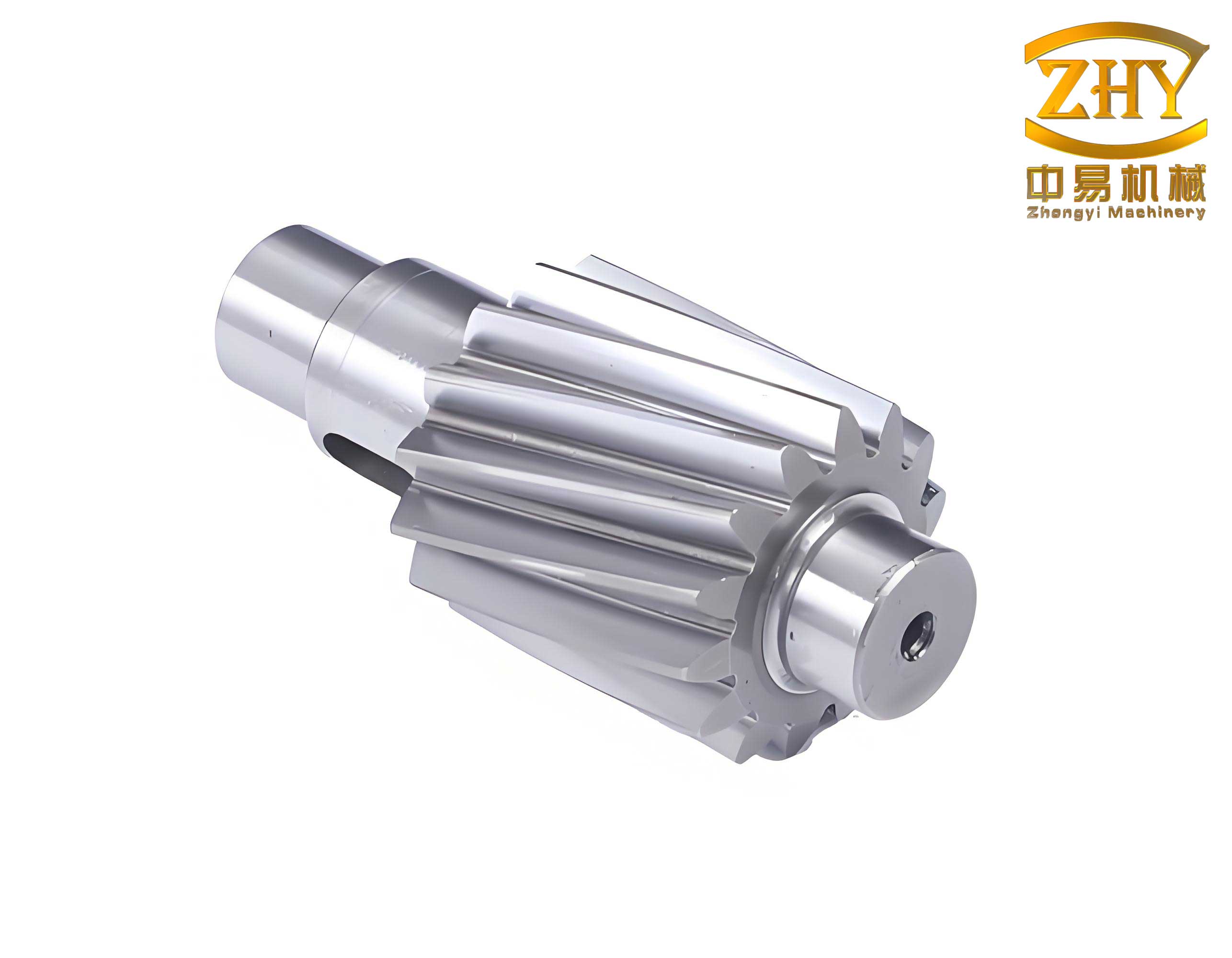
The core gear shaft assembly typically comprises four primary components: an output shaft (the central gear shaft), a gear, and two thin friction plates positioned above and below the gear. A critical feature of the friction plates is a non-circular central aperture (e.g., a square or elongated slot), which requires precise angular orientation (“clocking”) relative to the output shaft’s features for successful assembly. The traditional, entirely manual process involves sequential picking, orienting, greasing, and pressing of these components, followed by a final running-in (“run-in” or “break-in”) operation—a process that is both time-consuming and quality-variable.
1. Overall System Design and Architecture
The proposed automated system employs a 12-station rotary dial indexing configuration, chosen for its efficiency in high-cycle, multi-operation assembly tasks. This layout provides a deterministic, synchronous flow where each station is dedicated to a specific assembly or inspection operation. The system integrates a linear transfer mechanism for moving assemblies to and from a dedicated running-in station, decoupling this time-consuming process from the main indexing cycle.
1.1 System Layout and Operational Sequence
The 12-station rotary table, driven by a high-precision cam indexer, forms the system’s backbone. Each station is equipped with an identical, precision-machined pallet (traveling fixture) that holds the output shaft throughout the assembly process. The operational sequence is meticulously choreographed as follows:
- Station 1: Output Shaft Loading & Presence Check. The output shaft (the core gear shaft) is fed via a vibratory bowl feeder and a subsequent escapement mechanism. A robotic pick-and-place unit transfers it to the pallet fixture. A sensor immediately verifies correct loading.
- Station 2: Lower Friction Plate Loading. This is a critical station involving vibratory feeding, intermediate orientation, and robotic placement, detailed in Section 3.1.
- Station 3: Friction Plate Presence & Seat Check. A tactile probe or a through-beam sensor confirms the lower friction plate is fully seated on the gear shaft.
- Station 4: Grease Application (Lower Plate). A precision dispenser applies a controlled amount of lubricant to the friction plate surface.
- Station 5: Gear Loading & Orientation. The gear is fed and its top/bottom orientation is detected via a height-sensing mechanism. A 180-degree flipping mechanism corrects the orientation if necessary before robotic placement onto the gear shaft.
- Station 6: Gear Presence & Seat Check. An elastic probe verifies the gear is properly installed on the gear shaft.
- Station 7: Grease Application (Gear). Lubricant is applied to the gear’s mating surface.
- Station 8: Upper Friction Plate Loading. Functionally identical to Station 2, this station assembles the upper friction plate onto the gear shaft.
- Station 9: Friction Plate Presence Check. A reflective sensor confirms the upper plate’s presence.
- Station 10: Transfer to Run-in Station. A linear transfer mechanism (e.g., a walking beam or cross-shuttle) moves the partially assembled gear shaft unit from the rotary dial to a dedicated running-in fixture.
- Station 11: Reject Station. If any previous inspection failed, a robot arm removes the defective sub-assembly from the pallet before it proceeds.
- Station 12: Crimping/Pressing. A precision press or crimping head applies a defined force to permanently secure all components on the gear shaft. The completed assembly is then transferred to the run-in station.
A separate, parallel running-in station performs the final break-in operation on multiple units simultaneously. After run-in, a final robot deposits the finished gear shaft assembly into an output container.
1.2 Structural Composition and Key Parameters
The system’s framework is constructed from welded square steel tubing, providing rigidity and vibration damping essential for precision assembly. All feeding, handling, and processing modules are mounted on this base frame. The rotary indexing mechanism, comprising the cam indexer, a circular dial plate, and the pallet fixtures, is centrally located. The primary technical parameters governing the system’s design are summarized in Table 1.
| Parameter | Value / Specification |
|---|---|
| Cycle Time per Assembly | 20 seconds (theoretical) |
| Rotary Dial Diameter | 400 mm |
| Number of Indexing Stations | 12 |
| Work Height (from floor) | 900 mm |
| System Footprint (L x W x H) | 1700 mm x 1600 mm x 1800 mm |
| Operation Mode | Fully Automatic, Continuous |
| Control System | Programmable Logic Controller (PLC) with Human-Machine Interface (HMI) |
| Pallet Fixture Material | Tool Steel (e.g., Cr12), hardened |
The system’s theoretical throughput $T$ can be derived from the indexing cycle time $t_c$, which is the sum of the index time (motion) $t_m$ and the dwell time (station operation) $t_d$:
$$ t_c = t_m + t_d $$
For 12 stations, the production rate $R$ in units per hour is:
$$ R = \frac{3600}{t_c} $$
Assuming $t_m = 1s$ and $t_d = 2s$, $t_c = 3s$, yielding a maximum $R = 1200$ assemblies per hour. The actual rate is governed by the slowest station operation.
2. Design and Selection of Critical System Components
The reliability and precision of the automated assembly system for the gear shaft hinge on several core components: the traveling pallet fixture and the rotary indexing drive mechanism.
2.1 Design of the Traveling Pallet Fixture
The pallet fixture is paramount for maintaining the positional and angular accuracy of the gear shaft throughout all assembly stages. It must provide secure, repeatable location while allowing for easy automatic loading and unloading. The design utilizes the machined cylindrical surface and a shoulder (datum face) of the output shaft as primary and secondary locating datums.
The fixture, machined from tool steel (Cr12) for wear resistance and dimensional stability, features a spring-loaded, collet-like clamping mechanism. This ensures the gear shaft is held firmly without marring its precision surfaces. A key design element is a removable insert block that accommodates specific shaft shoulder geometries, making the pallet adaptable to different gear shaft variants. The required machining tolerance for critical locating features is within ±0.02 mm to guarantee overall assembly stack-up accuracy. The fixture’s locating scheme constrains all necessary degrees of freedom: translation along X, Y, Z axes and rotation about X and Y axes, leaving only rotation about the Z-axis (the gear shaft‘s central axis) controlled during friction plate orientation.
2.2 Selection of the Cam Indexer and Drive Motor
The demands of high-speed, precise intermittent motion for the 12-station dial are perfectly met by a parallel (or cylindrical) cam indexer. Superior to stepper- or servo-driven alternatives for this application, cam indexers offer unmatched rigidity, smooth acceleration/deceleration profiles (governed by the cam curve), zero backlash at the dwell position, and excellent repeatability. The selection process involves calculating dynamic loads based on the mass moment of inertia of the rotating components. Key parameters for selection are shown in Table 2.
| Parameter | Value |
|---|---|
| Number of Stations (Indexes per revolution) | 12 |
| Index Angle | 30° |
| Index Time (t_m) | 1 s |
| Dwell Time (t_d) | 2 s |
| Input Shaft Speed | 50 rpm |
| Diameter of Dial Plate | 400 mm |
| Mass of Dial Plate & Fixtures (approx.) | 8 kg |
| Mass Moment of Inertia (J_dial) | Calculated based on geometry |
The required torque $T_m$ at the indexer input shaft must overcome the dynamic torque $T_d$ required to accelerate the load inertia $J_{total}$ (dial + fixtures + payload) to the needed angular velocity $\omega$ within the index time $t_m$. A simplified calculation is:
$$ \alpha = \frac{\omega}{t_m} $$
$$ T_d = J_{total} \cdot \alpha $$
where $\omega = \frac{2\pi}{N \cdot t_c}$ (for N=12 stations) is the average angular velocity of the output shaft during index. The selected indexer must have a rated output torque exceeding $T_d$ plus a safety factor. A corresponding motor (e.g., a standard AC geared motor) is then selected to provide the input power and speed matching the indexer’s requirements and the 1s index time.
3. Design of Critical Assembly Stations
Certain assembly steps present significant technical challenges that necessitate specialized station design. The handling and orientation of the friction plate and the gear are the most critical among these.
3.1 Friction Plate Feeding and Orientation Station
The friction plate, often less than 0.5 mm thick with a small, non-circular internal feature, is the most challenging component to automate. The dual problems of reliable separation from a stack and precise angular orientation must be solved. A four-stage process was developed: 1) Bowl Feeding: A vibratory bowl feeder with custom tooling orients plates in a horizontal attitude. 2) Singulation: A linear feeder presents plates one-by-one to a pick-up point via an escapement. 3) Angular Orientation (Clockwise): This is the core challenge. A dedicated “clocking” station receives the plate via a first gripper. The station employs a rotating head with a pin that engages the plate’s internal feature. A servo or stepper motor rotates the head until a sensor (e.g., a vision system or a tactile switch) confirms the plate is in the target orientation. The rotational error $\Delta\theta$ must be minimized: $\Delta\theta < \pm1^\circ$. 4) Robotic Placement: A second, high-precision gripper picks the now-oriented plate from the clocking station and places it onto the waiting gear shaft. The gripper jaws are designed to locate on the plate’s outer diameter while avoiding distortion, machined from hardened steel with tight tolerances ($\pm0.05$ mm).
3.2 Gear Feeding and Orientation Station
The gear, while less delicate than the friction plate, may have an asymmetric profile (e.g., a chamfer on one side) requiring correct orientation for assembly. The station design integrates feeding, orientation detection, and correction. A vibratory bowl feeder delivers gears in a known orientation to a staging area. A sensor (e.g., a laser micrometer or a simple mechanical feeler gauge) measures a distinguishing feature—such as overall thickness or the presence of a chamfer—to determine if the gear is “face-up” or “face-down.” This decision logic can be represented as:
If $h_{measured} \ge h_{threshold}$ then Orientation = CORRECT else Orientation = FLIP_REQUIRED.
If a flip is required, a pick-and-place unit moves the gear to a 180-degree flipping mechanism. This mechanism can be a simple double-gripper rotating head or a mechanism using a gear and rack: a pneumatic cylinder drives a rack, which rotates a pinion gear attached to the gripper shaft. The rotation angle $\phi$ is given by the rack stroke $s$ and the pinion pitch radius $r$:
$$ \phi = \frac{s}{r} $$
The stroke is designed so that $\phi = \pi$ radians (180°). The correctly oriented gear is then placed onto the gear shaft.
4. Results and System Performance Discussion
The integrated design of this automated assembly system for the gear shaft addresses the fundamental shortcomings of manual and semi-automatic methods. The implementation of precision traveling pallets ensures the gear shaft remains accurately located throughout the process, directly contributing to final product quality by minimizing assembly stack-up errors. The selection of the high-precision cam indexer guarantees reliable, high-speed station-to-station transfer with the positional accuracy necessary for the various robotic placements and tool engagements.
The specialized solutions for the friction plate and gear stations are pivotal to system viability. The two-stage process for the friction plate—separating the orientation task from the placement task—proves effective in managing this delicate component. The clocking station’s ability to reliably achieve $\Delta\theta < \pm1^\circ$ is essential for the friction plate to engage with the gear shaft. Similarly, the in-line detection and flipping mechanism for the gear ensures 100% correct orientation before assembly, eliminating a potential failure mode.
The overall system performance yields substantial benefits. Compared to manual assembly, the automated system provides:
- Dramatically Increased Throughput: Cycle times are reduced from minutes per unit to seconds per unit, enabling mass production.
- Consistently High Quality: Automated, sensor-guided processes eliminate human variation and error, ensuring every gear shaft assembly meets specification.
- Reduced Operational Cost: While requiring capital investment, the system significantly lowers per-unit labor cost and reduces scrap and rework.
- Improved Ergonomics and Scalability: It removes workers from repetitive, potentially strenuous tasks and provides a clear path for increased production through duplication or system optimization.
In conclusion, the design of an automated assembly system for the gear shaft requires a holistic approach integrating mechanical design, precision component selection, and specialized process engineering. The 12-station rotary dial system, with its critical focus on precision fixturing, reliable high-speed indexing, and innovative solutions for micro-component handling, presents a robust and efficient solution. This system architecture not only solves the immediate challenge of assembling the specific gear shaft but also serves as a model for automating the assembly of other small, high-precision mechanical sub-assemblies.