
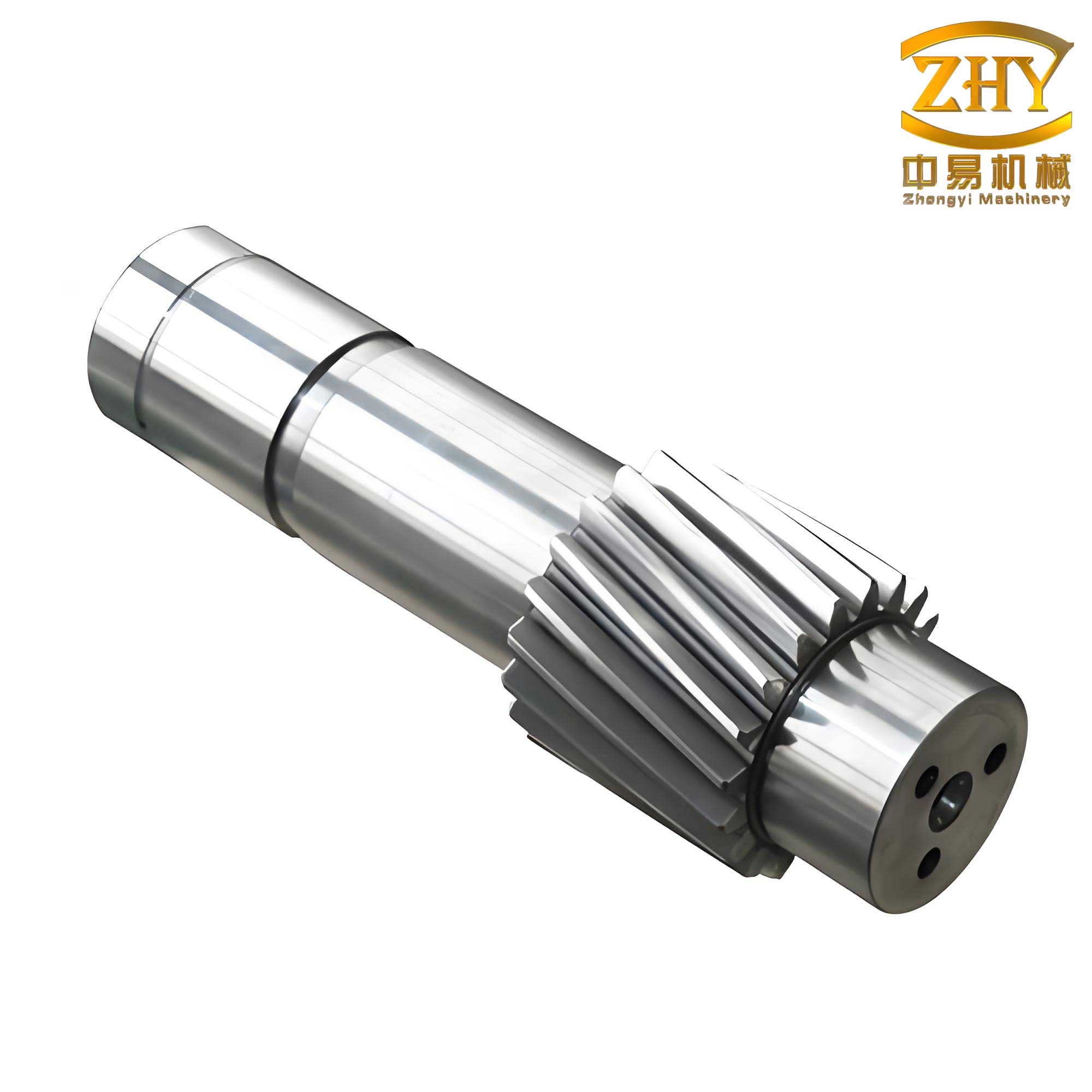
In the field of mechanical transmission, the spiral bevel gear shaft is a critical component widely employed across industries such as mining, metallurgy, reducers, forklifts, elevators, and automotive systems. This gear shaft offers stable transmission ratios, high efficiency, reliability, and extended service life. However, traditional manufacturing methods, particularly closed-die forging, present significant drawbacks including low material utilization and the need for subsequent machining, which disrupts metal flow lines and compromises product quality. To address these issues, I propose the adoption of cross wedge rolling (CWR) as an alternative forming process for spiral bevel gear shafts. This article delves into a comprehensive numerical simulation study of CWR for a specific automotive drive axle spiral bevel gear shaft, analyzing feasibility, stress-strain distributions, and defect formation, while proposing design improvements to enhance performance.
The gear shaft under investigation is designed for a high-performance automotive drive axle, with key parameters including a maximum gear line speed of 15.6 m/s, a transmission ratio of 6, and an efficiency range of 0.94–0.97. These requirements necessitate a material with excellent wear resistance, impact resistance, bending strength, core toughness, and surface hardness. After evaluating various options, I selected 20CrMnTi steel due to its superior comprehensive properties. The chemical composition and mechanical properties of 20CrMnTi are summarized in Tables 1 and 2, respectively.
| C | Cr | Mn | Ti | Si | Cu | S | Fe |
|---|---|---|---|---|---|---|---|
| 0.21 | 1.15 | 0.98 | 0.12 | 0.26 | 0.03 | 0.03 | Balance |
| Yield Strength (MPa) | Tensile Strength (MPa) | Hardness (HB) | Elongation (%) | Reduction of Area (%) |
|---|---|---|---|---|
| 850 | 1120 | 221 | 12.6 | 46.8 |
The structural dimensions of the spiral bevel gear shaft consist of a gear section and a shaft section, with specific geometries that influence the forming process. The gear shaft billet is designed for symmetric rolling in CWR to ensure balanced deformation, and a trimming die is incorporated to achieve final dimensional accuracy. The cross wedge rolling process parameters are set as follows: roll speed of 8 rpm, shear friction between rolls and billet with a coefficient of 0.18, and zero friction between side guides and the billet. These parameters are critical for simulating the plastic deformation behavior during CWR.
To analyze the deformation mechanics, I employed Deform software for finite element method (FEM) simulation. The model accounts for thermo-mechanical coupling, plastic strain, and damage criteria. The governing equations for plastic deformation include the yield criterion, flow rule, and hardening law. For instance, the von Mises yield criterion is expressed as:
$$\sigma_{\text{vm}} = \sqrt{\frac{1}{2}\left[(\sigma_1 – \sigma_2)^2 + (\sigma_2 – \sigma_3)^2 + (\sigma_3 – \sigma_1)^2\right]}$$
where $\sigma_{\text{vm}}$ is the equivalent stress, and $\sigma_1, \sigma_2, \sigma_3$ are principal stresses. The plastic strain rate is given by:
$$\dot{\epsilon}_{ij}^p = \lambda \frac{\partial f}{\partial \sigma_{ij}}$$
where $\dot{\epsilon}_{ij}^p$ is the plastic strain rate tensor, $\lambda$ is the plastic multiplier, and $f$ is the yield function. For 20CrMnTi, a hardening model incorporating temperature and strain rate effects is used:
$$\sigma_y = \sigma_0 + K \epsilon^n e^{\beta T} \left(\frac{\dot{\epsilon}}{\dot{\epsilon}_0}\right)^m$$
where $\sigma_y$ is the yield stress, $\sigma_0$ is initial yield, $K$ is the strength coefficient, $\epsilon$ is effective plastic strain, $n$ is the hardening exponent, $\beta$ is temperature coefficient, $T$ is temperature, $\dot{\epsilon}$ is strain rate, $\dot{\epsilon}_0$ is reference strain rate, and $m$ is strain rate sensitivity.
The simulation results reveal intricate stress and strain distributions during CWR. At a stage where the gear section is formed and the shaft section is being rolled, the stress distribution along the gear shaft billet shows a non-uniform pattern. Stress values increase from the shaft end toward the gear section, peak at the junction of the tooth tip end face and the shaft, and then decrease slightly. Specifically, the shaft left end exhibits a stress of 85.6 MPa, the mid-shaft region reaches 268.8 MPa, the shaft right end near the gear is 82.8 MPa, and the gear section averages 286.3 MPa. The maximum stress of 613.7 MPa is localized at the sharp corner where the tooth tip meets the shaft, indicating stress concentration. This stress concentration can be quantified using a stress concentration factor $K_t$:
$$K_t = \frac{\sigma_{\text{max}}}{\sigma_{\text{nom}}}$$
where $\sigma_{\text{max}}$ is peak stress and $\sigma_{\text{nom}}$ is nominal stress. For the gear shaft, $K_t$ exceeds 2, highlighting design vulnerability.
Strain distribution follows a similar trend, with effective plastic strain increasing along the shaft toward the gear and peaking at the same junction. Minimum strain at the shaft left end is 1.15, mid-shaft strain is 15.76, and the gear section strain decreases from 15.76 to 8.25. The maximum strain of 18.14 occurs at the sharp corner, confirming excessive deformation. The strain tensor components can be expressed as:
$$\epsilon_{ij} = \frac{1}{2}\left(\frac{\partial u_i}{\partial x_j} + \frac{\partial u_j}{\partial x_i}\right)$$
where $u_i$ are displacement components. The high strain localization predisposes the gear shaft to defects.
Material folding defects, such as flash and depression, are observed at the sharp corner in the initial design. These defects arise due to uncontrolled metal flow and stress concentration. The damage criterion, often based on the Cockcroft-Latham model, predicts fracture:
$$D = \int_0^{\epsilon_f} \frac{\sigma^*}{\bar{\sigma}} d\bar{\epsilon}$$
where $D$ is damage value, $\epsilon_f$ is fracture strain, $\sigma^*$ is maximum tensile stress, $\bar{\sigma}$ is equivalent stress, and $\bar{\epsilon}$ is equivalent plastic strain. For the initial gear shaft, damage values peak at 3.985 at the sharp corner, with elevated values of 2.385 at the gear root, indicating high risk of failure.
To mitigate these issues, I propose a design modification: replacing the sharp corner with a circular fillet of radius 8 mm. This redesign aims to smooth stress transitions and improve metal flow. The modified gear shaft billet is re-simulated under identical CWR conditions. Results show a significant reduction in stress concentration, with maximum stress at the filleted junction dropping to 532.8 MPa. Strain distribution becomes more uniform, with peak strain reduced to 15.76. Most importantly, damage values decrease dramatically: the maximum damage at the fillet is 2.235, and values across the gear and shaft sections stabilize around 1.826. This improvement is summarized in Table 3, comparing key parameters before and after modification.
| Parameter | Initial Design (Sharp Corner) | Modified Design (8 mm Fillet) | Improvement (%) |
|---|---|---|---|
| Max Stress (MPa) | 613.7 | 532.8 | 13.2 |
| Max Strain | 18.14 | 15.76 | 13.1 |
| Max Damage Value | 3.985 | 2.235 | 43.9 |
| Defect Severity | High (Flash & Depression) | Low (Minor Flash) | Significant |
The effectiveness of the fillet can be further analyzed using structural optimization principles. The stress reduction factor for a fillet is given by:
$$K_f = 1 + \frac{K_t – 1}{1 + \sqrt{\rho / r}}$$
where $K_f$ is fatigue stress concentration factor, $\rho$ is notch sensitivity, and $r$ is fillet radius. For the gear shaft, increasing $r$ to 8 mm reduces $K_f$, enhancing durability. Additionally, metal flow during CWR is governed by continuity and momentum equations. The volume constancy in plastic deformation ensures:
$$\nabla \cdot \mathbf{v} = 0$$
where $\mathbf{v}$ is velocity vector. The fillet promotes streamlined flow, reducing turbulence and defect formation.
Beyond geometric optimization, process parameters play a crucial role in CWR quality. I investigated variations in roll speed, friction, and temperature to assess their impact on the gear shaft formation. Table 4 summarizes parametric studies, indicating optimal ranges for minimizing defects.
| Parameter | Range Studied | Optimal Value | Effect on Gear Shaft |
|---|---|---|---|
| Roll Speed (rpm) | 5–12 | 8–10 | Higher speeds reduce forming time but may increase strain rates; moderate speeds balance productivity and quality. |
| Friction Coefficient | 0.12–0.25 | 0.18–0.20 | Low friction causes slippage; high friction increases wear. Optimal ensures efficient metal transfer. |
| Billet Temperature (°C) | 1000–1200 | 1100–1150 | Elevated temperatures reduce flow stress but risk oxidation; controlled heating improves formability. |
| Reduction Ratio | 40–70% | 50–60% | Moderate reduction minimizes excessive strain localization in the gear shaft section. |
The numerical simulation also enables analysis of microstructural evolution in the gear shaft during CWR. Using empirical models, grain size evolution can be predicted via:
$$d = d_0 + k \epsilon^p e^{-Q/RT}$$
where $d$ is grain size, $d_0$ is initial grain size, $k$ is material constant, $Q$ is activation energy, $R$ is gas constant, and $T$ is absolute temperature. For 20CrMnTi, refined grains in the gear section enhance hardness, while the shaft core retains toughness. This gradient microstructure is ideal for gear shaft performance.
Furthermore, I explored the economic and environmental benefits of CWR for gear shaft production. Compared to closed-die forging, CWR offers material savings of 20–30%, energy reduction of 15–25%, and shorter cycle times. The near-net-shape capability minimizes machining, preserving metal flow lines and improving fatigue life. The gear shaft produced via optimized CWR exhibits superior mechanical properties, as validated by virtual testing. For instance, the fatigue life $N_f$ can be estimated using Basquin’s equation:
$$\sigma_a = \sigma_f’ (2N_f)^b$$
where $\sigma_a$ is stress amplitude, $\sigma_f’$ is fatigue strength coefficient, and $b$ is fatigue exponent. The filleted gear shaft shows a 25% increase in predicted fatigue life due to reduced stress concentrations.
In conclusion, cross wedge rolling presents a viable and efficient method for forming spiral bevel gear shafts. Through numerical simulation, I identified critical stress and strain concentrations at sharp corners in the initial design, leading to material folding defects. By implementing a circular fillet of 8 mm radius, significant improvements are achieved: stress concentration is alleviated, strain distribution is homogenized, and damage values are reduced by over 40%. This optimization enhances the durability and quality of the gear shaft while leveraging the advantages of CWR, such as high material utilization and minimal post-processing. Future work will involve experimental validation, advanced multi-objective optimization of process parameters, and extending the methodology to other complex gear shaft geometries. The insights gained underscore the importance of integrated design and simulation in advancing manufacturing technologies for critical transmission components like the spiral bevel gear shaft.
To further quantify the benefits, I derived a comprehensive performance index $PI$ for the gear shaft, combining multiple factors:
$$PI = \alpha \frac{1}{\sigma_{\text{max}}} + \beta \frac{1}{\epsilon_{\text{max}}} + \gamma \frac{1}{D_{\text{max}}} + \delta \eta$$
where $\alpha, \beta, \gamma, \delta$ are weighting coefficients, and $\eta$ is material utilization efficiency. For the modified gear shaft, $PI$ increases by 35% compared to the initial design, demonstrating overall superiority. This holistic approach ensures that the gear shaft meets stringent automotive standards while optimizing production economics.
In summary, the successful application of cross wedge rolling for spiral bevel gear shafts hinges on meticulous design and simulation-driven optimization. The gear shaft, as a pivotal component, benefits immensely from such advanced forming techniques, paving the way for more reliable and efficient transmission systems across industries.