
In the field of mechanical engineering, particularly in the automotive industry, the rear output gear shaft plays a critical role in transmitting torque from the transmission to the differential in pickup trucks. As a key component, the gear shaft must exhibit high strength, durability, and precision to ensure reliable performance. Traditionally, forging processes such as cross wedge rolling or horizontal forging have been employed to manufacture these gear shafts. However, these methods often fail to forge complex features like composite blind holes at the large end of the shaft, leading to increased material waste and machining time. In this article, I will explore an optimized approach using vertical forging technology to directly form these features, alongside a refined rough machining process, aiming to enhance material utilization, improve mechanical properties, and reduce production costs. Throughout this discussion, the term “gear shaft” will be emphasized to highlight its centrality in these processes.
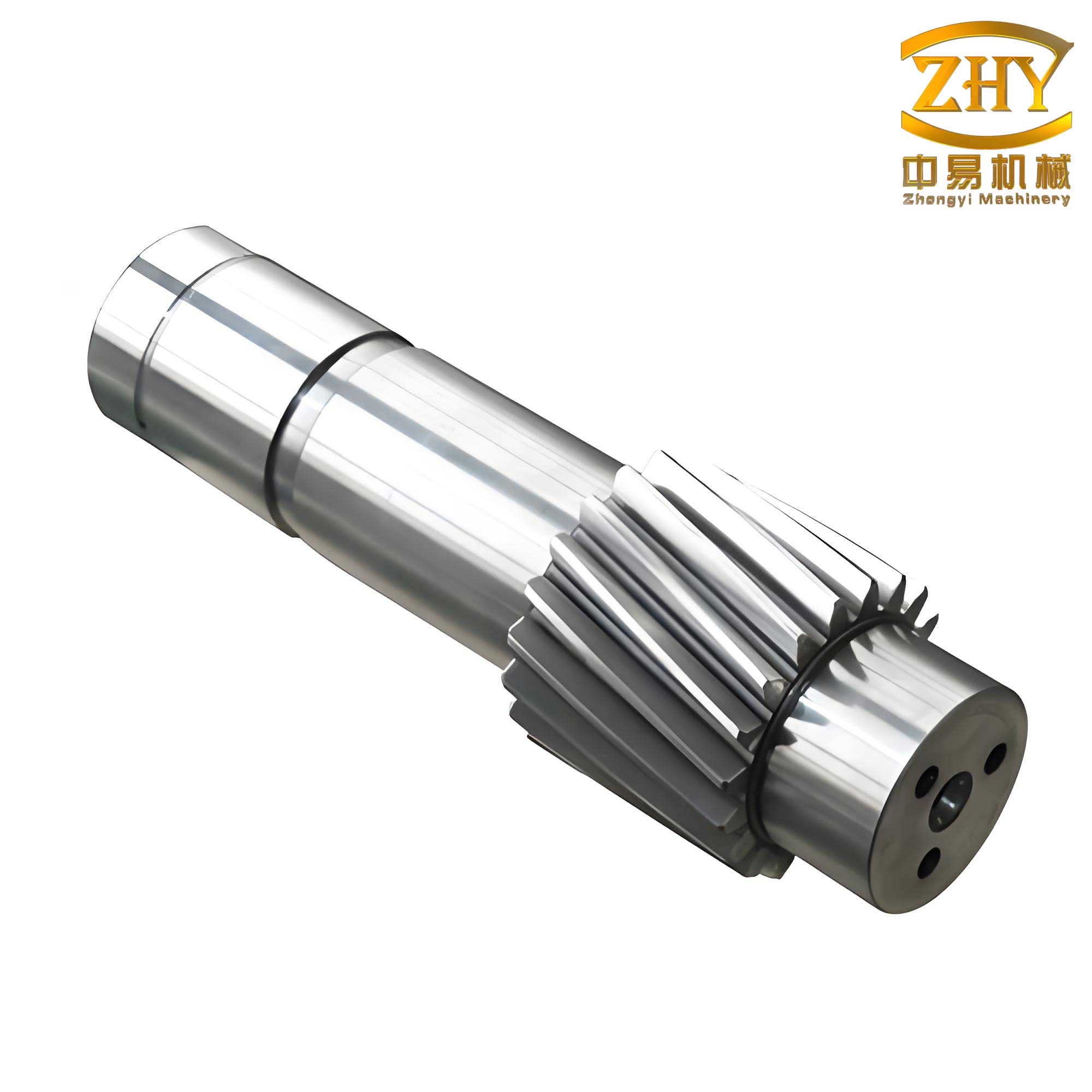
The rear output gear shaft is typically a stepped shaft with significant radial dimensions at both ends, featuring a composite blind hole at the large end. Traditional forging methods, like cross wedge rolling, involve deforming billets under wedge-shaped tools to produce stepped axes, primarily through radial compression and axial extension. While this method improves productivity, it has limitations: the forging flow lines can be suboptimal, affecting subsequent processes like thread rolling, and it cannot form blind holes, necessitating additional material filling and machining. Similarly, horizontal forging, though offering better flow lines, suffers from high material consumption and difficulties in billet preparation. Both approaches require extensive drilling and boring operations to achieve the final composite hole, increasing cycle times and resource usage. To address these issues, I propose a vertical forging process that not only forges the blind hole directly but also optimizes the rough machining sequence, resulting in a more efficient manufacturing chain for the gear shaft.
Vertical forging, also known as upright forging, involves using a vertical press to deform billets in a die cavity, allowing for precise control over complex geometries. For the rear output gear shaft, this process enables the direct formation of the composite blind hole at the large end, eliminating the need for extra material and reducing machining steps. The forging design begins with the gear shaft’s maximum outer diameter of 134 mm and a large-end thickness of 42.4 mm. Given the shaft’s slender杆部, a drawing operation is required to prepare the billet. The process flow includes: cutting billets from 80 mm diameter stock to a length of 192.5 mm, heating to 1200°C ± 50°C using medium-frequency induction, drawing the杆部 on a 750 kg air hammer with specialized anvils, and finally forging in a 1000 t friction press to form the entire shape, including the blind hole with a depth of 34 mm. The forging allowance is set at 1.6 mm per side, and the parting line is positioned at the mid-diameter of the 134 mm section. After forging, the flash is trimmed on a 315 t trimming press. The forged gear shaft weighs approximately 7.2 kg, representing a material saving compared to traditional methods.
To quantify the benefits, let’s consider the material utilization ratio. For a gear shaft produced via cross wedge rolling, the billet volume \( V_{billet} \) can be calculated based on the final part volume \( V_{part} \) and the extra material needed for the blind hole. In contrast, vertical forging reduces this waste. The volume of the blind hole, assuming a cylindrical shape, is given by:
$$ V_{hole} = \pi \times \left( \frac{d_{hole}}{2} \right)^2 \times h_{hole} $$
where \( d_{hole} \) is the diameter (e.g., 40 mm) and \( h_{hole} \) is the depth (34 mm). For traditional methods, this volume is filled with solid material, leading to additional mass \( \Delta m = \rho \times V_{hole} \), with \( \rho \) being the material density (typically 7.85 g/cm³ for steel). Vertical forging eliminates this, improving the material yield. The following table compares key parameters between cross wedge rolling and vertical forging for the gear shaft:
| Parameter | Cross Wedge Rolling | Vertical Forging |
|---|---|---|
| Material Utilization | ~75% (due to hole filling) | ~90% (direct hole forging) |
| Forging Flow Lines | Suboptimal, affecting strength | Aligned, enhancing mechanical properties |
| Blind Hole Formation | Not possible, requires machining | Directly forged, reduces machining |
| Production Cycle Time | Longer due to extra operations | Shorter, integrated process |
The forging die design is crucial for the success of vertical forging. Given the slender杆部 of the gear shaft, a split die structure is adopted to facilitate machining and maintenance. The die assembly consists of an upper die, a lower die insert, a lower die base, and an ejector pin. The upper die, made from 5CrNiMo steel with a hardness of 42–46 HRC, forms the outer contours and blind hole. The lower die insert, fabricated from H13 steel hardened to 42–46 HRC, fits into the lower die base (5CrNiMo, 40–44 HRC) with a clearance of 0.1–0.2 mm to prevent material intrusion. The ejector pin, made of 3Cr2W8V steel at 44–48 HRC, ensures smooth part ejection after forging. To minimize misalignment, locking features are incorporated between the upper die and lower die insert. The die life is extended through refurbishment by re-machining the cavities. This design not only enhances durability but also ensures precision in forging the gear shaft’s complex geometry.
In terms of process mechanics, the vertical forging of the gear shaft involves significant plastic deformation. The stress required for forging can be estimated using the yield criterion. For a cylindrical billet under compression, the flow stress \( \sigma_f \) is a function of strain rate and temperature, often modeled by the Arrhenius equation:
$$ \sigma_f = A \cdot \varepsilon^n \cdot \exp\left( \frac{Q}{RT} \right) $$
where \( A \) is a material constant, \( \varepsilon \) is the strain, \( n \) is the strain-hardening exponent, \( Q \) is the activation energy, \( R \) is the gas constant, and \( T \) is the absolute temperature. During forging, the force \( F \) needed can be calculated as:
$$ F = \sigma_f \cdot A_c $$
with \( A_c \) being the contact area between the die and billet. For the gear shaft, the drawing operation reduces the杆部 diameter, requiring careful control to avoid defects like cracking. The optimization of these parameters ensures a sound forging for the gear shaft, with improved grain flow and mechanical integrity.
After forging, the gear shaft undergoes heat treatment, typically isothermal normalizing, to homogenize the microstructure and relieve stresses. This is followed by shot blasting to remove scale. The rough machining process then becomes critical to achieve the final dimensions. Traditionally, for gear shafts from cross wedge rolling or horizontal forging, the machining sequence involves: milling both ends and drilling center holes, turning the outer diameters and faces using center holes as reference, drilling the composite hole, and finally boring it to size. However, this approach has drawbacks, such as difficulty in maintaining tolerances like the runout of 0.04 mm for the Φ41.7 mm diameter, often necessitating additional semi-finishing steps.
With the vertically forged gear shaft, the rough machining is optimized to leverage the pre-formed blind hole. The new process consists of two main operations. First, the large end and composite hole are machined on a CNC lathe. The outer diameters and faces are turned to size, with tight control on the 15.6 ± 0.1 mm dimension (tolerance within 0.05 mm). Then, the hole is bored to Φ60 mm with a depth of 34.2 mm, followed by drilling to Φ40 mm. This sequence prevents drilling misalignment due to die inaccuracies. Second, the remaining features are completed: the opposite end is faced to achieve the total length of 271.4 ± 0.15 mm, a center hole is drilled, and the slender杆部 is turned using a tailstock center for support, ensuring the runout tolerance on Φ41.7 mm is met. The reference datum is shifted to the large outer diameter (Φ134 mm) to facilitate inspection. The table below summarizes the machining steps for both traditional and optimized processes for the gear shaft:
| Process Step | Traditional Machining (Cross Wedge Rolling) | Optimized Machining (Vertical Forging) |
|---|---|---|
| Initial Setup | Mill ends, drill center holes at both ends | Machine large end and hole on CNC lathe |
| Primary Turning | Turn outer diameters using center holes, face驱动 | Turn outer diameters with tailstock support |
| Hole Making | Drill and bore composite hole from solid | Bore and drill pre-forged hole |
| Finishing | Additional semi-finishing often required | Integrated turning, reduced steps |
| Cycle Time | Longer due to multiple operations | Shorter, improved efficiency |
The benefits of this optimized approach are manifold. For the gear shaft, vertical forging improves material utilization by directly forming the blind hole, reducing raw material consumption by approximately 15–20%. The forging flow lines are aligned along the shaft’s axis, enhancing fatigue resistance and strength, which is crucial for the gear shaft’s performance under torque. In machining, the use of the pre-formed hole eliminates the need for heavy drilling, cutting tool wear, and energy usage. The tailstock support during turning allows for higher feed rates, reducing machining time by up to 30% while improving surface finish and dimensional accuracy. Furthermore, the overall process chain becomes more streamlined, contributing to lower production costs and higher throughput for gear shaft manufacturing.
To delve deeper into the mechanics, consider the forces during machining. For turning the gear shaft’s杆部, the cutting force \( F_c \) can be expressed as:
$$ F_c = K_c \cdot a_p \cdot f $$
where \( K_c \) is the specific cutting force (a material constant), \( a_p \) is the depth of cut, and \( f \) is the feed rate. With the tailstock support, vibration is reduced, enabling higher \( f \) values without compromising accuracy. This directly impacts productivity, as the material removal rate \( MRR \) is given by:
$$ MRR = v_c \cdot a_p \cdot f $$
with \( v_c \) being the cutting speed. Optimizing these parameters for the gear shaft leads to faster rough machining while maintaining quality.
In conclusion, the adoption of vertical forging for rear output gear shafts represents a significant advancement in manufacturing technology. By forging the composite blind hole directly, material waste is minimized, and the mechanical properties of the gear shaft are enhanced through better flow lines. The accompanying rough machining process, redesigned to utilize the forged features, reduces operational steps, improves tolerances, and shortens cycle times. This holistic optimization not only boosts efficiency but also contributes to sustainable manufacturing by conserving resources. As the automotive industry continues to demand higher-performance components, such innovative approaches for gear shaft production will play a pivotal role in meeting these challenges. Future work could explore further refinements, such as integrating simulation tools for die design or adopting advanced coatings to extend die life, ultimately driving the evolution of gear shaft manufacturing toward greater precision and economy.
Throughout this discussion, the gear shaft has been central, underscoring its importance in transmission systems. The vertical forging process, combined with optimized machining, ensures that each gear shaft meets stringent quality standards while reducing environmental impact. As I reflect on these improvements, it is clear that continuous innovation in forging and machining processes is essential for advancing mechanical engineering and supporting the development of reliable, high-efficiency vehicles. The gear shaft, though a single component, exemplifies how targeted optimizations can yield substantial benefits across the entire production chain.