
The reliable operation of large-scale industrial equipment hinges on the integrity of its core components. Among these, the gear shaft plays a pivotal role in transmitting torque and motion. In applications such as ball mills within the mining, building materials, and metallurgical industries, the trend towards larger equipment capacities places increasingly severe demands on these components. A common strategy to enhance the load-bearing capacity and wear resistance of a gear shaft is to replace medium-carbon alloy steels (typically quenched and tempered with surface-hardened teeth) with case-hardening steels subjected to carburizing and quenching. This process creates a hard, wear-resistant surface while maintaining a tough, ductile core, theoretically offering superior performance for heavy-duty service.
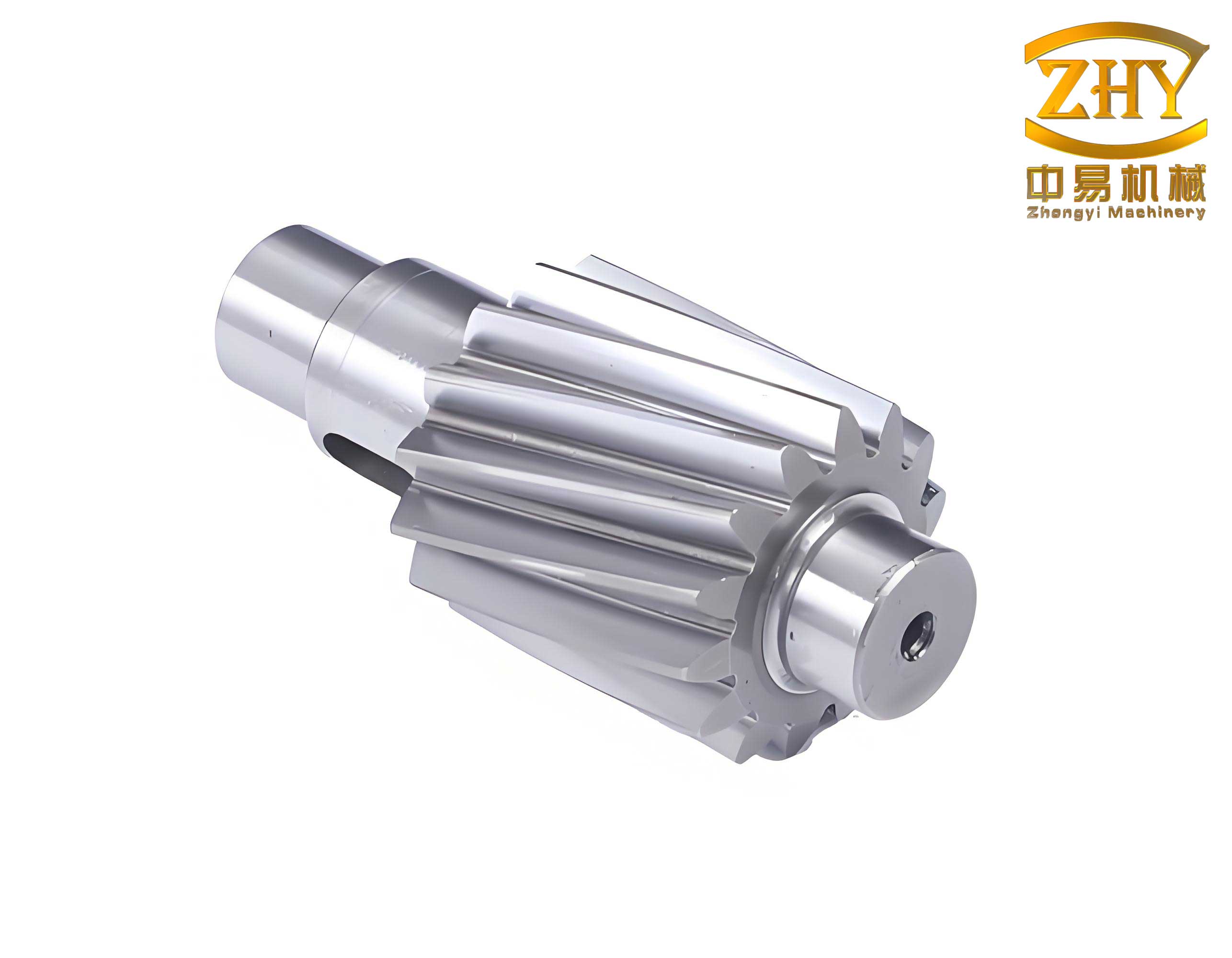
This article presents a detailed failure analysis of a large gear shaft manufactured from 20CrNi2Mo steel. The component, with specifications of approximately 579 mm in diameter and 3000 mm in length, a module of 25, and 21 teeth, failed unexpectedly after approximately 12 months of service in a ball mill drive system. The failure was characterized by a sudden halt in rotation despite the motor continuing to operate. The fractured gear shaft exhibited a brittle fracture morphology with a radial crack propagating through the entire cross-section. As the failed component was a spare part replacing another that had reached its service life, design, installation, and general maintenance were initially considered less likely as primary causes. The investigation, therefore, focused on the material quality and thermal processing history of the gear shaft. The manufacturing process sequence included forging, rough machining, non-destructive testing, quenching and tempering (QT) at 650°C, finish machining, pre-grind hobbing, tooth-flank carburizing & quenching + tempering (aiming for a case depth of 2.5-3 mm and surface hardness of 57-61 HRC), and finally gear grinding.
1. Physical and Chemical Testing Analysis
A comprehensive testing protocol was executed on samples extracted from the fractured gear shaft, proximal to the failure origin. The analysis encompassed macroscopic and microscopic fractography, metallographic examination, chemical composition analysis, and mechanical property testing.
1.1 Fractography Analysis
Macroscopic Examination: The fracture surface was relatively flat and exhibited clear radial marks, indicative of a brittle, fast fracture. The convergence point of these radial marks, identified as the fracture initiation site, was located in the core region of the gear shaft, approximately 250 mm from the tooth tip surface, and was slightly offset from the central axis. This origin area appeared as a relatively flat, circular zone. Upon cleaning, this region revealed clear dendritic solidification patterns with noticeable steps between dendrites, alongside macroscopic slag inclusion defects measuring approximately 15mm x 10mm and 10mm x 2mm.
Microscopic Examination (SEM): Scanning Electron Microscopy of the fracture origin and surrounding area revealed a microstructure dominated by cleavage and quasi-cleavage facets, confirming the brittle nature of the fracture. Energy Dispersive Spectroscopy (EDS) performed on the defects within the origin area detected elements such as O, Ca, Si, C, Al, Fe, Mg, Na, and K. This elemental signature is characteristic of non-metallic slag inclusions, confirming the macroscopic observation.
1.2 Metallographic Analysis
Macrostructure: Low-magnification examination of radial and axial sections near the fracture revealed a discernible dendritic pattern throughout the cross-section, which was particularly severe in the fracture origin region. The case-hardened layer and the underlying quenched & tempered (QT) layer were clearly visible. The depth of the QT layer from the tooth root was approximately 110 mm. According to GB/T 1979-2001, the general porosity was rated at 0.5 level.
Microstructure: The microstructural analysis at various depths provided a complete picture of the gear shaft‘s condition:
- Non-Metallic Inclusions: Rated per GB/T 10561-2005 as: A (sulfide), coarse series 1; B (alumina), coarse series 1; C (silicate), 0; D (globular oxide), thin series 2.
- Case-Hardened Layer (Tooth Root): The microstructure consisted of tempered martensite, rated as Martensite Level 5.
- Quenched & Tempered Layer (~30 mm from root): Structure was tempered sorbitte with some ferrite, displaying a dendritic pattern.
- Mid-Radius Region (~150 mm from root): Structure was pearlite and ferrite, with a pronounced dendritic pattern.
- Fracture Origin Core Region: The microstructure was ferrite and pearlite with severe dendrites, and a grain size ≥8.
1.3 Chemical Composition Analysis
The chemical composition of the failed gear shaft was analyzed and compared to the requirements of GB/T 3203-2016 for G20CrNi2Mo (equivalent to 20CrNi2Mo) carburizing bearing steel. The results are summarized in Table 1.
| Element | C | Si | Mn | P | S | Cr | Ni | Mo | Cu |
|---|---|---|---|---|---|---|---|---|---|
| Standard (GB/T 3203) | 0.19-0.23 | 0.25-0.40 | 0.55-0.70 | ≤0.020 | ≤0.015 | 0.45-0.65 | 1.60-2.00 | 0.20-0.30 | ≤0.25 |
| Measured Value | 0.20 | 0.30 | 0.70 | 0.018 | 0.008 | 0.66 | 1.75 | 0.19 | 0.062 |
The composition is essentially compliant with the standard specification, ruling out gross material misalloying as a root cause.
1.4 Mechanical Properties Testing
Mechanical property specimens were taken radially from the core region near the fracture origin. It is critical to note that these are transverse properties from the core, whereas standard values are typically for longitudinal specimens from a more favorably processed location (e.g., at 1/3 radius). The results are compared in Table 2.
| Property | Tensile Strength, Rm (MPa) | Yield Strength, Rp0.2 (MPa) | Elongation, A (%) | Reduction of Area, Z (%) | Impact Energy, KV2 (J) | Hardness (HBW) |
|---|---|---|---|---|---|---|
| Sample 1 (Transverse) | 790 | — | 11.5 | 27 | 68 | 226-241 |
| Sample 2 (Transverse) | 774 | 494 | 14.5 | 41 | 68 | — |
| Reference* (Longitudinal, Q&T @200°C) | ≥980 | — | ≥13 | ≥45 | ≥63 | — |
*Reference values from GB/T 3203-2016 for G20CrNi2Mo after quench and 200°C temper.
While the tensile strength is below the standard reference, this is attributed to the unfavorable transverse sampling location in the core. Notably, the Charpy impact values are satisfactory, indicating the core material possessed adequate toughness under the test conditions.
The effectiveness of the case-hardening process was evaluated through hardness traverses. The results are shown in Table 3 and Table 4.
| Distance from Surface (mm) | 0.1 | 0.5 | 1.0 | 1.5 | 2.0 | 2.5 | 3.0 | 3.5 |
|---|---|---|---|---|---|---|---|---|
| Hardness (HV1) | 573-591 | 559 | 594 | ~566* | 533 | ~493* | 509 | ~433* |
*Interpolated values for clarity. Effective case depth (to 550 HV) was approx. 3.0 mm.
| Distance from Root Surface (mm) | 5 | 30 | 60 | 100 | 120 | Core |
|---|---|---|---|---|---|---|
| Hardness (HV50) | 316 | 266 | 269 | 248 | 254 | 229 |
| Approx. Hardness (HRC) | 33.5 | 27.0 | 27.5 | 24.0 | 25.0 | 21.0 |
The case depth and surface hardness were slightly below the target specifications. The core hardness profile shows a classic quenched & tempered structure transitioning to a softer, predominantly ferritic-pearlitic core.
2. Analysis of Failure Mechanism
The collective evidence points towards a single-event, brittle fracture initiated in the core region of the gear shaft. The fracture morphology, with its radial marks and cleavage facets, is characteristic of fast fracture under high stress. The convergence of evidence leads to the following conclusions:
1. Presence of Critical Weak Links: The fracture origin area contained two significant defects:
a) Macroscopic Slag Inclusions: These non-metallic inclusions act as potent stress concentrators, drastically reducing the local fracture strength. The stress concentration factor (Kt) for an elliptical flaw can be approximated by:
$$K_t = 1 + 2\sqrt{\frac{a}{\rho}}$$
where ‘a’ is the flaw depth and ‘ρ’ is the root radius. For sharp, irregular inclusions like slag, ρ is very small, leading to a very high Kt.
b) Severe Dendritic Structure: The persistence of a pronounced as-cast dendritic pattern indicates insufficient hot work (forging) to break down and homogenize the original ingot structure. Dendritic segregation leads to micro-heterogeneity in composition and properties. The interdendritic regions, often enriched with impurities and exhibiting different transformation characteristics, are paths of low toughness and can be described by the relation between dendrite arm spacing (DAS) and toughness:
$$CVN \propto (DAS)^{-1/2}$$
A larger DAS, indicative of slower solidification and less effective forging, generally correlates with lower impact energy.
2. Stress State at Failure: The core of a rotating gear shaft primarily experiences torsional shear stress. However, the fracture initiation site was offset from the neutral axis. Furthermore, the brittle nature suggests the presence of a triaxial stress state or a superimposed tensile stress component. Potential sources include:
– Residual stresses from heat treatment (quenching).
– Transient bending stresses due to misalignment, shock loading, or uneven load distribution across the gear teeth during service.
– The complex stress field generated by the notch effect of the large inclusion itself.
While operational data was unavailable, the failure’s suddenness implies the applied stress exceeded the local fracture strength of the defective material. The stress intensity (K) at the inclusion likely reached the fracture toughness (KIC) of the segregated, dendritic material:
$$K = Y \sigma \sqrt{\pi a} \geq K_{IC}$$
where Y is a geometry factor, σ is the applied stress, and ‘a’ is the effective flaw size.
3. Sequence of Failure: The failure was not due to fatigue (no beach marks were observed) or gradual degradation. It was a instantaneous fracture. The satisfactory impact toughness measured on standard specimens is misleading, as those tests sample a larger, more averaged volume. Fracture initiation is a local phenomenon controlled by the worst defect in the highest stressed region. In this gear shaft, the combination of a severe stress concentrator (slag) within a microstructure of inherently low crack propagation resistance (dendritic core) created a critical weak link.
Conclusion: The fracture of the 20CrNi2Mo gear shaft was caused by a brittle fracture initiated at macroscopic slag inclusions and severe dendritic segregation in the core region. This locally weakened area could not withstand the operational stresses (likely a combination of torsional, bending, and residual stresses), leading to catastrophic failure. The chemical composition was conforming, and the heat treatment, while slightly sub-optimal in case depth, was not the primary cause. The root cause lies in the material’s internal quality stemming from the solidification and forging processes.
3. Countermeasures: Optimization of Thermal Processing
To prevent recurrence and enhance the service life of future gear shaft components, a multi-faceted improvement plan targeting the identified weaknesses is proposed. The focus is on enhancing homogenization, refining microstructure, and ensuring optimal heat treatment response.
3.1 Enhancement of Forging Practice and Pre-Homogenization
The primary goal is to eliminate the dendritic structure and ensure dissolution/segregation of inclusions.
A. Strict Control of Ingot Quality & Forging Ratio: Implement stricter ultrasonic testing standards for the raw forging stock to reject material with significant central imperfections. The total forging reduction ratio must be significantly increased to ensure thorough breakdown of the as-cast structure. A minimum forging ratio should be established based on the original ingot size to guarantee sufficient mechanical work in the core region of the final gear shaft forging.
B. Implementation of Post-Forging Normalizing: Immediately after forging, while the component is still at an elevated temperature, a controlled cooling or a dedicated normalizing heat treatment should be performed. Normalizing (heating to ~50°C above Ac3 followed by still-air cooling) serves to:
1. Refine the grain size.
2. Further homogenize the microstructure.
3. Alleviate severe banding.
The normalizing temperature for 20CrNi2Mo can be set in the range of 880-920°C.
3.2 Optimization of Heat Treatment Sequence
The traditional sequence performed QT on the blank before machining and hobbing. An adjusted sequence is proposed:
1. Forging → 2. Normalizing → 3. Rough Machining → 4. Pre-Hob Quench & Temper (First QT): Perform the first QT (e.g., 860°C austenitize, oil quench, 650°C temper) on the rough-machined blank. This establishes a uniform, tempered sorbitic structure with high toughness throughout the entire cross-section before gear hobbing.
5. Finish Machining & Pre-Grind Hobbing → 6. Carburizing & Quenching: The gear teeth are now carburized. Because the core is already in a QT condition, the thermal cycle during carburizing will affect it. Therefore, the carburizing temperature must be carefully selected to be below the prior tempering temperature of the first QT (e.g., 820-840°C) to avoid significant softening of the core. The quench from carburizing temperature will harden the case while the core undergoes a second, less severe quench, preserving much of its toughness.
7. Low-Temperature Tempering (e.g., 180-200°C) to relieve quenching stresses in the case.
This “double heat treatment” approach, while more costly, ensures a refined, homogeneous, and tough core microstructure prior to the introduction of the case, making the final component more resistant to internal defects.
3.3 Refinement of Carburizing and Quenching Parameters
To achieve the specified case depth and hardness more consistently and minimize distortion:
– Use precise carbon potential control during boost and diffuse stages of carburizing.
– Employ a direct quenching method from carburizing temperature using a high-pressure gas quench or a fast agitation oil quench to maximize hardness and minimize intergranular oxidation.
– Consider post-carburizing, pre-quench annealing if distortion is a major concern, though this adds step.
– Implement rigorous monitoring of furnace temperature uniformity and carbon sensors.
The proposed modified thermal processing parameters are summarized in Table 5.
| Processing Step | Key Objective | Proposed Parameters / Actions |
|---|---|---|
| 1. Post-Forging Normalize | Refine grain, homogenize structure | Heat to 900 ± 20°C, hold for sufficient time (e.g., 2-3 hrs), cool in still air. |
| 2. First Quench & Temper (Pre-Hob) | Establish tough, uniform core microstructure | Austenitize at 860-870°C, oil quench. Temper at 620-650°C for high toughness. |
| 3. Carburizing | Create deep, high-carbon case | Temperature: 820-840°C (to avoid core overtempering). Carbon Potential: 0.8-1.0% C (boost), 0.7-0.8% C (diffuse). Time: To achieve 2.8-3.2 mm total case depth. |
| 4. Final Quench | Harden case, preserve core | Direct quench from carburizing temperature into fast-agitation quenching oil. |
| 5. Final Tempering | Relieve stress, stabilize microstructure | Heat to 180-200°C, hold for 4-8 hours. |
3.4 Enhanced Non-Destructive Testing (NDT)
Implement more sensitive NDT methods after forging and rough machining to detect any remnant central unsoundness before significant value is added. Ultrasonic testing with focused probes designed for large diameters and capable of detecting flaws in the core region is essential. This serves as a final gatekeeper to ensure only sound material proceeds to the costly machining and heat treatment stages.
By addressing the material quality at its source through improved forging and homogenization, followed by a optimized heat treatment sequence designed to maximize core toughness, the reliability and service life of large-diameter 20CrNi2Mo gear shaft components can be significantly improved. The gear shaft is the backbone of heavy-duty power transmission, and its integrity must be assured through rigorous control of every stage of its thermal and mechanical processing.