
In the field of mechanical power transmission, gear shafts play a pivotal role, especially in demanding applications such as wind turbines. These components are responsible for transmitting torque, adjusting speed, and altering motion direction with high efficiency and reliability. However, the integrity of gear shafts can be compromised by unexpected failures, one of which is longitudinal delayed cracking occurring during storage after final heat treatment. This phenomenon not only halts production but also poses significant safety risks. In this comprehensive analysis, I delve into the root causes of such failures, focusing on material properties, processing effects, and environmental interactions. The investigation centers on a specific case involving gear shafts made from 18CrNiMo7-6 steel, which cracked longitudinally after gas carburizing, quenching, and low-temperature tempering. Through detailed examination, I aim to elucidate the mechanisms behind this delayed cracking and provide insights for prevention.
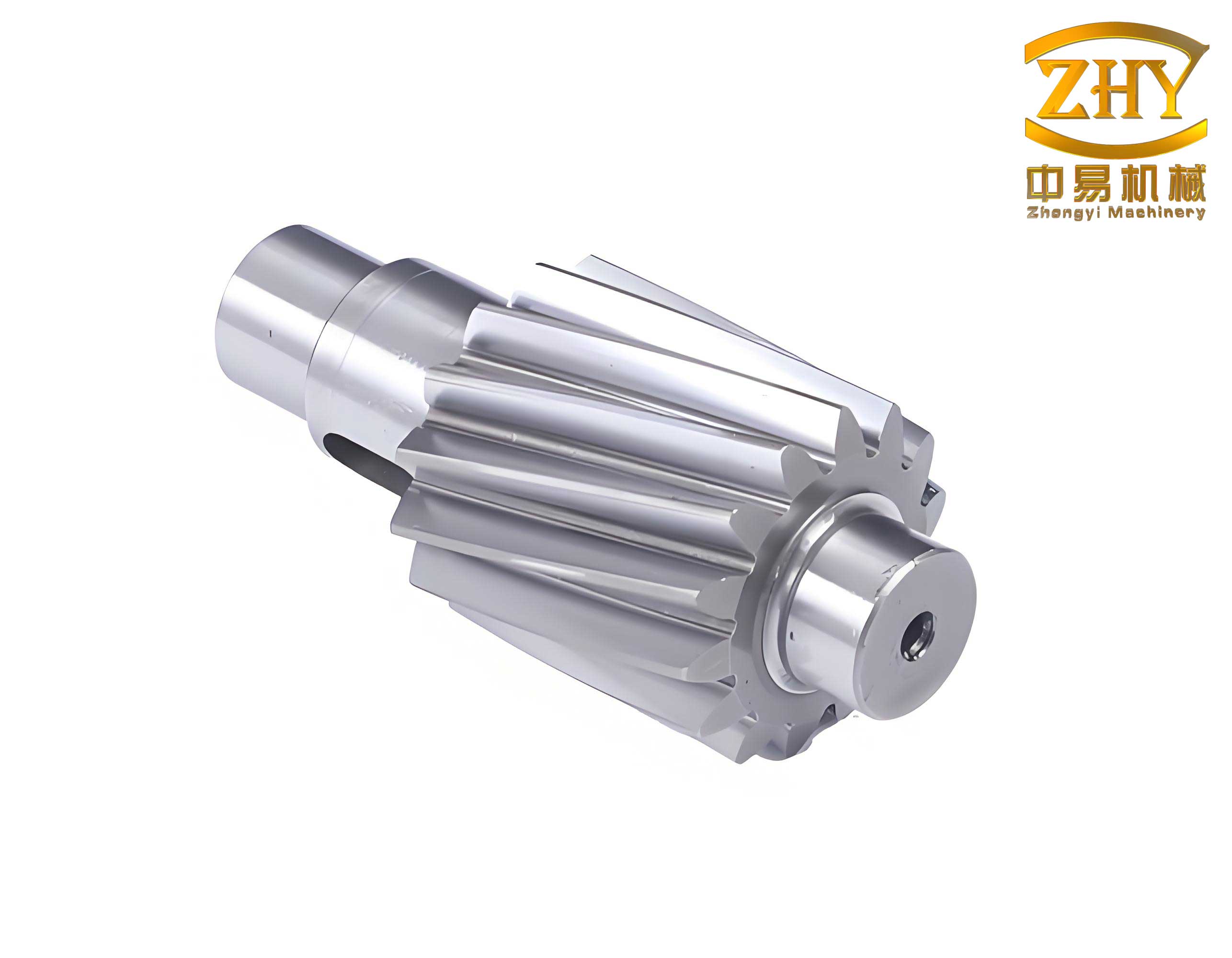
The gear shaft in question is a critical component in wind turbine systems, where it undergoes rigorous operational stresses. The manufacturing process involves shaping from bar stock, machining to form, surface gas carburizing, quenching, and low-temperature tempering. This sequence aims to achieve a hard, wear-resistant surface while maintaining a tough core. However, in several instances, these gear shafts developed longitudinal cracks during storage post-heat treatment, rendering them unfit for service. To understand this failure, I conducted a multi-faceted analysis covering chemical composition, mechanical properties, microstructural features, crack morphology, and fracture surfaces. The findings point toward a complex interplay of factors, primarily involving non-metallic inclusions and residual stresses, leading to hydrogen-induced delayed fracture.
Chemical composition analysis is fundamental in assessing material conformity. For the cracked gear shaft, samples were taken and analyzed using standard spectroscopic techniques. The results, summarized in Table 1, indicate that all elements fall within the specified range for 18CrNiMo7-6 steel. Notably, the hydrogen content is measured at 0.7 ppm, which is typically considered low but can still contribute to delayed cracking under certain conditions. The composition confirms that the material meets grade requirements, ruling out gross compositional deviations as a direct cause.
| Element | C | Si | Mn | Cr | Ni | Mo | P | S | H (ppm) |
|---|---|---|---|---|---|---|---|---|---|
| Content | 0.15 | 0.23 | 0.53 | 1.69 | 1.52 | 0.26 | 0.007 | <0.005 | 0.7 |
Mechanical properties were evaluated to ensure the gear shaft met performance standards. Tensile tests conducted in the circumferential direction yielded an ultimate tensile strength of 1100 MPa, a yield strength of 840 MPa, an elongation of 14%, and a reduction of area of 60%. These values align with expectations for heat-treated 18CrNiMo7-6 steel. Additionally, the case hardening depth at the tooth flank was measured as 1.37 mm, with surface hardness values indicating effective carburization. However, microhardness mapping revealed inconsistencies, with variations up to 40 HV0.5 in the core region, suggesting microstructural banding or segregation. This non-uniformity can influence stress distributions and susceptibility to cracking.
The crack morphology observed on the gear shaft is characteristic of quench-induced stresses. Macroscopically, the crack initiates near the tooth root and propagates longitudinally, appearing as a straight, open fissure with a maximum gap of about 1 mm on the outer surface. It extends through the wall thickness but does not reach the opposite end. The crack path is relatively linear radially, deviating only after passing through the core, indicating dominance by residual stresses rather than external loads. To further investigate, the crack was opened to expose the fracture surface, revealing initiation at a subsurface location approximately 2.2 mm below the tooth root surface. This region coincides with the transition zone between the carburized case and the core, where residual tensile stresses peak.
Fractographic analysis using scanning electron microscopy (SEM) identified the crack origin at a large non-metallic inclusion, measuring about 1.2 mm in length. Energy-dispersive X-ray spectroscopy (EDS) mapping showed this inclusion to be rich in magnesium and aluminum oxides, classifying it as an exogenous type. The fracture mode around the inclusion is a mix of intergranular and quasi-cleavage, typical of hydrogen embrittlement. Away from the origin, the carburized layer exhibits predominantly intergranular fracture, while the core shows quasi-cleavage features. Another large inclusion of similar composition was found nearby, aligned along the same microstructural flow line, highlighting potential material inhomogeneity. According to standard rating charts, the inclusion size corresponds to B2.5s, exceeding acceptable limits for critical applications.
Microstructural examination of transverse sections confirmed the presence of banded segregation, evident as alternating light and dark etching regions. The core microstructure consists of tempered lath martensite, with an prior austenite grain size of 8.0 per ASTM E112. The carburized case displays acicular tempered martensite. Non-metallic inclusion assessment at mid-radius and near the crack origin revealed a low overall inclusion content, primarily composed of fine oxides and some sulfides. However, the sporadic large inclusions act as stress concentrators and hydrogen traps, exacerbating crack initiation risk.
To quantify the stress state, I estimated the residual stress at the crack initiation site. Based on crack opening displacement and gear shaft geometry, the elastic strain was calculated, leading to an approximate circumferential residual tensile stress of 500 MPa using Hooke’s law:
$$ \sigma = E \epsilon $$
where \(\sigma\) is stress, \(E\) is Young’s modulus (approximately 210 GPa for steel), and \(\epsilon\) is strain. This substantial residual stress, combined with hydrogen presence, creates conditions ripe for delayed fracture. The absence of external loading during storage underscores the role of internal stresses and hydrogen.
Hydrogen-induced delayed fracture is a phenomenon where hydrogen atoms, even at low concentrations, reduce material ductility and facilitate crack propagation under stress. The critical hydrogen concentration \(C_{cr}\) for fracture can be described by:
$$ C_{cr} = C_0 \exp\left(-\frac{\sigma_h V_H}{RT}\right) $$
where \(C_0\) is the initial hydrogen content, \(\sigma_h\) is the hydrostatic stress, \(V_H\) is the partial molar volume of hydrogen, \(R\) is the gas constant, and \(T\) is temperature. In the gear shaft, hydrogen likely originates from the carburizing atmosphere or subsequent processing, accumulating at inclusion sites due to trapping effects. The large inclusion acts as a potent trap, locally elevating hydrogen concentration above \(C_{cr}\) under residual stress.
Furthermore, the stress intensity factor \(K\) at the inclusion tip governs crack initiation. For an embedded flaw, \(K\) can be approximated as:
$$ K = \sigma \sqrt{\pi a} $$
where \(\sigma\) is applied stress and \(a\) is flaw size. With \(\sigma = 500\) MPa and \(a = 1.2\) mm, \(K\) approaches thresholds for hydrogen-assisted cracking in high-strength steels. This explains why the crack initiated at this specific inclusion rather than at smaller, more numerous ones.
The residual stress profile in a carburized gear shaft is complex. During quenching, differential transformation between the high-carbon case and low-carbon core generates stresses. Typically, the case experiences compressive stresses, while the subsurface transition zone endures tensile stresses. Finite element modeling can illustrate this distribution, but simplistically, the maximum tensile stress occurs at a depth where hardness matches the core. For this gear shaft, that depth is around 2.2-2.5 mm, precisely where the crack-initiating inclusion resides. Table 2 summarizes key stress and inclusion parameters.
| Parameter | Value | Description |
|---|---|---|
| Inclusion Size | 1.2 mm | Length of Mg-Al oxide inclusion |
| Inclusion Depth | 2.2 mm | Below tooth root surface |
| Residual Stress | ~500 MPa | Circumferential tensile stress at inclusion |
| Case Hardness Depth | 1.37 mm | Effective carburized layer thickness |
| Core Hardness Variation | Up to 40 HV0.5 | Indicative of microstructural banding |
| Hydrogen Content | 0.7 ppm | Average bulk concentration |
The role of non-metallic inclusions cannot be overstated. These imperfections disrupt material continuity, acting as stress concentrators. The stress concentration factor \(K_t\) for an elliptical inclusion is given by:
$$ K_t = 1 + 2\sqrt{\frac{a}{\rho}} $$
where \(a\) is inclusion length and \(\rho\) is tip radius. For sharp inclusions, \(\rho\) is small, leading to high \(K_t\) values that amplify local stresses. Additionally, inclusions serve as hydrogen traps, with trapping energy \(\Delta E_t\) influencing hydrogen accumulation. The equilibrium hydrogen concentration at a trap site \(C_t\) is:
$$ C_t = C_L \exp\left(\frac{\Delta E_t}{RT}\right) $$
where \(C_L\) is hydrogen concentration in the lattice. Large oxide inclusions often have high \(\Delta E_t\), causing significant local hydrogen enrichment, which lowers the stress required for crack initiation.
Microstructural banding observed in the gear shaft further complicates matters. Banding arises from segregation of alloying elements during solidification, leading to alternating hard and soft zones. This heterogeneity affects hardness distribution, as measured, and can create micro-residual stresses. The variation in hardness suggests differential transformation behavior during quenching, potentially increasing overall residual stress levels. Banding also influences hydrogen diffusion, with paths possibly aligning along soft zones, facilitating hydrogen transport to critical sites.
To mitigate such failures, several strategies can be employed. First, enhancing non-destructive testing (NDT) for large inclusions is crucial. Ultrasonic testing or advanced imaging techniques can detect subsurface flaws that routine metallography might miss. Second, optimizing heat treatment parameters to reduce residual stresses is key. Increasing the tempering temperature, for instance, can relieve stresses without excessively lowering hardness. The tempering effect on yield strength \(\sigma_y\) can be modeled as:
$$ \sigma_y = \sigma_0 – k T \log(t) $$
where \(\sigma_0\) is initial strength, \(k\) is a constant, \(T\) is tempering temperature, and \(t\) is time. A balanced approach ensures adequate stress relief while maintaining performance.
Additionally, controlling hydrogen intake during processing is vital. Carburizing atmospheres can introduce hydrogen; thus, using dry processes or post-heat treatment baking to outgas hydrogen may help. Baking involves holding the gear shaft at elevated temperatures (e.g., 200°C) to allow hydrogen diffusion out of the material. The diffusion time \(t_d\) for hydrogen to reach a depth \(d\) is approximated by:
$$ t_d = \frac{d^2}{D} $$
where \(D\) is hydrogen diffusivity, which is temperature-dependent via \(D = D_0 \exp(-Q/RT)\), with \(D_0\) as pre-exponential factor and \(Q\) as activation energy.
Material selection and melting practices also play roles. Utilizing cleaner steels with lower inclusion content, achieved through vacuum arc remelting or electroslag remelting, can minimize initiation sites. Moreover, modifying alloy design to improve hydrogen tolerance, such as adding microalloying elements that form benign traps, could be beneficial.
In conclusion, the longitudinal delayed cracking of the gear shaft is a multifaceted issue rooted in the presence of large non-metallic inclusions at high residual stress zones, coupled with hydrogen embrittlement. The gear shaft’s failure underscores the importance of holistic quality control, from material production to heat treatment. By addressing inclusion detection, stress management, and hydrogen control, similar failures can be prevented, ensuring the reliability of gear shafts in critical applications like wind turbines. This analysis not only highlights specific causes but also provides a framework for evaluating other components prone to delayed fracture.
To further elaborate, let’s consider the statistical aspects of inclusion distribution. In steel production, inclusion size often follows a Pareto distribution, meaning large inclusions are rare but have disproportionate effects. The probability \(P\) of finding an inclusion larger than size \(x\) is:
$$ P(X > x) = \left(\frac{x_m}{x}\right)^\alpha $$
where \(x_m\) is minimum size and \(\alpha\) is shape parameter. For gear shafts, ensuring \(\alpha\) is high through process control reduces the risk of critical inclusions.
Another aspect is the effect of loading frequency in service, though not directly applicable to storage failures. For operational gear shafts, cyclic loading could interact with hydrogen, leading to fatigue crack growth. The crack growth rate \(da/dN\) in a hydrogen environment is often accelerated and can be modeled as:
$$ \frac{da}{dN} = C (\Delta K)^m $$
where \(C\) and \(m\) are material constants, and \(\Delta K\) is stress intensity factor range. This underscores the need for preemptive measures even before service.
In summary, the gear shaft cracking incident serves as a case study in failure analysis, emphasizing the interplay between material defects, processing stresses, and environmental factors. Continued research into advanced materials and processes will further enhance the durability of gear shafts, supporting industries that rely on precise and reliable power transmission.