
In the automotive industry, the gear shaft is a critical component in hydraulic rack-and-pinion power steering systems for passenger vehicles. With the rapid advancement of automotive technology, the variety and models of steering gears have proliferated, necessitating faster and more efficient design processes. To accelerate the design speed, particularly for the three-dimensional modeling of the gear shaft, our company has leveraged the Pro/ENGINEER (ProE) platform to implement computer-aided design (CAD) techniques based on parametric modeling. This approach has significantly enhanced design efficiency, improved product quality, and shortened design cycles. In this article, I will delve into the methodology and benefits of parametric modeling for gear shafts, emphasizing the use of parameters, equations, and geometric constructions to streamline the design process.
The gear shaft in a rack-and-pinion power steering system typically features a small-module helical gear at its lower section and a limit slot at the upper section. Parametric modeling allows for the automatic regeneration of the gear shaft model by altering key parameters, such as the number of teeth, module, and helix angle. This flexibility is crucial for adapting to diverse design requirements without manual redesign. For instance, by defining a set of parameters and relational equations, we can create a versatile model that can be easily modified for different steering gear applications. The core idea is to capture the design intent mathematically, enabling the CAD system to update the geometry accordingly.
To illustrate the parametric modeling process, let’s consider a specific example based on a gear shaft used in a steering system. The initial parameters include the number of teeth (Z), normal module (Mn), normal pressure angle (α), helix angle (β), normal addendum coefficient (ha), normal clearance coefficient (C), and modification coefficient (X). These parameters serve as the foundation for generating the gear shaft geometry. In ProE, we start by declaring these parameters and establishing relationships between them to compute derived values, such as the transverse module and transverse pressure angle. This parametric framework ensures that any change in the input parameters automatically propagates through the model.
The following table summarizes the key parameters and their initial values for the gear shaft model, along with their descriptions:
| Parameter Name | Symbol | Value | Description |
|---|---|---|---|
| Number of Teeth | Z | 7 | Number of teeth on the gear shaft |
| Normal Module | Mn | 1.94 mm | Module in the normal plane |
| Normal Pressure Angle | α | 20° | Pressure angle in the normal plane |
| Helix Angle | β | 20.5° | Helix angle of the gear shaft |
| Normal Addendum Coefficient | ha | 0.8 | Coefficient for addendum height |
| Normal Clearance Coefficient | C | 0.25 | Coefficient for clearance |
| Modification Coefficient | X | 0.625 | Profile shift coefficient |
| Face Width | B | 45 mm | Width of the gear shaft |
From these parameters, we derive additional quantities using relational equations. For example, the transverse module (Mt) is calculated from the normal module and helix angle, as the gear shaft involves helical geometry. The relationships are expressed mathematically to ensure accuracy and consistency. Below are the essential equations used in the parametric model:
$$ Mt = \frac{Mn}{\cos(\beta)} $$
$$ \alpha_t = \arctan\left(\frac{\tan(\alpha)}{\cos(\beta)}\right) $$
$$ h_t = h_a \cdot \cos(\beta) $$
$$ c_t = C \cdot \cos(\beta) $$
Here, Mt represents the transverse module, αt is the transverse pressure angle, ht is the transverse addendum coefficient, and ct is the transverse clearance coefficient. These derived parameters are critical for defining the gear shaft geometry in the transverse plane, which is necessary for accurate modeling of helical gears. Furthermore, we compute key diameters that characterize the gear shaft profile, such as the pitch diameter, base diameter, root diameter, and addendum diameter. These diameters are fundamental to constructing the gear tooth profile and ensuring proper meshing with the rack.
The equations for these diameters are as follows:
$$ d = Mt \cdot Z $$
$$ d_b = d \cdot \cos(\alpha_t) $$
$$ d_f = d – 2 \cdot Mt \cdot (h_t + c_t) $$
$$ d_a = d + 2 \cdot h_t \cdot Mt $$
In these equations, d is the pitch diameter, db is the base diameter, df is the root diameter, and da is the addendum diameter. These values are used to sketch the gear tooth profile, including the involute curve that defines the tooth flank. The involute curve is fundamental to gear design, as it ensures smooth and efficient power transmission. To generate this curve parametrically, we use an equation-driven approach in ProE. The involute equation is expressed in Cartesian coordinates, based on the base radius and an angular parameter.
The parametric equation for the involute curve is:
$$ r = \frac{d_b}{2} $$
$$ \theta = t \cdot 85 $$
$$ x = r \cdot \cos(\theta) + r \cdot \sin(\theta) \cdot \theta \cdot \frac{\pi}{180} $$
$$ y = r \cdot \sin(\theta) – r \cdot \cos(\theta) \cdot \theta \cdot \frac{\pi}{180} $$
$$ z = 0 $$
Here, t is a parameter that varies from 0 to 1, and the angle θ sweeps through 85 degrees to define a segment of the involute. This curve is created as a spline in the CAD software, providing a precise geometric representation. Once the involute curve is established, we sketch concentric circles representing the root circle, base circle, pitch circle, and addendum circle on the same plane. These circles are dimensioned using the calculated diameters, ensuring that the gear shaft model adheres to the specified parameters. For instance, the root circle diameter is set to df, the base circle diameter to db, the pitch circle diameter to d, and the addendum circle diameter to da.
After creating the involute curve and the circles, we proceed to mirror the involute curve about a symmetry plane to form one side of the gear tooth space. This symmetry plane is determined based on half of the tooth space width, which is derived from the gear parameters. The mirrored involute curves, along with the root circle, are then used to sketch the transverse cross-section of the tooth space. The root region is connected with a fillet to reduce stress concentration, a critical consideration for the durability of the gear shaft. This profile is defined in the front plane of the model, serving as the basis for generating the helical gear geometry.
The next step involves creating the helical sweep trajectory for the gear shaft. Since the gear shaft has helical teeth, we need to define a three-dimensional path that follows the helix angle. This is achieved by constructing a composite curve that includes a straight line along the gear axis and a curved segment for the gear tooth run-out. The straight line length equals the face width (B), while the curved segment accounts for the tool engagement during manufacturing, simulating the roll-off of the cutting tool. The helix angle β dictates the lead of the helix, which is computed from the base circle geometry. The lead (L) is given by:
$$ L = \frac{\pi \cdot d_b}{\tan(\beta)} $$
This lead value is used in the helical sweep operation to define the pitch of the helix. In ProE, we use the “Helical Sweep” feature to create a surface that represents the path of the tooth space along the gear shaft. The sweep trajectory is the composite curve, and the profile is the transverse tooth space sketch. This results in a helical surface that accurately captures the geometry of the gear tooth space. Subsequently, we use a “Sweep Blend” feature to generate a solid representation of the tooth space, ensuring smooth transitions along the helix.
Once a single tooth space is created, we array it around the axis of the gear shaft to form all tooth spaces. The number of instances in the array equals the number of teeth (Z), and the angular spacing is uniform based on the pitch angle. This array feature leverages the parametric nature of the model; if Z changes, the array updates automatically. After generating the tooth spaces, we create the main body of the gear shaft using a rotational feature. This involves sketching the outer contour of the gear shaft, including the addendum diameter and other features such as shafts and limit slots. The sketch is revolved around the central axis to produce a solid cylinder, which represents the blank of the gear shaft.
To finalize the gear shaft model, we subtract the tooth spaces from the solid cylinder using a “Cut” operation. This is done by employing the helical surfaces as cutting tools, effectively carving out the gear teeth. Additional features, such as chamfers, fillets, and machining details, are added through extruded cuts and blends to complete the model. The result is a fully parametric three-dimensional representation of the gear shaft that can be easily modified by altering the input parameters. For example, if we change the number of teeth to 8, the normal module to 1.85 mm, the helix angle to 25°, the normal addendum coefficient to 0.9, and the modification coefficient to 0.8, the model regenerates to reflect these new values, producing a different gear shaft geometry without manual redesign.
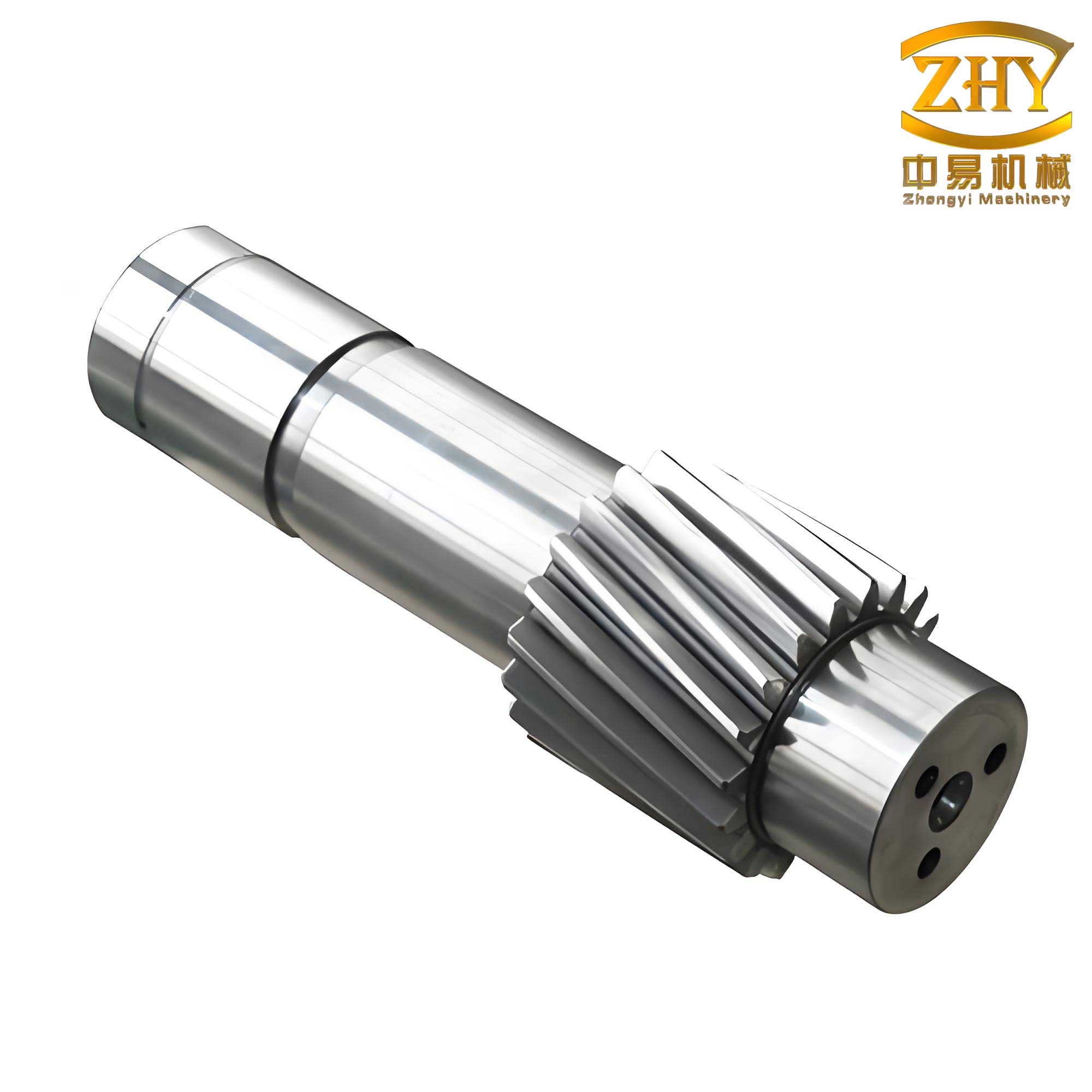
The image above illustrates a typical gear shaft model generated through parametric modeling, showcasing the helical teeth and overall structure. This visual representation highlights the complexity and precision achievable with this approach. Parametric modeling not only accelerates the design process but also enhances consistency and reduces errors, as the geometry is driven by mathematical relationships rather than manual adjustments. For gear shafts in steering systems, where performance and reliability are paramount, such accuracy is essential.
However, it’s important to note that parametric modeling has limitations. If the parameters vary beyond a certain range, the topological structure of the gear shaft may change, leading to regeneration failures. For instance, extreme values of helix angle or module could result in invalid geometry, such as undercut teeth or unrealistic proportions. Therefore, the parametric model is typically validated within a specific parameter range to ensure robustness. In practice, we define constraints and checks in the CAD software to prevent such issues, maintaining the integrity of the gear shaft design across different variants.
The benefits of parametric modeling for gear shafts extend beyond individual design tasks. In a manufacturing context, where multiple variants of steering gears are produced, having a parametric model library allows for rapid customization and adaptation. Designers can quickly generate new gear shaft models by inputting different parameter sets, reducing lead times and enabling faster response to market demands. Moreover, the parametric approach facilitates integration with other engineering tools, such as finite element analysis (FEA) and computer-aided manufacturing (CAM), as the model can be automatically updated for simulation or machining purposes. This interoperability further streamlines the product development cycle.
To elaborate on the mathematical foundation, let’s consider additional formulas relevant to gear shaft design. The transverse pressure angle (αt) is crucial for determining the tooth shape in the plane of rotation. Its calculation involves trigonometric transformations, as shown earlier. Similarly, the base helix angle (βb) can be derived from the base circle and lead, providing insight into the gear’s kinematic behavior. The relationship is:
$$ \beta_b = \arctan\left(\frac{\pi \cdot d_b}{L}\right) $$
This angle influences the contact pattern and load distribution on the gear shaft teeth. Additionally, the tooth thickness in the transverse plane (st) is computed based on the circular pitch and modification coefficient. The circular pitch (pt) is given by:
$$ p_t = \frac{\pi \cdot d}{Z} $$
And the tooth thickness at the pitch circle (st) can be approximated as:
$$ s_t = p_t \cdot \left(\frac{1}{2} + \frac{2 \cdot X \cdot \tan(\alpha)}{\pi}\right) $$
These formulas are incorporated into the parametric model to ensure accurate tooth geometry, which directly affects the meshing quality and noise performance of the steering system. By embedding such equations, the CAD model becomes an intelligent representation of the gear shaft, capturing both geometric and functional aspects.
In terms of implementation, the ProE platform offers robust tools for parametric modeling, including the “Parameters” dialog for defining variables, the “Relations” editor for entering equations, and the “Program” module for automating design logic. We leverage these features to create a user-friendly interface where designers can input key parameters and instantly see the updated gear shaft model. This interactive capability reduces the learning curve and empowers engineers to explore design alternatives efficiently. For example, a table of parameter values for different gear shaft variants can be stored and retrieved, enabling batch processing of designs.
The following table presents a comparison of gear shaft parameters for two different steering applications, demonstrating the flexibility of parametric modeling:
| Parameter | Application A | Application B |
|---|---|---|
| Number of Teeth (Z) | 7 | 8 |
| Normal Module (Mn) in mm | 1.94 | 1.85 |
| Helix Angle (β) in degrees | 20.5 | 25.0 |
| Normal Addendum Coefficient (ha) | 0.8 | 0.9 |
| Modification Coefficient (X) | 0.625 | 0.800 |
| Face Width (B) in mm | 45 | 50 |
| Pitch Diameter (d) in mm | Calculated from Mt and Z | Calculated from Mt and Z |
By simply updating these parameters in the CAD model, we can generate distinct gear shaft designs tailored to specific steering requirements. This parametric adaptability is particularly valuable in the automotive industry, where customization and performance optimization are ongoing priorities. The gear shaft, as a core component, must meet stringent standards for strength, wear resistance, and precision, and parametric modeling aids in achieving these goals through iterative design and analysis.
Furthermore, the parametric approach supports design reuse and standardization. Common features of gear shafts, such as keyways, bearings seats, and splines, can be parameterized and stored in a library. When designing a new gear shaft, engineers can import these features and adjust their dimensions based on the current parameters, saving time and ensuring consistency across projects. This modular design philosophy aligns with industry trends toward digital twins and model-based systems engineering, where the gear shaft model serves as a single source of truth throughout the product lifecycle.
From a technical perspective, the creation of the helical sweep trajectory warrants deeper explanation. The composite curve includes a straight segment along the gear shaft axis and a curved segment that represents the tool exit path. This curved segment is constructed based on the cutter geometry used in manufacturing, such as a hob or shaping tool. The radius of the curve corresponds to the tool’s outer radius, and its shape ensures a smooth transition at the ends of the gear teeth, preventing stress risers. The mathematical representation of this curve can be derived from tool-workpiece engagement kinematics, but in CAD, it is often approximated with arcs or splines for simplicity. The important aspect is that this trajectory is parametrically linked to the gear shaft dimensions, so changes in tooth size or helix angle automatically adjust the sweep path.
Another critical aspect is the definition of the tooth profile in the transverse plane. The involute curve, while standard, may be modified for specific applications to enhance performance. For example, tip relief or root fillets can be added to reduce noise and improve strength. These modifications are incorporated into the parametric model by adjusting the sketch geometry with additional parameters. For instance, the fillet radius at the root can be defined as a function of the module, such as R_f = k * Mn, where k is a coefficient. This ensures that the fillet size scales appropriately with the gear shaft size, maintaining geometric proportionality.
In conclusion, parametric modeling of gear shafts using ProE has revolutionized the design process for hydraulic rack-and-pinion power steering systems. By capturing design intent through parameters and equations, we achieve rapid model generation, easy modification, and high design quality. The gear shaft, as a complex mechanical component, benefits immensely from this approach, reducing development time and costs while enhancing reliability. The integration of mathematical formulas, such as those for involute curves and helical sweeps, ensures accuracy and consistency across variations. Although parametric modeling is constrained by topological limits, its advantages in flexibility and efficiency make it indispensable in modern automotive engineering. As technology evolves, further advancements in CAD software and simulation tools will continue to enhance the parametric design of gear shafts, driving innovation in steering systems and beyond.
To summarize the key equations used in the parametric modeling of gear shafts, here is a consolidated list:
$$ Mt = \frac{Mn}{\cos(\beta)} $$
$$ \alpha_t = \arctan\left(\frac{\tan(\alpha)}{\cos(\beta)}\right) $$
$$ d = Mt \cdot Z $$
$$ d_b = d \cdot \cos(\alpha_t) $$
$$ d_f = d – 2 \cdot Mt \cdot (h_t + c_t) $$
$$ d_a = d + 2 \cdot h_t \cdot Mt $$
$$ L = \frac{\pi \cdot d_b}{\tan(\beta)} $$
These formulas form the backbone of the parametric model, enabling the automatic computation of geometric features. By embedding them in the CAD environment, we create a dynamic and responsive design tool that adapts to changing requirements. The gear shaft, central to steering performance, thus becomes a product of precise engineering and intelligent design automation.