
In the realm of power transmission systems, the gear shaft serves as a critical component, integrating gear teeth and splines to transmit torque and motion efficiently. The performance and longevity of a gear shaft heavily depend on its heat treatment, which tailors surface hardness, core toughness, and dimensional stability. This article delves into a comprehensive optimization journey for heat treating a complex spline gear shaft, sharing firsthand experiences and technical insights gained from overcoming challenges associated with differential carburizing and implementing a superior induction hardening approach. Throughout this discussion, the term ‘gear shaft’ will be frequently emphasized to underscore its central role in mechanical design and manufacturing.
The gear shaft in question features an integrated design with gear teeth at one end and splines at the other, necessitating distinct surface properties for each functional region. The initial specifications required deep case hardening for the gear teeth and a shallower case for the splines, leading to the exploration of a double carburizing technique. However, this method induced excessive distortion, compromising the gear shaft’s几何精度 and assembly compatibility. Through iterative testing and process refinement, a hybrid method combining single carburizing for the gear section and localized induction hardening for the spline section emerged as an optimal solution. This narrative will elaborate on the technical parameters, experimental validations, and economic implications of this optimization, supported by formulas and tables to encapsulate key data.
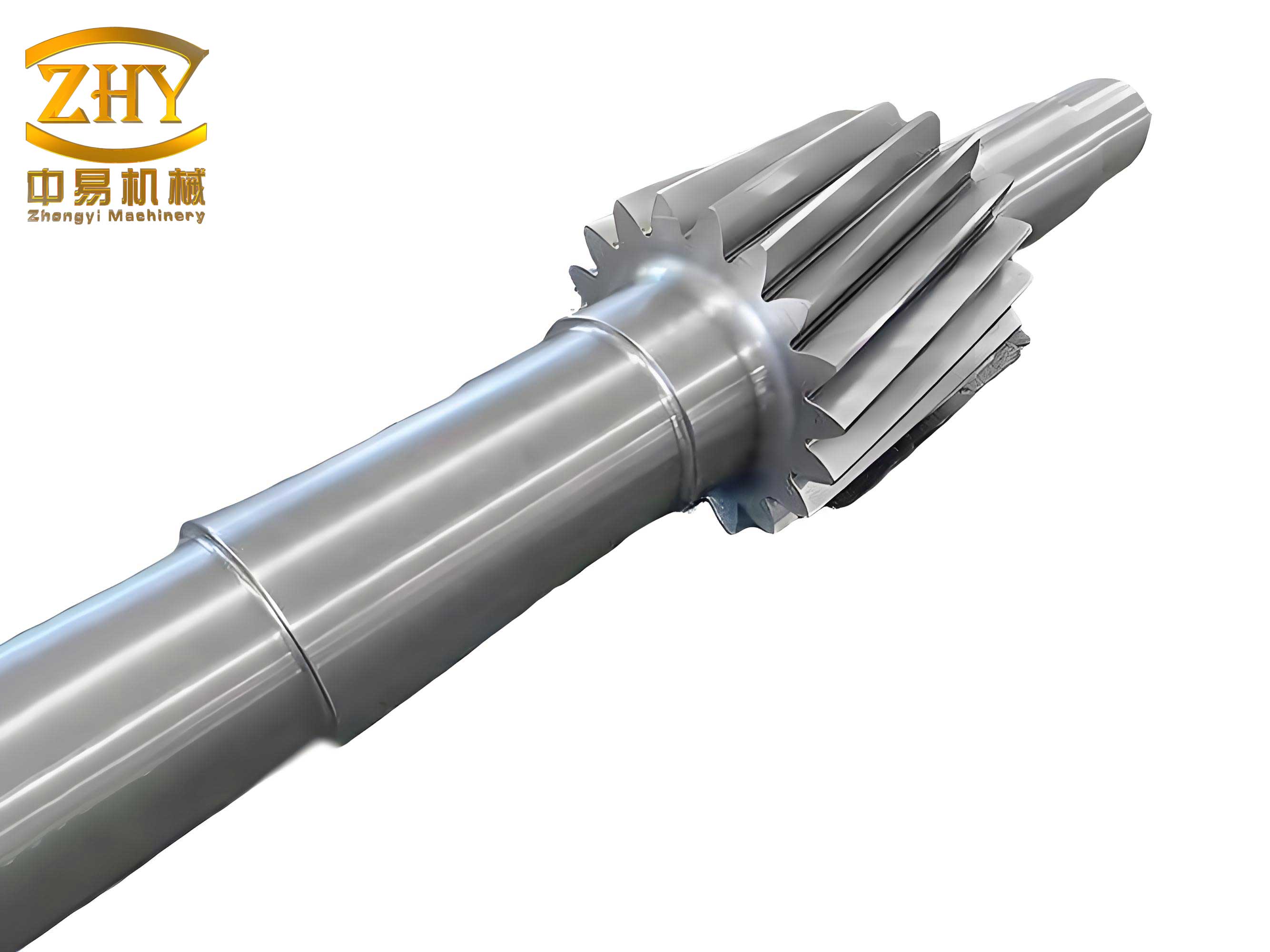
To understand the optimization context, let’s first detail the gear shaft’s characteristics. The gear shaft is fabricated from 20CrNi2MoA alloy steel, a material chosen for its high hardenability and strength. The chemical composition of this steel, as verified through spectrometry, is presented in Table 1. This composition directly influences the response to heat treatment, affecting phase transformations and final mechanical properties. For any gear shaft, the base material sets the foundation for subsequent processing.
| Element | C | Si | Mn | S | P | Cr | Ni | Mo |
|---|---|---|---|---|---|---|---|---|
| Content (%) | 0.19 | 0.27 | 0.98 | 0.017 | 0.02 | 0.62 | 1.95 | 0.23 |
The geometrical and performance specifications for this particular gear shaft are stringent, as outlined in Table 2. The gear section has a larger module and requires a deeper effective case depth (ECD) compared to the spline section. The ECD is typically defined as the depth from the surface to the point where hardness drops to a specific value, often 550 HV. For this gear shaft, the gear ECD is 2.8–3.5 mm, while the spline ECD is 1.1–1.7 mm. Surface hardness for both regions is specified at 57–61 HRC, with core hardness at 35–40 HRC. Additionally, the同心度 between the gear and spline axes must not exceed 1.0 mm to ensure smooth operation. These requirements pose a significant heat treatment challenge, as achieving different case depths on the same gear shaft can lead to distortion and processing complexity.
| Feature | Normal Module (m_n) | Number of Teeth (z) | Helix Angle (β) | Effective Case Depth (mm) | Surface Hardness (HRC) |
|---|---|---|---|---|---|
| Gear Section | 20 | 26 | 7°29’47” | 2.8–3.5 | 57–61 |
| Spline Section | 6 | 55 | N/A | 1.1–1.7 | 57–61 |
The initial heat treatment strategy, termed “differential carburizing,” involved two separate carburizing cycles. First, the entire gear shaft was carburized to achieve the deep case required for the gear teeth, while the spline area was masked with an anti-carburizing coating. After machining the splines, a second carburizing cycle was applied solely to the spline region to build up its shallower case. The complete process sequence included: forging → rough machining → normalizing at 900°C → semi-finishing → gear hobbing → first carburizing (for gear) → machining splines → second carburizing (for splines) → quench and temper. The quenching was performed from 820–830°C into fast oil at 60–80°C, followed by tempering at 200°C. The theoretical basis for carburizing depth can be approximated by the diffusion equation:
$$ d = k \sqrt{t} $$
where \( d \) is the case depth (mm), \( k \) is a temperature-dependent diffusion coefficient (mm/√h), and \( t \) is time (hours). For a gear shaft, controlling \( d \) precisely for different sections is crucial. However, this double-heating approach led to substantial distortion in the gear shaft, as documented in Table 3. The concentricity error between the gear and spline sections reached up to 2.44 mm, resembling a “twisted” deformation that complicated final machining and risked rejection. The long, slender geometry of the gear shaft, characterized by a high length-to-diameter ratio, exacerbated this distortion due to thermal stresses and phase transformation unevenness.
| Sample ID | Gear OD Change (mm) | Spline OD Change (mm) | Concentricity Error (mm) | Gear Span Change (mm) |
|---|---|---|---|---|
| 1 | 1.14 | 1.01 | 1.45 | 1.06 |
| 2 | 1.26 | 1.08 | 1.52 | 1.03 |
| 3 | 1.03 | 0.97 | 2.44 | 0.89 |
| 4 | 1.03 | 0.86 | 2.32 | 0.72 |
| 5 | 0.95 | 0.76 | 1.85 | 0.82 |
Faced with these challenges, a reassessment was undertaken. Mechanical analysis indicated that the spline section of the gear shaft did not necessitate such high surface hardness; a hardness of 38–42 HRC would suffice for its torque transmission duties, provided the core strength was adequate. This revision, agreed upon with design stakeholders, opened the door to alternative heat treatment methods. The goal became to achieve the deep, hard case on the gear teeth via carburizing and quenching, while applying a separate, localized hardening process to the splines to meet the revised hardness target. This approach would minimize overall thermal exposure for the gear shaft, thereby reducing distortion.
Preliminary hardening tests were conducted on cylindrical specimens of 20CrNi2MoA steel to evaluate its response to different quenching methods. As shown in Table 4, both flame heating with water quenching and furnace heating with oil quenching resulted in full through-hardness of 44–47 HRC on small diameters. This confirmed the material’s inherent hardenability, described by the ideal critical diameter \( D_I \) which can be estimated using Grossmann’s method based on alloy content. For a gear shaft, the hardenability dictates the depth of hardening under given cooling conditions. The relationship between cooling rate and hardness can be modeled using continuous cooling transformation (CCT) diagrams, but empirically, 20CrNi2MoA exhibits sufficient hardenability to achieve 40+ HRC with moderate quenching.
| Specimen ID | Heating Method | Quenching Medium | Hardness Result (HRC) |
|---|---|---|---|
| 1 | Flame Heating | Water | 44–47 |
| 2 | Furnace Heating | Oil | 44–47 |
Building on this, a simulated gear shaft with similar spline dimensions was subjected to induction hardening to validate the process for the actual component. Induction hardening employs electromagnetic induction to rapidly heat the surface layer of a conductive part, followed by immediate quenching. The depth of hardening \( \delta \) is governed by the skin effect, approximated by:
$$ \delta = 503 \sqrt{\frac{\rho}{\mu f}} $$
where \( \rho \) is the electrical resistivity (Ω·m), \( \mu \) is the magnetic permeability (H/m), and \( f \) is the frequency (Hz). For the spline section of the gear shaft, a medium frequency of 10 kHz was selected to achieve a hardening depth of 1.5–2.5 mm. The process parameters are summarized in Table 5. The gear shaft spline was heated using a环形 induction coil with a 2.5–3.0 mm air gap, traversed at a controlled speed while being sprayed with water for quenching. Post-heating, the part was tempered at 330°C to relieve stresses and achieve the desired toughness.
| Parameter | Value |
|---|---|
| Frequency | 10,000 Hz |
| Inductor Type | Encircling Coil |
| Workpiece-Coil Gap | 2.5–3.0 mm |
| Load Voltage | 750 V |
| Load Current | 168 A |
| Power Factor (cosφ) | 0.95 |
| Apparent Power | 120 kVA |
| Quenching Medium | Water |
| Quench Pressure | 0.1 MPa |
| Traverse Speed | 65 mm/min |
| Tempering Temperature | 330°C |
The results from the simulated gear shaft were highly promising. The spline surface hardness attained 43–45 HRC, with a contour-following hardened layer depth of 1.5–2.5 mm. Metallographic examination revealed a fine martensitic structure at the surface, indicative of proper austenitization and rapid cooling. Importantly, the distortion was minimal: radial change was 0.15–0.20 mm, and axial change was 0.1–0.15 mm. This demonstrated that induction hardening could impart the necessary surface properties to the spline section of a gear shaft without inducing the severe distortion associated with full-body reheating. The hardened layer profile showed conformity to the spline tooth root, enhancing bending fatigue resistance—a critical factor for a dynamically loaded gear shaft.
Consequently, the optimized heat treatment流程 for the spline gear shaft was established as follows: Forging → Rough Machining → Normalizing (900°C) → Semi-Finishing → Gear Hobbing → Single Carburizing and Quenching (for gear teeth only) → Spline Machining → Spline Induction Hardening and Tempering → Final Finishing → Gear Grinding → Assembly. In this sequence, the entire gear shaft undergoes carburizing, but the spline area is left unmachined or is masked during carburizing? Actually, in practice, the gear teeth are carburized and quenched first, then the splines are machined from the uncarburized core material, and finally, the splines are induction hardened. This avoids the double carburizing and reduces the number of high-temperature cycles for the gear shaft.
The efficacy of this optimized process was proven in a production batch of 28 gear shafts for a reducer project. Half were treated using the old differential carburizing method, and half with the new single carburizing plus induction hardening method. The distortion results, compared in Table 6, unequivocally favor the optimized process. The gear shafts processed with induction hardening exhibited significantly lower distortion in the spline region, with concentricity errors全部 within acceptable limits (≤0.20 mm radial runout). In contrast, the differential carburizing batches showed large and unpredictable distortions, jeopardizing their geometric integrity. The optimized process yielded a 100% qualification rate for the gear shaft, underscoring its reliability.
| Gear Shaft ID | Gear Section Distortion (OD Change, mm) | Gear Span Change (mm) | Spline Section Distortion (OD Change, mm) | Spline Radial Runout (mm) |
|---|---|---|---|---|
| 1 | 0.61 | 0.61 | 0.20 | ≤0.20 |
| 2 | 0.62 | 0.58 | 0.23 | ≤0.20 |
| 3 | 0.74 | 0.47 | 0.27 | ≤0.20 |
| 4 | 0.78 | 0.12 | 0.24 | ≤0.20 |
| 5 | 0.69 | 0.48 | 0.29 | ≤0.20 |
Beyond technical performance, the economic advantages of the optimized process are substantial, as quantified in Table 7. The induction hardening approach reduces both process time and cost per unit weight of the gear shaft. The simplified workflow eliminates the need for anti-carburizing coatings, double furnace runs, and associated handling, leading to higher throughput and lower energy consumption. For high-value components like a precision gear shaft, these savings translate directly into improved competitiveness and profitability.
| Process | Cycle Time per Gear Shaft (hours) | Cost per Unit Mass (currency/kg) | Yield Rate (%) | Process Complexity |
|---|---|---|---|---|
| Differential Carburizing + Quench | 35 | 8 | 70 | High |
| Single Carburizing + Induction Hardening | 25 | 5 | 100 | Low |
In conclusion, the optimization journey for this spline gear shaft highlights the importance of tailored heat treatment strategies. By replacing a complex, distortion-prone differential carburizing process with a synergistic combination of single carburizing for the gear teeth and localized induction hardening for the splines, we achieved superior dimensional control, mechanical performance, and production efficiency. The gear shaft, as a central element in transmission systems, benefits immensely from such precision engineering. The induction hardening process, with its rapid, localized heating, minimizes thermal distortion, ensures contour-hardened layers, and offers excellent repeatability. For gear shafts made from 20CrNi2MoA or similar alloys where spline hardness requirements are in the 40–45 HRC range, this hybrid approach represents a robust and economical solution. Future work may explore modeling the thermal and phase transformation stresses in the gear shaft during induction hardening using finite element analysis (FEA) to further optimize parameters and predict distortion. The general principles derived here can be extended to other complex components where differential surface properties are required, reinforcing the value of integrated process innovation in manufacturing.
To further elaborate on the metallurgical aspects, the core hardness of the gear shaft after carburizing and quenching is critical for overall toughness. The relationship between hardness and tensile strength for low-alloy steels can be approximated by \( \sigma_b \approx 3.5 \times \text{HB} \) for Brinell hardness, or via empirical conversions for HRC. For the gear shaft core hardness of 35–40 HRC, the corresponding tensile strength exceeds 1000 MPa, ensuring adequate load-bearing capacity. The effective case depth for the gear teeth, defined at 550 HV, correlates with the carbon profile established during carburizing. The carbon concentration \( C(x,t) \) as a function of depth \( x \) and time \( t \) can be described by Fick’s second law under appropriate boundary conditions:
$$ \frac{\partial C}{\partial t} = D \frac{\partial^2 C}{\partial x^2} $$
where \( D \) is the diffusion coefficient of carbon in austenite, which is temperature-dependent according to an Arrhenius equation: \( D = D_0 \exp(-Q/RT) \). For a gear shaft, controlling the carbon profile ensures a gradual hardness transition, mitigating stress concentrations. In induction hardening of the spline, the rapid heating results in austenitization of only the surface layer, with the core remaining in its prior condition (tempered martensite or ferrite-pearlite, depending on prior treatment). The hardened depth is primarily a function of power density and heating time, which can be optimized using the formula for power penetration depth \( \delta_p \):
$$ \delta_p = \sqrt{\frac{2\rho}{\omega \mu}} $$
where \( \omega = 2\pi f \) is the angular frequency. For the gear shaft spline, selecting 10 kHz frequency provided a good compromise between depth and efficiency. Post-hardening tempering reduces brittleness by precipitating carbides and relieving quench stresses, following kinetics described by the Hollomon-Jaffe parameter for tempering effects. The final microstructure in the spline consists of tempered martensite, offering an optimal balance of hardness and toughness for a gear shaft subjected to cyclic torsional loads.
In summary, every step in the heat treatment of a gear shaft must be meticulously designed and controlled. From material selection to process parameter optimization, the goal is to achieve the desired gradient in properties without compromising几何 integrity. The case study presented herein demonstrates that through systematic testing and process integration, significant improvements in quality and cost are attainable. The gear shaft, as a quintessential mechanical component, continues to evolve with advancements in heat treatment technology, and the lessons learned from this optimization are applicable to a wide range of high-performance传动零部件.