
In the realm of advanced machinery for sectors such as new energy, aerospace, and defense, the demand for high-performance gearboxes has escalated dramatically. As a critical component within these systems, the gear shaft plays a pivotal role in transmitting power and motion. Specifically, multi-feature gear shafts, which integrate elements like gears, splines, and conical surfaces into a single串联式 structure, enable compact design and multifunctional performance. However, the reliable operation of such gear shafts hinges not only on rational structural design and feature coordination but also on stringent manufacturing processes. Given existing gaps in material science and machining technology compared to Western counterparts, precise structural design and parameter optimization become paramount to bridge these deficiencies. In this study, we adopt a forward engineering design philosophy to propose a rapid static-dynamic joint design methodology. Our aim is to investigate the structural characteristics, mechanical performance, and delineate safe operational parameter intervals for high-speed multi-feature gear shafts. This work provides auxiliary design support for developing novel multi-feature shaft structures in engineering applications, emphasizing the gear shaft’s central role throughout.
The core of our approach lies in a synergistic analysis of static strength and rotor dynamics. We begin by modeling the multi-feature gear shaft under operational loads, simplifying non-critical geometric features while retaining essential elements like the involute gear and output conical surface. Static strength assessment employs the dangerous cross-section safety factor criterion, weighing factors for tooth contact strength, tooth root bending strength, and the shaft’s critical section. Dynamic analysis delves into the rotor-bearing system’s natural frequencies, mode shapes, and unbalanced responses, utilizing tools like Campbell diagrams and vibration amplitude relationships. By fusing insights from both static and dynamic domains, we derive reliable operational parameter intervals—spanning power and speed ranges—that ensure the gear shaft’s integrity and stability. This integrated methodology facilitates rapid design iteration and parameter selection for similar multi-feature gear shafts.
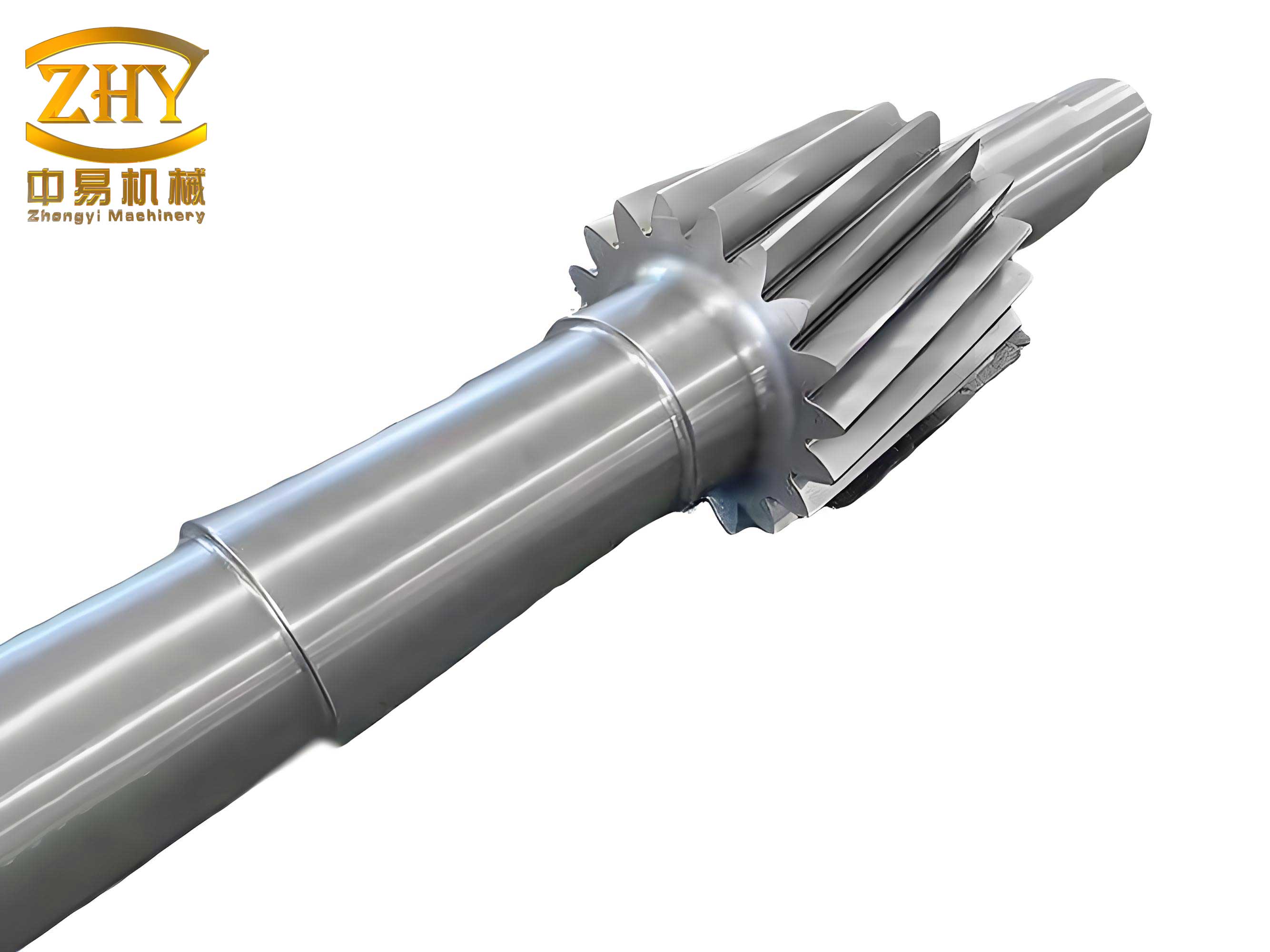
To ground our study, we consider a multi-feature gear shaft from a high-speed wire rod finishing mill gearbox. This gear shaft embodies multiple functional features: an involute gear for torque transmission, an involute spline for driving labyrinth seal rings, a rectangular spline combined with an external thread for preload adjustment, and a conical surface for output load transmission (where a roller is mounted to hot-roll wire rod). The primary parameters of these elements are summarized in Table 1. During operation, two such gear shafts drive rollers to squeeze wire rod, inducing complex loading including radial挤压 forces, gear meshing forces, and torsional moments. Support is provided by a combination of oil-film bearings (radial) and rolling bearings (axial), reflecting typical high-speed application constraints.
| Element | Module (mm) | Number of Teeth | Pressure Angle (°) | Helix Angle (°) | Face Width (mm) |
|---|---|---|---|---|---|
| Involute Gear | 5.0 | 25 | 20 | 15.5 | 80 |
| Involute Spline | 1.5 | 59 | 20 | 0 | 20 |
Static strength analysis commences with load determination. The output torque \(M\) is calculated from power \(P\) and rotational speed \(n\) using the standard relation:
$$M = 9549 \frac{P}{n} \quad \text{(in N·m)}$$
For instance, with \(P = 300\,\text{kW}\) and \(n = 8000\,\text{r/min}\), \(M = 358\,\text{N·m}\). The radial挤压 force \(F_r\) at the conical surface is derived from equilibrium with friction torque. Forces and moments acting on the gear shaft include gear啮合 forces (radial and tangential), conical surface radial force, gravity, and input/output torques. We construct a simplified mechanical model (Figure 3 in original, but here described textually) where non-critical features are omitted, and bearings are modeled as appropriate constraints. Using software like Romax, we compute force distributions, displacements, bending moments, and stresses. For the given parameters, maximum bending moment occurs in the YZ plane, peaking at 1609 N·m, while combined bending-torsion stress peaks at 13.6 MPa at a section transition near the right support, identified as the dangerous cross-section.
The safety factor \(S_s\) for this dangerous cross-section is evaluated via:
$$S_s = \frac{S_{s\sigma} S_{s\tau}}{\sqrt{S_{s\sigma}^2 + S_{s\tau}^2}} \geq S_{sp}$$
where \(S_{sp}\) is the allowable static safety factor (taken as 1.8), and \(S_{s\sigma}\) and \(S_{s\tau}\) are safety factors for pure bending and pure torsion, respectively:
$$S_{s\sigma} = \frac{\sigma_s Z}{M_{\text{max}}}, \quad S_{s\tau} = \frac{\tau_s Z_P}{T_{\text{max}}}$$
Here, \(\sigma_s\) and \(\tau_s\) are yield strengths in tension and torsion (290 MPa and 180 MPa for material 17CrNiMo6), \(Z\) and \(Z_P\) are section moduli, and \(M_{\text{max}}\) and \(T_{\text{max}}\) are maximum bending moment and torque. Computations yield \(S_{s\sigma} = 9.1\), \(S_{s\tau} = 50.5\), and \(S_s = 9.0 > S_{sp}\), indicating ample static strength margin.
To optimize the gear shaft’s utility, we explore the interplay between power, speed, and safety factors—\(S_S\) (shaft dangerous section), \(S_F\) (tooth root bending), and \(S_H\) (tooth contact)—while keeping shaft geometry constant. We sweep power from 300 to 1500 kW and speed from 5000 to 12000 r/min. At fixed speed, all safety factors decrease with increasing power, with \(S_S\) and \(S_F\) showing steeper initial declines than \(S_H\). Conversely, at fixed power, safety factors increase with speed, sensitivity order being \(S_F > S_H > S_S\). This inverse trend is captured in three-dimensional surfaces (Figure 10 original). Establishing allowable bounds—\(2.0 \leq S_S \leq 3.0\), \(1.6 \leq S_F \leq 3.0\), \(1.3 \leq S_H \leq 2.0\)—we extract the intersection region to define the static-based operational parameter interval. This region, depicted in Figure 11, illustrates the trade-off: higher powers necessitate lower speeds to maintain safety, and vice versa.
| Computational Tool | 1st Natural Frequency (Hz) | 2nd Natural Frequency (Hz) | 3rd Natural Frequency (Hz) | 4th Natural Frequency (Hz) |
|---|---|---|---|---|
| Romax | 374.9 | 471.1 | 722.3 | 1452.1 |
| DyRoBes | 374.7 | 478.2 | 732.1 | 1496.9 |
Rotor dynamics analysis is crucial for high-speed gear shafts to avoid resonant instability. We model the gear shaft as a rotor supported by oil-film bearings with stiffness and damping coefficients derived from static loads. Natural frequencies and mode shapes are computed via finite element methods in Romax. For initial parameters \(P = 900\,\text{kW}\), \(n = 8000\,\text{r/min}\), positive whirl modes yield frequencies listed in Table 2; negative whirl frequencies are slightly lower due to reduced effective stiffness. Mode shapes in the XZ plane (Figure 13) reveal characteristic deflections: first mode is primarily translational, second involves bending, third and fourth show higher-order bending. Validation with DyRoBes shows close agreement (max error 2.8% for fourth mode). The influence of bearing stiffness \(k_b\) on natural frequencies is explored: as \(k_b\) increases from \(10^5\) to \(10^6\,\text{N/mm}\), frequencies rise and eventually plateau at rigid-support values. Critical speeds are derived from natural frequencies; for instance, the first critical speed is \(22,494\,\text{r/min}\) (corresponding to 374.9 Hz). To identify potential excitation sources, we construct a damped Campbell diagram (Figure 16), plotting natural frequencies against rotational speed (as multiples of running speed). Intersections of running speed (N) and its harmonics (e.g., 2N) with natural frequencies indicate resonance risks, guiding speed avoidance zones.
Unbalanced response analysis assesses vibration amplitudes due to residual unbalance. We place unbalance masses at key locations—gear and shaft end—corresponding to dynamic balance grades G2.5 and G1.0, with maximum unbalance values of 0.25 kg·mm and 0.1 kg·mm, respectively. Response calculations show that amplitudes increase with speed and are largest at the rightmost node (near the conical output). For G2.5, amplitudes are higher than for G1.0, underscoring the impact of balance quality. Plots of node displacement versus speed (Figure 19) reveal a rapid amplitude increase beyond 9600 r/min, suggesting this as an upper speed limit for stable operation. Thus, dynamics considerations prescribe a speed interval below 9600 r/min,避开 critical speeds and high-response zones.
The final step integrates static and dynamic parameter intervals. The static-derived region (Figure 11) is filtered by the dynamic speed constraint (<9600 r/min), yielding the consolidated operational parameter interval shown in Figure 20. This region defines admissible power-speed pairs that ensure both strength and dynamic stability for the multi-feature gear shaft. The curvature of the boundary reflects the compounding effects: at higher powers, the allowable speed range narrows due to strength limits, while at very high speeds, dynamic constraints dominate.
To generalize our methodology, we formulate key equations and design principles. The static safety factor interplay can be summarized via sensitivity coefficients. Define dimensionless parameters: \(\alpha = P/P_0\), \(\beta = n/n_0\), where \(P_0\) and \(n_0\) are reference values. Empirical fits from our data suggest approximate relations:
$$S_S \approx a_1 \alpha^{-b_1} \beta^{c_1}, \quad S_F \approx a_2 \alpha^{-b_2} \beta^{c_2}, \quad S_H \approx a_3 \alpha^{-b_3} \beta^{c_3}$$
with \(b_i > c_i\), indicating power has stronger influence than speed on reducing safety factors. For dynamics, the critical speed map can be approximated by:
$$n_{\text{crit},i} = \frac{60 f_i}{m}$$
where \(f_i\) is the i-th natural frequency in Hz, and \(m\) is the harmonic order (1 for synchronous whirl). Vibration amplitude \(A\) due to unbalance \(U\) at speed \(n\) follows:
$$A \propto \frac{U n^2}{\sqrt{(k – m \omega^2)^2 + (c \omega)^2}}$$
with \(\omega = 2\pi n/60\), and \(k\), \(c\) being effective stiffness and damping. These relations aid rapid estimation for similar gear shafts.
| Constraint Type | Parameter Bounds | Governing Criteria |
|---|---|---|
| Static Strength | Power: 300–1500 kW, Speed: 5000–12000 r/min (within intersection region) | \(S_S \geq 2.0\), \(S_F \geq 1.6\), \(S_H \geq 1.3\) |
| Dynamic Stability | Speed < 9600 r/min | Avoid resonance, limit vibration amplitude |
| Fused Interval | Power-speed pairs within static region and speed < 9600 r/min | Combined static and dynamic safety |
Our study demonstrates that a forward engineering approach, combining static and dynamic analyses, effectively delineates safe operational envelopes for complex multi-feature gear shafts. The gear shaft, as a multifunctional component, requires balanced design across its features. We highlight that power and speed have opposing effects on safety factors, necessitating trade-offs. Dynamics reveal that bearing support stiffness significantly influences natural frequencies, and unbalance control is critical at high speeds. The fused parameter interval provides a practical design guide, enabling engineers to select power-speed combinations that ensure reliability. Future work could extend this methodology to include thermal effects, nonlinear dynamics, and probabilistic safety factors, further refining the gear shaft design process.
In conclusion, we have developed a rapid static-dynamic joint design method for high-speed multi-feature gear shafts. By systematically analyzing static strength via safety factor权重 and dynamics via natural frequencies and unbalanced responses, we derive reliable operational parameter intervals. This approach not only aids in optimizing individual gear shaft designs but also offers a template for similar multi-feature轴 structures, enhancing engineering efficiency and performance in high-end gearbox applications. The repeated emphasis on the gear shaft throughout this work underscores its centrality in advanced mechanical transmission systems.