
In the field of mechanical engineering, particularly for heavy-duty applications such as bulldozers, the performance and durability of gear shafts are critical. As a researcher focused on heat treatment processes, I have extensively studied the carburizing and quenching techniques applied to gear shafts. This article delves into the direct quenching method after carburizing, comparing it with the conventional single reheating and quenching process. The primary goal is to ensure the hardness of gear and spline sections while controlling the hardness in threaded areas and maintaining optimal microstructures, all while minimizing distortion and reducing production costs. Throughout this discussion, the term ‘gear shaft’ will be frequently emphasized to highlight its central role in this study.
The gear shaft, a key component in transmission systems, undergoes severe operational stresses including friction, contact fatigue, and impact loads. Traditionally, carburizing followed by a separate quenching step has been used to enhance surface hardness. However, this approach often leads to increased distortion and higher energy consumption. In this research, I explore the feasibility of direct quenching after carburizing for gear shafts made from fine-grained steels like 20CrMnTi. By eliminating one quenching cycle, we aim to achieve comparable mechanical properties with reduced distortion, making the process more efficient and cost-effective.
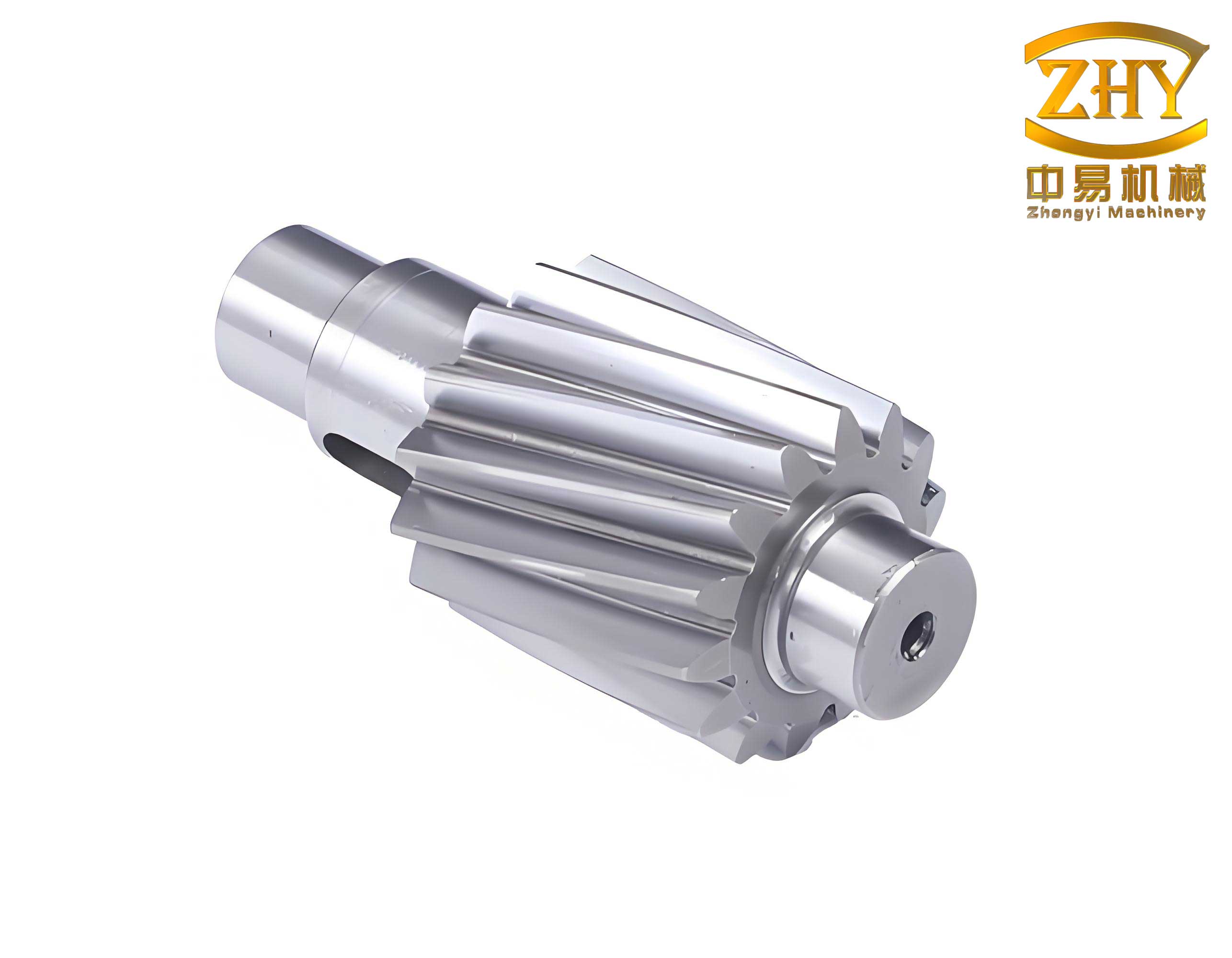
To understand the context, let’s first examine the structural requirements of a gear shaft. In a bulldozer, the gear shaft typically consists of gear teeth, splines, and threaded sections. The gear teeth require high surface hardness, wear resistance, and fatigue strength to withstand cyclic contact stresses. The splines need similar properties for torque transmission. In contrast, the threaded sections must retain adequate toughness to resist tensile loads without becoming brittle. This disparity necessitates precise control during heat treatment, especially when using direct quenching, where the entire gear shaft is subjected to rapid cooling after carburizing.
The material of focus is 20CrMnTi, a low-alloy steel commonly used for gear shafts due to its fine grain structure and hardenability. Its chemical composition is detailed in Table 1. This composition promotes the formation of martensite upon quenching, providing the desired hardness. However, the challenge lies in preventing carburization in areas like threads, which must remain machinable post-heat treatment.
| Element | C | Si | Mn | S | P | Cr | Ni | Cu | Ti |
|---|---|---|---|---|---|---|---|---|---|
| Content | 0.17-0.23 | 0.17-0.37 | 0.80-1.10 | ≤0.035 | ≤0.035 | 1.00-1.30 | ≤0.030 | ≤0.030 | 0.04-0.10 |
Carburizing involves diffusing carbon into the surface of the gear shaft to create a high-carbon layer. The process can be modeled using Fick’s second law of diffusion. For a semi-infinite solid with constant surface carbon concentration, the carbon profile \( C(x,t) \) as a function of depth \( x \) and time \( t \) is given by:
$$ C(x,t) = C_s – (C_s – C_0) \cdot \text{erf}\left( \frac{x}{2\sqrt{Dt}} \right) $$
where \( C_s \) is the surface carbon concentration, \( C_0 \) is the initial carbon content, \( D \) is the diffusion coefficient, and erf is the error function. For a gear shaft, achieving a uniform carburized layer is crucial for consistent hardness. After carburizing, direct quenching involves cooling the gear shaft directly from the carburizing temperature to form martensite. The cooling rate must exceed the critical cooling rate to avoid pearlite formation, which can be expressed as:
$$ \frac{dT}{dt} > \frac{T_{\text{Austenite}} – T_{\text{Ms}}}{\tau} $$
where \( T_{\text{Austenite}} \) is the austenitizing temperature, \( T_{\text{Ms}} \) is the martensite start temperature, and \( \tau \) is a time constant dependent on the steel composition. For 20CrMnTi, the critical cooling rate is relatively low due to its alloying elements, making direct quenching feasible.
In contrast, the single reheating and quenching process involves carburizing, followed by slow cooling, machining of threads, and then reheating to austenitize before quenching. This extra step refines the austenite grain size and reduces residual austenite, but it increases distortion and cost. To compare these processes, I conducted experiments on gear shafts with the following parameters. Table 2 summarizes the key steps in both processes.
| Process Step | Direct Quenching | Single Reheating and Quenching |
|---|---|---|
| Carburizing | At 920-940°C for 4-6 hours | At 920-940°C for 4-6 hours |
| Cooling | Direct oil quenching | Slow cooling to room temperature |
| Machining | Threads machined post-quenching | Threads machined after carburizing |
| Reheating | Not required | Reheat to 850-870°C |
| Quenching | Integrated with carburizing | Oil quenching after reheating |
| Tempering | Low-temperature tempering at 180-200°C | Low-temperature tempering at 180-200°C |
For direct quenching, protecting the threaded areas from carburization is essential. I used a copper-based anti-carburizing paste applied to the threads before carburizing. This paste forms a barrier that prevents carbon diffusion, ensuring the threads remain at the base hardness of around 30 HRC, suitable for machining. The effectiveness of this protection was verified through hardness testing, as shown in Table 3.
| Section | Gear Teeth | Splines | Threaded Area | Core |
|---|---|---|---|---|
| Hardness | 58-62 | 58-62 | 28-32 | 35-40 |
The hardness in the gear teeth and splines meets the required range of 58-62 HRC, indicating successful martensite formation. The threaded area, protected from carburizing, maintains a lower hardness, facilitating subsequent machining. In comparison, for single reheating and quenching, the hardness values are similar, but the process involves an extra step that can affect distortion.
Microstructural analysis is critical to evaluating the quality of the heat-treated gear shaft. I examined the carburized layer using optical microscopy at 400x magnification. For direct quenching, the microstructure consists of fine martensite with retained austenite, as shown in the image linked earlier. The grain size was assessed according to ASTM standards, yielding a rating of 9, indicating a fine grain structure. The retained austenite content was level 1, which is minimal. This is comparable to the microstructure from single reheating and quenching, where grain size is also 9 and retained austenite is level 1. The similarity confirms that direct quenching does not compromise microstructural integrity for fine-grained steels like 20CrMnTi.
The amount of retained austenite can be estimated using the Koistinen-Marburger equation for martensite transformation:
$$ f_M = 1 – \exp\left( -\alpha (M_s – T) \right) $$
where \( f_M \) is the volume fraction of martensite, \( \alpha \) is a constant (~0.011 for steel), \( M_s \) is the martensite start temperature, and \( T \) is the quenching temperature. For a gear shaft, lower retained austenite improves fatigue resistance, and both processes achieve this effectively.
Distortion is a major concern in gear shaft manufacturing. During quenching, non-uniform cooling induces stresses that cause dimensional changes. I measured the runout of the spline section after complete processing using a dial indicator. For direct quenched gear shafts, the average distortion was 0.03 mm, while for single reheating and quenched ones, it was 0.06 mm. This 50% reduction in distortion with direct quenching is significant for precision applications. The distortion can be modeled using thermal stress equations. For a cylindrical gear shaft, the radial distortion \( \Delta r \) due to quenching can be approximated as:
$$ \Delta r = \frac{\alpha E (T_{\text{surface}} – T_{\text{core}}) r}{2(1-\nu)} $$
where \( \alpha \) is the thermal expansion coefficient, \( E \) is Young’s modulus, \( T_{\text{surface}} \) and \( T_{\text{core}} \) are temperatures at surface and core during quenching, \( r \) is the radius, and \( \nu \) is Poisson’s ratio. Direct quenching reduces temperature gradients, thereby lowering distortion.
Table 4 summarizes the distortion data from multiple gear shaft samples, highlighting the consistency of direct quenching.
| Process | Sample 1 | Sample 2 | Sample 3 | Sample 4 | Average |
|---|---|---|---|---|---|
| Direct Quenching | 0.028 | 0.031 | 0.029 | 0.032 | 0.03 |
| Single Reheating and Quenching | 0.058 | 0.062 | 0.059 | 0.061 | 0.06 |
Machinability of the threaded areas post-quenching is another key aspect. With direct quenching, the protected threads had a hardness of 30 HRC, allowing smooth turning operations. Tool wear was minimal, and surface roughness met specifications. Using a threading gauge, all threads passed go/no-go tests, confirming dimensional accuracy. This eliminates the need for post-carburizing machining in the single reheating process, streamlining production.
The economic benefits of direct quenching for gear shafts are substantial. By eliminating one heating cycle, energy consumption is reduced by approximately 30%. Additionally, shorter cycle times increase throughput. For a production line manufacturing thousands of gear shafts annually, this translates to significant cost savings. Moreover, reduced distortion lowers scrap rates and improves assembly efficiency.
From a mechanical performance perspective, fatigue strength is crucial for gear shafts. The bending fatigue limit \( \sigma_f \) can be related to hardness and microstructure. For a carburized gear shaft, it can be estimated using:
$$ \sigma_f = k_H \cdot H + k_M \cdot (1 – f_{RA}) $$
where \( H \) is the hardness in HRC, \( k_H \) and \( k_M \) are material constants, and \( f_{RA} \) is the retained austenite fraction. With similar hardness and microstructure, direct quenched gear shafts exhibit fatigue performance comparable to conventionally treated ones, as validated through rotary bending tests.
In summary, my research demonstrates that carburizing and direct quenching is a viable and advantageous process for gear shafts made from fine-grained steels like 20CrMnTi. The key findings are: effective hardness control in threaded areas through anti-carburizing protection, comparable microstructural quality with fine grain size and low retained austenite, significant reduction in distortion by 50%, and enhanced cost-efficiency. This process is now being implemented in mass production for gear shafts, ensuring reliable performance in demanding applications such as bulldozers. Future work could explore optimizing cooling rates for even lower distortion or extending the method to other steel grades for gear shafts.
To further elaborate on the theoretical aspects, the kinetics of carburizing for a gear shaft can be enhanced by considering variable diffusion coefficients. The carbon diffusion coefficient \( D \) depends on temperature \( T \) according to the Arrhenius equation:
$$ D = D_0 \exp\left( -\frac{Q}{RT} \right) $$
where \( D_0 \) is a pre-exponential factor, \( Q \) is the activation energy, and \( R \) is the gas constant. For a typical carburizing temperature of 930°C, \( D \) is around \( 1.5 \times 10^{-11} \, \text{m}^2/\text{s} \), allowing carbon to penetrate to a depth of about 1 mm in 5 hours. This depth is sufficient for the gear teeth of a gear shaft to achieve the required case hardness.
In conclusion, the direct quenching method after carburizing offers a robust solution for manufacturing high-performance gear shafts. By integrating heat treatment steps, we achieve superior dimensional control and economic benefits without compromising on mechanical properties. As industries strive for efficiency and sustainability, such processes will become increasingly important for components like gear shafts in heavy machinery.