
As a mechanical engineer specializing in precision manufacturing for automotive applications, I have extensively studied the challenges associated with machining hollow gear shafts for new energy vehicle transmissions. These gear shafts are critical components that operate at high rotational speeds, often exceeding 9000 rpm, necessitating exceptional dimensional accuracy and minimal runout to ensure smooth power transmission and reduce noise. The central hole, serving as the primary datum for subsequent grinding operations such as gear tooth profile grinding and cylindrical grinding, plays a pivotal role in achieving the required precision. Any imperfection in the central hole—be it in its depth, cone angle, roundness, surface finish, or the coaxiality between the two ends—can propagate errors into the final product, compromising gear quality to levels below the demanded Grade 4 to 6 accuracy. This article details my comprehensive analysis and the systematic optimization strategies I have developed and implemented to enhance the machining process of the 60° central holes on hollow gear shafts.
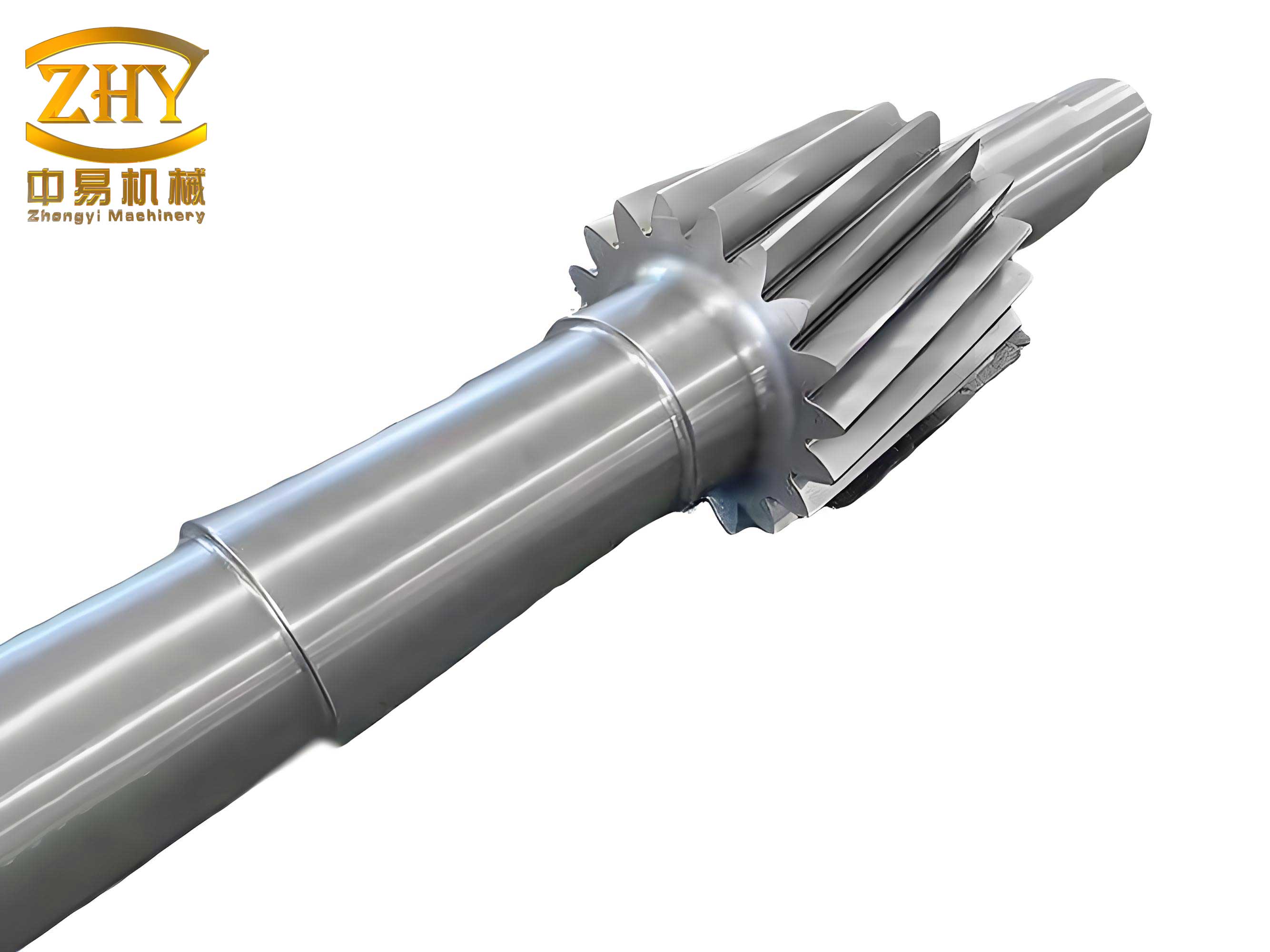
The specific gear shaft under consideration is a first-stage driven hollow gear shaft. Its manufacturing sequence involves blanking, forging, normalizing, rough turning, finish turning (including central hole machining), gear hobbing, heat treatment, and finally precision grinding operations. Throughout this process, the gear shaft relies on the two opposing central holes as the unified datum for critical finishing stages. However, the hollow nature of this gear shaft introduces unique difficulties. Its relatively thin and non-uniform wall sections make it susceptible to distortion during carburizing and quenching heat treatments. This distortion manifests as changes in the central hole’s geometry—typically an enlargement of the 60° cone angle and degradation of roundness. Furthermore, inconsistencies in the initial machining of the central holes, compounded by potential damage during handling, can lead to misalignment between the two datum points. The cumulative effect is increased radial runout of the gear teeth relative to the bearing journals, ultimately affecting the transmission’s performance and longevity.
My investigation began with a thorough analysis of the initial CNC turning process for the central holes. The original method involved using the rough-turned outer diameter as a datum for one end, and the finish-turned diameter for the other. This inconsistency in datum quality inherently introduced errors. Measurements confirmed significant disparities, with cone angle variations reaching approximately 2° between the two ends of the gear shaft. To address this, I implemented a standardized and refined CNC turning procedure. The process is now executed in two dedicated setups on high-precision CNC lathes. For the first end, the gear shaft is clamped using a three-jaw self-centering chuck, with the primary locating datum being the largest central cylindrical section and its left face. In this single setup, the entire external cylindrical surface, the end face, and the central hole of that end are finish-turned consecutively to ensure optimal coaxiality. The gear shaft is then transferred to a second machine. Here, it is clamped using soft jaws machined to precisely fit the already finished cylindrical section from the first operation. Using this consistent, high-quality datum, the opposite end’s external surfaces and central hole are machined. Prior to clamping any component, I mandate the calibration of the chuck’s runout to be less than 0.01 mm and the thorough cleaning of all locating surfaces with compressed air to eliminate particulate contamination. The CNC program’s tool path was also fine-tuned to achieve a more accurate and consistent 60° cone profile. The effectiveness of these steps can be summarized by the following relationship for achievable coaxiality, $$ \Delta C_{turning} \propto \frac{1}{\sqrt{R_{chuck}^2 + R_{datum}^2}} $$ where $\Delta C_{turning}$ represents the coaxiality error from turning, $R_{chuck}$ is the radial runout of the chuck, and $R_{datum}$ is the roundness error of the cylindrical datum used. By minimizing both $R_{chuck}$ and $R_{datum}$, we significantly reduce $\Delta C_{turning}$.
Following the machining of the central hole, the gear shaft undergoes heat treatment. The carburizing and quenching process induces significant and non-uniform thermal stresses in the hollow gear shaft, leading to predictable yet variable distortion. Post-heat-treatment metrology on sample gear shafts revealed a consistent trend: the central hole’s 60° cone angle increased by 20 to 40 arcminutes, and the roundness error deteriorated to values around 20 μm. To compensate for this predictable deformation, I introduced a pre-compensation strategy during the CNC turning stage. The nominal cone angle for the central hole is now deliberately machined slightly smaller than 60°. The specific compensation value, $\Delta \theta_{comp}$, is derived empirically from historical deformation data and is modeled as a function of the gear shaft’s wall-thickness ratio: $$ \Delta \theta_{comp} = k \cdot \left( \frac{t_{min}}{t_{max}} \right) $$ where $k$ is a material-and-process-dependent constant (typically yielding a 15-25 arcminute reduction), and $t_{min}$ and $t_{max}$ are the minimum and maximum wall thicknesses of the hollow gear shaft section. This proactive compensation reduces the final post-heat-treatment cone angle deviation, thereby minimizing the material removal required in the subsequent grinding stage and preserving the integrity of the case-hardened surface layer.
Another critical optimization involved the geometric design of the central hole itself. The original design utilized a standard A-type center. I advocated for and implemented a B-type center hole with a 120° protective chamfer. This design offers several advantages for a hollow gear shaft. Firstly, the 120° chamfer physically protects the sensitive 60° working surface from nicks and dents during part handling and transportation. Secondly, it intentionally reduces the effective contact area of the 60° cone. This smaller contact zone is less influenced by bulk heat treatment distortion and is easier to correct precisely in a subsequent operation. The optimized geometry ensures that only a precise, minimal area of the cone serves as the true datum, enhancing repeatability. The design parameters are shown in the following table, contrasting the old and new specifications for the central hole on the gear shaft.
| Feature | Previous Design (A-Type) | Optimized Design (B-Type) |
|---|---|---|
| Primary Cone Angle | 60° | 60° ± 2′ |
| Protective Chamfer | None | 120° ± 5′ |
| Effective Contact Length | Full cone length | Reduced, controlled length (e.g., 3.5 mm) |
| Surface Finish (Ra) | ≤ 3.2 μm | ≤ 1.6 μm (post-grinding) |
Despite the improvements in pre-heat-treatment machining and design, a final, high-precision correction of the central hole after heat treatment is indispensable. This is where center hole grinding becomes the cornerstone of the entire precision chain for the gear shaft. I selected and optimized a dedicated center hole grinding machine process. The operation involves a complex kinematic motion. The gear shaft is not driven by the headstock but is instead supported between a dead tailstock center and a unique self-centering fixture that locates on the gear’s pitch circle (for the toothed end) or a finished diameter. A high-speed grinding wheel, mounted on a dedicated spindle, performs three simultaneous motions: high-speed rotation (self-rotation) for cutting, a planetary revolution around the gear shaft’s axis, and a 30° oscillating traverse along the cone’s surface. The gear shaft itself rotates slowly to ensure uniform stock removal. The key process parameters were rigorously optimized through Design of Experiments (DOE). The critical relationships governing the final quality of the gear shaft’s datum are the material removal rate (MRR) and the resulting surface integrity. The MRR in this oscillating grind can be approximated by: $$ MRR \approx v_f \cdot d_e \cdot b $$ where $v_f$ is the feed rate component normal to the cone surface (maintained at 0.005–0.010 mm/s), $d_e$ is the equivalent grinding depth, and $b$ is the effective contact width. The final surface roughness ($R_a$) is strongly correlated with the wheel’s grain size ($G$) and the effective speed ratio ($q$) between the wheel’s revolution and the workpiece’s rotation: $$ R_a \propto \frac{G^{1.2}}{q^{0.5}} $$ where $q = \frac{N_{wheel-rev}}{N_{work}}$. We use a F100-grit chromium oxide abrasive wheel for a target $R_a$ ≤ 0.4 μm.
The fixture for the grinding operation was a key innovation. For the gear shaft end with splines or gear teeth, a custom pitch-circle clamping fixture was developed. This fixture consists of three radially adjustable jaws that contact the gear teeth at the pitch diameter, ensuring that the central hole grinding datum is established relative to the functional gear geometry, not just an external cylinder. This method effectively minimizes the potential coaxiality error between the gear teeth and the central holes. The setup ensures that the subsequent gear grinding operation, which also uses the central holes as datum, produces teeth with minimal runout relative to their own theoretical pitch circle. The clamping force ($F_c$) is calculated to avoid distortion of the thin-walled gear shaft: $$ F_c = \frac{\pi \cdot E \cdot t^3 \cdot \delta}{12 \cdot (1 – \nu^2) \cdot r^2} $$ where $E$ is Young’s modulus, $t$ is the local wall thickness, $\nu$ is Poisson’s ratio, $r$ is the radius, and $\delta$ is the permissible elastic deformation (set below 2 μm).
The tooling for the grinding process itself was also scrutinized. The grinding wheel arbor’s accuracy is paramount for the wheel’s dynamic balance and concentricity. The arbor is machined in a single setup where the mounting thread (e.g., M14) and the primary location diameter are turned together. It is then reversed in the collet, referenced from this primary diameter, to machine the nose that receives the abrasive wheel. The total indicated runout (TIR) of the arbor’s nose relative to its mounting datum is controlled to be less than 0.015 mm. This minimizes vibration and ensures the grinding wheel wears uniformly, maintaining the geometric accuracy of the central hole on the gear shaft.
The results of this comprehensive process optimization for the hollow gear shaft are quantitatively significant. The following table presents comparative data from sample gear shafts processed before and after implementing the full suite of optimizations, including B-type center design, turning compensation, and precision grinding.
| Process Stage / Metric | Post-CNC Turning (Before Optim.) | Post-Heat Treatment (Before Optim.) | Post-Center Grinding (After Full Optim.) | Target Specification |
|---|---|---|---|---|
| Cone Angle (60° nominal) | 59°58′ to 62°17′ | 60°19′ to 62°55′ | 59°43′ to 60°03′ | 60° ± 4′ |
| Roundness at Small End (μm) | 5 – 13 | 11 – 15 | 1.7 – 5.3 | ≤ 3 |
| Roundness at Large End (μm) | 7 – 14 | 12 – 20 | 2.0 – 6.7 | ≤ 5 |
| Surface Finish, Ra (μm) | ≤ 3.2 | ≤ 3.2 | ≤ 0.4 | ≤ 0.4 |
| Radial Runout of Journal (after grinding using central hole as datum, μm) | N/A | 11 – 15 | 1.4 – 3.3 | ≤ 5 |
The data unequivocally demonstrates the success of the optimized process. The final center hole on the gear shaft exhibits exceptional geometric control. The cone angle is held within a tight band of ±4 arcminutes of nominal. Roundness errors are consistently below 3 μm at the critical small end of the cone, which is the primary contact point with the lathe or grinder center. Most importantly, when this high-precision datum is used for cylindrical grinding of the bearing journals and other critical diameters on the gear shaft, the resulting radial runout is consistently below 3.5 μm. This level of accuracy directly translates to superior gear meshing performance, reduced noise, and higher overall efficiency in the transmission assembly. The relationship between central hole quality and final gear runout ($R_{gear}$) can be expressed as a error stack-up: $$ R_{gear} = \sqrt{(\Delta C_{hole})^2 + (e_{grinder})^2 + (e_{bearing})^2} $$ where $\Delta C_{hole}$ is the coaxiality error between the two central holes, $e_{grinder}$ is the machine tool error, and $e_{bearing}$ is the error from bearing clearance. By driving $\Delta C_{hole}$ to a minimal value through our process, we become limited by the capability of the gear grinding machine itself, which is the desired state for manufacturing high-precision gear shafts.
In conclusion, achieving ultra-high precision in hollow gear shafts for demanding applications like new energy vehicle transmissions requires a holistic and meticulously controlled approach to machining the central datum holes. My work has established that this is not achievable through a single operation but through a synergistic series of optimized steps. The journey begins with rationalizing the turning datums and clamping methods on the CNC lathe. It is followed by intelligent pre-compensation for predictable heat treatment distortions and a robust center hole design that protects the datum and confines the functional area. The culmination is a precision center hole grinding process, supported by dedicated pitch-circle fixturing and meticulous tooling preparation, which finalizes the datum geometry to micrometer-level accuracy. This comprehensive methodology ensures that the humble central hole fulfills its critical role as the foundation for all subsequent precision grinding, enabling the production of gear shafts that meet the stringent requirements of modern, high-performance powertrains. The continuous focus on every aspect of the gear shaft’s manufacturing, from blank to finished datum, is what unlocks the levels of quality and reliability demanded by the automotive industry’s future.