
In my extensive involvement in the mechanical manufacturing sector, I have consistently recognized the gear shaft as a pivotal component across numerous industries such as aerospace, transportation, machinery, and printing. The efficient operation of production equipment heavily relies on the quality and precision of these gear shafts. Particularly in small and medium-sized enterprises, where production scales are fragmented and capabilities limited, ensuring the reliability of gear shaft manufacturing becomes paramount. The diversity in gear shaft types, each with unique characteristics, necessitates a deep understanding of machining processes to enhance operational efficiency and overall product quality. This article delves into the intricacies of gear shaft machining, addressing prevalent issues and proposing actionable solutions to optimize performance.
The machining of gear shafts is a complex process influenced by myriad factors including material properties, operator skill, environmental conditions, and procedural methodologies. From my perspective, one of the most critical challenges lies in maintaining stringent control over part accuracy. The use of substandard or non-conforming components must be strictly prohibited to prevent downstream failures. Typically, gear shaft machining involves fixture-based positioning and clamping, which can introduce problems such as vibrations due to uneven end faces post-heat treatment. Such vibrations compromise machining accuracy, necessitating robust fixation techniques. Below, I outline common problems and explore pathways to mitigate them, drawing from practical experiences and technical insights.
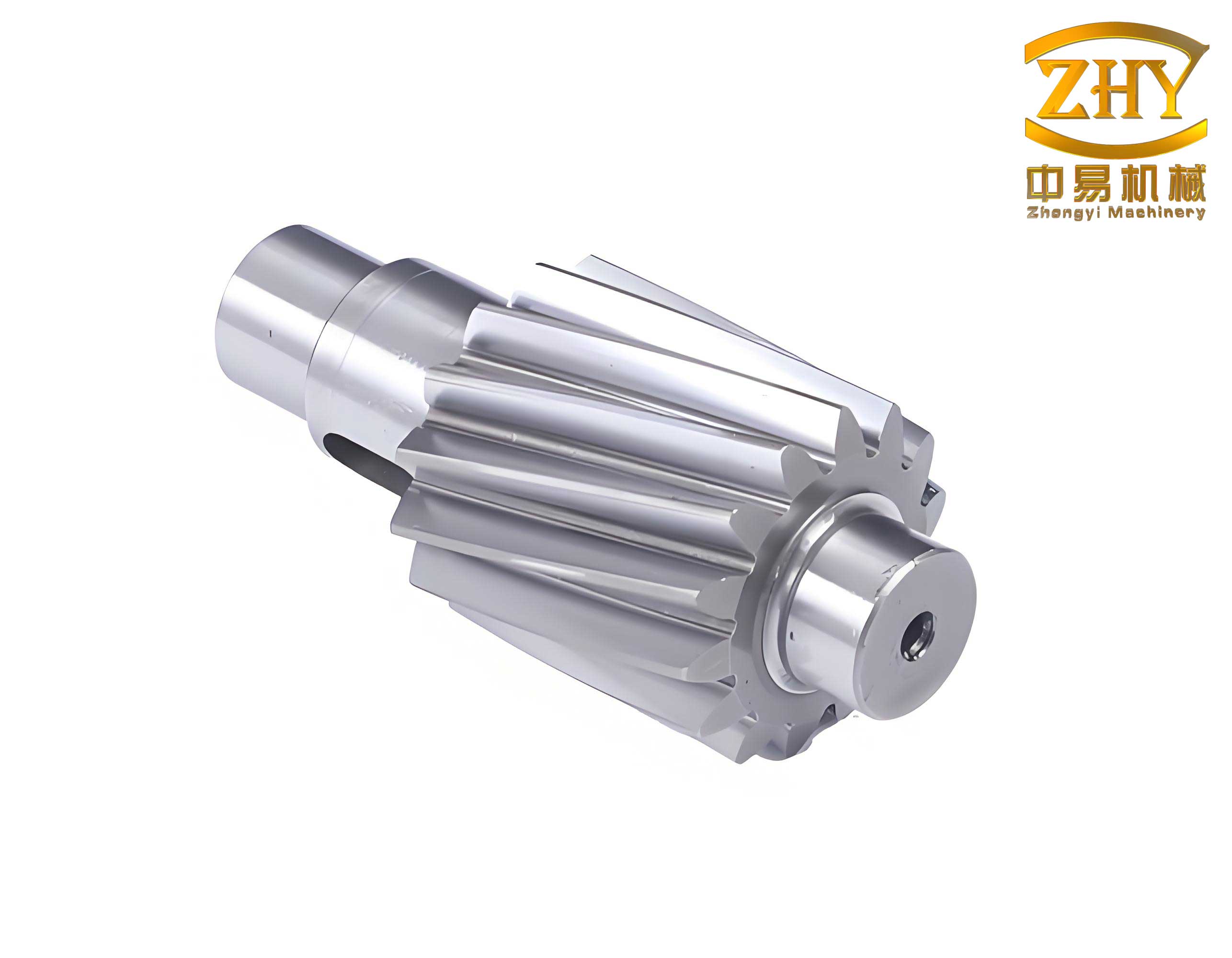
In gear shaft machining, fixture management plays a crucial role in determining installation precision. I have observed that inadequate fixture handling often leads to misalignment and reduced part quality. For instance, on a Y38 gear hobbing machine, the following steps are essential for proper fixture and workpiece setup. First, clean the mounting area of any contaminants like oil or debris to ensure accurate placement. The workpiece should be positioned with its reference surface facing downward, gradually brought into contact with the support surface without inserting any foreign materials such as copper sheets or paper. This prevents induced stresses. After full compaction, verify for any deformation and regulate clamping force to avoid excessive or insufficient pressure. Additionally, using a dial indicator to check shaft diameter and tooth tip circle runout during rotation ensures alignment within tolerances. Tool holder and hob installation also demand care: distinguish between finish and rough machining holders, clean all washers and sleeves, and avoid forceful hammering during assembly. Finally, secure the hob headstock using screw-based adjustments and calibrate its position to prevent machining errors. The round runout tolerance for fixtures, as standardized, is detailed in Table 1.
| Gear Accuracy Grade | A | B | C | D |
|---|---|---|---|---|
| Round Runout Tolerance | 0.015 | 0.010 | 0.005 | 0.015 |
Improving hobbing processes is another vital aspect. I recommend determining cutting parameters based on gear material, specifications, and fixture conditions. For rough machining, lower speeds with higher feed rates are preferable, while precision machining of small-modulus gear shafts benefits from higher speeds and reduced feeds. The number of passes depends on gear geometry and surface roughness requirements; typically, 2-3 passes suffice, with separate roughing and finishing stages. Feed rate selection should maximize efficiency without compromising quality. During roughing, reduce feeds to minimize vibrations in less rigid setups, whereas in finishing, depth of cut becomes the limiting factor. Cutting speed, derived from passes and feeds, also considers material properties and gear module. The relationship can be expressed mathematically. For example, cutting speed \( v_c \) in meters per minute is given by:
$$ v_c = \frac{\pi \times D \times N}{1000} $$
where \( D \) is the hob diameter in mm, and \( N \) is the spindle speed in rpm. Feed per tooth \( f_z \) influences surface finish and tool life, calculated as:
$$ f_z = \frac{f}{Z \times N} $$
with \( f \) as feed rate in mm/min, and \( Z \) as the number of hob teeth. Optimizing these parameters enhances gear shaft quality and longevity.
The selection and application of cutting fluids significantly impact gear shaft machining outcomes. Based on material properties, I advocate for tailored fluid choices. For gear shafts made of 40Cr steel, composite cutting fluids are effective. During hobbing, irrigate the cutting zone adequately to leverage cooling and lubrication, stabilizing hob temperature and reducing thermal shocks. This extends tool life and improves surface roughness. Maintaining a clean workspace is imperative; debris can scratch surfaces and pose safety risks. Regularly replace contaminated fluids and increase volume as needed to lower surface roughness. The effectiveness of cutting fluids can be modeled through heat transfer equations, such as:
$$ Q = h \times A \times \Delta T $$
where \( Q \) is heat dissipated, \( h \) is heat transfer coefficient, \( A \) is area, and \( \Delta T \) is temperature difference. Proper fluid management thus directly correlates with gear shaft integrity.
Controlling the precision of gear shaft components is fundamental. Given the variety of parts involved, I emphasize segregated management based on type and structure. For elongated gear shafts, strategic clamping minimizes vibrations and maintains accuracy. Statistical process control (SPC) methods can be employed, using control charts to monitor dimensions. The standard deviation \( \sigma \) of critical features should satisfy:
$$ \sigma \leq \frac{T}{6} $$
with \( T \) as tolerance range. Implementing rigorous inspection protocols ensures compliance with specifications, reducing scrap rates. Table 2 summarizes recommended machining parameters for common gear shaft materials, derived from empirical data.
| Material | Cutting Speed (m/min) | Feed Rate (mm/rev) | Depth of Cut (mm) | Suggested Cutting Fluid |
|---|---|---|---|---|
| 40Cr Steel | 80-120 | 0.1-0.3 | 2-4 | Composite Oil |
| Carbon Steel | 90-150 | 0.15-0.4 | 3-5 | Emulsion |
| Alloy Steel | 70-110 | 0.08-0.25 | 2-3.5 | Synthetic Fluid |
| Stainless Steel | 50-80 | 0.05-0.2 | 1.5-3 | Chlorinated Oil |
Beyond traditional methods, advanced techniques like multi-axis CNC machining offer precision improvements for gear shafts. The tool path trajectory can be optimized using parametric equations. For a helical gear shaft, the tooth profile coordinates \( (x, y, z) \) may be expressed as:
$$ x = r_b \cos(\theta) + r_b \theta \sin(\theta) $$
$$ y = r_b \sin(\theta) – r_b \theta \cos(\theta) $$
$$ z = p \theta $$
where \( r_b \) is base radius, \( \theta \) is rotation angle, and \( p \) is helix parameter. Implementing such models in CAM software reduces errors and enhances consistency. Additionally, vibration analysis during machining is crucial. The natural frequency \( f_n \) of a gear shaft system can be approximated by:
$$ f_n = \frac{1}{2\pi} \sqrt{\frac{k}{m}} $$
with \( k \) as stiffness and \( m \) as mass. Avoiding resonant frequencies through speed adjustments minimizes vibrations, preserving gear shaft quality.
Heat treatment effects on gear shaft machining cannot be overlooked. Residual stresses from processes like quenching can cause distortions, impacting accuracy. I suggest incorporating stress-relief annealing and controlling cooling rates. The relationship between hardness \( H \) and tempering temperature \( T \) for steel gear shafts follows an empirical formula:
$$ H = H_0 \exp\left(-\frac{Q}{RT}\right) $$
where \( H_0 \) is initial hardness, \( Q \) is activation energy, and \( R \) is gas constant. Pre- and post-machining treatments ensure dimensional stability. Table 3 outlines common heat treatment cycles for gear shaft materials.
| Material | Annealing Temperature (°C) | Quenching Medium | Tempering Temperature (°C) | Resultant Hardness (HRC) |
|---|---|---|---|---|
| 40Cr | 850-870 | Oil | 550-600 | 25-32 |
| 20CrMnTi | 880-900 | Oil | 180-200 | 58-62 |
| 42CrMo | 840-860 | Water | 500-550 | 28-35 |
| 304 Stainless | 1010-1120 | Air | N/A | ≤20 |
Quality assurance in gear shaft machining involves comprehensive inspection protocols. I utilize coordinate measuring machines (CMM) and gear analyzers to verify parameters like tooth profile error \( \Delta f_f \) and pitch deviation \( \Delta f_p \). These can be quantified using Fourier series expansions. For instance, the profile deviation \( \Delta f_f \) may be modeled as:
$$ \Delta f_f = \sum_{n=1}^{\infty} A_n \cos(n\omega t + \phi_n) $$
where \( A_n \) are amplitudes, \( \omega \) is angular frequency, and \( \phi_n \) are phase shifts. Statistical analysis of these deviations helps in refining processes. Moreover, surface integrity assessment through roughness parameters like \( R_a \) (arithmetic mean deviation) ensures compliance with standards. The relationship between feed rate and \( R_a \) for turning operations is given by:
$$ R_a = \frac{f^2}{32r} $$
with \( r \) as tool nose radius. Applying such formulas enables predictive control over gear shaft surface quality.
Environmental and human factors also play a role in gear shaft machining. I advocate for continuous training programs to enhance operator skills and adherence to protocols. Implementing IoT-based monitoring systems allows real-time tracking of machine parameters, reducing human error. The overall equipment effectiveness (OEE) can be calculated as:
$$ \text{OEE} = \text{Availability} \times \text{Performance} \times \text{Quality} $$
By targeting OEE improvements, productivity in gear shaft manufacturing rises. Additionally, sustainable practices like recycling cutting fluids reduce costs and environmental impact, aligning with modern manufacturing trends.
In conclusion, addressing gear shaft machining challenges requires a multifaceted approach. Through diligent fixture management, optimized hobbing processes, appropriate cutting fluid selection, and stringent precision control, significant enhancements in quality and efficiency are achievable. My experiences underscore the importance of integrating theoretical models with practical adjustments, fostering innovation in techniques and management. As technology evolves, embracing digital tools and advanced materials will further propel gear shaft manufacturing toward higher reliability and performance, solidifying its critical role in industrial applications.