
In my experience within heavy machinery manufacturing, the machining of gear shafts presents significant challenges, primarily due to deformation after heat treatment. Gear shafts, characterized by their large length-to-diameter ratios (L/D), often fall within the range of L/D = 3 to 7. This structural aspect leads to considerable distortion following carburizing and quenching processes. Such deformation severely complicates subsequent machining operations and jeopardizes the attainment of critical quality specifications. This is especially critical for gear shafts used in heavy-duty, high-speed, and high-reliability transmission systems, where failure can result in component damage or complete machine breakdown. The core issue revolves around maintaining uniform hardened layer depth on gear teeth and preserving precise geometrical tolerances for features like keyways after thermal processing.
The primary problem can be summarized as follows. First, achieving a consistent effective case hardening depth of 2–3 mm on the gear teeth is paramount. Post-heat-treatment distortion causes uneven grinding allowances. If the grinding allowance is minimized to conserve the hardened layer—a common practice for critical reliability—the resulting non-uniform material removal leads to an irregular effective case depth after final grinding. This inconsistency directly compromises the fatigue life and durability of the entire assembly. Second, for features such as a 40 mm wide input keyway designed for an interference fit (e.g., Ø155 H7/s6), heat treatment can distort the keyway’s size and geometric tolerances, notably its symmetry, making assembly difficult or impossible if machined prior to heat treatment.
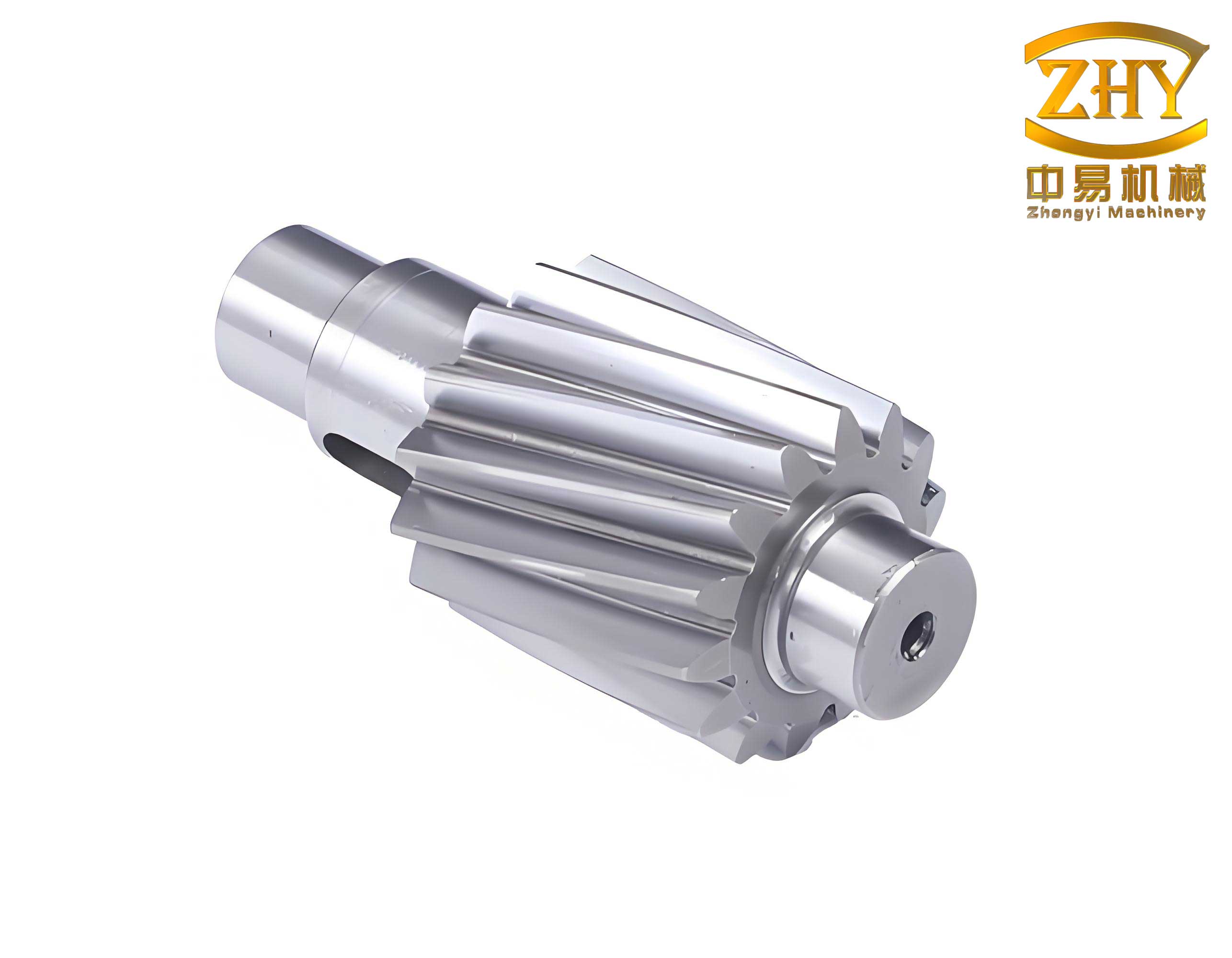
Addressing these challenges requires a fundamental rethinking of the machining sequence and the development of specialized tooling. The guiding principle is to ensure all measured elements maintain an ideal positional relationship relative to a unified datum. Specifically, all critical features must be concentric with the axis defined by the center holes at both ends of the gear shaft. This axis serves as the primary reference throughout the process.
Based on this principle, I have developed and implemented a refined process flow. This sequence is designed to strategically manage and correct for anticipated distortion, ensuring final precision. The core steps are outlined in the table below.
| Process Step | Key Objectives and Descriptions | Critical Notes |
|---|---|---|
| 1. Forging & Rough Turning | Obtain the basic gear shaft blank geometry. | Material preparation and initial shaping. |
| 2. Quenching and Tempering (QT) | Improve the core microstructure and mechanical properties of the gear shaft. | Enhances machinability and prepares for subsequent hardening. |
| 3. Finish Turning I | Machine accurate diameters and create preliminary center holes at both ends. | Center holes are prepared for future refinement. The diameter for the future keyway seat is turned to Ø156 mm and coated with anti-carburizing compound. |
| 4. Rough Grinding I | Establish preliminary roundness and size on major external diameters. | Prepares surfaces for gear hobbing. |
| 5. Gear Hobbing | Cut the gear teeth to a pre-hardened state with adequate stock allowance. | Tooth geometry is generated prior to case hardening. |
| 6. Heat Treatment (Carburize & Quench) | Achieve the required surface hardness (e.g., 58-62 HRC) and case depth on the gear shaft teeth. | Primary source of distortion. The anti-carburized area remains softer. |
| 7. Center Hole Refinishing | Re-establish the datum axis by re-machining the 60° center holes based on the heat-treated gear pitch circle. | The most critical step. The gear shaft is indicated using the pitch circle at both ends, with runout held within 0.03 mm, before re-cutting and lapping the center holes to Ra ≤ 0.8 µm. |
| 8. Finish Turning II | Remove the hardened surface layer from the anti-carburized Ø156 mm area, turning it down to Ø151 mm. | Facilitates easier keyway milling post-heat-treatment. |
| 9. Rough Grinding II | Grind critical diameters (e.g., Ø175 mm and Ø151 mm) to close tolerances. | Runout must not exceed 0.03 mm, roughness Ra ≤ 0.4 µm. |
| 10. Gear Tooth Grinding | Finish grind the gear teeth to final dimensions and quality. | Uses the refined center holes as datum. May require special fixturing if the gear shaft overhangs standard machine limits. |
| 11. Keyway Milling | Mill the input keyway with the gear shaft supported between centers. | Geometric and size tolerances are easily maintained using the precise datum axis. |
| 12. Finish Grinding | Final precision grinding of journals and other functional diameters. | Ensures all dimensions and surface finishes meet final drawing requirements. |
The success of this gear shaft process hinges on several key operations. Finish Turning I involves creating robust center holes designed for later correction. A common design includes a 60° working surface with a protective chamfer and a smaller center hole for stability, as shown in prior illustrations. The strategic oversizing and anti-carburizing of the keyway seat diameter (to Ø156 mm) is crucial. This ensures the area remains machinable after hardening, avoiding the extreme difficulty of cutting a keyway in a fully hardened gear shaft surface.
The single most critical operation is the post-heat-treatment center hole refinishing. This step literally redefines the gear shaft’s geometric reference. The shaft is mounted in a lathe using temporary supports, and a dial indicator is used to measure the runout of the pitch circle at both ends of the gear. The objective is to minimize this runout, typically to within 0.03 mm. Once aligned, the existing center holes are recut and lapped. The relationship between the initial error (e) and the correction can be modeled. If the pitch circle runout is measured as $e$, the adjustment $\Delta$ needed at the center hole location (at a distance $L$ from the gear) to bring the axis into alignment is governed by similar triangles. The angular misalignment $\theta$ is small, so:
$$\theta \approx \frac{e}{D_p/2} = \frac{\Delta}{L}$$
where $D_p$ is the pitch diameter of the gear shaft. Therefore, the required center correction is:
$$\Delta = \frac{2eL}{D_p}$$
This correction is applied by offsetting the tailstock or using a boring head to recut the center hole, effectively making the new center hole axis coincident with the average axis of the heat-treated gear teeth.
Subsequent turning removes the hardened layer from the keyway seat. The depth of cut must be sufficient to remove all carburized material, which has a depth $d_c$. The required turned diameter $D_{turn}$ from the initial protected diameter $D_{prot}$ is:
$$D_{turn} = D_{prot} – 2d_c$$
For example, starting at Ø156 mm and requiring removal of a 2.5 mm deep case, the diameter is turned to Ø151 mm. This guarantees a soft, machinable substrate for the keyway.
Grinding operations post-correction are vital for achieving final precision. The runout tolerance $T_{runout}$ on critical diameters directly affects assembly quality. The total indicated runout (TIR) is a composite of the residual alignment error from center hole refinishing $E_{align}$ and the machine spindle error $E_{machine}$. A conservative estimate is the sum:
$$TIR \leq E_{align} + E_{machine}$$
By controlling $E_{align}$ to 0.015 mm or better during setup, and with a capable grinder ($E_{machine}$ < 0.005 mm), the target TIR of 0.03 mm is achievable. Surface finish requirements, such as Ra ≤ 0.4 µm, are ensured by proper selection of grinding wheel grit size and feed rates. The relationship between theoretical peak-to-valley roughness $R_t$ and feed per revolution $f$ for a given wheel geometry can be approximated for planning:
$$R_t \propto \frac{f^2}{8R_g}$$
where $R_g$ is the grinding wheel radius. This informs parameter selection to meet Ra targets.
A significant challenge arises when the gear shaft configuration exceeds the capacity of standard gear grinding machines, such as the Y7163A model, which has limited travel. For a 530 mm long gear shaft with the gear cluster near one end, standard between-centers mounting may not be possible. This necessitates custom fixture design. The solution involves creating a fixture that allows the gear shaft to be mounted horizontally with the gear end fixed to a baseplate, effectively transferring the datum from the center holes to a stable, adjustable platform compatible with the machine.
The fixture design comprises several key components, as summarized in the table below.
| Component | Material/Specification | Primary Function |
|---|---|---|
| Baseplate (1) | Stable cast iron or steel, with precisely machined locating features and 8x M12 threaded holes for clamping. | Provides a rigid, flat mounting surface attached to the machine worktable. |
| Connector Sleeve (2) | Steel, with a flange featuring 4x M10 threaded holes to mate with the gear shaft end face. | Acts as an adapter, securely connecting the gear shaft to the baseplate. The clearance fit with the baseplate allows for fine adjustment. |
| Adjustment Mechanism | Set of M12 bolts and nuts (8 sets). A Ø15 mm steel ball placed between the baseplate and connector sleeve. | Bolts allow for precise alignment. The steel ball minimizes friction during adjustment, enabling easy micro-positioning under the gear shaft’s weight. |
| Workpiece (Gear Shaft) | The actual gear shaft, with 4x M10 threaded holes in its end face for connection. | Mounted with the gear teeth facing downward, its axis is aligned via the fixture to the machine’s grinding axis. |
The setup procedure is meticulous. First, the connector sleeve is bolted to the gear shaft’s end face. This sub-assembly is then placed on the baseplate, with the steel ball intervening. The gear shaft’s free end is supported on a steady rest or center. Using dial indicators on two critical diameters (e.g., Ø150 mm and Ø175 mm), the eight adjustment bolts are carefully tightened or loosened to minimize runout. The presence of the steel ball is crucial; it transforms sliding friction into rolling friction, making the fine adjustment of the heavy gear shaft manageable. The alignment goal is to achieve a runout of less than 0.015 mm on both reference diameters. The force required for adjustment is reduced significantly. The frictional force $F_f$ without the ball is $F_f = \mu W$, where $\mu$ is the coefficient of friction and $W$ is the weight of the gear shaft assembly. With the steel ball, the effective rolling resistance is much lower, allowing precise control with minimal applied force. Once aligned, the locking nuts are secured on the adjustment bolts.
The fixture’s effectiveness can be analyzed through static equilibrium and error stack-up. The primary alignment error in the finished gear shaft tooth profile after fixture-based grinding comes from several sources: fixture alignment error $E_f$, machine tool geometric error $E_m$, and process-induced errors $E_p$ (e.g., wheel wear). Assuming these errors are independent, the resultant profile error $E_{total}$ can be estimated as a root sum square:
$$E_{total} = \sqrt{E_f^2 + E_m^2 + E_p^2}$$
By controlling $E_f$ to a very small value through the precise alignment process described, its contribution to the total error is minimized. This ensures the gear tooth grinding quality is not compromised by the unconventional mounting method.
Keyway milling becomes straightforward once the gear shaft has been ground between centers. Using the perfected center holes as the datum, the keyway’s symmetry and location are guaranteed relative to the gear shaft’s true axis. The width tolerance $T_w$ and symmetry tolerance $T_s$ are directly machined. The positional accuracy $\delta$ of the keyway relative to the axis is a function of the milling machine’s alignment and tool deflection. By machining post-heat-treatment and post-alignment, the initial distortion $D_{dist}$ is eliminated from the error budget:
$$\delta = \sqrt{D_{machine}^2 + D_{tool}^2}$$
where $D_{machine}$ is the machine’s positional error and $D_{tool}$ is error due to cutter deflection. Without the heat treatment distortion term, these controllable errors are kept within drawing limits.
The implementation of this comprehensive process for the gear shaft has yielded consistently excellent results. Finished components exhibit uniform case depth across all teeth, verified through metallurgical sectioning and microhardness traverses. The effective case depth $d_{eff}$ should be within the specified range (e.g., 2.0–3.0 mm) at all points. The process capability index $C_{pk}$ for this critical dimension improves significantly. Keyways are produced within all geometric tolerances, ensuring smooth assembly with mating parts. This methodology is particularly well-suited for long, slender gear shafts where the gear is located at one end and standard machine travel is insufficient, and where heat treatment distortion would otherwise be irrecoverable.
Several important lessons have been reinforced. First, the sequence is most applicable for gear shafts with end-located gears that experience significant thermal distortion. Second, the success of the custom fixture depends on initial coarse alignment; the baseplate’s external reference surface must first be indicated to have a runout within 0.10–0.15 mm relative to the machine spindle before the workpiece is even mounted. This provides a reasonable starting point for the fine adjustment. Third, the bolt holes on the baseplate must be accurately aligned in their upper and lower rows to ensure the adjustment forces are applied symmetrically, preventing binding or unwanted moments on the gear shaft during clamping.
In conclusion, the integration of a strategically ordered machining sequence with targeted post-heat-treatment datum re-establishment and purpose-built fixturing provides a robust solution to the perennial problem of precision machining for distortion-prone gear shafts. This approach ensures the critical functional attributes of the gear shaft—namely, the uniformity of the hardened gear tooth layer and the precise geometry of ancillary features like keyways—are achieved reliably, thereby safeguarding the performance and longevity of the final transmission assembly. The consistent application of these principles has proven essential for manufacturing high-integrity gear shafts for demanding applications.