
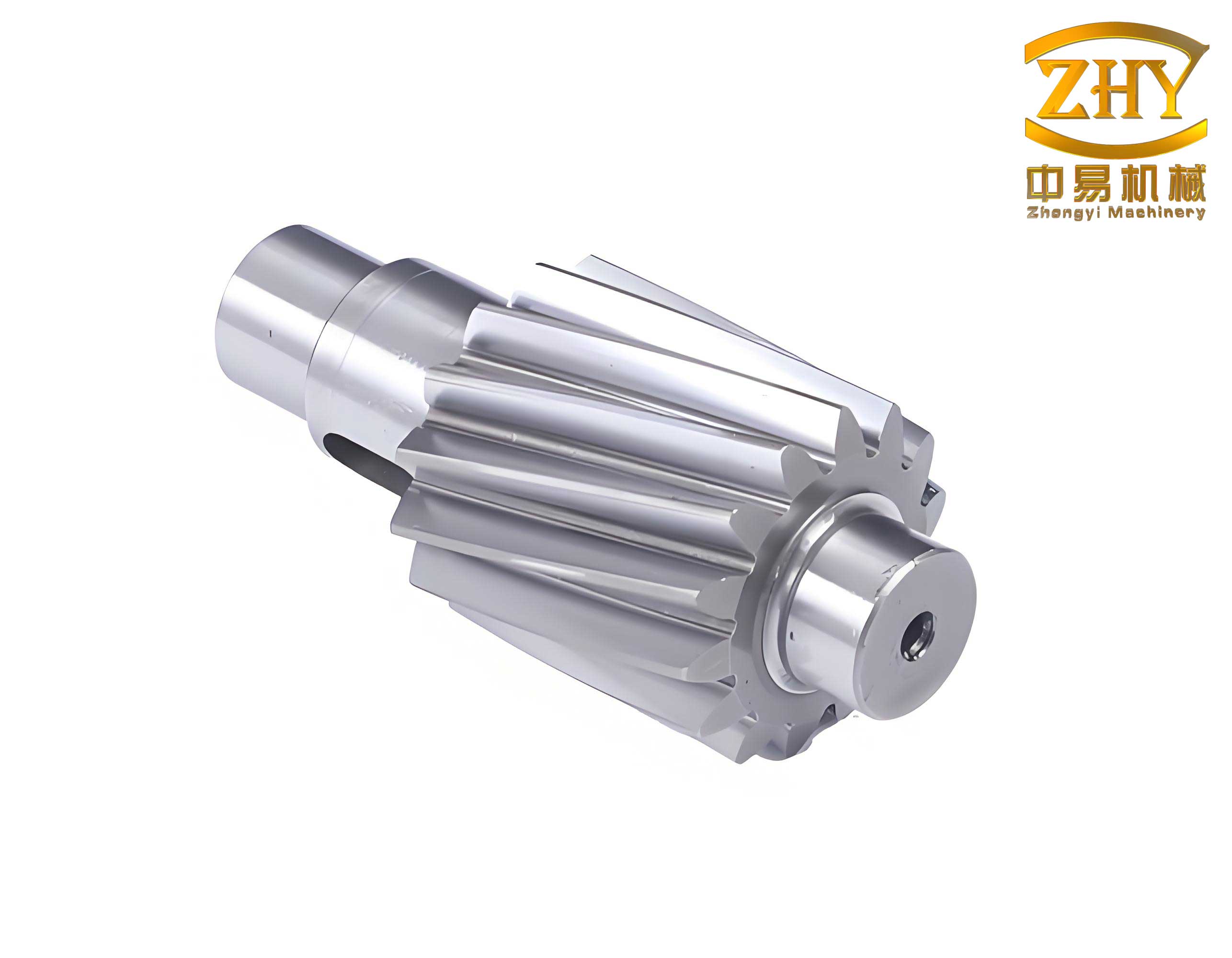
The reliable operation of accessory drive systems is paramount in aero-engine design. These systems transmit power from the engine core to critical components such as fuel, oil, and hydraulic pumps. During events like engine start-up or rapid acceleration, the inertial resistance of these accessories can generate severe transient torque shocks on the driving **gear shaft**. A failure in such a critical component not only jeopardizes the function of vital systems but can also lead to catastrophic secondary damage. This work was motivated by the persistent failure of a specific **gear shaft** in an accessory gearbox during bench testing, where the shaft fractured at the gear root under a simulated torque shock load. Initial static stress analysis under equivalent loads indicated nominal stress levels well below the material’s yield strength, which pointed to a potential oversight: the dynamic amplification of stress due to transient impact. Therefore, this study focuses on employing explicit dynamic finite element analysis to unravel the dynamic stress response of the **gear shaft** under shock loading, comparing it with static analysis results, and subsequently optimizing its geometry to ensure sufficient safety margin.
1. Methodology: From Implicit Static to Explicit Dynamic Analysis
To comprehensively understand the failure, a two-pronged analytical approach was adopted: first, a conventional implicit static analysis to establish a baseline stress state, followed by a high-fidelity explicit dynamic analysis to capture the transient phenomena.
1.1 Explicit Dynamics Fundamentals
For high-speed transient events involving impact, contact, and large deformations, explicit dynamics is the preferred solution method. It uses a central difference time integration scheme to advance the kinematic state. The nodal accelerations at time \(t\) are computed directly from the dynamic equilibrium equation:
$$a_t = M^{-1}(F^{ext}_t – F^{int}_t)$$
Here, \(M\) is the lumped mass matrix, \(F^{ext}_t\) is the vector of applied external and body forces, and \(F^{int}_t\) is the internal force vector. The internal force vector is assembled from element contributions:
$$F^{int}_t = \sum \left( \int_{\Omega} B^T \sigma_n \, d\Omega \right) + F^{hg} + F^{contact}$$
where \(\int_{\Omega} B^T \sigma_n \, d\Omega\) represents the equivalent nodal forces from the current element stress field \(\sigma_n\), \(F^{hg}\) are hourglass control forces (introduced to suppress spurious zero-energy modes in under-integrated elements), and \(F^{contact}\) are the contact forces. Once acceleration is known, velocity and displacement are updated explicitly:
$$v_{t+\Delta t/2} = v_{t-\Delta t/2} + a_t \Delta t$$
$$u_{t+\Delta t} = u_t + v_{t+\Delta t/2} \Delta t_{t+\Delta t/2}$$
The stability of this explicit scheme is governed by the Courant-Friedrichs-Lewy (CFL) condition. The critical time step \(\Delta t_{cr}\) is limited by the smallest element in the mesh and the speed of sound in the material:
$$\Delta t \leq \Delta t_{cr} = \frac{l_{min}}{c_d}$$
where \(l_{min}\) is the smallest characteristic element length and \(c_d\) is the dilatational wave speed. This condition necessitates a very small time step, making explicit methods conditionally stable but highly effective for short-duration events.
1.2 Finite Element Model Development
The subject of analysis is the high-speed **gear shaft** from an aero-engine accessory gearbox. The shaft incorporates multiple gears and features lightening holes (ventilation holes) along its length. The material properties for the shaft and gears are identical, as summarized in Table 1.
| Material Property | Value |
|---|---|
| Young’s Modulus, \(E\) | 210 GPa |
| Density, \(\rho\) | 7860 kg/m³ |
| Poisson’s Ratio, \(\nu\) | 0.3 |
| Yield Strength, \(\sigma_{0.2}\) | 1130 MPa |
Two distinct finite element models were created:
1. Implicit Static Model: This model was used for dynamic balance stress analysis, which includes the steady-state centrifugal stress due to rotation. Boundary conditions simulated the operational state: a constant high rotational speed (2841.68 rad/s ≈ 27136 RPM) was applied. Torques representing the input and output loads were applied at the shaft ends, with a reaction torque applied at the relevant gear’s inner ring. Supports at bearing locations constrained radial and axial degrees of freedom. The purpose was to identify high-stress concentration zones under a quasi-steady load case.
2. Explicit Dynamic Model: This model was built to simulate the transient shock event. To reduce computational scale while preserving accuracy for the **gear shaft** itself, bearing stiffness was simplified to fixed constraints at the bearing journals. A constant high rotational speed (27136 RPM) was applied via one of the main gears. The critical load was a time-dependent torque applied at one shaft end, ramping from 0.528 N·m to 67.21 N·m over a 2-second period, as shown in Figure 1. This represents the inertial shock from the driven accessory. The interaction between the driving gear and the mating gear on a parallel shaft was modeled using a surface-to-surface contact algorithm with a penalty formulation to capture the time-varying mesh stiffness and potential separation/impact.
| Analysis Type | Software | Primary Purpose | Key Loads & BCs |
|---|---|---|---|
| Implicit Static (Dynamic Balance) | ANSYS Workbench | Identify stress concentrations under combined torque and centrifugal load. | Constant RPM, steady torques, fixed bearings. |
| Explicit Dynamic (Transient Shock) | LS-DYNA via Workbench | Capture dynamic stress amplification and transient response to torque shock. | Constant RPM, time-variant shock torque, contact pairs, fixed bearings. |
2. Analysis Results: Unveiling the Dynamic Stress Amplification
2.1 Static Stress Analysis Results
The dynamic balance analysis (implicit static) provided the initial stress map. High-stress concentrations were predictably located at geometric discontinuities. The maximum von Mises stress and maximum principal stress were found at the fillet region of the gear root and, notably, around the edges of the lightening holes on the **gear shaft**. Table 3 compares the peak stresses with and without considering centrifugal forces from the operational speed.
| Stress Measure | Without Centrifugal Stress | With Centrifugal Stress | Increase |
|---|---|---|---|
| Max. Von Mises Stress | 489 MPa | 736 MPa | ~50% |
| Max. Principal Stress | 512 MPa | 852 MPa | ~66% |
Even with the centrifugal stress included, the maximum computed stress (852 MPa) remained below the material’s yield strength of 1130 MPa. According to a purely static strength assessment, the **gear shaft** should not have failed. This starkly contrasted with the test results, forcing the investigation towards dynamic effects.
2.2 Dynamic Shock Analysis Results
The explicit dynamics simulation revealed the true severity of the load case. The transient nature of the applied torque, combined with system inertia and time-varying gear mesh stiffness, led to significant dynamic amplification.
The gear mesh force history, shown conceptually in Figure 2, exhibited high-frequency fluctuations superimposed on the rising mean load. These fluctuations are due to the changing contact conditions as teeth engage and disengage, and the excitation from the variable mesh stiffness. This dynamic excitation directly feeds into the **gear shaft** structure.
The key finding was the evolution of stress at the critical locations (gear root and lightening hole edge). While the static analysis predicted a peak stress of ~850 MPa under the final load, the explicit analysis showed the dynamic stress rising much more sharply. By approximately 1.1 seconds into the shock event, the dynamic stress at the gear root had already approached the material’s yield limit. Shortly after, at around 1.18 seconds, the computed dynamic stress exceeded the 1130 MPa yield strength (\(\sigma_{0.2}\)). This result provided a direct and convincing explanation for the fracture observed during testing: failure was caused by transient dynamic stresses that far exceeded the levels predicted by a static or quasi-static analysis.
| Aspect | Implicit Static Analysis (Dynamic Balance) | Explicit Dynamic Analysis |
|---|---|---|
| Peak Stress at Gear Root | ~850 MPa (at final load) | >1130 MPa (at t ~1.18s) |
| Stress History | Constant value for a given load. | Time-varying, with significant overshoot and oscillation. |
| Failure Prediction | No failure predicted (Stress < Yield). | Failure predicted (Stress > Yield), matching test. |
| Key Insight | Identifies stress concentrations. | Captures inertial and transient amplification effects critical for impact. |
The dynamic stress concentration factor (\(K_d\)) for this event can be loosely estimated by comparing the dynamic peak stress to the static stress from an analysis under the *final* torque load (67.21 N·m) without considering dynamics. If the static stress under that torque is roughly 500 MPa (from the “without centrifugal” column scaled proportionally), then:
$$K_d \approx \frac{\sigma_{dynamic}}{\sigma_{static (final\ load)}} > \frac{1130\ MPa}{500\ MPa} > 2.2$$
This highlights a critical design lesson: for short-duration shock loads, the dynamic response of the **gear shaft** can induce stresses more than double the equivalent static stress.
3. Structural Optimization of the Gear Shaft
Having identified the failure cause and the critical locations, the next step was to redesign the **gear shaft** to withstand the shock load without failure. A parametric optimization approach was employed, targeting the two high-stress zones: the gear root fillet and the lightening hole geometry.
3.1 Parameterization and Objective
Two key design variables were defined, as illustrated in Figure 3:
1. Gear Root Fillet Radius (\(R_f\)): Increasing this radius reduces the stress concentration factor at the gear-shaft transition.
2. Lightening Hole Connecting Length (\(L_c\)): The original single long hole was split into two segments, connected by a short, wider bridge. The axial length of this connecting bridge (\(L_c\)) was parameterized. Increasing \(L_c\) provides more material to carry the torsional shear load around the hole, reducing stress concentration.
The optimization objective was to minimize the mass (\(m\)) of the modified **gear shaft** to avoid any weight penalty. The constraint was to ensure that the peak dynamic von Mises stress (\(\sigma_{v}^{max}\)) at both critical locations during the shock event remained below 50% of the material yield strength, providing a safety factor of 2 against yield under dynamic conditions:
$$\text{Minimize: } m(R_f, L_c)$$
$$\text{Subject to: } \sigma_{v}^{max}(R_f, L_c) \leq \frac{\sigma_{0.2}}{2} = 565 \text{ MPa}$$
3.2 Optimization Procedure and Results
An automated workflow was established using APDL (ANSYS Parametric Design Language). The process involved the following steps in a loop:
1. Generate the **gear shaft** geometry based on current \(R_f\) and \(L_c\).
2. Mesh the model.
3. Set up and run the explicit dynamic analysis for the 2-second shock event.
4. Extract the maximum dynamic stresses (\(\sigma_{v1}^{max}\) at gear root, \(\sigma_{v2}^{max}\) at lightening hole).
5. Evaluate constraints. If both stresses are below 565 MPa, record the design and mass; otherwise, adjust variables.
6. Use an optimization algorithm (like a gradient-based or direct search method) to propose new variable values aiming to reduce mass while satisfying constraints.
After several iterations, an optimal design configuration was found. The optimized **gear shaft** featured a significantly larger gear root fillet and a carefully sized connecting bridge for the lightening holes. A subsequent full explicit dynamic analysis of the optimized model confirmed its performance. The peak dynamic stress was reduced to approximately 420 MPa at both critical locations, well below the 565 MPa constraint and, more importantly, far below the material’s yield strength. This was achieved with a minimal increase in mass, satisfying the primary objective.
| Design State | Gear Root Fillet | Lightening Hole Bridge Length \(L_c\) | Peak Dynamic Stress | Mass (Relative) |
|---|---|---|---|---|
| Original (Failing) | Small | Short / None (Single Hole) | >1130 MPa | 1.00 (Baseline) |
| Optimized | Larger | Optimized Length | ~420 MPa | ~1.02 (2% increase) |
4. Conclusions and Design Implications
This integrated study of explicit dynamic analysis and structural optimization for a failing **gear shaft** led to several crucial conclusions with broad implications for the design of high-speed rotating machinery components subjected to transient loads:
1. Centrifugal Stress is Significant: For a **gear shaft** operating at very high rotational speeds (e.g., 27,000 RPM), the centrifugal stress component can increase the effective static stress by 50-70% compared to a pure torque-load analysis. This must be included in any strength evaluation.
2. Dynamic Amplification is Critical for Shock Loads: The most significant finding is that under short-duration impact or shock loads, the dynamic stresses in a **gear shaft** can be 1.5 to over 2.2 times greater than the stresses predicted by an equivalent static analysis. Relying solely on static analysis for such load cases is non-conservative and can lead to unexpected in-service failures, as witnessed in the initial tests.
3. Explicit Dynamics as a Verification Tool: For components where shock loading is a defined design condition, explicit dynamic finite element analysis should be employed as a necessary verification step. It uniquely captures the inertial effects, stress wave propagation, and transient contact conditions that govern the peak dynamic response.
4. Targeted Optimization is Effective: Parametric optimization, focusing specifically on the geometry of identified failure-prone locations (like fillets and lightening holes), is a highly effective method to enhance dynamic strength with minimal impact on weight and overall function. Increasing fillet radii and carefully shaping stress-raising features are simple yet powerful design modifications.
5. Safety Margin Definition: When accounting for dynamic shock loads, the required safety margin on yield strength must be applied to the *dynamically amplified stress*, not the static stress. This often necessitates a more robust local geometry.
In summary, the integrity of a **gear shaft** under operational shock cannot be assured through static analysis alone. The transient dynamics induce significantly higher stresses. Incorporating explicit dynamic analysis into the design and validation cycle, followed by targeted structural optimization, is essential for developing reliable, safe, and lightweight **gear shaft** components for demanding aerospace and industrial applications.