
In the realm of automotive engineering, the transmission system plays a pivotal role in delivering power from the engine to the wheels. Within this system, the gear shaft is a critical component that undergoes severe operational stresses. As an engineer specializing in materials and heat treatment, I have dedicated significant effort to optimizing the heat treatment processes for these gear shafts to enhance their performance, durability, and reliability. This analysis delves into the comprehensive optimization of heat treatment for automotive transmission gear shafts, focusing on material selection, process parameters, and the underlying metallurgical principles. The term “gear shaft” will be frequently referenced throughout this discussion, as it is the central element under scrutiny.
The gear shaft in an automotive transmission is subjected to a complex set of working conditions. During operation, it rotates at high speeds while engaging with gears to transmit torque. This results in exposure to significant frictional forces, alternating bending moments, and cyclic tensile-compressive loads. The gear shaft must, therefore, possess exceptional mechanical properties, including high wear resistance, fatigue strength, and toughness to withstand these demands. Failure to meet these requirements can lead to premature wear, pitting, or even catastrophic fracture, compromising the entire transmission system. Thus, the heat treatment process is not merely a manufacturing step but a crucial determinant of the gear shaft’s service life. In my analysis, I consider these factors to tailor the heat treatment for optimal performance.
Material selection is the foundation of any heat treatment optimization. For gear shafts operating under such conditions, low-carbon alloy steels suitable for carburizing or carbonitriding are preferred. These steels allow for the development of a hard, wear-resistant surface while maintaining a tough, ductile core. After evaluating various options, I have determined that 20CrMnTi is the most suitable material for this gear shaft application. Its composition offers a balanced combination of strength, hardenability, and cost-effectiveness. The chemical composition of 20CrMnTi is as follows, with each element contributing to specific properties:
| Element | Content (%) | Role in Steel |
|---|---|---|
| C (Carbon) | ~0.20 | Forms solid solutions to increase strength; creates carbides for enhanced hardness and wear resistance. |
| Mn (Manganese) | ~1.00 | Strengthens the steel, improves hardenability by lowering critical cooling rate, and enhances low-temperature toughness. |
| Si (Silicon) | ~0.30 | Strengthens ferrite, increases hardenability, and improves oxidation and corrosion resistance. |
| Cr (Chromium) | ~1.00 | Enhances hardenability, contributes to wear resistance, and optimizes carburizing parameters. |
| Ti (Titanium) | ~0.10 | Forms hard carbides that pin grain boundaries, inhibiting grain growth and refining microstructure for improved strength and wear resistance. |
The critical transformation temperatures for 20CrMnTi are essential for designing heat treatment cycles. These points are: Ac1: 740°C, Ar1: 650°C, Ac3: 825°C, and Ms (martensite start): 365°C. Understanding these temperatures allows precise control over phase transformations during heating and cooling.
The optimization of heat treatment involves a series of carefully planned steps. The overall processing route for the 20CrMnTi gear shaft is: Forging → Normalizing → Machining → Carbonitriding → Quenching → Tempering → Finish Grinding → Shot Peening. Each step is critical, and I have analyzed alternatives to justify the chosen methods.
Starting with the forging process, the gear shaft blank is shaped under high temperature and pressure. However, the as-forged microstructure is often coarse and non-uniform, necessitating a preparatory heat treatment before machining. I evaluated three common methods: annealing, normalizing, and quenching-tempering (i.e., hardening and tempering). Annealing involves slow cooling, which is time-consuming and reduces productivity. Quenching-tempering provides excellent mechanical properties but requires additional tempering steps, increasing energy consumption and process complexity. Normalizing, on the other hand, involves heating above Ac3 and air cooling, which refines the grain structure, improves machinability, and is relatively efficient. Therefore, I selected normalizing as the preparatory treatment. The normalizing temperature is set at 875°C, which is 50°C above Ac3 (825°C), ensuring complete austenitization. The holding time is calculated using the formula:
$$ t = \alpha K D $$
where \( t \) is the holding time in hours, \( \alpha \) is a material constant (taken as 1.4 for diameters less than 50 mm), \( K \) is a stacking factor (1.3 for the stacking arrangement used), and \( D \) is the effective diameter of the gear shaft. For a typical gear shaft with an effective diameter of 30 mm, the calculation yields:
$$ t = 1.4 \times 1.3 \times 0.03 \, \text{m} = 0.0546 \, \text{h} \approx 1.5 \, \text{h} $$
After holding, the gear shafts are air-cooled, resulting in a fine pearlitic structure (often referred to as sorbitic) that is ideal for subsequent machining. The equipment used is a box-type resistance furnace, such as RX3-15-9, with a rated temperature of 950°C and power of 15 kW.
Following machining, the gear shaft undergoes surface hardening to enhance its wear and fatigue resistance. I considered several chemical heat treatment options: carburizing, nitriding, nitrocarburizing, and carbonitriding. Nitriding and nitrocarburizing produce extremely hard surfaces but are brittle and prone to spalling under impact loads, which is unsuitable for gear shafts that may experience shock during service. Carburizing is effective but requires high temperatures (typically 900-950°C), leading to potential distortion during quenching and necessitating pre-cooling steps. Carbonitriding, conducted at lower temperatures (860-880°C), introduces both carbon and nitrogen into the surface, resulting in a hard, wear-resistant case with good toughness. It allows direct quenching after treatment, minimizing distortion and simplifying the process. Thus, I opted for carbonitriding. The carbonitriding temperature is set at 870°C, within the optimal range for 20CrMnTi. The case depth required is 0.8 mm, and the carbonitriding rate is approximately 0.2 mm/h. Therefore, the holding time is calculated as:
$$ t_{\text{carbonitriding}} = \frac{\text{Case Depth}}{\text{Rate}} = \frac{0.8 \, \text{mm}}{0.2 \, \text{mm/h}} = 4 \, \text{h} $$
The carbonitriding atmosphere is a mixture of kerosene (as a carbon source) and ammonia (as a nitrogen source). To achieve the desired carbon and nitrogen concentration gradients, the ammonia ratio is controlled at 40% of the total gas flow. Specifically, the ammonia flow rate is set at 0.1 m³/h, and the kerosene drip rate is maintained at 35 drops per minute. This combination ensures a balanced diffusion of both elements into the gear shaft surface. The equipment used is a sealed quench furnace, such as RQ3-35-9, with a rated temperature of 950°C and power of 35 kW.
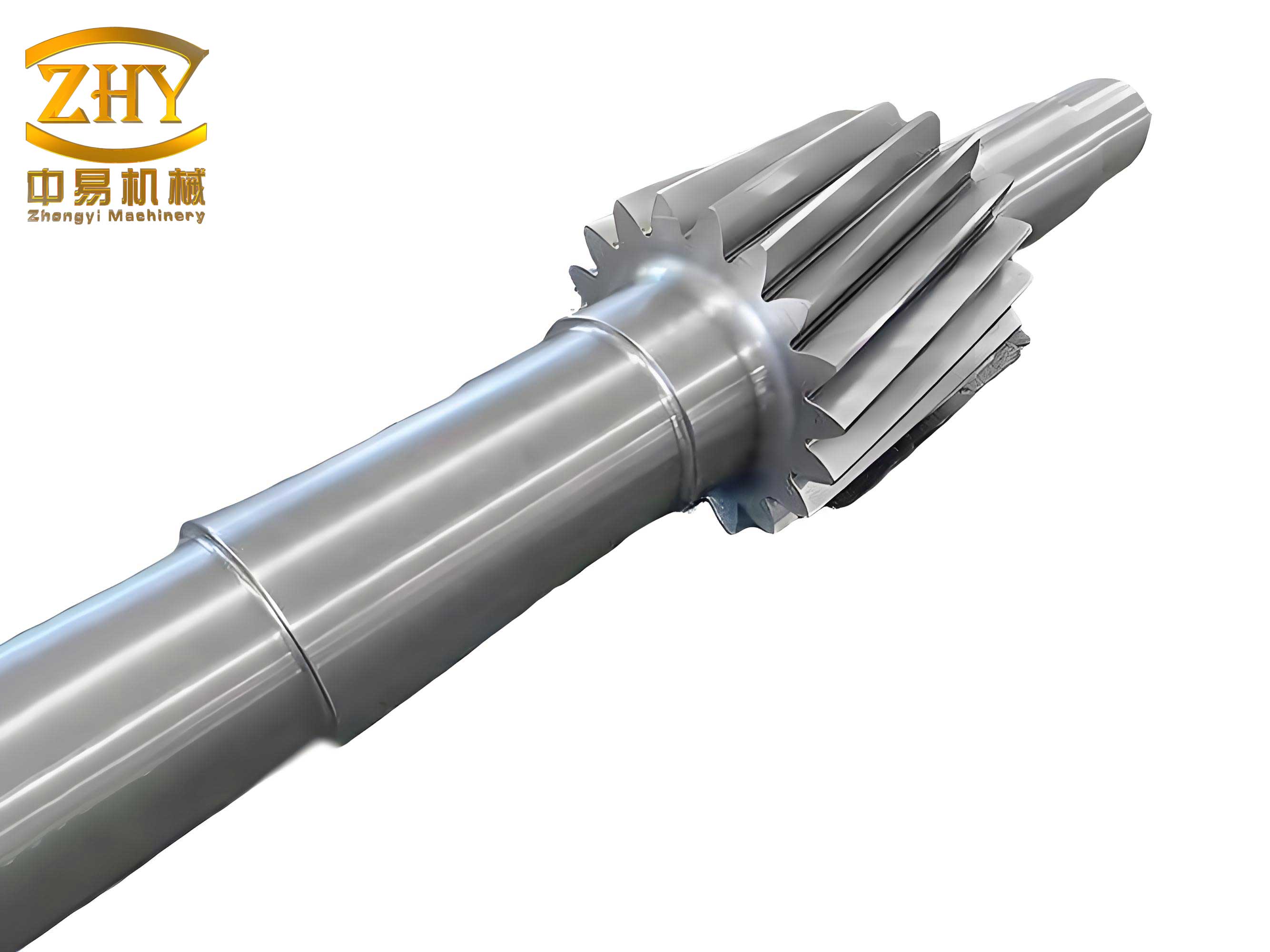
After carbonitriding, the gear shaft is directly quenched in oil to transform the austenitized case into martensite, achieving high hardness. The quenching medium is selected based on the cooling rate required to avoid cracking while ensuring full hardness. Oil quenching provides an intermediate cooling rate suitable for alloy steels like 20CrMnTi. Following quenching, the gear shaft is tempered to relieve internal stresses and improve toughness without significantly reducing hardness. The tempering temperature is set at 200°C, which is below the tempering range where significant softening occurs. The holding time for tempering is 2 hours, ensuring uniform stress relief throughout the gear shaft cross-section. The tempering equipment is a low-temperature furnace, such as RJ2-36-6, with a rated temperature of 650°C and power of 36 kW. The resulting microstructure consists of tempered martensite in the case and a tougher ferrite-pearlite structure in the core, providing an excellent combination of surface hardness (58-63 HRC) and core toughness.
To further enhance fatigue performance, secondary operations like finish grinding and shot peening are employed. Shot peening introduces compressive residual stresses on the gear shaft surface, which inhibits crack initiation and propagation under cyclic loading. This is particularly important for gear shafts subjected to alternating bending stresses.
In optimizing the heat treatment for the gear shaft, I also considered the effects of alloying elements on hardenability and mechanical properties. The hardenability of 20CrMnTi can be quantified using the ideal critical diameter (\( D_I \)), which represents the maximum diameter that can be fully hardened to martensite under ideal quenching conditions. For 20CrMnTi, \( D_I \) is approximately 40-50 mm, ensuring that the gear shaft, typically with diameters less than 50 mm, achieves full hardness through its case. The hardenability can be estimated using the Grossmann equation, which relates alloy composition to critical diameter. However, for practical purposes, the carbonitriding and quenching process is designed to ensure a uniform case depth.
The fatigue strength of the gear shaft is a critical parameter, as it determines the lifespan under cyclic loading. The surface hardness and residual stress state significantly influence fatigue resistance. The carbonitrided case, with its high hardness and compressive stresses, enhances fatigue limit. The relationship between surface hardness and fatigue strength can be approximated by empirical formulas, such as:
$$ \sigma_f = k \cdot \text{HB} $$
where \( \sigma_f \) is the fatigue strength, \( k \) is a material constant, and HB is the Brinell hardness. For carbonitrided steels, \( k \) typically ranges from 0.3 to 0.5. With a surface hardness of 60 HRC (approximately 600 HB), the fatigue strength can be estimated to be in the range of 180-300 MPa. However, actual fatigue testing is recommended for precise validation.
Wear resistance is another key property for the gear shaft. The carbonitrided case, rich in hard carbides and nitrides, provides excellent resistance to abrasive and adhesive wear. The wear rate can be modeled using Archard’s wear equation:
$$ W = k \frac{F_n s}{H} $$
where \( W \) is the wear volume, \( k \) is a wear coefficient, \( F_n \) is the normal load, \( s \) is the sliding distance, and \( H \) is the hardness. By increasing surface hardness through carbonitriding, the wear rate is significantly reduced, extending the gear shaft’s service life.
To summarize the optimized heat treatment parameters, I have compiled the following table:
| Process Step | Temperature (°C) | Holding Time | Cooling Method | Equipment | Key Parameters |
|---|---|---|---|---|---|
| Normalizing | 875 | 1.5 h | Air Cool | Box Furnace (RX3-15-9) | α=1.4, K=1.3, D=30 mm |
| Carbonitriding | 870 | 4 h | N/A (Heating only) | Sealed Quench Furnace (RQ3-35-9) | NH3: 0.1 m³/h, Kerosene: 35 drops/min, Case Depth: 0.8 mm |
| Quenching | Direct after Carbonitriding | N/A | Oil Quench | Same as Carbonitriding | Oil temperature: 60-80°C |
| Tempering | 200 | 2 h | Air Cool | Low-Temp Furnace (RJ2-36-6) | Stress relief, hardness maintained |
The microstructural evolution throughout this heat treatment cycle is crucial. During normalizing, the austenite transforms into fine pearlite, which is soft and machinable. Carbonitriding involves diffusion of carbon and nitrogen into the austenite, enriching the surface layer. Upon quenching, this enriched austenite transforms to martensite, while the core, with lower carbon content, forms a mixture of ferrite and pearlite or bainite, depending on cooling rate. Tempering then tempers the martensite, improving toughness. The final microstructure ensures that the gear shaft meets all mechanical requirements.
In addition to the technical aspects, I considered economic and environmental factors. The use of 20CrMnTi is cost-effective compared to higher alloy steels like 18Cr2Ni4W. The carbonitriding process, while requiring precise gas control, is energy-efficient due to lower temperatures and shorter cycles compared to carburizing. Furthermore, the direct quenching after carbonitriding reduces energy consumption by eliminating separate heating steps. These optimizations contribute to sustainable manufacturing practices.
Quality control is integral to the heat treatment process. For the gear shaft, non-destructive testing methods such as hardness testing, microstructural examination, and residual stress analysis are employed. Hardness gradients are measured from surface to core to ensure proper case depth and hardness values. Microstructural analysis verifies the absence of defects like grain growth or decarburization. Residual stress profiling, using X-ray diffraction, confirms the presence of compressive stresses in the case. These checks ensure that each gear shaft conforms to specifications.
The performance of the optimized gear shaft can be validated through simulation and testing. Finite element analysis (FEA) can model the stress distribution under load, predicting fatigue life and wear patterns. Experimental tests, such as rotary bending fatigue tests and wear tests, provide empirical data. For instance, the fatigue limit under alternating bending can be determined using the following relationship derived from stress-life curves:
$$ \sigma_a = \sigma_f’ (2N_f)^b $$
where \( \sigma_a \) is the stress amplitude, \( \sigma_f’ \) is the fatigue strength coefficient, \( N_f \) is the number of cycles to failure, and \( b \) is the fatigue strength exponent. For carbonitrided 20CrMnTi, typical values are \( \sigma_f’ \approx 1000 \, \text{MPa} \) and \( b \approx -0.1 \), indicating high fatigue resistance.
Moreover, the gear shaft’s performance in actual transmission systems can be monitored through field testing. Parameters such as noise, vibration, and temperature are indicators of wear and fatigue. The optimized heat treatment ensures that the gear shaft operates smoothly over extended periods, reducing maintenance needs and enhancing vehicle reliability.
In conclusion, the optimization of heat treatment for automotive transmission gear shafts is a multifaceted endeavor that balances material science, process engineering, and economic considerations. By selecting 20CrMnTi and implementing a tailored process of normalizing, carbonitriding, quenching, and tempering, I have achieved a gear shaft with superior surface hardness, core toughness, fatigue strength, and wear resistance. The use of tables and formulas, as presented, aids in standardizing the process and ensuring reproducibility. This analysis underscores the importance of heat treatment in maximizing the performance and longevity of gear shafts, which are indispensable components in automotive transmissions. Continuous improvement through advanced techniques like simulation and testing will further refine these processes, meeting the evolving demands of the automotive industry.
Throughout this discussion, the gear shaft has been the focal point, and its optimization is critical for the overall efficiency of the transmission system. The integration of carbonitriding, in particular, offers a robust solution for enhancing surface properties while maintaining dimensional stability. As technology advances, new methods such as plasma carburizing or laser heat treatment may offer additional benefits, but the current optimized process provides a reliable and cost-effective approach for mass production. Ultimately, the goal is to ensure that every gear shaft performs flawlessly under the rigorous conditions of automotive operation, contributing to safer and more efficient vehicles.