
In the realm of mechanical transmission components, gear shafts hold a pivotal role due to their ability to transmit torque and motion efficiently. Among these, conical gear shafts, such as the one depicted below, are particularly crucial in applications requiring angular power transfer. The manufacturing of such gear shafts often presents significant challenges, especially when aiming for high-volume production with minimal material waste. Cold extrusion, a near-net-shape forming process, has emerged as a promising alternative to traditional machining methods like milling or shaping, as it enhances mechanical properties, boosts productivity, and reduces costs in industries like automotive and motorcycle manufacturing. However, during the cold extrusion of gear shafts, issues such as incomplete tooth filling, increased forming resistance, and premature模具 wear frequently arise, necessitating innovative工艺 improvements.
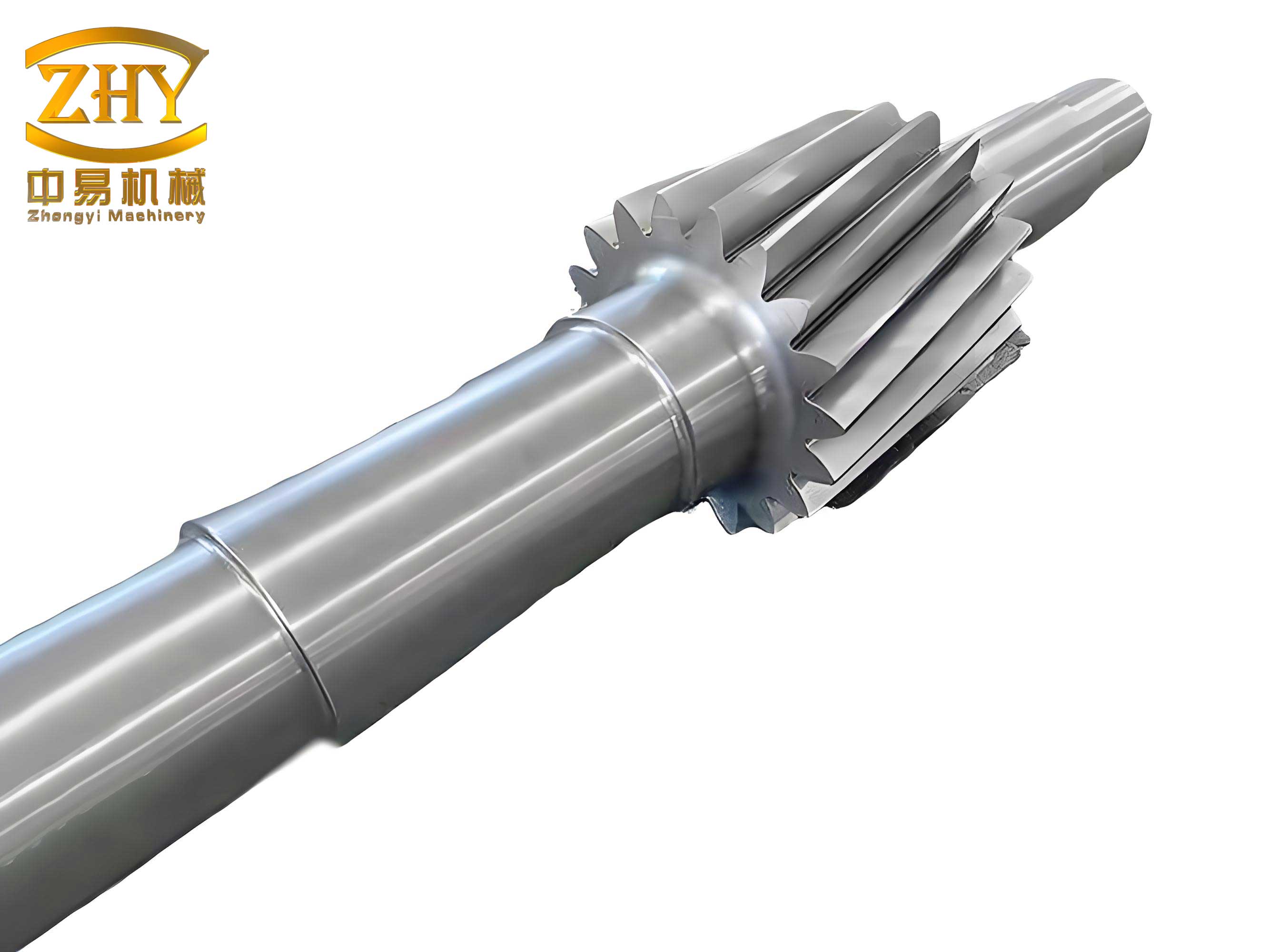
This article explores a novel approach to address these drawbacks by introducing periodic vibration to the die during the cold extrusion process. We focus on a conical gear shaft with a module of 2, 40 teeth, a pressure angle of 20°, and made from 20Cr steel. The primary objective is to investigate how die vibration influences metal flow, stress distribution, and forming forces, ultimately aiming to improve the quality and efficiency of gear shaft production. Through finite element analysis using DEFORM-3D software, we simulate two scenarios: one with a stationary die and another with a die subjected to periodic vibration. The results are compared comprehensively, leveraging tables and mathematical formulations to summarize key insights. The term “gear shaft” is central to our discussion, as it represents the core component under study, and we will emphasize it throughout to highlight its significance in plastic forming processes.
The challenges in cold extruding gear shafts are multifaceted. First, ensuring complete tooth filling often requires higher extrusion pressures, which exacerbate metal hardening and increase成形抗力. Second, the lubrication conditions deteriorate during deformation, leading to accelerated模具磨损 and potential tooth cracking. Third, cold extrusion demands presses with substantial tonnage and rigidity to withstand room-temperature塑性变形. To mitigate these issues, vibration-assisted forming has garnered attention, as it can reduce friction, enhance metal流动性, and lower energy consumption. In this context, we apply a periodic vibrational signal to the die, hypothesizing that it will promote better material flow and more uniform deformation in the gear shaft. Our methodology involves constructing a simplified 3D model of the extrusion system, meshing it appropriately, and defining boundary conditions that reflect real-world挤压 parameters.
We begin by detailing the finite element model setup. The gear shaft, or specifically the conical gear shaft坯料, is modeled as a plastic body using 20Cr material, which undergoes softening treatment prior to extrusion. The punch and die are treated as rigid bodies made from Cr12MoV steel, hardened for durability. To reduce computational complexity, we exploit symmetry and consider only one-eighth of the longitudinal cross-section, imported into DEFORM-3D as an STL file. The mesh is discretized into approximately 8,000 tetrahedral elements using an absolute meshing strategy. Friction at the interfaces is modeled with a constant shear model, assuming a coefficient of 0.12 at 20°C. The punch moves downward at a constant velocity of 10 mm/s, typical for hydraulic presses, over a total stroke of 8 mm. The simulation uses a time increment of 0.001 s, with 800 steps and data stored every 10 steps.
For the scenario with die vibration, we impose a harmonic excitation on the die. The vibrational signal is defined as a simple harmonic motion with a frequency of 100 Hz and an amplitude of 0.02 mm. This can be mathematically represented by the velocity function:
$$v(t) = A \omega \cos(\omega t)$$
where \(A = 0.02 \, \text{mm}\) is the amplitude, \(\omega = 2\pi f = 200\pi \, \text{rad/s}\) is the angular frequency, and \(f = 100 \, \text{Hz}\) is the frequency. The time-velocity curve, derived from simulations类似 to ADAMS software, shows a sinusoidal pattern that modulates the die’s motion during extrusion. This vibrational input is expected to interact dynamically with the metal flow in the gear shaft, altering its deformation characteristics.
To systematically compare the two extrusion cases, we analyze multiple aspects: metal flow网格 patterns, velocity fields, equivalent stress distributions, and punch load histories. The results are summarized in Table 1, which provides a quantitative overview of key metrics. This table helps underscore the impact of die vibration on the gear shaft forming process.
| Parameter | Stationary Die | Vibrating Die (100 Hz, 0.02 mm) |
|---|---|---|
| Maximum Metal Flow Velocity (mm/s) | 37.8 | 85.6 |
| Step at Maximum Velocity | 799 | 796 |
| Metal Flow Grid Deformation | High distortion, less regular | Reduced distortion, more streamlined |
| Maximum Equivalent Stress (MPa) | Concentrated at die corners | More uniform distribution |
| Punch Load Fluctuation | Consistently high | Periodic drops接近 zero |
| Plastic Deformation Amount | Moderate | Increased |
| Forming Resistance | Elevated | Reduced |
From the metal flow网格 analysis, we observe distinct differences. In the stationary die case, the flow lines exhibit significant distortion, particularly near the tooth regions of the gear shaft, indicating turbulent material movement and potential缺陷 like folding. In contrast, with die vibration, the网格 patterns become more orderly and aligned with the die cavity, suggesting improved flow guidance. This enhancement is attributed to the alternating forces from the vibrating die, which help overcome friction and rearrange metal particles more effectively. The term “gear shaft” is pertinent here, as the flow directly dictates the final tooth geometry and integrity of the shaft.
The velocity fields reveal a dramatic increase in metal flow speed when vibration is applied. As shown in Table 1, the maximum velocity jumps from 37.8 mm/s to 85.6 mm/s. This acceleration can be explained by the superposition of the punch’s downward pressure and the die’s oscillatory motion. During vibration, when the die moves opposite to the punch, it creates a momentary reduction in contact pressure, allowing metal to flow more freely into the gear shaft’s齿槽. Conversely, when the die moves in the same direction, it assists the extrusion, further boosting velocity. The governing equation for metal flow under vibration can be approximated by modifying the plasticity equations with an additional vibrational term:
$$\sigma_y = \sigma_0 + K \epsilon^n + \eta \dot{\epsilon} + F_v \sin(\omega t)$$
where \(\sigma_y\) is the yield stress, \(\sigma_0\) is the initial stress, \(K\) is the strength coefficient, \(\epsilon\) is the strain, \(n\) is the hardening exponent, \(\eta\) is the viscosity coefficient, \(\dot{\epsilon}\) is the strain rate, and \(F_v\) represents the vibrational force component. This illustrates how vibration降低 the effective flow stress, facilitating faster deformation in the gear shaft.
Equivalent stress distributions are critical for assessing the mechanical behavior of the gear shaft during extrusion. In the stationary die simulation, stress concentrations are prominent at the die corners, with high gradients indicating localized塑性变形 and potential failure points. With die vibration, the stress becomes more evenly spread across the workpiece, reducing peak values and minimizing the risk of cracking. This uniformity is beneficial for the gear shaft’s fatigue life and load-bearing capacity. The von Mises stress criterion, commonly used in such analyses, is given by:
$$\sigma_{vm} = \sqrt{\frac{(\sigma_1 – \sigma_2)^2 + (\sigma_2 – \sigma_3)^2 + (\sigma_3 – \sigma_1)^2}{2}}$$
where \(\sigma_1, \sigma_2, \sigma_3\) are the principal stresses. Vibration seems to homogenize these stresses, as evidenced by the smoother contours in the simulation outputs.
Punch load analysis offers insights into the energy requirements and machine demands. For the stationary die, the load remains consistently high throughout the stroke, reflecting the continuous resistance of the gear shaft material. With die vibration, the load exhibits周期性 fluctuations, dropping接近 zero when the die vibrates in sync with the punch. This reduction in average load translates to lower forming forces, which can extend模具寿命 and allow for the use of smaller presses. The load profile can be modeled as:
$$F(t) = F_0 + \Delta F \sin(\omega t + \phi)$$
where \(F_0\) is the base load, \(\Delta F\) is the load amplitude due to vibration, and \(\phi\) is a phase shift. This dynamic loading condition is less severe on the tooling, especially for intricate shapes like those in a gear shaft.
To validate the simulation findings, experimental挤压 trials were conducted on a hydraulic press. Two sets of gear shaft samples were produced: one using conventional cold extrusion with a fixed die, and another with the die subjected to periodic vibration matching the simulation parameters. The results corroborated the numerical predictions. The gear shafts extruded with vibration displayed fewer flashes, fuller tooth profiles, and improved surface finish compared to those from the stationary die. This real-world evidence reinforces the benefits of die vibration in enhancing the quality of cold-extruded gear shafts.
Further discussion delves into the underlying mechanisms. The vibration effect can be attributed to several phenomena: (1) Reduction in friction through periodic separation at the die-workpiece interface, (2) Acoustic softening or振动塑性 that lowers the material’s yield strength, and (3) Improved metal流动性 due to alternating shear stresses. For gear shafts, which require precise tooth forms, these factors collectively ensure better cavity filling and dimensional accuracy. The relationship between vibrational parameters and extrusion outcomes can be explored through dimensionless numbers, such as the Strouhal number \(St = fL/v\), where \(f\) is frequency, \(L\) is a characteristic length (e.g., gear shaft diameter), and \(v\) is punch speed. Optimizing \(St\) could lead to even greater improvements in gear shaft manufacturing.
In terms of practical implications, the application of die vibration in cold extrusion presents opportunities for cost savings and performance enhancement. For instance, lower forming forces reduce energy consumption and tool wear, while better metal flow minimizes post-processing for gear shafts. However, challenges remain in implementing this technology industrially, such as designing robust vibration systems and controlling parameters for different gear shaft geometries. Future work could involve multi-objective optimization using response surface methodology or artificial neural networks to fine-tune vibrational settings for specific gear shaft designs.
In conclusion, our investigation demonstrates that applying periodic vibration to the die during cold extrusion significantly benefits the forming of gear shafts. Compared to traditional stationary die extrusion, vibration promotes higher metal flow velocities, more uniform stress distributions, reduced forming resistance, and enhanced plastic deformation. These advantages lead to gear shafts with improved tooth filling and mechanical properties. The integration of finite element simulations with experimental validation provides a comprehensive understanding of the process, paving the way for broader adoption of vibration-assisted冷挤压 in gear shaft production. As the demand for efficient and high-quality transmission components grows, such innovative approaches will play a crucial role in advancing manufacturing technologies.