
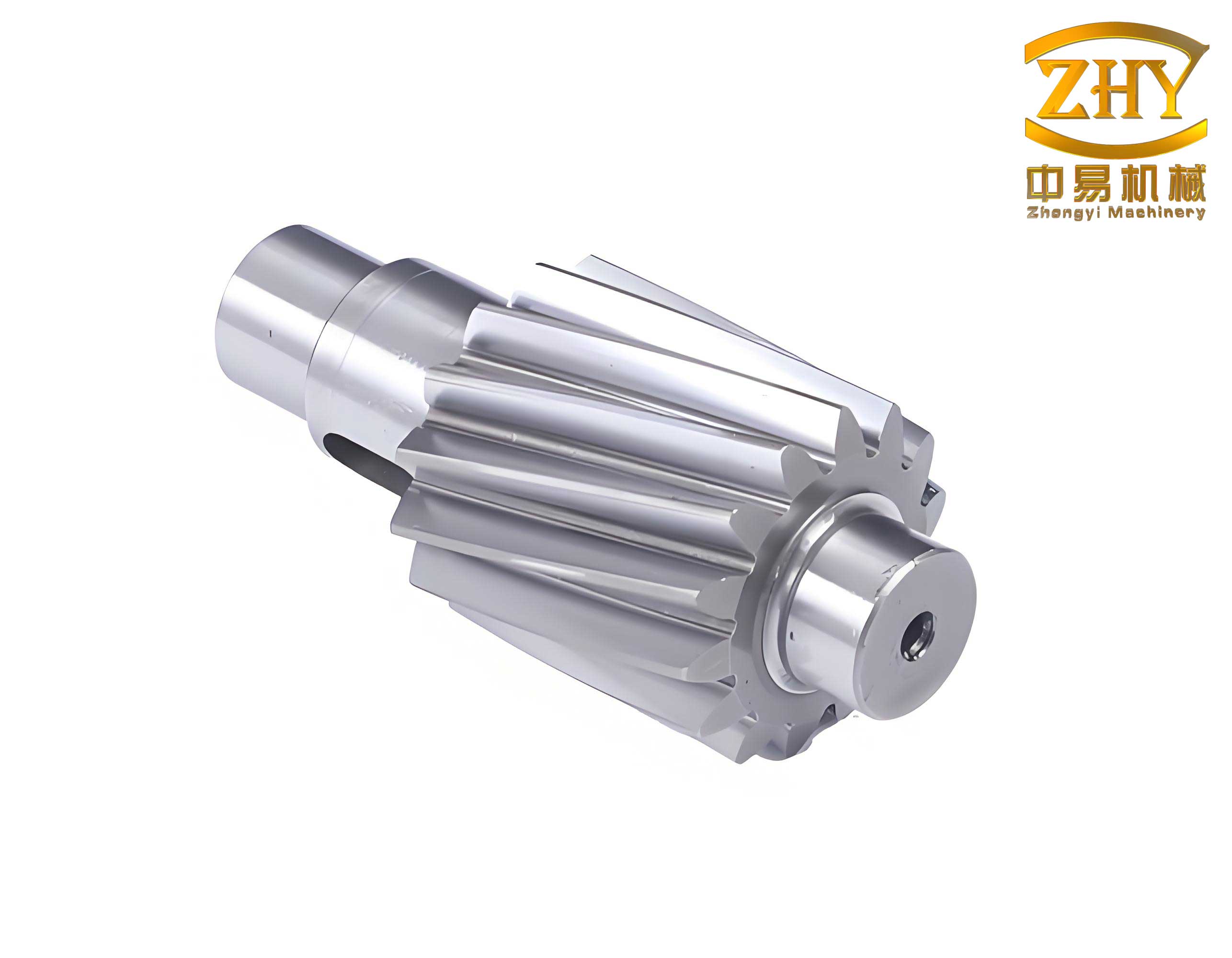
In my extensive experience within automotive powertrain component analysis, the integrity of gear shafts, particularly those in rear axle differential assemblies, is paramount for vehicle safety and longevity. A recent incident involving the fracture of threads on spiral bevel gear drive shafts during assembly and in-service operations prompted a deep-dive failure investigation. This article details my first-person analytical journey, from initial fracture observation to root cause determination and the implementation of effective corrective actions, with a continuous focus on the performance and reliability of these essential gear shafts.
The failure involved multiple 20CrMnTiH steel gear shafts where the threaded section, responsible for coupling to the propeller shaft, fractured near the fillet radius (R-area) connecting the thread to the shank. The immediate consequence was assembly line stoppages and potential field failures, underscoring the critical nature of this issue. My investigation began with a macroscopic examination of the failed components. The fracture surfaces were relatively flat and exhibited a metallic luster. Crucially, the crack initiation site was identified at the surface of the fillet radius on one side, propagating radially inward. The fracture surface revealed two distinct zones: an initial propagation region with a slightly oxidized appearance and a final fast fracture zone that was relatively clean. This macroscopic evidence pointed towards a surface-originated crack undergoing staged growth.
To delve deeper, I employed scanning electron microscopy (SEM) on the fracture surfaces. The crack initiation sites showed signs of oxidation and a mixed morphology of micro-void coalescence and tearing. More tellingly, the microstructure adjacent to the origin suggested the presence of pre-existing micro-cracks or seams. The initial crack propagation zone within the carburized case exhibited a classic “rock candy” intergranular fracture morphology, indicative of embrittlement. The final fracture zone in the core showed a mixture of cleavage and ductile tearing. This sequence suggested that a pre-existing surface flaw in the gear shafts was exacerbated by a brittle surface layer, leading to catastrophic failure under assembly or service loads.
The next phase involved metallurgical and mechanical analysis of the failed gear shafts. Transverse and longitudinal sections were prepared for metallographic examination, hardness testing, and chemical analysis. The core material chemistry confirmed it was within specification for 20CrMnTiH steel, as shown in Table 1.
| Element | C | Si | Mn | P | S | Cr | Ti |
|---|---|---|---|---|---|---|---|
| Measured Value | 0.19 | 0.26 | 1.01 | 0.016 | 0.0035 | 1.16 | 0.056 |
| 20CrMnTiH Standard | 0.17-0.23 | 0.17-0.37 | 0.80-1.10 | ≤0.035 | ≤0.035 | 1.00-1.30 | 0.04-0.10 |
Microstructural analysis of the thread root and fillet area revealed the primary issue. The surface layer showed a hardened microstructure of acicular martensite with carbides and retained austenite, a structure resulting from unintended carburization and quenching. This is unsuitable for threads which require good toughness. The core showed a tempered martensitic structure. Even more critical was the discovery of surface folding defects and decarburization at the crack initiation site, as seen in the micrograph. These folds, acting as stress concentrators, were the likely pre-cursors to failure. The hardness profile was highly inconsistent, failing to meet the thread specification of 32-45 HRC. This inconsistency is summarized in Table 2, highlighting the problem areas in these gear shafts.
| Measurement Location | Hardness Value 1 (HRC) | Hardness Value 2 (HRC) | Hardness Value 3 (HRC) | Comment |
|---|---|---|---|---|
| Thread Crest | 52.0 | 45.0 | 48.9 | Above specification max (45 HRC) |
| Thread Root (near fillet) | 50.5 | 31.4 | 50.7 | Simultaneously above and below spec |
Energy Dispersive Spectroscopy (EDS) on the fracture origin confirmed the presence of oxygen, indicating that the crack surfaces had oxidized, supporting the theory of a pre-existing flaw exposed to the high-temperature carburizing atmosphere. Macro-etching tests did not reveal significant segregation or inclusions in the bulk material, further localizing the problem to the surface treatment of the thread region on these gear shafts.
The root cause analysis converged on the manufacturing process sequence. The original process involved full-length carburizing and quenching of the gear shafts, followed by a local high-frequency induction annealing of the threads intended to soften them. My investigation concluded that this annealing process was insufficient to fully temper the hard, brittle martensite formed during carburization, especially in the stress-concentrating fillet radius. Furthermore, the thread rolling operation, if performed with dull tools or excessive penetration into the fillet, could create the observed surface folds and micro-cracks. The combination created a perfect scenario for failure: a sharp notch (the fold) in a brittle, high-hardness surface layer, subjected to tensile stresses from assembly pre-load. The stress concentration factor (Kt) at such a notch can be approximated for a semi-elliptical surface flaw by equations such as:
$$ K_t \approx 1 + 2\sqrt{\frac{a}{\rho}} $$
where ‘a’ is the flaw depth and ‘ρ’ is the root radius. For a sharp fold, ρ is very small, leading to a very high Kt, drastically reducing the effective fatigue strength of the gear shafts.
The fracture mechanics can be further modeled. The stress intensity factor (K) for a surface crack under tensile stress (σ) is given by:
$$ K = Y \sigma \sqrt{\pi a} $$
where Y is a geometric factor. When K exceeds the material’s fracture toughness (KIC), catastrophic fracture occurs. In this case, the brittle martensitic case likely had a low KIC, and the assembly pre-load stress (σ) acting on the crack of size (a) drove the failure. The original heat treatment cycle parameters are summarized in Table 3, illustrating the process that led to the problematic microstructure in the gear shafts.
| Process Zone | Temperature (°C) | Carbon Potential (%) | Atmosphere Gases | Target Outcome |
|---|---|---|---|---|
| Pre-oxidation & Heating | 910 | — | N2, Air | Surface activation |
| Boost Carburizing I & II | 920 | 1.2 – 1.1 | C3H8, N2, CH3OH | High surface carbon |
| Diffusion | 910 | 0.85 | C3H8, N2, CH3OH | Carbon profile smoothing |
| Temperature Stabilization | 850 | 0.78 | N2, CH3OH | Prepare for quench |
| Quenching | 860 (Oil at 80°C) | 0.9 | N2 | Form hardened case |
Based on this comprehensive analysis, I led the initiative to redesign the manufacturing process for these critical gear shafts. The corrective actions were twofold, addressing both the metallurgical and geometric stress concentrators.
1. Revised Heat Treatment Protocol: The core change was to prevent the formation of brittle martensite in the thread and fillet areas altogether. The new process mandates the application of a proprietary anti-carburizing coating to the thread section and the fillet radius before the gear shafts enter the carburizing furnace. This coating acts as a barrier to carbon diffusion. After the gear shafts undergo complete carburizing and quenching (which now only hardens the gear teeth and other designated areas), the thread region is processed via a carefully calibrated high-frequency induction annealing. Since this area was protected from carburization, its base material (low-carbon steel) simply undergoes a softening anneal or normalizing cycle, resulting in a tough, ductile microstructure of ferrite and pearlite with optimal hardness. The target hardness range for the thread after this new process is a uniform 32-45 HRC. The key parameters for the new induction annealing process are detailed in Table 4.
| Process Step | Command/Function | Target Value/Position | Objective |
|---|---|---|---|
| Positioning & Rotation Start | G1, M03 | X = -35.1 mm | Align induction coil |
| Heating Cycle I | M24, G4, M32 | Power: 200V, 45A, 38.5 kHz; Time: 0.5 min | Achieve austenitizing temperature |
| Heating Cycle II | G1, M23, G4 | X = -19.4 mm; Power: 210V, 48A | Uniform heating through thread length |
| Cooling & Shutdown | M33, M08, G1, M05, M09 | Coolant on, retract coil, stop rotation | Controlled air cool for softening |
The resultant microstructure in the thread is now a soft, tough mixture of pearlite and ferrite, with no brittle phases. The hardness gradient from the hardened case to the soft thread is now managed without creating a sharp, brittle interface at the fillet of the gear shafts.
2. Design for Manufacturing (DFM) Enhancements: Concurrently, I recommended and implemented design modifications. The fillet radius (R) was increased from 3mm to 4mm. This geometrically reduces the stress concentration factor, which for a shoulder fillet is roughly proportional to 1/√R. The relationship can be expressed as:
$$ K_t \propto 1 + \sqrt{\frac{t}{R}} $$
where ‘t’ is a geometric dimension. Increasing R directly decreases Kt, enhancing the fatigue life of the gear shafts. Secondly, the effective thread length was precisely controlled to ensure the thread rolling operation does not encroach upon the fillet radius, eliminating the risk of creating tooling folds in this critical stress area.
The efficacy of these changes was validated through a production batch of over 10,000 gear shafts. Post-implementation, the threads exhibited consistent hardness within the specified range, as verified by random sampling shown in Table 5. More importantly, there have been zero instances of thread fracture during assembly or in field service since the changes were instituted, confirming the success of the root-cause-based solution.
| Measurement Location | Sample 1 (HRC) | Sample 2 (HRC) | Sample 3 (HRC) | Status |
|---|---|---|---|---|
| Thread Crest | 42.3 | 41.0 | 38.9 | Within Spec (32-45 HRC) |
| Thread Root (near fillet) | 40.5 | 33.4 | 40.7 | Within Spec (32-45 HRC) |
In conclusion, my investigation into the fracture of threads on these vital automotive gear shafts underscores a fundamental principle in component engineering: failure often arises from the interaction of multiple factors. In this case, it was the synergy between a manufacturing defect (surface fold), an unsuitable microstructure (brittle martensite), and a geometric stress concentrator (sharp fillet). The solution required a holistic view of the entire process chain for manufacturing gear shafts. By implementing a preventive anti-carburization step and optimizing the subsequent annealing, we eliminated the brittle phase. Coupling this with thoughtful design modifications to reduce stress concentration created a robust and reliable product. This case study serves as a template for systemic problem-solving in the production of high-stress components like gear shafts, where material science, thermal processing, mechanical design, and manufacturing precision must be perfectly aligned to ensure ultimate performance and safety.