
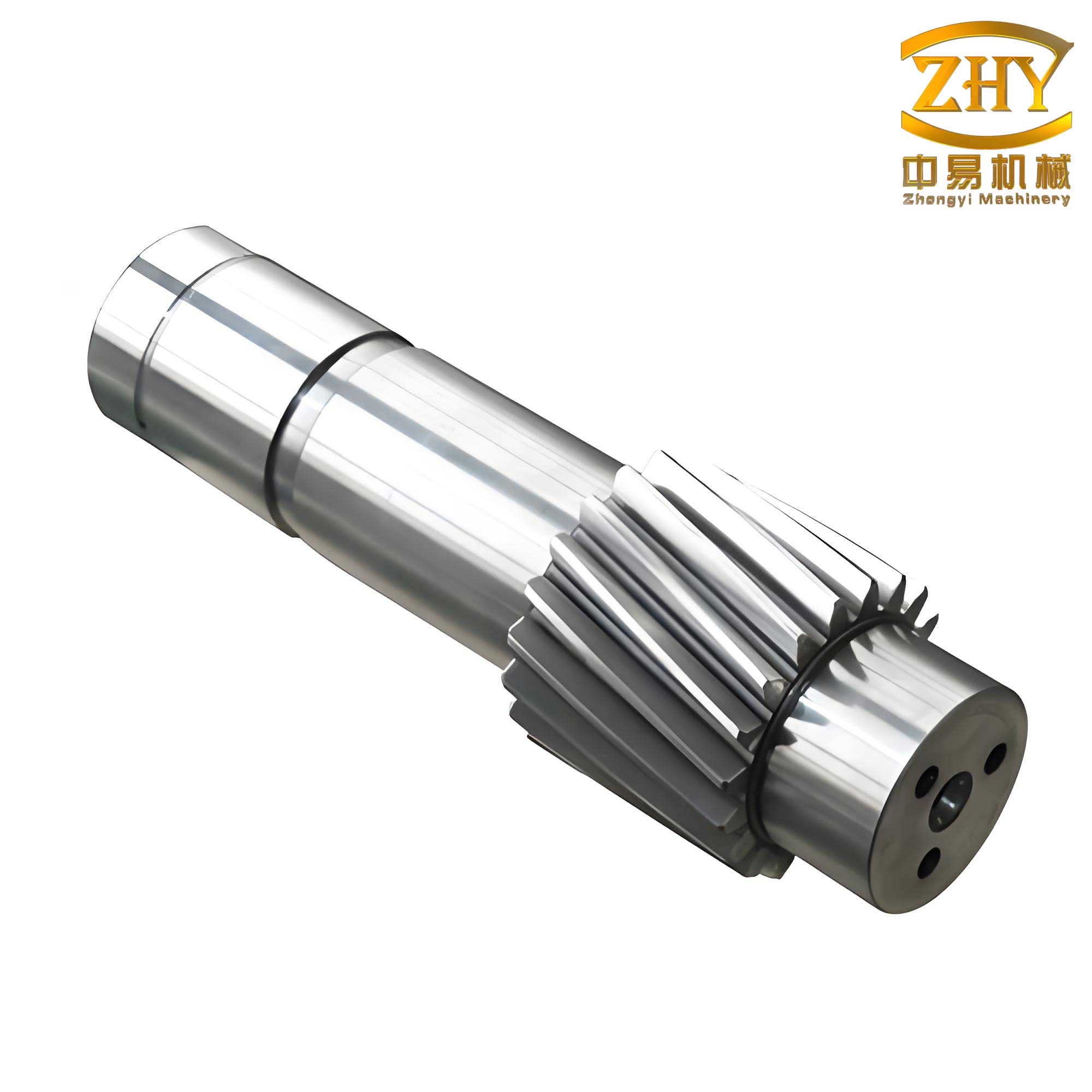
In modern mechanical transmission systems, gear shafts play a pivotal role due to their ability to efficiently transfer power, adjust speed, and change motion direction. Compared to belt, chain, or friction wheel drives, gear shaft transmissions offer compact structures, high efficiency, and stable operation, with precise transmission ratios suitable for various speeds and power levels. In wind turbine applications, gear shafts are critical components, and their reliability directly impacts the operational stability of the entire system. However, during production, gear shafts made from 18CrNiMo7-6 steel have repeatedly exhibited longitudinal cracking during storage after final heat treatment, leading to significant production delays and quality concerns. This article delves into a detailed failure analysis of such cracked gear shafts, employing chemical composition testing, mechanical property evaluation, metallographic examination, and fracture morphology studies to uncover the root causes. The focus is on understanding the mechanisms behind hydrogen-induced delayed fracture, the role of non-metallic inclusions, and the influence of residual stresses, with the keyword “gear shafts” emphasized throughout to highlight its relevance.
The gear shafts in question undergo a manufacturing process involving: raw material (bar stock) → machining to shape → surface gas carburizing → quenching → low-temperature tempering. After final heat treatment, cracks were observed longitudinally along the shaft, often originating near the tooth root and extending radially inward. This phenomenon suggests a delayed fracture mechanism, where failure occurs under static conditions without external loads. To investigate, we analyzed a representative cracked gear shaft, employing various instruments such as scanning electron microscopy (SEM) for fracture surface observation, optical microscopy for microstructure and inclusion assessment, and hardness testing for carburized layer evaluation. The following sections present our findings in detail, supported by tables and formulas to summarize key data and theoretical insights.
Chemical composition analysis was conducted on samples extracted from the cracked gear shafts. The results, summarized in Table 1, indicate that all elements fall within the specified range for 18CrNiMo7-6 steel. Notably, hydrogen content was measured at 0.7 ppm, which is within typical industrial limits but can still contribute to delayed cracking under certain conditions. The consistency in composition rules out material grade mismatches as a cause of failure.
| Element | C | Si | Mn | Cr | Ni | Mo | P | S | H (ppm) |
|---|---|---|---|---|---|---|---|---|---|
| Content | 0.15 | 0.23 | 0.53 | 1.69 | 1.52 | 0.26 | 0.007 | <0.005 | 0.7 |
Mechanical properties were evaluated through tensile testing on circumferential samples. The results show an ultimate tensile strength of 1100 MPa, yield strength of 840 MPa, elongation of 14%, and reduction of area of 60%. These values meet the technical requirements for gear shafts in wind turbine applications. Additionally, the effective case depth of the carburized layer, measured at the tooth flank, was 1.37 mm according to GB/T 9450-2005. The core hardness averaged 430 HV0.5, but variations up to 40 HV0.5 were observed, indicating non-uniform hardness distribution. This non-uniformity can be linked to microstructural banding, as discussed later. The surface hardness gradient is critical for understanding residual stress profiles, which are derived from volume changes during martensitic transformation. The relationship between case depth and residual stress can be approximated by:
$$ \sigma_r(x) = \sigma_0 \cdot e^{-k x} $$
where $\sigma_r(x)$ is the residual stress at depth $x$, $\sigma_0$ is the surface residual stress, and $k$ is a material constant. For carburized gear shafts, the stress profile typically shows compressive stresses at the surface and tensile stresses in the subsurface transition zone.
Macroscopic examination of the cracked gear shafts revealed longitudinal cracks originating from the tooth root region. The cracks appeared straight and open, with a maximum aperture of nearly 1 mm on the outer surface, tapering inward. They propagated radially, often passing through the shaft center, indicating dominance by quenching stresses. After opening the crack, the fracture surface was analyzed. The initiation site was located approximately 2.2 mm below the tooth root surface, within the transition zone between the carburized case and the core. At this location, a large non-metallic inclusion, measuring 1.2 mm in length, was identified as the crack origin. SEM-EDS analysis showed that this inclusion primarily consisted of magnesium-aluminum oxides, classifying it as an exogenous inclusion. Reference to GB/T 10561-2005 suggests it corresponds to a B2.5s rating, which is considered oversized for high-stress applications. Another similar inclusion, 1.5 mm long, was found about 1 cm away from the origin, both aligned along a deformation flow line or segregation band.
Fracture morphology at the origin exhibited a mix of brittle intergranular and quasi-cleavage features, characteristic of hydrogen embrittlement. In contrast, the carburized layer showed predominantly intergranular fracture, while the core displayed quasi-cleavage patterns. This transition in fracture mode correlates with microstructural gradients and hydrogen diffusion. Hydrogen-induced delayed fracture is governed by the critical combination of local hydrogen concentration and stress intensity. The threshold stress intensity for hydrogen-assisted cracking can be expressed as:
$$ K_{IH} = K_{IC} \cdot f(C_H, \sigma) $$
where $K_{IH}$ is the hydrogen-affected threshold stress intensity, $K_{IC}$ is the plain strain fracture toughness, $C_H$ is the local hydrogen concentration, and $\sigma$ is the applied stress. In gear shafts, residual stresses from heat treatment act as the driving force for crack propagation.
To estimate the residual stress at the crack initiation site, we calculated the elastic strain from crack opening displacement and gear shaft dimensions. Using Hooke’s law:
$$ \sigma = E \cdot \epsilon $$
where $E$ is Young’s modulus (approximately 210 GPa for steel) and $\epsilon$ is the strain. The rough estimate yielded a circumferential residual tensile stress of about 500 MPa at the inclusion location. This high stress, combined with hydrogen accumulation at the inclusion, created conditions conducive to delayed fracture. Hydrogen atoms diffuse and accumulate at microstructural traps like inclusions, lowering the fracture energy. The diffusion of hydrogen in steel can be described by Fick’s second law:
$$ \frac{\partial C}{\partial t} = D \nabla^2 C $$
where $C$ is hydrogen concentration, $t$ is time, and $D$ is the diffusion coefficient. For gear shafts, the presence of large inclusions accelerates local hydrogen buildup, reducing the time to failure.
Metallographic examination of transverse sections revealed a uniform macrostructure with minor ingot segregation, but no other defects. Microstructurally, the carburized surface layer consisted of acicular tempered martensite, while the core exhibited lath tempered martensite. However, severe banded micro-segregation was observed, as shown in Figure 6 of the reference material (not reproduced here). This banding contributes to hardness variations and anisotropic mechanical properties, potentially exacerbating crack propagation. The prior austenite grain size in the core was measured as ASTM 8.0, which is acceptable but can influence hydrogen diffusion paths.
Non-metallic inclusion assessment at mid-radius and near the crack origin indicated low overall inclusion content, primarily comprising point oxides, with minor sulfides and chain oxides. However, the large exogenous inclusion at the origin was an outlier not typically detected in routine inspections. This highlights the need for advanced non-destructive testing (NDT) methods, such as ultrasonic or eddy current testing, to identify such defects in gear shafts before they lead to failure.
The discussion centers on the synergistic effects of hydrogen, inclusions, and residual stresses. Hydrogen embrittlement in high-strength steels like 18CrNiMo7-6 is a well-known phenomenon, where even low bulk hydrogen levels can cause catastrophic failure if locally concentrated. In gear shafts, hydrogen may originate from the manufacturing process, such as during carburizing or from environmental exposure during storage. Although the storage environment was dry and well-ventilated, internal hydrogen from processing sufficed to induce cracking. The large inclusion acted as a stress concentrator, elevating the local stress intensity factor:
$$ K_I = \sigma \sqrt{\pi a} \cdot Y $$
where $a$ is the inclusion size and $Y$ is a geometric factor. For an inclusion of 1.2 mm, $K_I$ can approach critical values under residual stresses. Additionally, inclusions serve as hydrogen traps, with trapping energy described by:
$$ \Delta E_t = RT \ln\left(\frac{C_t}{C_L}\right) $$
where $\Delta E_t$ is the trapping energy, $R$ is the gas constant, $T$ is temperature, $C_t$ is the trapped hydrogen concentration, and $C_L$ is the lattice hydrogen concentration. High-trapping-energy sites like oxide inclusions promote hydrogen retention, facilitating crack initiation.
The residual stress profile in carburized gear shafts is complex. During quenching, the surface transforms to martensite first, expanding and placing the subsurface in tension. The maximum tensile stress typically occurs at the case-core transition, coinciding with the crack origin in these gear shafts. Finite element analysis (FEA) simulations can model this, but simplified formulas help illustrate the point. The stress distribution can be approximated as:
$$ \sigma(z) = A \cdot (z – z_0)^2 + B $$
where $z$ is depth, $z_0$ is the depth of maximum stress, and $A$ and $B$ are constants derived from material properties and processing parameters. For gear shafts, optimizing heat treatment to reduce residual stresses is crucial.
To mitigate such failures, several recommendations are proposed. First, enhance raw material inspection for large inclusions using NDT techniques. Second, adjust heat treatment parameters, such as increasing tempering temperature, to lower residual stresses and reduce hydrogen susceptibility. Tempering can relieve stresses and allow hydrogen effusion, as described by the diffusion equation with appropriate boundary conditions. Third, improve microstructure homogeneity through controlled forging and heat treatment to minimize banding. Finally, consider hydrogen relief treatments, like baking, after carburizing to reduce internal hydrogen levels.
In conclusion, the longitudinal delayed cracking in wind turbine gear shafts is primarily attributed to hydrogen-induced fracture initiated at large exogenous non-metallic inclusions under high residual tensile stresses. The inclusions, located in the critical transition zone, act as stress concentrators and hydrogen traps, while the residual stresses from carburizing and quenching provide the driving force for crack propagation. Microstructural banding and hardness non-uniformity further exacerbate the issue. By addressing these factors through improved material quality control and optimized heat treatment, the reliability of gear shafts can be significantly enhanced, ensuring the stable operation of wind energy systems. This analysis underscores the importance of a holistic approach to failure prevention in critical components like gear shafts, where small defects can lead to costly failures.
To further elaborate, the mechanics of crack propagation in gear shafts can be modeled using fracture mechanics principles. For a semi-elliptical surface crack, the stress intensity factor varies along the crack front. In gear shafts, the crack often initiates sub-surface and propagates radially. The mode I stress intensity factor for such geometry can be expressed as:
$$ K_I = \sigma \sqrt{\pi a} \cdot F\left(\frac{a}{c}, \frac{a}{t}, \phi\right) $$
where $a$ is crack depth, $c$ is half crack length, $t$ is section thickness, $\phi$ is parametric angle, and $F$ is a correction factor. For hydrogen-assisted cracking, the effective $K_I$ is reduced due to hydrogen embrittlement, leading to subcritical crack growth. The crack growth rate $da/dt$ can be described by empirical models:
$$ \frac{da}{dt} = A (K_I – K_{th})^n $$
where $A$ and $n$ are material constants, and $K_{th}$ is the threshold stress intensity for hydrogen-induced cracking. In gear shafts, this growth can occur slowly during storage, resulting in delayed failure.
Regarding non-metallic inclusions, their impact on gear shaft performance can be quantified using statistical methods. The probability of failure $P_f$ due to inclusions can be related to inclusion size distribution:
$$ P_f = 1 – \exp\left(-\int_V g(a) dV\right) $$
where $g(a)$ is the density function of critical inclusion size $a$, and $V$ is the volume under stress. For gear shafts, the high-stress region near the tooth root is particularly vulnerable. Standards like GB/T 10561-2005 provide rating systems, but for critical applications, more stringent criteria are needed.
Hydrogen diffusion and trapping in gear shafts are influenced by microstructure. The effective diffusion coefficient $D_{eff}$ in the presence of traps is given by:
$$ D_{eff} = D_L \left(1 + \frac{N_t k_t}{N_L}\right)^{-1} $$
where $D_L$ is the lattice diffusion coefficient, $N_t$ is trap density, $k_t$ is trapping equilibrium constant, and $N_L$ is lattice site density. In gear shafts with banded structures, $D_{eff}$ may vary locally, affecting hydrogen distribution.
Residual stress measurement techniques, such as X-ray diffraction or hole-drilling, can be employed to validate stress profiles in gear shafts. For quality assurance, establishing allowable residual stress limits is essential. Based on our analysis, a maximum tensile stress below 300 MPa in the transition zone is recommended to prevent delayed cracking.
In terms of material selection, alternative steels with higher resistance to hydrogen embrittlement, such as those with reduced impurity levels or added microalloying elements, could be considered for gear shafts. However, cost and processing constraints must be balanced.
Finally, ongoing monitoring of gear shafts in service through vibration analysis or acoustic emission can detect early signs of cracking, but prevention at the manufacturing stage is paramount. This comprehensive analysis highlights the multifaceted nature of gear shaft failures and the need for integrated solutions across material science, processing, and design.
To summarize key data, Table 2 presents a comparison of properties between the cracked gear shaft and ideal specifications.
| Property | Cracked Gear Shaft | Ideal Specification | Remarks |
|---|---|---|---|
| Ultimate Tensile Strength | 1100 MPa | 1100-1300 MPa | Within range |
| Yield Strength | 840 MPa | ≥800 MPa | Acceptable |
| Elongation | 14% | ≥12% | Acceptable |
| Case Depth | 1.37 mm | 1.2-1.5 mm | Within range |
| Core Hardness | 430 HV0.5 | 400-450 HV0.5 | Non-uniform |
| Hydrogen Content | 0.7 ppm | <1 ppm | Low but critical |
| Inclusion Size at Origin | 1.2 mm (B2.5s) | <0.5 mm preferred | Oversized |
| Residual Stress at Origin | ~500 MPa | <300 MPa recommended | Too high |
This analysis reinforces that gear shafts are susceptible to delayed cracking from synergistic factors, and continuous improvement in manufacturing and inspection is vital for their performance in demanding applications like wind turbines. By addressing inclusions, residual stresses, and hydrogen management, the durability of gear shafts can be assured, contributing to the reliability of renewable energy infrastructure.