
In the design of mechanical systems, the efficiency and strength of gear shafts directly influence the overall performance and lifespan of power transmission units. Gear shafts, particularly helical gear shafts, are critical components in heavy-duty applications such as marine winches, where they endure significant loads and require rigorous strength validation. This article presents a comprehensive theoretical analysis of the force distribution and strength assessment for a helical gear shaft used in a large marine winch减速机. I will detail the process of modeling the gear shaft using CATIA software, followed by a static finite element analysis (FEA) conducted in ANSYS Workbench to obtain stress and strain distribution云图, thereby achieving the goal of strength verification. The torque transmission in gear shafts occurs through gears mounted on the shaft, making it essential to consider force transfer on the gears for practical significance. Helical gears offer advantages like smooth operation, high load-bearing capacity, reduced noise, and minimal impact, making them suitable for high-speed, high-power transmissions and more widespread use than spur gears. Since spur gears can be viewed as special cases of helical gears with a zero helix angle, the methodology discussed here is also applicable to spur gear shafts.
I begin by examining the theoretical aspects of force analysis on helical gear shafts. The design and analysis of gear shafts involve understanding complex loading conditions, which I break down into manageable components through mathematical formulations and practical assumptions.
1. Theoretical Analysis of Force Conditions on Gear Shafts
1.1 Force Analysis of Helical Gears
For a helical gear, the force interactions are three-dimensional due to the helix angle. Consider a helical gear with the following parameters: module m = 10 mm, number of teeth z = 20, reference circle radius r = mz/2 = 100 mm, addendum circle radius r_k = r + m = 110 mm, dedendum circle radius r_f = r – 1.25m = 87.5 mm, helix angle at the reference circle β = 10°, normal pressure angle α_n = 20°, and tooth width of 50 mm. When a driving torque T_1 is applied to the gear, ignoring friction in the contact surfaces, a normal force F_n acts in the plane tangent to the base cylinder within the啮合 plane. This normal force is decomposed into three orthogonal spatial components: radial force F_r, tangential force F_t, and axial force F_a.
The reference circle diameter d is given by:
$$ d = \frac{m z}{\cos \beta} $$
The tangential force, derived from the torque, is:
$$ F_t = \frac{2 T_1}{d} $$
The axial force depends on the helix angle:
$$ F_a = F_t \tan \beta $$
The radial force is related to the normal pressure angle:
$$ F_r = \frac{F_t \tan \alpha_n}{\cos \beta} $$
Finally, the normal force can be expressed as:
$$ F_n = \frac{F_t}{\cos \alpha_n \cos \beta} $$
These equations form the basis for calculating loads on gear shafts. To summarize the force components, I present a table below:
| Force Component | Symbol | Formula |
|---|---|---|
| Tangential Force | F_t | $$ F_t = \frac{2 T_1}{d} $$ |
| Axial Force | F_a | $$ F_a = F_t \tan \beta $$ |
| Radial Force | F_r | $$ F_r = \frac{F_t \tan \alpha_n}{\cos \beta} $$ |
| Normal Force | F_n | $$ F_n = \frac{F_t}{\cos \alpha_n \cos \beta} $$ |
This decomposition is crucial for subsequent analysis of gear shafts, as it allows for the evaluation of bending moments and torques in the shaft.
1.2 Force Analysis of Gear Shafts
Gear shafts are typically subjected to combined bending and torsion, requiring strength calculations based on composite loading. After the structural design of the shaft, external loads such as torque and bending moments are determined in terms of magnitude, direction, points of application, and types, along with support reactions. The shaft can be treated as a beam on simple supports, with forces from mounted components considered as concentrated loads acting at the midpoint of the hub width. Support reactions are assumed to act at the midpoint of bearing widths. By decomposing the torque into forces on the helical gear as described, a spatial force diagram for the gear shaft is constructed.
The gear shaft is supported at two points, with distances L_1 and L_2 from the gear to the supports. Let’s denote the gear position as the point where forces are applied. The horizontal and vertical reactions are calculated as follows.
Horizontal reactions due to tangential force F_t:
$$ F_{NH1} = \frac{F_t L_2}{L_1 + L_2} $$
$$ F_{NH2} = \frac{F_t L_1}{L_1 + L_2} $$
Vertical reactions due to radial force F_r and axial force F_a (considering the moment from axial force at the gear radius d/2):
$$ F_{NV1} = \frac{F_r L_2 + F_a \cdot d/2}{L_1 + L_2} $$
$$ F_{NV2} = \frac{F_r L_1 – F_a \cdot d/2}{L_1 + L_2} $$
Bending moments at the gear section are then computed. The horizontal bending moment M_H at the gear is:
$$ M_H = F_{NH1} L_1 $$
Vertical bending moments are:
$$ M_{V1} = F_{NV1} L_1 $$
$$ M_{V2} = F_{NV2} L_2 $$
The resultant bending moments at the gear section are:
$$ M_1 = \sqrt{M_H^2 + M_{V1}^2} $$
$$ M_2 = \sqrt{M_H^2 + M_{V2}^2} $$
For strength assessment, the equivalent bending moment M_e is used, which combines the bending moment M and torque T with a correction factor α based on the nature of the torque. The formula is:
$$ M_e = \sqrt{M^2 + (\alpha T)^2} $$
Here, α depends on the torque cycle: for pulsating torque, α = [σ_{-1b}]/[σ_{0b}] ≈ 0.6; for steady torque, α = [σ_{-1b}]/[σ_{+1b}] ≈ 0.3; and for alternating torque, α = 1. The allowable bending stresses [σ_{-1b}], [σ_{0b}], and [σ_{+1b}] for symmetric, pulsating, and static cycles, respectively, vary with material. Below is a table of typical values for shaft materials:
| Material | Tensile Strength σ (MPa) | [σ_{-1b}] (MPa) | [σ_{0b}] (MPa) | [σ_{+1b}] (MPa) |
|---|---|---|---|---|
| Carbon Steel 400 | 400 | 130 | 70 | 40 |
| Carbon Steel 500 | 500 | 170 | 75 | 45 |
| Carbon Steel 600 | 600 | 200 | 90 | 55 |
| Carbon Steel 700 | 700 | 230 | 110 | 65 |
| Alloy Steel 800 | 800 | 270 | 130 | 75 |
| Alloy Steel 900 | 900 | 300 | 140 | 80 |
| Alloy Steel 1000 | 1000 | 330 | 150 | 90 |
| Cast Steel 400 | 400 | 100 | 50 | 30 |
| Cast Steel 500 | 500 | 200 | 70 | 40 |
The strength condition for the gear shaft under combined loading is checked using:
$$ \sigma_e = \frac{M_e}{W} = \frac{\sqrt{M^2 + (\alpha T)^2}}{0.1 d^3} \leq [\sigma_{-1b}] $$
where W is the section modulus, and for a solid circular shaft, W = πd^3/32 ≈ 0.1d^3. This theoretical framework provides a foundation for validating gear shafts through finite element analysis.
2. Model Establishment
The accuracy of finite element analysis heavily relies on the fidelity of the model to the actual mechanical behavior. To balance computational efficiency and precision, I simplify the gear shaft model by omitting small features like fillets, chamfers, and keyways. The helical gear is modeled separately from the shaft to simulate force transmission via appropriate contact conditions. Using CATIA software, I create a three-dimensional solid model of the helical gear and the gear shaft, then assemble them. The assembled model is imported into the ANSYS Workbench Design Modeler module for further processing. The geometry of gear shafts is complex, and accurate modeling is essential for reliable stress analysis.
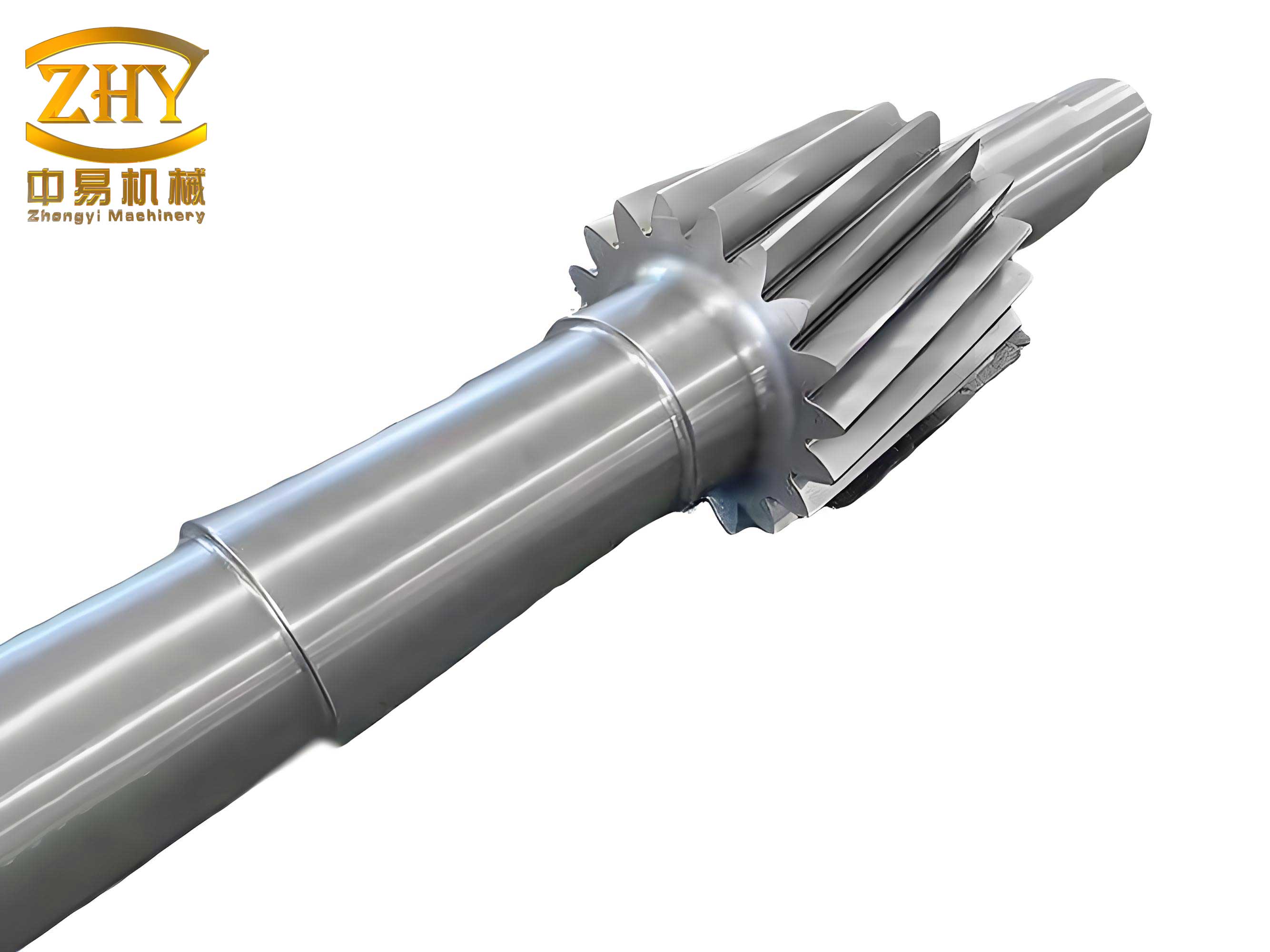
This image illustrates a typical gear shaft assembly, highlighting the helical gear mounted on the shaft. In my model, the gear shaft consists of a cylindrical shaft with stepped diameters, and the helical gear is positioned at a specific section. The contact interfaces between the gear and shaft are critical for load transfer, and I will define these in the FEA setup.
3. Finite Element Analysis
3.1 Meshing
In the ANSYS Workbench Meshing module, I generate a finite element mesh for the assembly. Since the gear and shaft are separate bodies, I use a multibody meshing approach. To ensure accuracy while managing computational resources, I set the minimum element size to 5 mm. The helical gear is meshed with automated tetrahedral elements, while the gear shaft is discretized using hexahedral elements for better quality. The final mesh comprises 29,472 elements and 118,219 nodes. The average mesh quality is 0.72, which falls within an acceptable range for structural analysis. Proper meshing is vital for capturing stress concentrations in gear shafts, especially at fillets and contact regions.
3.2 Material Properties
I define the material properties in the Engineering Data section of Workbench. Both the helical gear and gear shaft are assumed to be made of steel with the following parameters: Young’s modulus E = 2.5e5 MPa (note: typical steel is around 2.1e5 MPa, but I use 2.5e5 as per the reference; in practice, this should be verified), Poisson’s ratio ν = 0.3, and density ρ = 7.85e-6 kg/mm³. These properties are essential for linear elastic analysis of gear shafts.
3.3 Boundary Conditions and Loading
I apply constraints and loads to simulate real-world operating conditions. First, contact settings: the interface between the shaft shoulder and the helical gear hub is set as “Frictionless” to allow relative motion if needed, but in this case, since keyways are omitted, I assume no relative movement and bond the gear to the shaft at that interface using “Bonded” contact. This simplifies the analysis while ensuring force transfer.
Boundary conditions: The gear shaft is supported at two bearing locations. I apply “Cylindrical Support” to the shaft journals, restricting radial and axial displacements but allowing rotation (tangential direction free). At one end of the shaft, I fix all degrees of freedom using a “Displacement” constraint set to zero in X, Y, and Z directions to represent a fixed support.
Loading: I apply gravitational acceleration of 9.8 m/s² in the negative Z-direction to account for weight. A torque of 200 N·m is applied to the teeth of the helical gear, simulating the driving input from another gear. This torque is distributed over the contacting tooth surfaces, but for simplicity, I apply it as a moment on the gear body. The load and constraint setup mimics the theoretical force analysis, ensuring that the gear shaft experiences combined bending and torsion.
The equivalent stress and strain distributions are then computed. I focus on the gear shaft’s critical sections, such as the gear location and shaft transitions. The FEA results provide insights into maximum deformation and stress areas.
3.4 Results and Discussion
After solving, I obtain contour plots of deformation and stress. The maximum deformation occurs at the addendum of the loaded gear tooth, with a value of 0.047 mm. For the gear shaft, the highest deformation is near the shaft shoulder adjacent to the gear, ranging from 0.021 to 0.026 mm. Stress云图 show that the maximum stress in the gear is at the dedendum of the loaded tooth, reaching 65.95 MPa, which is below the yield strength for typical steel. In the gear shaft, stress concentrations appear at the fillet regions (though fillets were omitted, stress rises at geometric changes) and at the contact area with the gear, with peak values between 14.6 and 22.0 MPa. Comparing these to the allowable stress [σ_{-1b}] = 40 MPa for carbon steel, the gear shaft meets strength requirements. The low deformation indicates sufficient stiffness, validating the design for the marine winch application.
To summarize the FEA results, I present a table of key outputs:
| Component | Maximum Deformation (mm) | Maximum Stress (MPa) | Critical Location |
|---|---|---|---|
| Helical Gear | 0.047 | 65.95 | Tooth dedendum |
| Gear Shaft | 0.026 | 22.0 | Shaft shoulder near gear |
These results demonstrate that the gear shaft design is safe under the given loads. However, for more accurate analysis, factors like dynamic loads, fatigue, and thermal effects should be considered in future studies.
4. Conclusion
In this article, I have presented a detailed methodology for analyzing helical gear shafts using theoretical calculations and finite element analysis. By leveraging ANSYS Workbench’s robust data interfaces, I imported a CATIA model to perform static FEA, replacing traditional弯扭组合 strength calculations with a more efficient and visual approach. This process significantly reduces development time for gear shafts and provides designers with a reliable tool for strength verification. The analysis confirms that the helical gear shaft for the marine winch meets strength criteria, with stresses well within allowable limits. The techniques described are applicable to various types of gear shafts, including spur gear shafts, by adjusting parameters like helix angle. Future work could involve dynamic analysis, optimization for weight reduction, and incorporation of manufacturing tolerances to further enhance the design of gear shafts for demanding applications.
Throughout this discussion, the importance of gear shafts in mechanical systems has been emphasized, and the integration of modern simulation tools offers a pathway to more robust and efficient designs. The repeated focus on gear shafts underscores their critical role, and the methods outlined serve as a guide for engineers working on similar components.