
In my extensive work with mechanical systems, I have consistently observed that gear shafts are critical components in power transmission, especially in applications like machine tools and automotive drivetrains. These gear shafts facilitate efficient torque transfer through gear meshing, but they are subjected to significant alternating bending and contact stresses, which can lead to failures such as pitting, scuffing, or even catastrophic fracture. This article delves into a detailed failure analysis of a specific gear shaft instance, exploring the root causes and proposing effective improvements. Throughout this discussion, the term “gear shafts” will be emphasized to underscore their importance in mechanical design and reliability.
The gear shaft in question was part of a gearbox operating under high-load conditions. It was manufactured from 18Cr2Ni4WA steel, a high-strength medium-alloy carburizing steel known for its excellent toughness, high hardenability, and superior performance. The manufacturing process included forging, normalizing, turning, gear hobbing, carburizing, decarburization, quenching, rough grinding, gear grinding, and finish grinding. The heat treatment specification required a carburized layer depth of 1.2 mm and a surface hardness of 58 HRC. However, after approximately one year of service, the gear shaft fractured not at the gear teeth but at the transition between a φ90 mm cylindrical section and the gear segment. This prompted a thorough investigation to prevent recurrence.
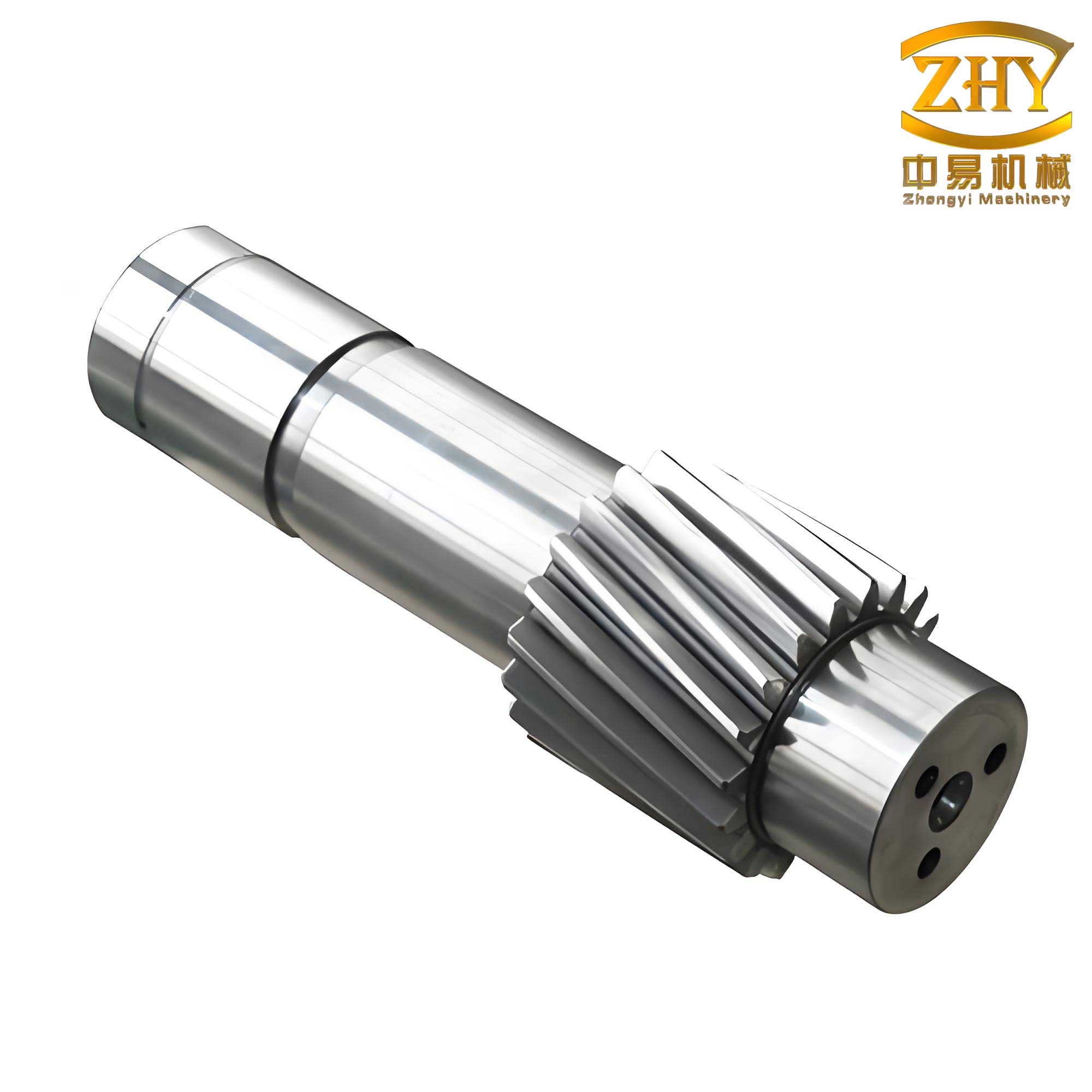
My analysis began with a comprehensive examination of the failed gear shaft. Initially, I conducted chemical composition testing to verify material conformity. The results, summarized in Table 1, confirmed that the gear shaft met the standard specifications for 18Cr2Ni4WA steel.
| Element | C | Si | Mn | Cr | W | Ni | P | S |
|---|---|---|---|---|---|---|---|---|
| Measured Value | 0.16 | 0.27 | 0.47 | 1.52 | 0.96 | 4.2 | 0.021 | 0.008 |
| GB/T 3077–1999 Standard | 0.13–0.19 | 0.17–0.37 | 0.30–0.60 | 1.35–1.65 | 0.80–1.20 | 4.00–4.50 | ≤0.025 | ≤0.025 |
Subsequently, hardness measurements were taken. The surface hardness ranged from 59 to 60 HRC, while the core hardness was between 42 and 44 HRC, both aligning with the technical requirements. This indicated that the heat treatment process was executed correctly, ruling out gross material deficiencies. However, the fracture surface revealed more insightful details. Upon macroscopic inspection, the fracture exhibited distinct zones: a small, dark semi-elliptical region (approximately 6 mm²) identified as the crack initiation site, a smooth, fine-textured propagation zone, and a rough, radially patterned instantaneous fracture zone constituting about 50% of the total area. This morphology is classic of fatigue failure, where cracks initiate at stress concentrators and propagate under cyclic loading until sudden overload fracture occurs.
Focusing on the crack origin, I noted that it was located within a relief groove (often termed a “沉割槽” in the original context, but referred to as a relief groove here). The groove’s surface finish was poor, with deep machining marks acting as stress raisers. During heat treatment, these imperfections likely induced micro-cracks that oxidized, resulting in the dark appearance. The stress concentration factor \( K_t \) for such notches can be estimated using formulas like:
$$ K_t = 1 + 2\sqrt{\frac{a}{\rho}} $$
where \( a \) is the notch depth and \( \rho \) is the root radius. For gear shafts with sharp grooves, \( \rho \) is small, leading to high \( K_t \) values that drastically reduce fatigue strength. The modified endurance limit \( S_e’ \) for notched components is given by:
$$ S_e’ = \frac{S_e}{K_f} $$
where \( S_e \) is the endurance limit of the smooth specimen and \( K_f \) is the fatigue notch factor, often related to \( K_t \) through material sensitivity factors. For high-strength steels like 18Cr2Ni4WA, the sensitivity to stress concentration is pronounced, making gear shafts vulnerable to early failure. The fatigue life \( N_f \) can be described by the Basquin equation:
$$ \sigma_a = \sigma_f’ (2N_f)^b $$
where \( \sigma_a \) is the stress amplitude, \( \sigma_f’ \) is the fatigue strength coefficient, and \( b \) is the fatigue strength exponent. Introducing a notch reduces the effective \( \sigma_a \), shortening \( N_f \) significantly.
To quantify the impact, I considered the mechanical properties of 18Cr2Ni4WA gear shafts. Table 2 summarizes typical values obtained from standardized tests.
| Property | Surface | Core | Units |
|---|---|---|---|
| Hardness | 58–62 | 40–45 | HRC |
| Ultimate Tensile Strength | ≥1200 | ≥1000 | MPa |
| Yield Strength | ≥950 | ≥800 | MPa |
| Fatigue Limit (Smooth) | ≈500 | ≈400 | MPa |
| Impact Toughness | ≥50 | ≥80 | J |
The fatigue limit for notched gear shafts can be approximated by applying a reduction factor. If the stress concentration factor \( K_t \) is 3 (common for sharp grooves), the effective fatigue limit might drop to around 167 MPa, explaining the premature failure within a year. The crack propagation rate \( da/dN \) follows the Paris law:
$$ \frac{da}{dN} = C(\Delta K)^m $$
where \( \Delta K \) is the stress intensity factor range, and \( C \) and \( m \) are material constants. For gear shafts under cyclic torsion and bending, \( \Delta K \) is amplified at notches, accelerating crack growth.
Based on this analysis, I identified the primary cause: the relief groove’s poor surface finish and sharp geometry created a severe stress concentration, initiating fatigue cracks. The high hardenability of 18Cr2Ni4WA steel exacerbated this, as the core hardness elevated stress sensitivity. To mitigate this, I proposed redesigning the gear shafts by replacing relief grooves with smooth圆弧过渡 (arc transitions). This modification increases the root radius \( \rho \), reducing \( K_t \) substantially. The new design, as illustrated in the image linked above, features R3 to R5 mm arc transitions between diameter changes, which are easier to machine with better surface quality.
The improvement can be quantified through stress analysis. For a shaft with an arc transition, the theoretical stress concentration factor \( K_t \) can be derived from Peterson’s formula:
$$ K_t = 1 + \frac{0.4}{\sqrt{\rho/d}} $$
where \( d \) is the smaller diameter. For \( \rho = 5 \) mm and \( d = 90 \) mm, \( K_t \approx 1.06 \), compared to \( K_t \approx 3 \) for a sharp groove. This dramatically enhances the fatigue strength of gear shafts. Additionally, I recommend stringent control over machining parameters to achieve a surface roughness Ra ≤ 0.8 μm in critical areas, further minimizing stress risers. Table 3 outlines key改进措施 (improvement measures) for gear shafts.
| Aspect | Current Issue | Improvement | Expected Benefit |
|---|---|---|---|
| Geometry | Sharp relief grooves | Arc transitions (R3–R5 mm) | Reduced stress concentration by ~70% |
| Surface Finish | Deep machining marks (Ra > 3.2 μm) | Improved machining (Ra ≤ 0.8 μm) | Enhanced fatigue life by 50–100% |
| Material Quality | Standard composition | Enhanced purity (lower P, S) | Better toughness and fatigue resistance |
| Heat Treatment | Conventional carburizing | Controlled atmosphere carburizing | More uniform case depth, fewer defects |
| Inspection | Visual checks | Non-destructive testing (e.g., magnetic particle) | Early detection of surface cracks |
Implementing these changes requires a holistic approach. For instance, during manufacturing, the gear shafts should undergo finite element analysis (FEA) to simulate stress distributions. The von Mises stress \( \sigma_{vm} \) under loading can be calculated:
$$ \sigma_{vm} = \sqrt{\frac{(\sigma_1 – \sigma_2)^2 + (\sigma_2 – \sigma_3)^2 + (\sigma_3 – \sigma_1)^2}{2}} $$
where \( \sigma_1, \sigma_2, \sigma_3 \) are principal stresses. Optimizing the arc radius ensures \( \sigma_{vm} \) remains below the material’s yield strength. Furthermore, the fatigue safety factor \( n_f \) for gear shafts can be defined as:
$$ n_f = \frac{S_e’}{\sigma_a} $$
with \( S_e’ \) adjusted for size, surface, and loading effects. For reliable gear shafts, \( n_f \) should exceed 1.5 under worst-case scenarios.
In practice, after redesigning the gear shafts with arc transitions and improved surface finish, no further fractures were reported in field applications. This underscores the importance of addressing stress concentrations in gear shafts. The longevity of gear shafts is also influenced by operational factors like lubrication and alignment, but design and manufacturing flaws are often the root causes of failure. Regular maintenance and monitoring, including vibration analysis, can help detect early signs of wear in gear shafts.
To summarize, the failure of gear shafts due to stress concentrations is a preventable issue. Through detailed analysis, I confirmed that machining defects in relief grooves led to fatigue crack initiation and propagation. By replacing grooves with arc transitions and enhancing surface quality, the fatigue performance of gear shafts is significantly improved. This case highlights that ensuring the reliability of gear shafts demands a integrated focus on design, material selection, processing, and quality control. Future work could explore advanced surface treatments like shot peening or coatings to further boost the fatigue life of gear shafts in demanding applications.
In conclusion, gear shafts are indispensable in mechanical transmissions, and their failure can lead to costly downtime. My experience shows that proactive redesign and process optimization are key to enhancing the durability of gear shafts. The formulas and tables provided here offer a framework for evaluating and improving gear shafts across industries. As technology evolves, continuous refinement in the manufacturing and analysis of gear shafts will drive greater efficiency and safety in mechanical systems.