
The premature failure of mechanical components through cracking during storage or service represents a significant reliability and economic concern in the automotive industry. Among these, **gear shafts** are critical power transmission elements, and their integrity is paramount for system safety and performance. This article presents a detailed investigation into the root cause of longitudinal cracking observed in 20CrMnTi steel **gear shafts** intended for automotive steering systems. The failure occurred during the storage period post-manufacturing, without any applied service loads. A systematic analytical approach encompassing material characterization, metallurgical examination, and fractographic analysis was employed to identify the failure mechanism. The findings conclusively point to hydrogen-induced delayed cracking under the influence of residual thermal stresses. This case study underscores the importance of integrated material processing control to mitigate such failures in high-strength **gear shafts**.
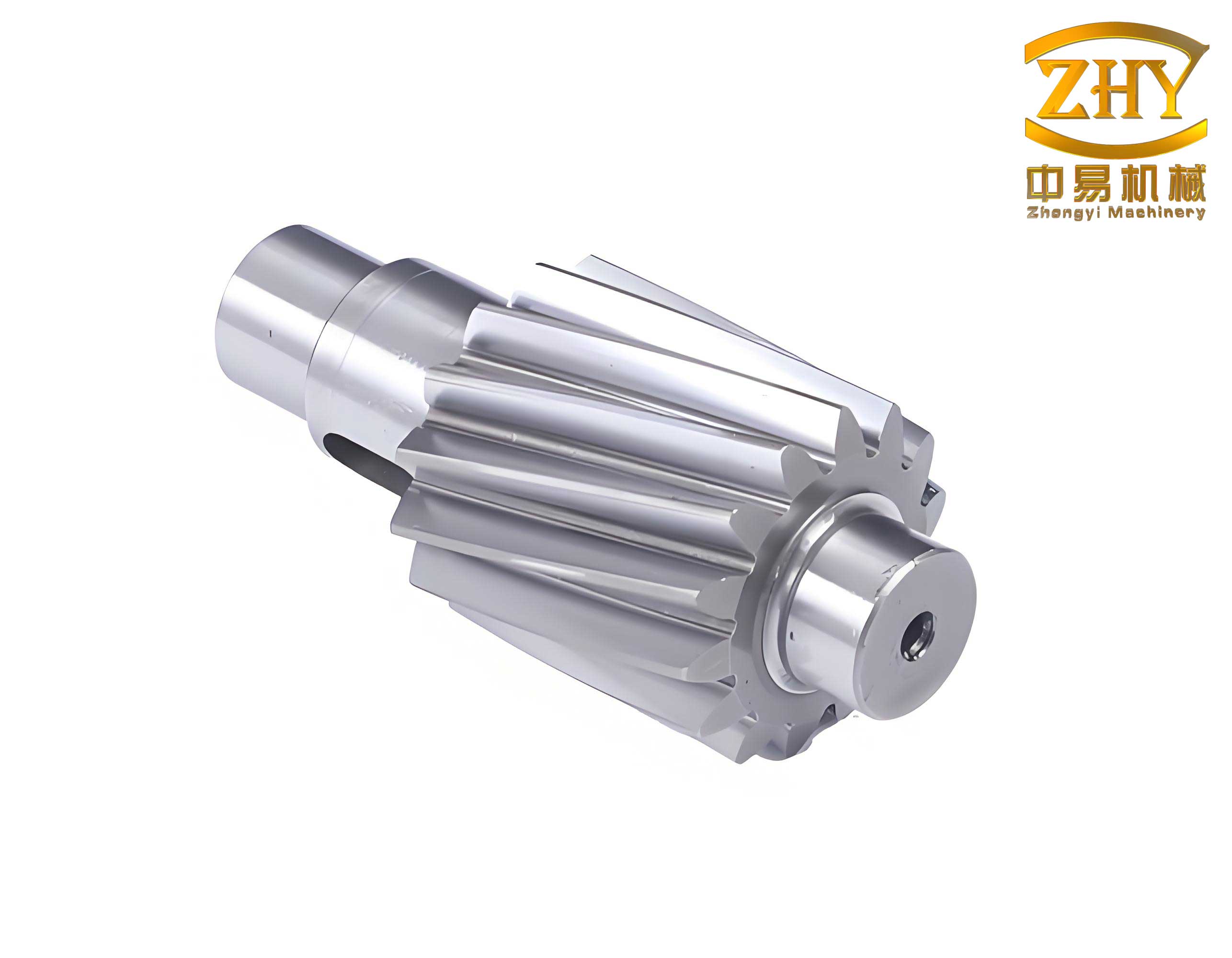
The **gear shafts** under investigation were manufactured from case-hardening steel 20CrMnTi, a common choice for automotive components due to its excellent hardenability and core toughness. The standard manufacturing process for such **gear shafts** involves machining, carburizing, quenching, and tempering. The failures were identified during final quality inspection, where multiple units exhibited longitudinal cracks, rendering the batch non-conforming. The primary objective of this analysis is to determine the failure mechanism, as understanding the root cause is essential for implementing corrective actions in the production process and preventing future recurrence in **gear shafts**.
Analytical Methodology and Process Flow
A comprehensive analytical protocol was followed to dissect the failure of the **gear shafts**. The workflow integrated multiple techniques to evaluate material conformity, mechanical properties, microstructure, and fracture surface characteristics. The synergy of these methods provides a holistic view of the failure causation.
The analytical process can be summarized by the following sequence:
$$ \text{Macroscopic Examination} \rightarrow \text{Chemical Analysis} \rightarrow \text{Hardness/Case Depth Measurement} \rightarrow \text{Metallography} \rightarrow \text{Fractography (SEM)} \rightarrow \text{Mechanism Deduction} $$
This structured approach ensures no critical evidence is overlooked in the failure analysis of the **gear shafts**.
Material Conformity and Mechanical Property Assessment
The first step involved verifying the base material’s conformity to the specified grade. Chemical composition analysis was conducted using optical emission spectrometry. The results, compared against the GB/T 3077-1999 standard for 20CrMnTi steel, are presented in Table 1. All elemental concentrations were within the specified limits, confirming the correct material was used for the **gear shafts**.
| Element | C | Si | Mn | Cr | Ti | P | S |
|---|---|---|---|---|---|---|---|
| Measured Value | 0.211 | 0.278 | 1.06 | 1.21 | 0.0531 | 0.0153 | 0.0088 |
| Standard Range | 0.17-0.23 | 0.17-0.37 | 0.80-1.10 | 1.00-1.30 | 0.04-0.10 | ≤0.035 | ≤0.035 |
The surface mechanical properties and case depth are critical for **gear shafts** performance. Surface and core hardness were measured using Rockwell and Vickers scales, respectively. The effective case depth was determined by microhardness profiling from the surface to the core until a hardness of 550 HV was reached. The results, summarized in Table 2, confirm that the surface hardness and case depth met the drawing specifications (58-63 HRC and 1.0-1.5 mm, respectively). The core hardness also fell within the required range of 27-42 HRC, indicating a nominally correct heat treatment for the **gear shafts**.
| Location | Measurement | Value | Specification |
|---|---|---|---|
| Surface Hardness | HV10 (Point I) | 708 HV | 58 – 63 HRC |
| HV10 (Point II) | 720 HV | ||
| HV10 (Point III) | 726 HV | ||
| Core Hardness | HRC (Average) | ~32 HRC | 27 – 42 HRC |
| Case Depth | CHD (550 HV) | 1.43 mm | 1.0 – 1.5 mm |
Metallurgical and Fractographic Investigation
Metallographic examination of a section through the crack in the **gear shaft** was performed. The crack was observed to propagate longitudinally, reaching a depth of approximately 14.1 mm and extending towards the central axis. The microstructure at the surface consisted of martensite, retained austenite, and fine carbides, which is typical for a carburized and quenched steel. No evidence of gross non-metallic inclusions or decarburization was found in the vicinity of the crack path, ruling out material defects or improper atmosphere control during carburizing as direct causes for the failure of the **gear shafts**.
The fracture surface was opened for detailed examination. Macroscopic observation revealed a relatively flat fracture morphology with the crack origin located approximately 2 mm beneath the tooth surface. This subsurface origin is a characteristic feature often associated with stress-driven failures in hardened components like **gear shafts**.
Scanning Electron Microscopy (SEM) of the crack initiation zone provided definitive evidence. The fracture mode at the origin was predominantly intergranular, exhibiting a “rock candy” appearance. Crucially, the faceted grain surfaces displayed a distinct “flaky” or “layered” morphology, as shown in high-magnification micrographs. This specific feature is a recognized signature of Hydrogen-Induced Delayed Cracking (HIDC), also known as hydrogen embrittlement. The absence of dimpled rupture or fatigue striations further supports a brittle, environmentally assisted failure mechanism for these **gear shafts**.
Discussion: Mechanism of Hydrogen-Induced Delayed Cracking
The failure of the **gear shafts** is attributed to Hydrogen-Induced Delayed Cracking (HIDC). This phenomenon is a form of environmentally assisted cracking where atomic hydrogen (H), present within the metal lattice, interacts with tensile stress to cause subcritical crack initiation and propagation, often after a latency period. The necessary conditions for HIDC in high-strength steels like those used for **gear shafts** are: a susceptible microstructure (high-strength martensite), a source of hydrogen, and a sustained tensile stress.
1. Source of Hydrogen: Hydrogen can be introduced during several stages of **gear shaft** manufacturing. Common sources include:
- Atmospheric moisture dissociation during high-temperature carburizing: $$ \text{H}_2\text{O} \rightarrow \text{O} + 2\text{H} $$
- Acidic cleaning or pickling processes prior to heat treatment.
- Electroplating (if applied), though not typical for this component.
Even with controlled atmospheres, trace amounts of hydrogen can be absorbed by the steel.
2. Tensile Stress Field: In carburized and quenched **gear shafts**, a complex residual stress profile is generated. The high-carbon surface layer transforms to martensite at a lower temperature (Ms) than the lower-carbon core. This sequential transformation creates significant internal stresses. While the surface is typically in a state of compressive residual stress (beneficial for fatigue), a subsurface region exists where the residual stress transitions to maximum tensile stress. This tensile stress zone often coincides with the location of maximum shear stress under applied loads. The crack origin at ~2 mm below the surface in the failed **gear shafts** aligns perfectly with this region of high residual tensile stress, providing the driving force for crack propagation.
3. Mechanism of Crack Initiation and Growth: The synergistic action of stress and hydrogen leads to failure. Dissolved hydrogen atoms diffuse through the crystal lattice, aided by stress gradients (stress-directed diffusion). They accumulate at regions of high triaxial stress, such as grain boundaries or dislocation arrays near the subsurface tensile zone in the **gear shafts**.
The presence of hydrogen reduces the cohesive strength of the metal lattice at these sites. A widely accepted model describes the critical condition for crack initiation as:
$$ \sigma_{th} = f([H], T, K_{IC}) $$
where $\sigma_{th}$ is the threshold stress for HIDC, $[H]$ is the local hydrogen concentration, $T$ is temperature, and $K_{IC}$ is the material’s fracture toughness. For a given hydrogen concentration and microstructure, a critical stress intensity ($K_{IH}$) exists below which cracking does not occur.
Once a micro-crack initiates, it creates a new stress concentration at its tip. Hydrogen diffuses towards this new tip, the local cohesion fails again, and the crack advances incrementally. This process can be modeled by hydrogen diffusion laws (Fick’s second law) coupled with crack tip stress fields:
$$ \frac{\partial C}{\partial t} = D \nabla^2 C + \frac{D V_H}{RT} \nabla \cdot (C \nabla \sigma_h) $$
where $C$ is hydrogen concentration, $D$ is the diffusion coefficient, $V_H$ is the partial molar volume of hydrogen, $R$ is the gas constant, $T$ is temperature, and $\sigma_h$ is the hydrostatic stress. The term $\nabla \cdot (C \nabla \sigma_h)$ accounts for stress-directed diffusion, which is crucial in **gear shafts** with steep residual stress gradients.
The “delayed” nature stems from the time required for hydrogen to diffuse and reach the critical concentration at the susceptible site. The **gear shafts** cracked during storage because this latency period ended without any external load, implicating the residual stresses as the sole driving force.
| Factor Category | Specific Condition in Failed Gear Shafts | Role in HIDC Mechanism |
|---|---|---|
| Material & Microstructure | High-strength martensitic case (≥58 HRC) | High susceptibility to hydrogen embrittlement. Susceptibility generally increases with yield strength. |
| Stress State | High residual tensile stress at subsurface region (~2 mm depth) | Provides the necessary mechanical driving force for crack initiation and propagation. Acts as a trap site for hydrogen accumulation. |
| Hydrogen Content | Presence of atomic hydrogen introduced during processing | Embrittles the microstructure, reducing cohesive strength at grain boundaries. The local concentration must exceed a critical value. |
| Time | Cracking occurred during storage (no external load) | Manifestation of the “delayed” failure, allowing time for hydrogen diffusion and accumulation to critical levels. |
Conclusions and Preventive Recommendations for Gear Shafts
The comprehensive analysis confirms that the longitudinal cracking in the 20CrMnTi **gear shafts** was caused by Hydrogen-Induced Delayed Cracking (HIDC). The failure occurred under the influence of internal residual tensile stresses originating from the carburizing and quenching heat treatment process, in combination with the presence of residual hydrogen in the material. The fracture initiated at a subsurface location corresponding to the region of maximum tensile stress and exhibited classic intergranular features with flaky facets indicative of hydrogen embrittlement.
To prevent recurrence of such failures in future production batches of **gear shafts**, the following integrated measures are recommended, focusing on reducing both residual stress and hydrogen content:
1. Optimize Heat Treatment and Stress Relief:
- Immediate Tempering: Ensure **gear shafts** are tempered as soon as possible after quenching to reduce residual stresses and allow effusion of hydrogen. The tempering temperature can be optimized; a slightly higher temperature within the specification range may promote greater stress relaxation without adversely affecting hardness. The tempering process aids in hydrogen desorption, as the diffusion coefficient $D$ increases with temperature according to an Arrhenius relationship: $$ D = D_0 \exp\left(-\frac{Q}{RT}\right) $$ where $D_0$ is a pre-exponential factor and $Q$ is the activation energy for diffusion.
- Extended Tempering Duration: Implementing a longer tempering cycle can further decrease residual stress levels and provide more time for hydrogen to escape from the **gear shafts**.
2. Minimize Hydrogen Intake During Processing:
- Controlled Atmosphere: Strictly monitor and control the dew point in the carburizing furnace atmosphere to minimize hydrogen generation from moisture.
- Process Review: Review any cleaning, pickling, or surface preparation steps prior to heat treatment. Replace acidic cleaners with alkaline or neutral alternatives where feasible.
- Post-Processing Baking: Introduce a low-temperature baking operation (e.g., 190-230°C for 8-24 hours) after final tempering. This is a highly effective method to drive out residual hydrogen from the **gear shafts** without altering the mechanical properties.
3. Material and Design Considerations:
- While the material specification is appropriate, collaboration with steel suppliers to ensure low initial hydrogen content in the raw material bar stock is beneficial.
- Review the carburizing profile to potentially achieve a more favorable residual stress distribution, though this must be balanced with core properties and case depth requirements for the **gear shafts**.
By implementing a holistic strategy addressing both stress and hydrogen factors, the risk of hydrogen-induced delayed cracking in high-strength **gear shafts** can be substantially mitigated, ensuring long-term reliability and performance in demanding automotive applications.