
In the realm of vehicle powertrain engineering, the transmission stands as a critical component, responsible for transmitting power from the engine to the driveline while enabling variable speed and torque. Its performance directly influences vehicle safety, efficiency, and comfort. A transmission is a complex elastic mechanical system comprising primarily the gear shafts assembly—including gears, shafts, bearings, and clutches—and the housing structure. During operation, the gear shafts are subjected to multiple dynamic excitations such as engine torque fluctuations, road load variations, and dynamic gear meshing forces. These excitations induce coupled bending and torsional vibrations in the gear shafts. The resulting dynamic bearing reaction forces act upon the housing, causing elastic deformations and altering its stress state. Conversely, these housing deformations modify the effective support stiffness and damping characteristics for the gear shafts via the bearings, thereby influencing the dynamic behavior of the entire gear train. This bidirectional interaction constitutes a dynamic coupling phenomenon between the gear shafts and the housing. A quantitative understanding of this coupling is essential for accurate prediction of system dynamics, optimization of structural design for durability, and effective vibration and noise control. While previous studies have often treated the housing as rigid or examined the subsystems in isolation, this work aims to develop and solve a fully coupled dynamic model that explicitly accounts for the mutual influence between the elastic housing and the gear shafts assembly. This approach provides a more holistic framework for analyzing transmission dynamics.
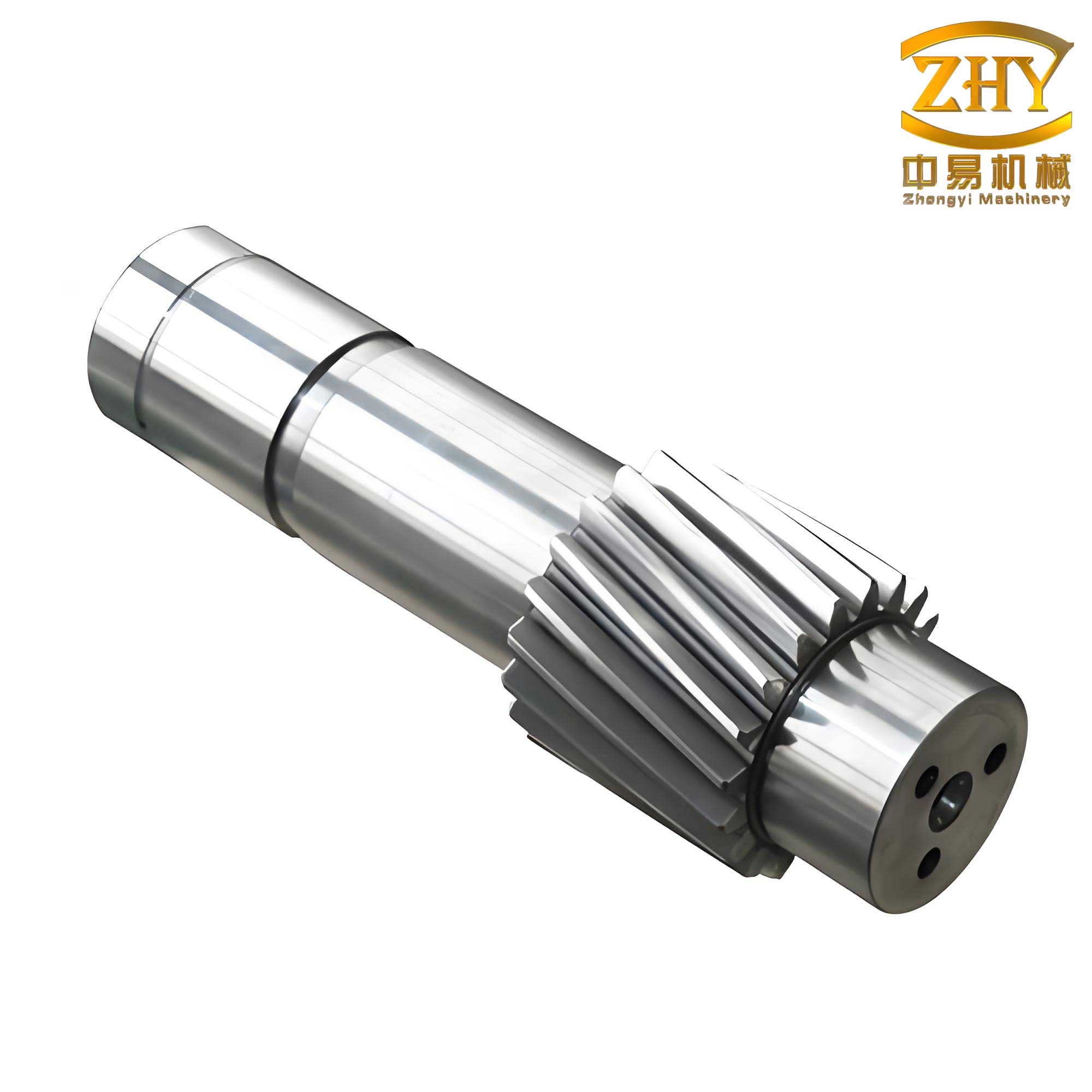
The transmission system under consideration is a multi-speed, constant-mesh gearbox representative of those used in heavy-duty vehicles, such as tracked platforms. It features a three-shaft layout with multiple gear pairs and wet clutches for gear selection. For the purpose of this study, which focuses on steady-state operating conditions, the sixth gear is selected as the primary analysis case. This gear is often associated with high-speed operation where vibration and noise concerns are pronounced. The power flow in this gear involves specific gear pairs along the input, counter, and output shafts. The gear shafts system includes spur or helical gears, rolling element bearings, synchronizer or clutch assemblies, and the supporting shafts. The housing is a intricate thin-walled casting, typically made of aluminum alloy, designed to enclose and support all internal components.
A foundational step in coupling analysis is the characterization of the housing’s elastic properties. The housing cannot be assumed rigid, as its deformations under load are significant. A detailed finite element (FE) model of the housing was constructed. The model involved geometry cleanup, meshing with first-order tetrahedral solid elements (approximately 440,506 elements), and assignment of material properties (cast aluminum alloy, Young’s modulus ~70 GPa, Poisson’s ratio ~0.33). Boundary conditions for free-free modal analysis were applied. The Lanczos method was employed to extract the natural frequencies and mode shapes of the housing. The first 20 modes were computed, revealing that lower-order modes often represented local deformations (e.g., around ribs and bearing boss areas), while higher-order modes (e.g., modes 19 and 20) exhibited global bending or twisting of the housing structure. Areas with large modal amplitudes were identified as potential “hot spots” prone to higher vibration levels under excitation.
To validate the FE model, experimental modal analysis (EMA) was conducted on the physical housing assembly. The housing was suspended with soft ropes to approximate free-free boundary conditions. Impact testing was performed using an instrumented hammer and tri-axial accelerometers at numerous measurement points covering the housing surface. Frequency Response Functions (FRFs) were acquired and processed using the PolyMAX method in commercial software to identify experimental modal parameters (natural frequencies and mode shapes). A comparison between the FE-predicted and experimentally identified natural frequencies for the first 20 modes is presented in Table 1. The maximum relative error is within an acceptable margin (less than 6%), confirming the fidelity of the FE model for subsequent dynamic analysis. This validated elastic model of the housing is crucial for the coupled simulation.
| Mode Number | Experimental Frequency (Hz) | FEM Frequency (Hz) | Relative Error (%) |
|---|---|---|---|
| 1 | 367.2 | 376.8 | 2.55 |
| 2 | 391.4 | 385.1 | 1.60 |
| 3 | 419.1 | 424.0 | 1.17 |
| 4 | 434.5 | 452.1 | 4.10 |
| 5 | 458.6 | 474.2 | 3.40 |
| 6 | 498.9 | 487.8 | 2.22 |
| 7 | 531.1 | 548.9 | 3.35 |
| 8 | 563.3 | 564.7 | 0.25 |
| 9 | 578.6 | 569.5 | 1.57 |
| 10 | 609.6 | 576.6 | 5.41 |
| 11 | 619.7 | 615.2 | 0.73 |
| 12 | 659.3 | 668.7 | 1.43 |
| 13 | 693.3 | 700.1 | 0.98 |
| 14 | 711.9 | 728.8 | 2.37 |
| 15 | 739.1 | 748.7 | 1.30 |
| 16 | 755.0 | 761.6 | 0.87 |
| 17 | 782.9 | 791.5 | 1.10 |
| 18 | 793.3 | 817.5 | 3.05 |
| 19 | 829.2 | 848.2 | 2.29 |
| 20 | 848.9 | 858.7 | 1.15 |
The core of the coupling methodology lies in mathematically representing the interaction between the housing, the bearings, and the gear shafts. Both the housing and the individual shafts within the gear shafts assembly are treated as elastic bodies. They are discretized into a finite number of mass units or represented via modal coordinates. The bearing support is modeled as a set of linear (or nonlinear) stiffness and damping elements connecting a node on the housing to a corresponding node on a shaft. Consider a simplified one-dimensional representation along a specific direction (e.g., radial direction). Let the housing be discretized into ‘n’ mass units and the shaft into ‘m’ mass units. The equations of motion for a coupled housing-bearing-shaft segment can be derived. For the interface between the i-th housing node and the j-th shaft node connected via a bearing, the governing equations involve terms representing the inertia of the masses, the internal stiffness/damping of the housing and shaft structures, and the coupling stiffness/damping from the bearing. A generalized form for the system can be written using matrices. However, a conceptual set of equations for key nodes illustrates the coupling:
For a housing mass unit mxi at node i adjacent to the bearing connection:
$$ m_{xi} \ddot{x}_{xi} = (k_{xi} + k_{xi+1})x_{xi} – k_{xi+1}x_{x(i+1)} – k_{b}x_{xi} + k_{b}x_{zj} + (c_{xi} + c_{xi+1})\dot{x}_{xi} – c_{xi+1}\dot{x}_{x(i+1)} – c_{b}\dot{x}_{xi} + c_{b}\dot{x}_{zj} + \ldots $$
For the corresponding shaft mass unit mzj at node j:
$$ m_{zj} \ddot{x}_{zj} = (k_{zj} + k_{zj+1})x_{zj} – k_{zj+1}x_{z(j+1)} – k_{b}x_{zj} + k_{b}x_{xi} + (c_{zj} + c_{zj+1})\dot{x}_{zj} – c_{zj+1}\dot{x}_{z(j+1)} – c_{b}\dot{x}_{zj} + c_{b}\dot{x}_{xi} + \ldots $$
Here, xxi and xzj represent the displacements of housing and shaft nodes, respectively. kxi, cxi are the equivalent internal stiffness and damping coefficients between housing discrete units; kzj, czj are those for the shaft; and kb, cb are the bearing’s support stiffness and damping in the considered direction. This formulation ensures that dynamic forces from the gear shafts are transmitted to the housing via the bearing stiffness/damping, and conversely, housing deformations impose kinematic constraints and additional dynamic loads back onto the gear shafts through the same bearing elements. This bidirectional link is the essence of the dynamic coupling for the entire gear shafts and housing system.
Building upon this coupling concept, a detailed multi-body dynamics (MBD) model of the complete transmission was developed using a commercial simulation environment. The model integrates several key sub-models:
1. Gear Pair Model: Each engaged gear pair in the power path is modeled dynamically. A common approach to incorporate dynamic meshing excitation is to use a “dummy gear” or a torsional spring-damper element between the driving and driven gears. The equations governing a single gear pair can be expressed as:
$$ J_{g1} \ddot{\theta}_1 = T_1 – \frac{1}{i} \left[ k’_g e'(t) + k’_g (\theta_c – \theta_2) + c’_g (\dot{\theta}_c – \dot{\theta}_2) \right] $$
$$ J_{g2} \ddot{\theta}_2 = \left[ k’_g e'(t) + k’_g (\theta_2 – \theta_c) + c’_g (\dot{\theta}_2 – \dot{\theta}_c) \right] – T_2 $$
Here, Jg1 and Jg2 are moments of inertia; θ1, θ2, θc are rotational angles; T1 and T2 are input/output torques; i is gear ratio; k’g = kgRb2 and c’g = cgRb2 are equivalent torsional stiffness and damping (Rb is base radius); e'(t) = e(t)/Rb is equivalent transmission error. Gear geometry parameters for the studied gear pairs are summarized in Table 2.
| Parameter | Gear Pair 1 | Gear Pair 2 |
|---|---|---|
| Driving Gear Teeth | 33 | 21 |
| Driven Gear Teeth | 26 | 37 |
| Module (mm) | 9 | 9 |
| Pressure Angle (°) | 20 | 20 |
| Face Width (mm) | 35 | 35 |
| Profile Shift Coefficient | -0.3 / +0.3 | -0.3 / +0.3 |
2. Bearing Model: Rolling element bearings are critical as they define the coupling points between the gear shafts and the housing. Their time-varying stiffness is calculated based on Hertzian contact theory and bearing geometry. The stiffness matrix for a bearing connects the six degrees of freedom (DOFs) of the inner race (shaft) to the six DOFs of the outer race (housing). For a ball bearing, the radial stiffness varies with load and can be computed from its parameters. A sample of key bearing geometric parameters used in the model is listed in Table 3. The damping of bearings is often estimated as a fraction of the critical damping or based on empirical formulas.
| Bearing ID | Pitch Diameter (mm) | Ball Diameter (mm) | Contact Angle (°) | Number of Balls |
|---|---|---|---|---|
| Bearing 1, 3, 6 | 110 | 20 | 35 | ~12 |
| Bearing 2 | 125 | 22.5 | 35 | ~12 |
| Bearing 4 | 117.5 | 21.25 | 35 | ~12 |
| Bearing 5, 8 | 140 | 25 | 35 | ~12 |
| Bearing 7, 9 | 147.5 | 26.25 | 35 | ~12 |
3. Clutch Model: For the studied steady-state gear, engaged wet clutches are modeled as rigid connections capable of transmitting torque. The torque capacity MCC of a clutch is given by:
$$ M_{CC} = \mu_d R_{eq} z F_{non} $$
where μd is the dynamic friction coefficient, Req is the effective radius, z is the number of friction pairs, and Fnon is the normal applied force. Disengaged clutches are modeled as disconnected inertia elements.
4. Shaft and Housing Elastic Models: The individual shafts within the gear shafts assembly are also treated as flexible bodies. Their elastic properties are derived from FE models and reduced to modal representations (e.g., using component mode synthesis) to create modal neutral files that can be imported into the MBD environment. The housing’s elastic FE model, validated earlier, is similarly reduced and incorporated as a flexible component with its mass and stiffness characteristics.
5. Excitation Sources: The model includes multiple excitation sources: engine torque ripple (approximated as a sinusoidal fluctuation around the mean torque at engine firing frequency), static load from road resistance, and most importantly, the dynamic gear meshing excitation characterized by static transmission error (STE) and time-varying mesh stiffness. The mesh stiffness of the gear pairs is modeled as a periodic function of the gear rotation.
The final coupled model integrates all these components: the flexible housing, the flexible shafts of the gear shafts system, the discrete gear pair models, the nonlinear bearing connections, and the clutch elements. The interactions are defined through the bearing connections that link specific nodes on the flexible housing to specific nodes on the flexible gear shafts. This results in a high-fidelity model where dynamics of the gear shafts directly affect housing deformation and vice versa.
Simulations were conducted for the sixth gear steady-state condition with an engine speed of 2000 rpm. Two simulation cases were run: one with the fully coupled model (flexible housing coupled to flexible gear shafts via bearings) and one with a simplified model where the housing was treated as rigid (effectively decoupling the gear shafts dynamics from housing deformation, though bearing stiffness values were still used). The GSTIFF integrator with a time step of 0.01 ms was employed. Key dynamic responses were analyzed to assess the impact of housing elasticity on the gear shafts behavior.
Kinematic Output: The output speed of the transmission was monitored. The time history showed that the output speed fluctuated around a mean value corresponding to the gear ratio. Crucially, the waveforms for the coupled and uncoupled (rigid housing) cases were virtually identical. This confirms that kinematic parameters like speed ratios are governed solely by the kinematic constraints of the gear train (tooth numbers) and input speed, and are not influenced by the elastic coupling between the gear shafts and the housing. The fluctuations were due to torsional compliance in the system and excitation frequencies.
Dynamic Loads: The dynamic gear mesh force for one of the engaged pairs was extracted. The force in the plane of action direction (y-direction in the model coordinate system) is shown conceptually. The mean value and the fluctuation pattern were very similar between the coupled and uncoupled simulations. The relative difference in mean force was less than 1%, and in peak force less than 3%. This indicates that the dynamic meshing force, a primary internal excitation within the gear shafts, is predominantly determined by the gear design parameters, applied torque, and the inherent time-varying mesh stiffness. The influence of housing flexibility on the meshing force itself is minimal because the gear mesh is a highly localized contact phenomenon largely independent of far-field boundary conditions at the bearings, provided the shaft bending modes are not severely excited.
Bearing Reaction Forces: In contrast, the bearing reaction forces exhibited significant differences. Taking a representative bearing (e.g., bearing 6 on the output shaft), the radial reaction force (y-direction) time history was analyzed. With the rigid housing assumption, the force showed periodic variations linked to gear meshing frequencies but with relatively contained amplitude. In the fully coupled simulation, the same bearing reaction force displayed much larger amplitude fluctuations and a more complex waveform. The root mean square (RMS) value was substantially higher in the coupled case. This is a direct consequence of the coupling: dynamic loads from the gear shafts cause the housing to deform elastically. This deformation alters the relative displacement between the housing and shaft at the bearing location. Since the bearing is modeled as a spring-damper, this changed relative displacement directly translates into a changed reaction force (Fbearing ≈ kbΔx + cbΔv). Therefore, housing elasticity amplifies and modulates the dynamic bearing forces transmitted from the gear shafts to the housing structure.
Dynamic Response of Gear Shafts: The vibration response (displacement and acceleration) of specific nodes on the gear shafts was examined. For instance, a node on the countershaft near a gear location was monitored. The results clearly showed that considering housing elasticity increased the vibration levels of the gear shafts. The displacement and acceleration amplitudes were larger and contained more high-frequency content in the coupled simulation. This is because the housing, when flexible, does not provide a perfectly rigid foundation. Its dynamic deformation adds another source of motion input to the gear shafts via the bearings. Essentially, the housing acts as a dynamic vibration absorber or a coupled oscillator, exchanging energy with the gear shafts. This alters the effective system natural frequencies and mode shapes, leading to different resonant behaviors and overall higher vibration responses in certain frequency bands for the components of the gear shafts.
To validate the coupled dynamic model, real-vehicle road tests were conducted. The transmission was installed in its vehicle, and tests were performed on a smooth concrete road. Tri-axial accelerometers were mounted at several critical locations on the transmission housing surface, identified from the modal analysis as areas prone to higher vibration (e.g., near bearing bosses, on side walls, and on the top cover). Data was acquired for various gears and vehicle speeds. For direct comparison with the sixth-gear simulation, data corresponding to a vehicle speed of 70 km/h (engine ~2000 rpm) was extracted. The measured acceleration signals contained broadband noise and excitations from other vehicle sources (e.g., engine, driveline). Therefore, the data was post-processed. A low-pass filter with a cutoff frequency of 2000 Hz was applied to remove very high-frequency noise. Furthermore, since the simulation model did not include certain high-frequency excitations present in the real vehicle (e.g., from other non-power-carrying gear pairs), a band-stop filter was also applied around specific known mesh frequencies not relevant to the primary power path in the simulation. This allowed for a more apples-to-apples comparison of the vibration due to the main gear shafts excitation.
The filtered experimental acceleration time histories and their frequency spectra were compared against the simulated housing surface accelerations from the coupled model at corresponding locations. The time-domain waveforms showed similar trends and periodicities, dominated by the gear meshing frequencies and their harmonics. The frequency spectra showed good agreement in the dominant peaks corresponding to the meshing frequencies of the power-carrying gear pairs in the gear shafts. A quantitative comparison of the RMS values of the normal-direction acceleration at several measurement points is presented in Table 4. The simulation results generally under-predicted the experimental RMS values, with errors ranging up to approximately 33%. This discrepancy is expected and attributable to several factors: (1) The real vehicle test includes additional vibration inputs not modeled, such as vertical excitation from road roughness acting on the entire vehicle chassis and transmission mounts. (2) The simulation model necessarily involves simplifications, such as idealizing gear tooth profiles, assuming linear bearing behavior, and neglecting friction and micro-impacts in joints. (3) The material damping properties in the simulation are estimated and may not fully capture reality. Despite these differences, the fact that the simulation captured the dominant spectral content and the order of magnitude of vibration, and showed a consistent under-prediction trend, lends strong credibility to the coupled modeling approach. It confirms that the model effectively represents the core dynamic coupling mechanism between the gear shafts and the housing.
| Measurement Point | Simulation RMS (m/s²) | Experiment RMS (m/s²) | Relative Error (%) |
|---|---|---|---|
| Point 2 | 29.1 | 35.3 | 17.6 |
| Point 3 | 39.3 | 51.5 | 23.7 |
| Point 4 | 39.9 | 51.1 | 21.9 |
| Point 5 | 124.3 | 83.8 | 32.6 |
| Point 6 | 34.6 | 48.3 | 28.4 |
| Point 7 | 95.1 | 132.2 | 28.1 |
| Point 8 | 64.7 | 90.5 | 28.5 |
This research has systematically investigated the dynamic coupling between the gear shafts assembly and the housing in a vehicle transmission. A methodology was developed to integrate a flexible housing model, derived from validated FE and experimental modal analysis, with a detailed multi-body dynamics model of the gear shafts system. The coupling is explicitly realized through bearing models that connect the elastic degrees of freedom of the housing to those of the gear shafts. The primary conclusions are as follows:
First, the kinematic output of the transmission, such as speed ratio, is invariant to the housing elasticity and is solely determined by the gear train geometry and input conditions. Second, the dynamic gear meshing forces within the gear shafts are also largely unaffected by housing flexibility, as they are governed by local gear tooth contact mechanics and system torque. Third, and most significantly, the bearing reaction forces and the vibration responses of both the housing and the gear shafts are strongly influenced by the coupling. Housing elasticity amplifies dynamic bearing forces and alters the vibration characteristics of the gear shafts. The bearing forces acting on the housing are higher when coupling is considered, which has direct implications for housing fatigue life and radiated noise. Conversely, the vibration levels of the gear shafts themselves are increased due to the dynamic feedback from the deforming housing structure. This bidirectional interaction must be accounted for in high-fidelity dynamic simulations aimed at predicting noise and vibration harshness (NVH) or performing structural durability analysis.
The coupled model was partially validated against real-vehicle road test data. While absolute acceleration levels showed some under-prediction due to unmodeled excitation sources and system complexities, the model successfully captured the dominant frequency content and the general vibration behavior, confirming its utility. The study underscores the importance of considering the gear shafts and housing as a coupled dynamic system rather than as isolated subsystems. This integrated approach provides a more accurate and comprehensive tool for transmission design optimization, particularly in the context of lightweighting (which increases housing flexibility) and the pursuit of higher power density and lower NVH in modern vehicles. Future work could extend this model to include nonlinear bearing clearance effects, more detailed lubricated gear contact models, and transient events like gear shifts to further enhance its predictive capabilities for the complete dynamic behavior of vehicle transmission systems.