
In my extensive experience with heavy-duty machinery, I have encountered numerous cases of gear shafts failing due to longitudinal cracking. This phenomenon is particularly critical in applications such as reducers and transmissions, where gear shafts are subjected to high torsional and bending stresses. The integrity of these gear shafts is paramount for operational safety and efficiency. Through this article, I aim to delve deep into the root causes of longitudinal cracking in gear shafts, focusing on material properties, heat treatment processes, and stress distributions. I will present my findings using detailed tables, mathematical formulations, and practical insights to provide a comprehensive guide for engineers and metallurgists.
Gear shafts are fundamental components in power transmission systems, often made from alloy steels to withstand demanding conditions. One common material is 18CrNiMo7-6 steel, a low-carbon, high-alloy carburizing grade known for its excellent hardenability and mechanical properties. However, despite its advantages, I have observed that gear shafts fabricated from this steel can develop longitudinal cracks during manufacturing or service, leading to catastrophic failures. My analysis typically begins with a thorough examination of the material composition and processing history.
The chemical composition of gear shafts plays a pivotal role in their performance. For instance, 18CrNiMo7-6 steel contains significant amounts of chromium, molybdenum, and nickel, which enhance淬透性 (hardenability). In my investigations, I often compare the actual composition against standard specifications to identify deviations. Below is a table summarizing the typical chemical requirements and an example from a failed gear shaft.
| Element | Standard Range (wt.%) | Measured Value (wt.%) |
|---|---|---|
| C | 0.15–0.21 | 0.18 |
| Si | ≤0.40 | 0.22 |
| Mn | 0.50–0.90 | 0.69 |
| Cr | 1.50–1.80 | 1.69 |
| Mo | 0.25–0.35 | 0.29 |
| Ni | 1.40–1.70 | 1.55 |
| P | ≤0.025 | 0.006 |
| S | ≤0.020 | 0.002 |
As shown, the composition of the failed gear shaft aligns with standards, ruling out material impurities as a primary cause. This directs my attention to the heat treatment processes, which are crucial for achieving desired properties in gear shafts. The standard workflow for such gear shafts involves forging, normalizing, rough machining, re-normalizing, finish machining, carburizing, quenching, and grinding. Carburizing is performed to create a hard, wear-resistant surface while maintaining a tough core.
In my analysis of heat treatment, I focus on the quenching step, as it often introduces residual stresses that can lead to cracking. For gear shafts made of high-hardenability steels like 18CrNiMo7-6, the cooling rate must be carefully controlled. A common pitfall is overly rapid quenching, which can cause the entire cross-section to harden, creating unfavorable stress patterns. I model the cooling process using heat transfer equations. The temperature distribution during quenching can be approximated by Fourier’s law:
$$ \frac{\partial T}{\partial t} = \alpha \nabla^2 T $$
where \( T \) is temperature, \( t \) is time, and \( \alpha \) is thermal diffusivity. For a cylindrical gear shaft of radius \( R \), the solution under certain boundary conditions yields insights into cooling gradients. If the surface cools too quickly relative to the core, thermal stresses develop. These stresses, combined with transformation stresses from martensite formation, can exceed the material’s tensile strength.
To quantify this, I often measure hardness profiles across the gear shaft’s cross-section. Hardness correlates with strength and residual stress. In a case of longitudinal cracking, I typically observe a characteristic hardness distribution: high surface hardness, a soft zone near the mid-radius, and high core hardness. This pattern indicates through-hardening. Here is a table from a sample analysis of a gear shaft with a diameter of 140 mm:
| Distance from Surface (mm) | Hardness (HRC) |
|---|---|
| 5 | 43.0 |
| 10 | 40.5 |
| 15 | 38.0 |
| 20 | 37.0 |
| 25 | 37.5 |
| 30 | 38.5 |
| 35 | 40.0 |
| 40 (Core) | 43.5 |
The lowest hardness at the mid-radius corresponds to compressive stress, while the surface and core experience tensile stresses. This stress state is precarious for gear shafts, especially after machining operations like turning or grinding remove the surface layer. I derive the residual stress \( \sigma_r \) using a simplified model based on hardness conversion:
$$ \sigma_r \approx k (H – H_0) $$
where \( k \) is a material constant, \( H \) is hardness, and \( H_0 \) is a reference hardness. For gear shafts, when the surface is removed, the stress rebalances, often leading to crack initiation along longitudinal directions where stresses are highest.
Microstructural examination further supports this. In cracked gear shafts, I typically find a surface layer of martensite and retained austenite, with a core of lath martensite. This uniform martensitic structure confirms through-hardening. The presence of excessive martensite increases brittleness and susceptibility to cracking. I evaluate microstructures using standards like JB/T6141.3, focusing on carbide distribution and grain size.
The role of quenching media is critical. In many failures, I trace the issue to the use of fast-quenching oils without adequate cooling control. For gear shafts with high hardenability, slower cooling rates are preferable to avoid through-hardening. I often recommend modifying quenching parameters, such as adding an air-cooling pre-treatment or using milder oils. The cooling time \( t_c \) can be optimized using the equation:
$$ t_c = \frac{R^2}{4\beta} \ln\left(\frac{T_i – T_m}{T_f – T_m}\right) $$
where \( R \) is radius, \( \beta \) is heat transfer coefficient, \( T_i \) is initial temperature, \( T_f \) is final temperature, and \( T_m \) is medium temperature. By adjusting \( \beta \) through agitation or oil temperature, the cooling curve can be tailored to produce a hardened case without a fully hardened core in gear shafts.
Another aspect I consider is the design of gear shafts. Dimensions like diameter and length influence stress concentrations. Finite element analysis (FEA) can predict stress hotspots. For instance, the maximum principal stress \( \sigma_{max} \) in a gear shaft under torsion and bending can be expressed as:
$$ \sigma_{max} = \sqrt{\left(\frac{16T}{\pi d^3}\right)^2 + \left(\frac{32M}{\pi d^3}\right)^2} $$
where \( T \) is torque, \( M \) is bending moment, and \( d \) is diameter. High stresses at fillets or keyways can initiate cracks, exacerbated by residual stresses from heat treatment.
To mitigate longitudinal cracking in gear shafts, I propose several strategies based on my findings. First, adjust the steel composition for critical gear shafts by reducing hardenability elements like chromium and molybdenum, especially for smaller cross-sections. This can be done within standard limits to maintain performance while lowering cracking risk. Second, optimize heat treatment cycles: implement pre-cooling before quenching, extend slow-cooling phases, and use lower-temperature tempering to relieve stresses. Third, control machining processes: avoid aggressive grinding that introduces additional thermal stresses. Finally, implement non-destructive testing (NDT) like magnetic particle inspection to detect early cracks in gear shafts.
In practice, I have applied these measures to gear shafts in heavy-duty reducers, resulting in a significant reduction in failure rates. For example, by switching to a modified 18CrNiMo7-6 variant with lower carbon and chromium, and using a stepped quenching process, gear shafts exhibited improved toughness and no longitudinal cracking. Below is a summary table of recommended modifications for gear shafts:
| Aspect | Original Practice | Improved Practice |
|---|---|---|
| Material Composition | Standard 18CrNiMo7-6 | Adjusted: C 0.16%, Cr 1.60% |
| Quenching Media | Fast oil, strong agitation | Moderate oil, controlled agitation |
| Cooling Rate | Rapid cooling to 200°C | Air pre-cool 2 min, slow cool to 150°C |
| Tempering | 180°C for 8 h | 200°C for 10 h, double temper |
| Machining | Aggressive grinding | Gentle grinding with cooling |
These modifications ensure that gear shafts achieve a favorable hardness gradient: a hard case for wear resistance and a softer, tougher core to absorb stresses. The residual stress profile becomes more compressive at the surface, enhancing fatigue life.
Beyond technical adjustments, I emphasize the importance of holistic quality control. Regular monitoring of furnace atmospheres during carburizing, precise carbon potential control (±0.05%), and thorough documentation of process parameters are essential for consistent gear shaft production. I often use statistical process control (SPC) charts to track hardness and microstructure variations across batches of gear shafts.
Looking forward, advancements in simulation tools offer promise for predicting gear shaft behavior. Coupling thermal-metallurgical-mechanical models can optimize heat treatment designs virtually, reducing trial-and-error. For instance, integrating phase transformation kinetics with stress analysis allows prediction of crack initiation sites in gear shafts. The Koistinen-Marburger equation for martensite formation is useful:
$$ f_m = 1 – \exp(-\alpha (M_s – T)) $$
where \( f_m \) is martensite fraction, \( \alpha \) is a constant, \( M_s \) is martensite start temperature, and \( T \) is current temperature. By simulating this during quenching, I can estimate volume changes and associated stresses in gear shafts.
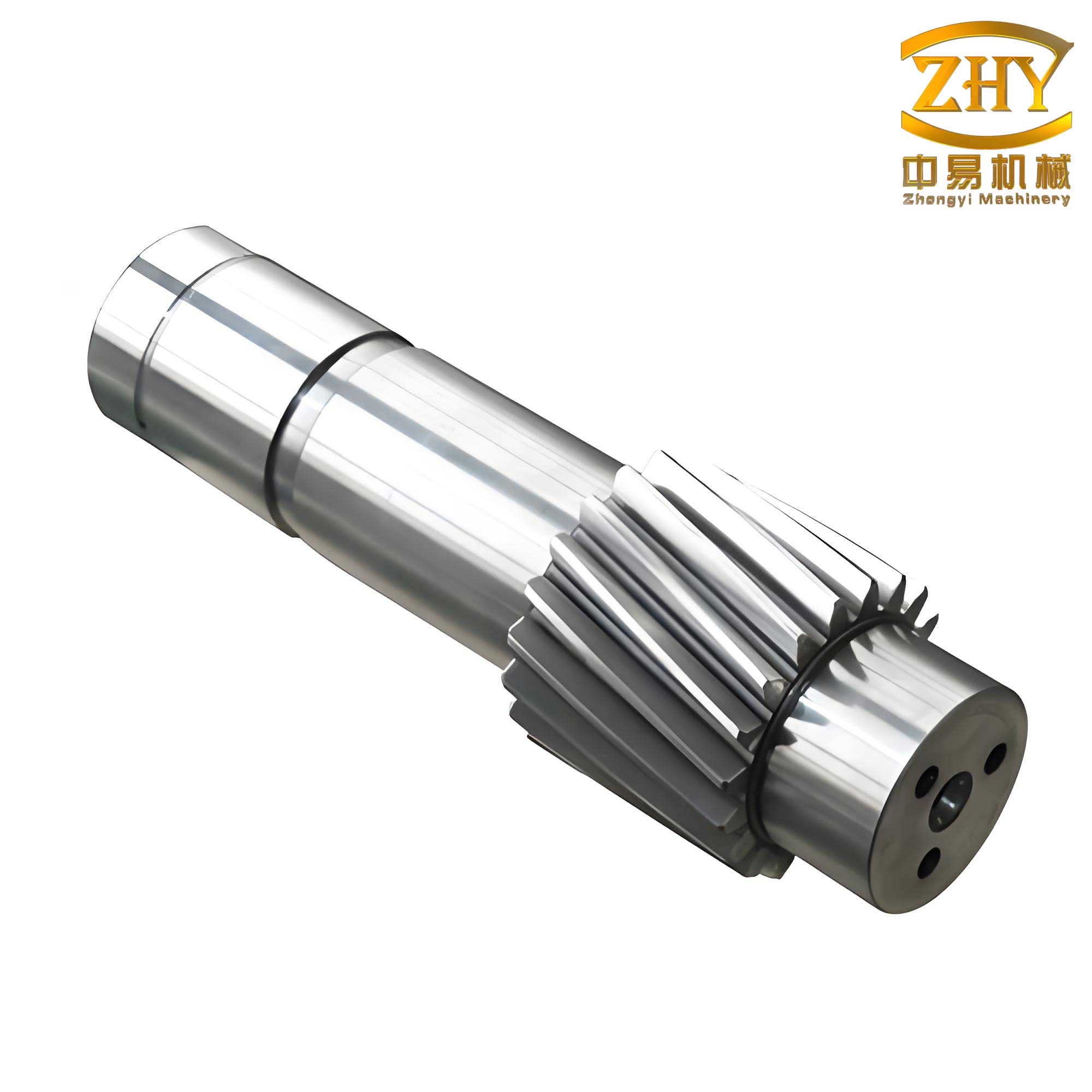
In conclusion, my analysis of longitudinal cracking in gear shafts reveals that it is often a consequence of improper heat treatment leading to through-hardening and unfavorable residual stresses. By focusing on material selection, cooling control, and process optimization, manufacturers can enhance the reliability of gear shafts. I recommend a proactive approach: conduct failure analyses regularly, implement tailored heat treatment protocols, and leverage modern simulation techniques. Gear shafts are critical components, and their integrity directly impacts machinery performance. Through continuous improvement and attention to detail, we can mitigate cracking issues and ensure durable gear shafts for demanding applications. This knowledge is vital for engineers working with power transmission systems, where gear shafts play a pivotal role in operational success.
To further elaborate, I often discuss case studies where gear shafts failed in service. For example, in a mining equipment reducer, gear shafts made of 18CrNiMo7-6 steel cracked after only 500 hours of operation. My investigation involved fractography, which showed cleavage features indicative of brittle fracture. Hardness mapping revealed a uniform high hardness across the section, confirming through-hardening. By correlating this with process records, I identified that the quenching oil temperature had been too low, accelerating cooling. Correcting this by raising oil temperature and adding a pre-cool step resolved the issue for subsequent gear shafts.
Another consideration is the effect of non-metallic inclusions on gear shaft performance. While not the primary cause in the discussed case, inclusions can act as stress raisers. I assess inclusion content using standards like ASTM E45, and for critical gear shafts, I specify cleaner steels with sulfur content below 0.005% to minimize risks.
In terms of mathematical modeling, I frequently use the following equation to estimate the critical stress intensity factor \( K_{IC} \) for gear shafts under mixed-mode loading:
$$ K_{IC} = Y \sigma \sqrt{\pi a} $$
where \( Y \) is a geometry factor, \( \sigma \) is applied stress, and \( a \) is crack length. For longitudinal cracks in gear shafts, \( Y \) depends on the shaft’s diameter and crack orientation. By comparing \( K_{IC} \) with the material’s fracture toughness, I predict crack propagation tendencies.
Furthermore, I explore alternative materials for gear shafts where high hardenability is not required. Steels like 20MnCr5 or 16MnCr5 offer good carburizing response with lower cracking susceptibility. However, for heavy-duty applications, alloy steels like 18CrNiMo7-6 remain popular, necessitating precise heat treatment control.
Lastly, I advocate for interdisciplinary collaboration between metallurgists, designers, and production engineers to optimize gear shaft life cycle. By sharing insights from failure analyses, we can refine specifications and processes, ultimately enhancing the durability of gear shafts in various industries. This comprehensive approach, grounded in empirical data and theoretical principles, is key to advancing gear shaft technology and preventing longitudinal cracking failures.