
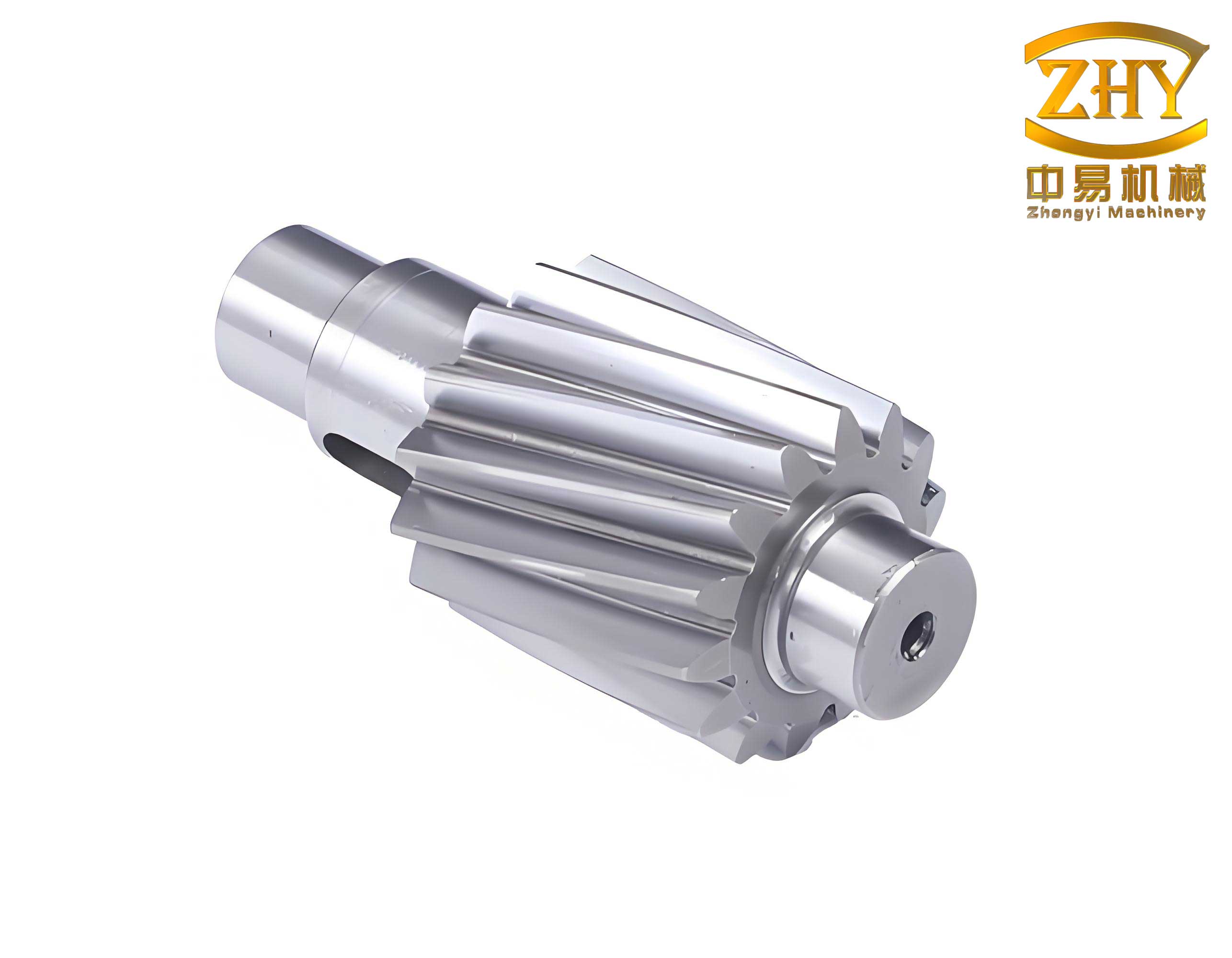
In my experience managing and maintaining tobacco primary processing equipment, the consistent performance of the cutter is paramount for final product quality. The SQ3A series, particularly the SQ37A model, is a critical machine where the precise coordination between the knife roll and the feed system determines cut width consistency. The heart of the feed system’s drive is the bottom apron gear shaft assembly. This component is responsible for transmitting power to both the upper and lower apron rollers, which in turn drive the aprons that convey and compact the tobacco bed. The reliable operation of these gear shafts is therefore non-negotiable. However, a persistent design flaw in the sealing and lubrication of this assembly led to frequent failures, impacting both product quality and maintenance efficiency.
The core issue stemmed from the original configuration’s vulnerability to water ingress. During routine cleaning of the tobacco-laden aprons, a necessity given the accumulation of leaf debris and residue, small amounts of water were inevitable. The original sealing on the gear shaft bearings was insufficient. As illustrated in the schematic below, the assembly relied merely on static PTFE dust shields on both sides of the bearings. These fixed shields would wear against the rotating gear shafts, creating micro-gaps.
Water exploited these paths, particularly on the right-side bearing where the shaft stepped down to a smaller diameter. Once inside the bearing housing, the water contaminated and emulsified the original aluminum-complex grease, which offered poor water resistance. This led to a rapid degradation of lubricity and initiated corrosion. The lubrication system itself was also flawed. Neither bearing had a designed lubrication point; the left side was blocked by external components, and the right side had no end cover at all. This made periodic re-greasing or grease replacement impossible. Consequently, once contaminated, the bearings were on a direct path to failure, typically within 6 months. The resulting symptoms included increased vibration in the gear shafts, unstable apron feed speed, and a loss of synchronization with the knife roll speed. This manifested in uneven cut widths, the production of tobacco “slivers,” and overall quality deterioration.
The failure modes and their root causes can be systematically summarized as follows:
| Observed Symptom | Direct Cause | Root Cause (Design Flaw) |
|---|---|---|
| Bearing seizure or excessive play | Lubricant wash-out/emulsification & corrosion | 1. Inadequate sealing (dust shields only). 2. Non-water-resistant grease. 3. No lubrication access points. |
| Gear shaft vibration | Deteriorated bearing condition | Water ingress and lubricant failure. |
| Uneven cut width, slivers | Unstable apron feed speed | Failing bearings causing irregular gear shaft rotation. |
| High maintenance frequency (6-month bearing life) | Premature bearing failure | Combination of all above root causes. |
To address these chronic issues, a comprehensive modification project was undertaken, focusing on three pillars: enhanced sealing, a new lubrication strategy, and superior lubricant selection.
Pillar 1: Enhanced Sealing Design
The PTFE dust shields were wholly inadequate for a damp environment. The solution was to retrofit proper radial lip seals. This required modifying the bearing housings to create the necessary space and sealing surface.
- Left Side Bearing Housing: The housing was shortened by machining to create an axial space for a seal. A metric oil seal with dimensions 85 mm (bore) x 100 mm (OD) x 8 mm (width) was installed. This seal’s lip is spring-loaded, maintaining constant contact with the gear shaft and providing a dynamic barrier far superior to a static shield.
- Right Side Bearing Housing: The housing was extended by adding material (effectively increasing thickness by 9mm) to provide a sealing surface. A larger seal, 85 mm x 110 mm x 12 mm, was fitted here. Crucially, a new end cap was designed (see Pillar 2) to retain this seal and house the lubrication fitting.
The fundamental sealing principle relies on the contact pressure ($P_c$) of the seal lip, which can be conceptualized as a function of the spring force and material interference:
$$P_c = \frac{F_{spring} + F_{interference}}{A_{contact}}$$
where $F_{spring}$ is the garter spring force, $F_{interference}$ is the force due to the radial interference fit of the seal lip on the shaft, and $A_{contact}$ is the contact area. This $P_c$ must be sufficient to prevent fluid film penetration while minimizing wear. The new seals provided this critical pressure, whereas the worn dust shields had $P_c \approx 0$.
Pillar 2: Redesigned Lubrication System
A proactive, periodic lubrication regimen was established to displace any minor moisture ingress and replenish the grease film before degradation could occur.
- Left Side: A lubrication channel was drilled radially through the modified left-side bearing housing, terminating at the bearing outer race. A standard grease nipple was installed on the housing’s exterior, allowing direct greasing of the bearing without disassembly.
- Right Side: A custom two-part end cap assembly was designed. It consists of a primary cap that holds the oil seal and a secondary PTFE spacer. The spacer features a radial drilling that aligns with a hole in the primary cap when assembled. A grease nipple is installed on the primary cap. During lubrication (scheduled every 2-3 months), the locknut on the gear shaft is temporarily removed, this end-cap assembly is fitted, grease is pumped in, and then the original locknut is reinstalled. This design provides lubrication access without permanently altering the shaft’s external configuration.
The lubrication interval ($T_{lube}$) was determined based on the operational hours ($H_{op}$) and an empirical factor ($k$) for the harsh environment, aiming to refresh the grease before its useful life expires:
$$T_{lube} = \frac{L_{10\_grease}}{k \cdot H_{op\_month}}$$
where $L_{10\_grease}$ is the estimated grease life under ideal conditions, and $k > 1$ accounts for water exposure and load. For our conditions, $T_{lube}$ was set at approximately 500-700 operating hours.
Pillar 3: Advanced Lubricant Selection
The original aluminum-complex grease was a key point of failure. We replaced it with a calcium sulfonate complex grease. The performance difference is stark, as shown in the comparison below:
| Property | Original Aluminum-Complex Grease | New Calcium Sulfonate Grease |
|---|---|---|
| Water Resistance | Poor; easily emulsifies | Excellent; highly resistant to wash-out and emulsion |
| Rust & Corrosion Prevention | Moderate | Outstanding; provides a protective chemical layer |
| Mechanical Stability | Good | Excellent; maintains structure under shear |
| Density relative to water | Lower (floats) | Higher (sinks, stays in place) |
| Operating Principle in Wet Conditions | Forms a soft emulsion that loses lubricity. | Repels water, maintaining a stable lubricating film on the gear shaft bearing surfaces. |
The superior performance stems from the thick, adherent soap structure formed by the overbased calcium sulfonate. This structure physically blocks water and neutralizes acidic contaminants. Its adhesion to metal surfaces ensures the rolling elements and races of the gear shaft bearings remain protected.
Validation and Results
The combined improvements created a synergistic effect. The seals drastically reduced the rate of water ingress ($Q_{in}$). The new grease could handle the residual moisture that might eventually penetrate, and the lubrication ports allowed this defensive barrier to be periodically reinforced.
The most significant metric of success is the bearing service life. Using the standard bearing life calculation modified for lubrication and contamination factors, we can estimate the improvement. The basic L10 life formula is:
$$L_{10} = \left( \frac{C}{P} \right)^p$$
where $C$ is the dynamic load rating, $P$ is the equivalent dynamic load, and $p=3$ for ball bearings. However, this is for ideal conditions. The ISO 281 standard introduces a life modification factor $a_{ISO}$ for lubrication, contamination, and fatigue load limit:
$$L_{nm} = a_1 \cdot a_{ISO} \cdot L_{10}$$
In the original state, with water contamination and poor grease, $a_{ISO}$ was very low (<0.1). After modifications, with excellent sealing (high contamination factor $e_c$), superior grease (high viscosity ratio $κ$), and periodic replenishment, the $a_{ISO}$ factor increased dramatically, leading to a multiplicative increase in predicted life. Empirically, this translated to:
- Bearing Life: Increased from an average of **6 months** to over **18 months** (a 3x improvement).
- Gear Shaft Life: The associated wear and vibration damage to the gear shafts themselves was eliminated, extending their service life indefinitely under normal loads.
- Operational Stability: Vibration in the drive train was minimized, ensuring stable apron feed speed. The synchronization between the apron (driven by the gear shafts) and the knife roll is now consistently maintained, which is critical for cut quality. The relationship for cut width ($W_c$) is directly tied to this synchronization:
$$W_c = \frac{v_{apron}}{n_{knife} \cdot N_{edges}}$$
where $v_{apron}$ is the apron linear speed (a direct function of gear shaft rotational speed), $n_{knife}$ is the knife roll rotational speed, and $N_{edges}$ is the number of cutting edges. Stable $v_{apron}$ ensures consistent $W_c$.
In conclusion, the systematic re-engineering of the sealing, lubrication access, and lubricant chemistry for the gear shaft bearings on the SQ37A cutter transformed a chronic reliability problem into a model of robust performance. The solution is elegantly simple in principle—keep water out and maintain a reliable lubricant film—but required careful mechanical redesign to implement effectively. The project underscores the profound impact that focused, fundamental improvements in bearing support systems can have on overall machine reliability, product quality, and operational cost-effectiveness.