
In the manufacturing of high-speed, heavy-duty drive systems, gear shafts play a critical role in transmitting torque and motion under extreme conditions. The production of large-section, high-tonnage gear shafts, particularly those made from materials like 17Cr2Ni2Mo, presents significant challenges due to stringent internal quality requirements, susceptibility to defects such as coarse grains and flakes, and the need for precise control over forging and heat treatment processes. This article delves into the comprehensive approach we adopted to forge and heat treat 17Cr2Ni2Mo gear shafts, ensuring they meet advanced ultrasonic testing standards and performance criteria. Through meticulous material selection, optimized forging deformation parameters, and tailored post-forging heat treatments, we achieved superior internal compaction and microstructural refinement, resulting in gear shafts that excel in demanding applications like semi-autogenous mills. The following sections detail our methodology, supported by tables and formulas to summarize key aspects.
The success of forging high-integrity gear shafts begins with stringent control over raw materials. For 17Cr2Ni2Mo gear shafts, we prioritize vacuum-refined steel ingots to minimize impurities and segregation. The chemical composition is tightly controlled, with particular attention to reducing harmful elements like sulfur, phosphorus, and hydrogen, which can compromise toughness and promote defects. Table 1 outlines the required and actual chemical composition values, highlighting our internal standards that exceed typical specifications. Ensuring low hydrogen content (≤2 ppm) is crucial to prevent flaking, a common issue in large forgings.
| Element | Standard Requirement | Internal Control | Measured Value |
|---|---|---|---|
| C | 0.14–0.19 | 0.14–0.19 | 0.14 |
| Si | 0.17–0.35 | 0.17–0.35 | 0.24 |
| Mn | 0.40–0.60 | 0.40–0.60 | 0.49 |
| P | ≤0.030 | ≤0.015 | 0.012 |
| S | ≤0.030 | ≤0.010 | 0.008 |
| Cr | 1.50–1.80 | 1.60–1.80 | 1.65 |
| Ni | 1.40–1.70 | 1.50–1.70 | 1.57 |
| Mo | 0.25–0.35 | 0.25–0.35 | 0.28 |
| Cu | ≤0.25 | ≤0.25 | 0.05 |
Heating of the steel ingot is a foundational step to achieve a homogeneous austenitic structure, enhance plasticity, and reduce deformation resistance. For gear shafts, we carefully calibrate heating temperatures and times based on the forging stage. Initially, higher start-forging temperatures (up to 1250°C) with extended soaking periods (1–1.5 hours per 100 mm) are used to promote center compaction and diffusion. In final forging passes, lower temperatures (1150–1180°C) and shorter soaking times (0.7–1 hour per 100 mm) are employed to refine grain size while ensuring complete deformation above 750°C. This dual strategy balances defect healing and microstructural control. The heating process can be modeled using the following relationship for temperature uniformity: $$ T(t) = T_0 + \Delta T \cdot \left(1 – e^{-kt}\right) $$ where \( T(t) \) is the temperature at time \( t \), \( T_0 \) is the initial temperature, \( \Delta T \) is the temperature gradient, and \( k \) is a thermal diffusivity constant dependent on material properties.
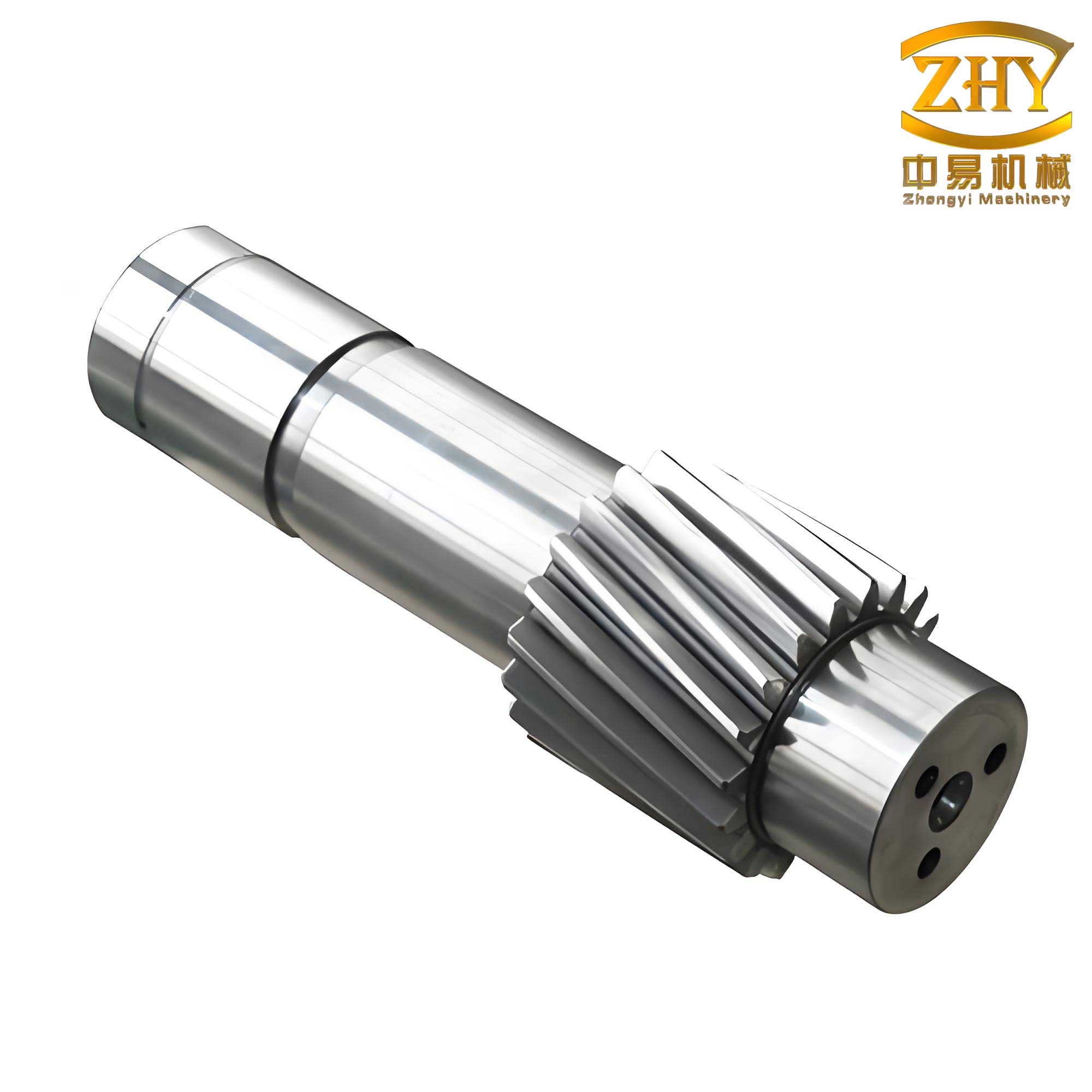
The forging deformation process for 17Cr2Ni2Mo gear shafts involves multiple heats to achieve adequate forging ratios and internal consolidation. We utilize a 32 MN hydraulic press, which, while slightly underpowered for such large sections, is optimized through strategic passes. The primary goal is to achieve a forging ratio \( K \geq 4 \) for critical sections, defined as: $$ K = \frac{A_0}{A_f} $$ where \( A_0 \) is the original cross-sectional area and \( A_f \) is the final area. This ensures thorough breakdown of the as-cast structure and closure of internal voids. Table 2 summarizes the multi-heat forging sequence, emphasizing key operations like upsetting and flat-anvil stretching.
| Heat Number | Temperature Range (°C) | Operation Description and Schematic |
|---|---|---|
| First Heat | 1100–850 | Press the grip, chamfer, and remove the riser. This prepares the ingot for subsequent deformation while preventing eccentricity. |
| Second Heat | 1250–750 | Upset to a maximum diameter of 1700 mm. This increases the forging ratio and enhances homogenization through extended soaking. |
| Third Heat | 1250–750 | Flat-anvil stretching using 800 mm wide anvils with high reduction rates. The anvil width ratio is controlled at 0.6–0.8 for optimal center compaction. The process involves multiple rotations to achieve a square section of 950 mm. |
| Fourth Heat | 1250–750 | Second upsetting to 1700 mm diameter. This additional upsetting further refines the microstructure and ensures defect healing. |
| Fifth Heat | 1250–750 | Repeat flat-anvil stretching to a 950 mm square section, similar to the third heat, to maintain deformation consistency. |
| Sixth Heat | 1220–750 | Switch to 500 mm anvils for final shaping according to the branching diagram. This step efficiently forms the gear shaft profile while avoiding excessive cooling. |
During flat-anvil stretching, we apply large reductions (e.g., 20% per pass) to maximize strain and promote void closure. The effective strain \( \epsilon \) can be estimated using: $$ \epsilon = \ln\left(\frac{h_0}{h_f}\right) $$ where \( h_0 \) and \( h_f \) are the initial and final heights, respectively. For gear shafts, maintaining a high strain rate in the core region is vital, which is achieved through precise anvil placement and controlled rotations. The final forging passes ensure that residual forging ratios for different sections range from 1.4 to 4.4, guaranteeing uniformity across the gear shaft.
Post-forging heat treatment is critical to alleviate residual stresses, prevent coarse or mixed grains, and eliminate hydrogen embrittlement in 17Cr2Ni2Mo gear shafts. Given the material’s susceptibility to grain growth and inheritance, we employ a double normalizing and tempering cycle. The first high-temperature normalizing (e.g., at 950°C) refines the grain structure and fragments inclusions, while a subsequent normalizing at a lower temperature adjusts the microstructure for ultrasonic testing and further processing. Tempering follows to enhance toughness and stability. The heat treatment curve can be represented by a time-temperature profile, but for brevity, key parameters include soaking times proportional to section thickness. The effectiveness of this treatment is validated by ultrasonic testing, where no超标 defects are detected, exceeding standards like JB/T 5000.15-2007 Grade II.
To quantify the thermal cycles, we can use the Larson-Miller parameter for creep and stress relief analysis: $$ P = T \cdot (\log t + C) $$ where \( P \) is the parameter, \( T \) is the temperature in Kelvin, \( t \) is time in hours, and \( C \) is a material constant (typically around 20 for steel). This helps optimize heat treatment schedules for gear shafts. Additionally, the cooling rate \( \frac{dT}{dt} \) during normalizing is controlled to avoid martensite formation, which could induce cracking in large sections.
The production of 17Cr2Ni2Mo gear shafts also involves rigorous quality checks. Ultrasonic testing is performed after rough machining to assess internal integrity. The acceptance criteria are based on echo amplitudes and defect sizes, with our gear shafts consistently showing superior results. This is attributed to the integrated approach of material purity, controlled forging deformation, and tailored heat treatment. Furthermore, mechanical properties such as tensile strength and impact toughness are tested, though detailed values are proprietary. The overall process emphasizes the importance of each step in achieving reliable gear shafts for heavy-duty applications.
In conclusion, the forging of 17Cr2Ni2Mo gear shafts requires a holistic strategy that encompasses raw material selection, precise heating, multi-pass deformation with high forging ratios, and advanced heat treatment. By implementing these measures, we produce gear shafts with excellent internal quality, fine grain structures, and no detectable defects, meeting the demands of high-speed, heavy-load environments. The use of tables and formulas, as shown, aids in summarizing complex parameters and outcomes. Future work may focus on simulating deformation patterns using finite element analysis to further optimize processes for gear shafts. This research underscores our commitment to advancing forging technologies for critical components like gear shafts, ensuring they perform reliably under extreme conditions.
Throughout this discussion, the term “gear shafts” has been emphasized to highlight the focus of our study. The methodologies described are applicable to other large forgings but are particularly tailored for gear shafts due to their unique geometric and functional requirements. By continuously refining our techniques, we aim to set benchmarks in the forging industry for gear shafts and similar components.