
In the realm of mechanical power transmission, gear shafts are critical components, responsible for transferring torque and motion between elements within a system. Their operational integrity is paramount, as failure can lead to catastrophic system shutdowns, significant economic loss, and potential safety hazards. One particularly insidious and common mode of failure in these components is the initiation and propagation of cracks at the tooth root fillet region. This area is a natural stress concentrator, making it highly susceptible to failure under cyclic loading or due to inherent material and processing flaws. The following analysis presents a comprehensive, first-person investigation into the root cause of such cracking incidents in a specific batch of gear shafts, moving from initial macroscopic observation through detailed laboratory characterization to a synthesized theoretical failure model.
The investigation commenced with the receipt of a failed gear shaft assembly. Preliminary reports indicated the presence of suspicious fissures at the root of several teeth, raising immediate concerns about material quality or improper heat treatment. The primary suspect was the forging stock, but a systematic approach was necessary to isolate the true cause. The material was specified as a medium-carbon, low-alloy steel, typically 42CrMo (or its equivalent AISI 4140), chosen for its good hardenability, strength, and toughness—properties essential for demanding gear shafts applications.
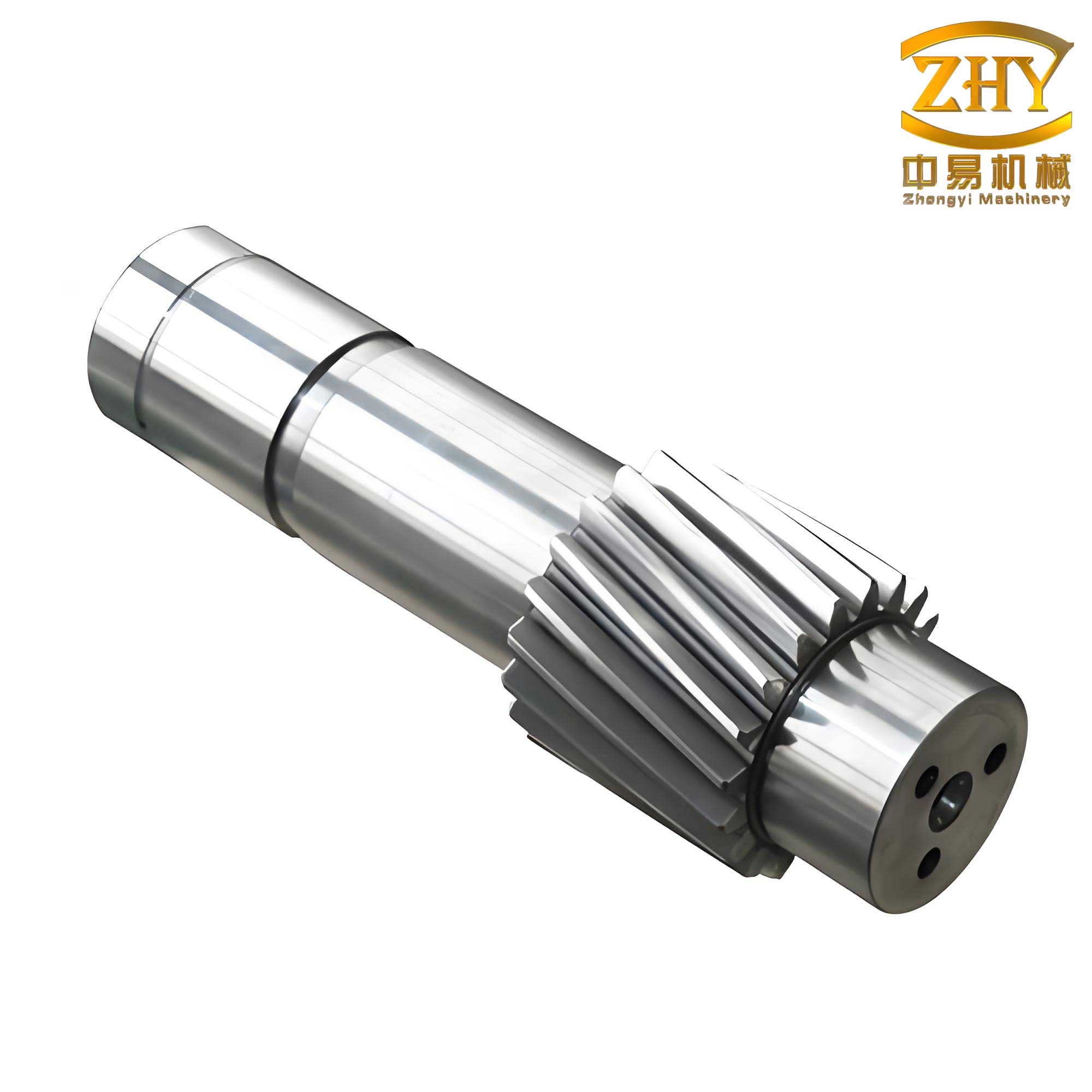
The initial phase involved a thorough macroscopic examination. The gear shaft was visually and tactilely inspected. The gear teeth mating surfaces showed no significant signs of abnormal wear, scuffing, or plastic deformation indicative of severe overloading or misalignment during service. The focus quickly narrowed to the tooth root fillets. Here, multiple cracks were identified, predominantly clustered on one flank of the gear. These cracks were not continuous but appeared as a series of discreet, initiated flaws aligned along the root contour. Their length varied, typically in the range of 200 to 300 mm along the axis of the gear shaft. The crack openings were notably tight, making them difficult to see with the naked eye without the aid of dye penetrant or magnetic particle inspection techniques.
To assess the penetration depth, a section containing a representative crack was carefully cut perpendicular to the gear shaft axis, traversing the cracked tooth root. Upon sectioning and polishing, the crack path was revealed. It originated precisely at the surface of the root fillet (the “R” corner) and propagated radially inwards towards the core of the gear shaft. The maximum observed crack depth was approximately 15 mm. The fracture surface, when opened, appeared dull and gray, with a slight oxidized tint. Most tellingly, distinct crack progression marks (beach marks or arrest lines) were visible, radiating from multiple origin points at the surface. This morphology is a classic signature of progressive crack growth rather than a single instantaneous failure. The absence of gross plastic deformation on the fracture surface suggested a brittle or quasi-brittle fracture mode.
Following macro-examination, chemical analysis was performed using optical emission spectrometry (OES) to verify the material grade. Samples were taken from the core of the gear shaft, away from the heat-affected zones. The results are summarized in Table 1, confirming that the composition was within the standard specification for 42CrMo steel, effectively ruling out gross material substitution or major elemental deviations as a primary cause.
| Element | Measured Value | Standard Range (42CrMo) |
|---|---|---|
| C | 0.41 | 0.38 – 0.45 |
| Si | 0.24 | 0.17 – 0.37 |
| Mn | 0.68 | 0.50 – 0.80 |
| P | 0.013 | ≤ 0.035 |
| S | 0.002 | ≤ 0.035 |
| Cr | 0.98 | 0.90 – 1.20 |
| Mo | 0.18 | 0.15 – 0.30 |
The microstructure holds the most critical clues to the failure mechanism. Metallographic samples were prepared from the sectioned gear shaft, encompassing the crack path from the surface to the unaffected core. Etching with nital revealed a distinct microstructural gradient, evidence of a surface-hardening treatment (likely induction or flame hardening) applied after the gear shaft was machined. The microstructure at different regions is detailed below and summarized in Table 2.
- Case (Surface): A thin, high-hardness layer consisting of fine, acicular martensite. This is the intended structure for wear resistance.
- Subsurface (Transition Zone): Immediately beneath the martensitic case, the microstructure became mixed and problematic. It comprised a complex mixture of pro-eutectoid ferrite, martensite, and pearlite. Most significantly, many areas exhibited a pronounced Widmanstätten morphology. In this structure, ferrite precipitates as sharp, needle-like plates from prior austenite grain boundaries. The formation of Widmanstätten ferrite is a function of specific cooling conditions from the austenitizing temperature. It typically occurs with moderately fast cooling rates that are too slow to form full martensite but too fast to allow equilibrium ferrite formation, often in the range associated with air cooling of medium-section sizes. This structure is known to detrimentally impact toughness and ductility.
- Core: The microstructure transitioned to a softer, tougher mixture of equiaxed ferrite and pearlite, characteristic of a normalized or tempered state, with no evidence of Widmanstätten morphology.
The crack itself was meticulously examined. It initiated precisely at the surface of the root fillet, consistent with the highest tensile stress location under bending load. The crack path was predominantly transgranular through the microstructure. A key observation was the complete absence of oxide scale or decarburization along the crack flanks. This is a vital negative indicator; it rules out the crack being a pre-existing defect from the forging stage (where high-temperature exposure would cause oxidation) or from prior processing before the final heat treatment. Furthermore, at the interface between the hard martensitic case and the softer subsurface, the crack exhibited a distinct “step” or offset. This is a clear micrographic signature of a high level of residual stress acting at this microstructural boundary, likely due to the differential volume change during phase transformations.
| Region | Observed Microstructure | Implied Thermal History |
|---|---|---|
| Tooth Surface (Case) | Fine Martensite | Rapid quenching from austenite (Ac3+) |
| Tooth Subsurface (~1-5mm depth) | Martensite, Pearlite, and Widmanstätten Ferrite | Intermediate cooling rate from austenite, insufficient for full hardening. |
| Core of Gear Shaft | Equiaxed Ferrite and Pearlite | Slower cooling, likely normalized or tempered condition. |
| Crack Flanks | No oxidation/decarburization | Crack formed at low temperature, post-final heat treatment. |
Scanning Electron Microscopy (SEM) fractography was conducted on the opened crack surface. The analysis revealed distinct zones:
- Origin Zone: At the very surface of the root fillet, the fracture mode was predominantly intergranular. Cracks propagated along prior austenite grain boundaries. This is a classic brittle fracture mode associated with weak boundaries, often caused by impurity segregation or, more pertinently in this case, by the presence of brittle micro-constituents like grain boundary ferrite or the stress state from transformation.
- Propagation Zone: Beyond the origin, the fracture surface transitioned to a mostly cleavage morphology, characterized by flat facets and river patterns. This indicates a brittle, transgranular crack growth. Isolated, small regions of micro-void coalescence (dimples) and quasi-cleavage were also observed, but they were not the dominant mode. Numerous secondary cracks were found branching from the main fracture plane, further evidence of a brittle material condition during failure.
This fractographic sequence—intergranular initiation followed by cleavage propagation—is inconsistent with fatigue (which shows striations) or stress-corrosion cracking (which often shows corrosion products). It strongly points towards a single-event or limited-cycle brittle fracture triggered by a high stress concentration acting on a locally embrittled microstructure.
Mechanical property tests were performed on samples extracted from the core of the gear shaft to assess the base material quality. Hardness surveys were taken across the tooth profile. The results are consolidated in Table 3.
| Property | Measured Value | Typical Specification (Quenched & Tempered 42CrMo) | Drawing Requirement |
|---|---|---|---|
| Yield Strength (Rp0.2) | 425, 455, 420 MPa | ≥ 390 MPa | N/A |
| Tensile Strength (Rm) | 775, 790, 760 MPa | ≥ 590 MPa | N/A |
| Elongation (A) | 44.5, 40.5, 41.5 % | ≥ 16 % | N/A |
| Core Hardness | 255, 266, 255 HB | ~229-269 HB (Typical for Q&T) | 229 – 269 HB |
| Tooth Surface Hardness | 49.0, 51.0, 48.5 HRC | N/A | 45 – 52 HRC |
The core tensile properties (yield strength, ultimate tensile strength, and elongation) comfortably met the standard requirements for quenched and tempered 42CrMo. The core hardness was within the range specified on the engineering drawing for the “hardened and tempered” condition. The surface hardness of the tooth flanks also fell within the specified range for “surface hardened” teeth. This data confirms that the bulk material was sound and that the final hardness targets were ostensibly met. The problem, therefore, was not with the achieved hardness or bulk strength, but with the microstructural state and the associated toughness in the critical subsurface region of the gear shaft tooth root.
Theoretical Synthesis and Failure Mechanism
Piecing together the forensic evidence leads to a coherent failure scenario centered on improper heat treatment practice. The presence of Widmanstätten ferrite in the subsurface is the pivotal clue. This structure forms when austenite transforms on cooling at a specific, often uncontrolled, rate. For a gear shaft of this size and material, achieving a uniform, through-hardened martensitic structure requires a sufficiently rapid quench (e.g., in oil). The observed microstructure gradient suggests an inadequate quench severity, cooling rate ($\dot{T}$), or improper austenitizing conditions prior to quenching.
We can model the stress state at the tooth root. Under bending load, the maximum tensile stress ($\sigma_{max}$) occurs at the root fillet surface and is amplified by the stress concentration factor ($K_t$):
$$
\sigma_{max} = K_t \cdot \sigma_{nom}
$$
where $\sigma_{nom}$ is the nominal bending stress. For a standard gear tooth fillet, $K_t$ can range from 1.5 to over 2.5. The residual stress ($\sigma_{res}$) from heat treatment superimposes on this. The case hardening process induces compressive residual stresses in the surface martensite, which is beneficial. However, in the subsurface transition zone where the brittle Widmanstätten structure forms, the volume change associated with the transformation from austenite can generate high tensile residual stresses. The net driving force for crack initiation is the combined stress intensity:
$$
\sigma_{eff} = \sigma_{max} + \sigma_{res}
$$
At the root surface, $\sigma_{res}$ is compressive, inhibiting initiation. But just beneath, where the microstructure is embrittled and $\sigma_{res}$ may be tensile, the conditions are ripe for failure. A small surface flaw or micro-crack in the hard case can easily propagate into this vulnerable zone.
The Widmanstätten ferrite itself is a potent embrittling agent. Its needle-like morphology acts as internal stress concentrators and provides easy paths for crack propagation. The toughness (fracture resistance, $K_{IC}$) of this microstructure is severely reduced compared to a fine, tempered martensite or a bainitic structure. The fracture toughness can be conceptually related to the crack-tip opening displacement (CTOD, $\delta_c$) or the critical stress intensity factor. For a brittle microstructure:
$$
K_{IC} \propto \sqrt{E \cdot \gamma_{eff}}
$$
where $E$ is Young’s modulus and $\gamma_{eff}$ is the effective surface energy for fracture. The sharp interfaces and coarse plates in Widmanstätten structure lower $\gamma_{eff}$, thereby reducing $K_{IC}$.
The failure sequence is thus reconstructed:
- Processing Flaw: During the final heat treatment of the machined gear shafts, the austenitizing temperature and/or time may have been excessive, leading to austenite grain coarsening. Subsequent quenching was insufficiently rapid for the section size, resulting in a mixed transformation in the subsurface: some martensite near the surface, but predominantly a medium-temperature transformation product (Widmanstätten ferrite and pearlite) in the critical zone just below.
- Embrittlement: This subsurface zone developed a brittle Widmanstätten ferrite network and high tensile residual transformation stresses.
- Stress Concentration: In service, the tooth root experienced cyclic tensile stresses. The combined action of applied stress and residual stress created a local stress field exceeding the brittle fracture strength of the embrittled subsurface material.
- Crack Initiation and Propagation: Cracks initiated intergranularly at the surface root, likely at microscopic stress concentrators. They rapidly propagated in a brittle, cleavage-dominated manner through the embrittled Widmanstätten zone. The crack followed the path of least resistance, often deflecting at the interface between the hard case and softer core, creating the observed steps. Propagation continued until the crack depth reduced the effective load-bearing cross-section to a point where final, fast fracture occurred, or until the gear shaft was taken out of service upon detection.
This mechanism explains all observations: the location at the stress-concentrated root, the absence of oxidation on crack faces, the specific brittle microstructures, the fractographic features, and the fact that bulk mechanical properties were acceptable. The root cause is conclusively attributed to improper heat treatment cycle, specifically inadequate control over cooling rates leading to the formation of a brittle, non-ideal microstructure (Widmanstätten ferrite) in a critically stressed region of the gear shafts.
Preventive Measures and Recommendations
To prevent recurrence of this failure in future productions of gear shafts, a multi-faceted approach focusing on process control is essential:
- Material and Forging Control: Ensure fine, uniform prior austenite grain size in the forging through controlled forging temperatures and subsequent normalizing. A fine grain size increases hardenability and suppresses Widmanstätten formation. The hardenability of the steel lot should be verified via Jominy end-quench tests to confirm it is suitable for the section size of the gear shaft.
- Heat Treatment Optimization: The quenching process must be rigorously designed and validated.
- Austenitizing: Use the minimum temperature and time necessary to achieve full austenitization, preventing grain growth. For 42CrMo, this is typically in the range of 840°C – 860°C.
- Quenching: Select a quenchant (oil, polymer, or high-pressure gas) with a cooling severity ($H$-value) sufficient to avoid the nose of the Time-Temperature-Transformation (TTT) curve for this steel grade. The cooling rate must ensure that the entire tooth cross-section, down to a depth beyond the expected maximum stress, transforms to martensite or lower bainite. Computational modeling of heat transfer can aid in defining the required quench agitation and temperature.
- The continuous cooling transformation (CCT) diagram for the specific steel is the key reference. The cooling curve must lie to the left of the ferrite and pearlite transformation zones. The critical cooling rate ($V_{crit}$) to avoid Widmanstätten ferrite can be estimated from the CCT diagram:
$$
\dot{T} > V_{crit}
$$
where $V_{crit}$ is the cooling rate required to miss the ferrite start ($F_s$) curve.
- Tempering: After quenching, immediate and adequate tempering is crucial to relieve quenching stresses, improve toughness, and achieve the desired core hardness. A typical tempering range for such gear shafts is 550°C – 650°C.
- Surface Hardening: If surface hardening (like induction hardening) is performed post-quench and temper, its process parameters must be controlled to create a defined, fully martensitic case with a smooth gradient into the tough core, avoiding re-austenitizing and re-quenching the vulnerable subsurface zone in a non-ideal manner.
- Non-Destructive Testing (NDT): Implement 100% non-destructive inspection of all finished gear shaft tooth roots using a sensitive method such as fluorescent magnetic particle inspection (MPI) or automated ultrasonic testing. This will detect any processing-induced cracks before the component enters service.
- Design Consideration: While not the cause here, increasing the root fillet radius ($R$) where design allows can significantly reduce the stress concentration factor $K_t$, providing a larger safety margin against any inherent material or processing flaws.
In conclusion, the failure of the subject gear shafts was a direct consequence of a suboptimal heat treatment process that produced an embrittling Widmanstätten ferrite microstructure in the critically stressed tooth root subsurface. This case underscores that for high-integrity components like gear shafts, achieving specified hardness values is necessary but not sufficient. Control over the entire thermal history to ensure a globally tough and uniform microstructure, free from deleterious phases, is absolutely imperative for reliable performance under cyclic loading conditions. The integration of material science, controlled processing, and rigorous inspection forms the bedrock of manufacturing reliable gear shafts.