
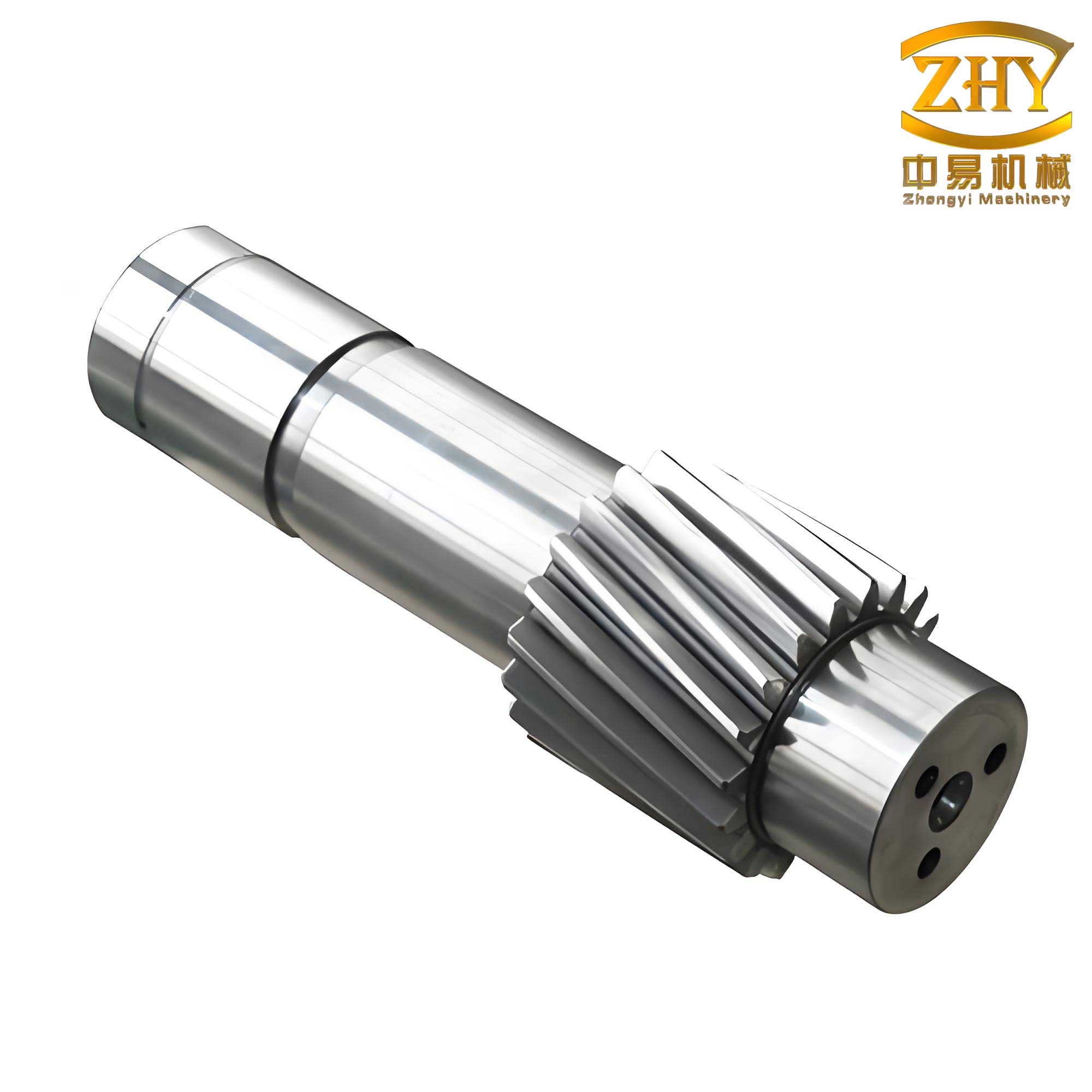
The design and verification of power transmission components are fundamental to mechanical engineering. Among these, the gear shaft stands as a critical and complex element, particularly in ubiquitous systems like speed reducers. A gear shaft integrates the functionalities of a shaft and a gear, carrying both significant bending moments from radial loads and torsional loads from transmitted torque. This combined loading, along with inherent stress concentrations at features like shoulders and keyways, makes its accurate stress analysis challenging. Traditional textbook methods, while foundational, often fall short in precisely identifying the true critical sections in these complex geometries. This article explores the journey of gear shafts analysis, contrasting the classical hand-calculation approach with modern Finite Element Analysis (FEA), and demonstrates how FEA provides a more realistic and comprehensive understanding of their structural behavior.
The Classical Approach: Theory and Limitations
In conventional mechanical design education, the verification of a shaft subjected to combined loading relies heavily on strength theories applied to simplified beam models. For gear shafts, the process typically involves determining reaction forces, constructing shear force and bending moment diagrams, and then applying a failure criterion.
The most common criterion used for ductile materials like the steel typically employed for gear shafts is the Maximum Shear Stress Theory (Tresca criterion), also known as the Third Strength Theory. This theory posits that yielding begins when the maximum shear stress in the material equals the maximum shear stress at yielding in a simple tension test.
For a shaft section experiencing a bending moment \(M\) and a torque \(T\), the equivalent or von Mises stress (though derived from a different theory) is often computed in a simplified form. The key formula for the equivalent bending moment used in classical shaft design is:
$$ M_{eq} = \sqrt{M^2 + (\alpha T)^2} $$
where \(\alpha\) is a combined fatigue factor that accounts for the differing nature of bending (completely reversed) and torsional (often steady) stresses. The bending stress is then calculated as:
$$ \sigma_b = \frac{M_{eq}}{W} $$
Here, \(W\) is the section modulus. For a solid round shaft of diameter \(d\), \(W = \frac{\pi d^3}{32}\). The calculated stress \(\sigma_b\) is compared against an allowable stress \([\sigma]\) for the material. A typical workflow for analyzing a gear shaft from a two-stage reducer would involve:
- Load Identification: Calculating tangential (\(F_t\)), radial (\(F_r\)), and axial (\(F_a\)) gear forces.
- Statics Analysis: Determining bearing reaction forces in vertical and horizontal planes.
- Internal Load Diagrams: Plotting bending moments \(M_y\), \(M_z\), and the resultant \(M = \sqrt{M_y^2 + M_z^2}\), along with the torque \(T\).
- Critical Section Selection: Identifying sections with high \(M\) and \(T\), and potentially small diameters (e.g., at bearing seats or shoulder fillets).
- Stress Calculation & Check: Applying the formula at these sections to verify \(\sigma_b \leq [\sigma]\).
While systematic, this method has profound limitations for gear shafts:
- Geometric Simplification: It treats the gear shaft as a series of uniform beams. Complex geometries like gear teeth, profiled keyways, and non-uniform shoulders are reduced to simple diameters for calculating \(W\). This ignores localized stress concentrations, which are often the initiation points for failure.
- Theoretical Compromise: The formula \(M_{eq} = \sqrt{M^2 + T^2}\) is essentially a derivation from the Distortion Energy Theory (von Mises), yet it is applied within a Tresca-based design framework. More importantly, it is a 2D simplification. It inherently neglects the influence of the intermediate principal stress \(\sigma_2\) and does not account for multi-axial stress states present at stress concentrators.
- Critical Section Ambiguity: For a complex gear shaft, the true “weakest link” may not be obvious. It could be at a stress concentration in the gear tooth root, a sharp fillet, or under a bearing seat. The classical method forces the designer to guess and check these locations individually, a tedious and potentially inaccurate process.
The results, while generally conservative (“safe-side”), can be significantly different from reality. A section might be deemed safe by calculation, while an unexamined stress concentration nearby could have a dangerously high stress level.
The Finite Element Method: A Paradigm Shift in Analysis
Finite Element Analysis represents a fundamental shift from global simplification to localized discretization. Instead of treating the entire gear shaft as a single entity governed by a few equations, FEA subdivides it into a finite number of small, simple elements (like tetrahedrons or hexahedrons). The complex governing partial differential equations of elasticity are solved approximately over this mesh.
The core theoretical foundation for ductile materials in FEA is typically the Distortion Energy Theory (von Mises criterion), or the Fourth Strength Theory. This theory states that yielding occurs when the distortion energy per unit volume equals or exceeds the distortion energy per unit volume at yield in a uniaxial tension test. It is mathematically represented by the von Mises equivalent stress \(\sigma_{vm}\):
$$ \sigma_{vm} = \sqrt{\frac{(\sigma_1 – \sigma_2)^2 + (\sigma_2 – \sigma_3)^2 + (\sigma_3 – \sigma_1)^2}{2}} $$
where \(\sigma_1\), \(\sigma_2\), and \(\sigma_3\) are the principal stresses. This criterion considers the full three-dimensional stress state and is generally more accurate than Tresca for predicting the onset of yield in ductile metals.
The workflow for analyzing a gear shaft using FEA (e.g., in SolidWorks Simulation, ANSYS, etc.) is as follows:
- Geometry Import/Creation: Using a precise 3D CAD model of the gear shaft, including all fillets, keyways, and gear tooth details.
- Material Definition: Assigning material properties (Young’s Modulus \(E\), Poisson’s ratio \(\nu\), yield strength \(\sigma_y\), ultimate strength \(\sigma_u\)).
- Boundary Conditions: Applying realistic constraints (e.g., bearing supports modeled as cylindrical or remote displacements) and loads (gear forces applied as distributed pressures or remote forces/moments).
- Meshing: Discretizing the geometry into elements. Critical areas like gear tooth roots, fillets, and keyway corners require mesh refinement.
- Solving & Post-Processing: The solver computes displacements, strains, and stresses for every node/element. Results are visualized as contour plots (e.g., von Mises stress, displacement, safety factor).
The following table contrasts the key aspects of the two methodologies for gear shafts analysis:
| Aspect | Classical Method | Finite Element Method (FEA) |
|---|---|---|
| Governing Theory | Primarily Maximum Shear Stress (Tresca) | Primarily Distortion Energy (von Mises) |
| Geometry Handling | Highly simplified (prismatic beams) | Exact 3D CAD model |
| Stress State | Uni-axial or simplified bi-axial | Full 3D multi-axial stress state |
| Stress Concentrations | Accounted for via empirical stress concentration factors \(K_t\) (often overlooked) | Directly revealed by the analysis in the contour plots |
| Critical Section Identification | Requires educated guessing and multiple calculations | Automatically visualized; the highest stress point is clearly shown |
| Result Output | A few calculated stress values | Complete field data: stress, strain, displacement, safety factor plots |
| Primary Use | Preliminary design, sizing, educational purposes | Detailed verification, optimization, failure analysis |
Case Study: Analyzing a Reducer Gear Shaft
Consider a high-speed input gear shaft from a two-stage helical gear reducer. The shaft is machined from AISI 4140 steel (quenched and tempered). The material properties and operational loads are summarized below:
| Parameter | Symbol | Value | Unit |
|---|---|---|---|
| Young’s Modulus | \(E\) | 210 | GPa |
| Poisson’s Ratio | \(\nu\) | 0.28 | – |
| Yield Strength | \(\sigma_y\) | 585 | MPa |
| Ultimate Strength | \(\sigma_u\) | 850 | MPa |
| Input Power | \(P\) | 15 | kW |
| Rotational Speed | \(n\) | 1450 | rpm |
| Gear Pressure Angle | \(\phi\) | 20 | ° |
| Gear Helix Angle | \(\psi\) | 15 | ° |
Step 1: Classical Analysis
First, the transmitted torque is calculated:
$$ T = \frac{60 \times P}{2 \pi n} = \frac{60 \times 15 \times 10^3}{2 \pi \times 1450} \approx 98.7 \text{ N·m} $$
The gear forces are derived from this torque, the gear geometry, and the pressure/helix angles. After performing statics and drawing bending moment diagrams, the most loaded section is identified, for instance, at the bearing location adjacent to the gear. Assuming a diameter \(d = 35 \text{ mm}\) at that section and a resultant bending moment \(M = 120 \text{ N·m}\), the equivalent bending moment (assuming \(\alpha = 1\) for combined shock loading) is:
$$ M_{eq} = \sqrt{(120)^2 + (98.7)^2} \approx 155.6 \text{ N·m} $$
The section modulus is:
$$ W = \frac{\pi (0.035)^3}{32} \approx 4.21 \times 10^{-6} \text{ m}^3 $$
The bending stress is:
$$ \sigma_b = \frac{M_{eq}}{W} = \frac{155.6}{4.21 \times 10^{-6}} \approx 37.0 \text{ MPa} $$
Using an allowable stress based on the yield strength and a safety factor (e.g., \([\sigma] = \sigma_y / 2.5 = 234 \text{ MPa}\)), the condition \(\sigma_b \ll [\sigma]\) is satisfied. The classical method deems this gear shaft safe, identifying the bearing seat as the critical region.
Step 2: Finite Element Analysis
The same gear shaft is analyzed in a commercial FEA software. The 3D model includes accurate gear teeth, fillets, and keyways. Bearing supports are applied as cylindrical constraints on the journal surfaces. The gear forces are applied as a distributed pressure on the tooth flank surfaces. A fine mesh with local refinement at all fillets and the gear tooth root is generated.
The FEA results paint a dramatically different picture:
- Von Mises Stress Plot: The maximum von Mises stress is not at the bearing seat. Instead, it is located at the root fillet of the gear teeth, with a value of approximately \(520 \text{ MPa}\). High stress concentrations are also visible at the shoulder fillets adjacent to the bearing seats and in the keyway corners.
- Displacement Plot: The maximum deflection occurs at the free end (coupling end) of the gear shaft, with a magnitude of about \(0.08 \text{ mm}\), which is acceptable for most applications.
- Safety Factor Plot: Based on the von Mises stress and the material yield strength, the minimum safety factor is calculated as \(SF_{min} = \sigma_y / \sigma_{vm}^{max} = 585 / 520 \approx 1.12\). This is much lower than the factor implied by the classical calculation and is borderline for static loading, indicating a potential risk of localized yielding at the gear tooth root under peak loads.
Comparative Analysis and Practical Implications
The divergence in results between the two methods is not merely academic; it has significant practical consequences for the design and reliability of gear shafts.
The classical method predicted a low, safe stress of ~37 MPa at a general shaft section. The FEA revealed a localized “hot spot” at the gear tooth root with a stress of ~520 MPa. This stress is 93% of the material’s yield point. The reasons for this discrepancy are clear:
- Theoretical Basis: The classical formula is a 1D/2D simplification ($$ \sigma \approx \frac{\sqrt{M^2+T^2}}{W} $$) that ignores stress multi-axiality and the precise geometry of stress raisers.
- Geometric Detail: The classical method cannot “see” the stress concentration effect at the tooth root fillet, which is governed by the fillet radius, tool profile, and load application point. FEA captures this exactly.
- Load Application: In classical analysis, gear forces are simplified to point loads at the pitch circle. In FEA, they can be applied as distributed pressures or forces across the contact area of the tooth flank, modeling the actual load path more accurately.
Therefore, while the classical method suggested the shaft body was the weak link, FEA correctly identifies the gear teeth themselves (specifically their roots) as the most critical component of the gear shaft assembly. This insight is crucial for design improvement.
Optimization and Design Enhancement Guided by FEA
The true power of FEA lies not just in identification but in guiding optimization. Knowing that the tooth root fillet is critical, a designer can use FEA parametrically to improve the design:
- Fillet Radius Optimization: Increasing the root fillet radius is one of the most effective ways to reduce stress concentration. An FEA parametric study can quantify the stress reduction versus the manufacturable fillet size.
- Material Selection/Heat Treatment: If the stress is too high, FEA results justify selecting a higher-grade steel or specifying a surface hardening treatment (like nitriding) specifically for the gear teeth to increase surface fatigue strength.
- Profile Modification: Tip and root relief on the gear teeth can be modeled in FEA to study their effect on load distribution and root stress.
- Shaft Diameter Adjustment: While the shaft body was not the primary critic, FEA can also be used to strategically increase diameters at high-stress shoulders or to optimize the entire shaft layout for minimum weight and deflection.
This iterative “analyze-modify-reanalyze” loop, enabled by FEA, leads to gear shafts that are not only safe but also optimized for performance, weight, and cost—an outcome nearly impossible to achieve reliably with classical methods alone.
Conclusion
The analysis and verification of gear shafts have evolved significantly with the advent of computational tools. The classical method, rooted in the Third Strength Theory, provides a valuable foundation for initial sizing and educational understanding. Its simplicity and conservatism offer a quick safety check. However, its inherent simplifications—neglecting complex geometry, multi-axial stress states, and precise stress concentrations—render it inadequate for the detailed verification and optimization of modern, high-performance gear shafts.
Finite Element Analysis, grounded in the more accurate Distortion Energy Theory (Fourth Strength Theory), overcomes these limitations. By discretizing the exact 3D geometry and solving for the complete stress field, FEA reveals the true critical areas, such as gear tooth roots and fillets, which are often missed by hand calculations. The comparison unequivocally shows that FEA yields results that are far more representative of the actual operational state of a gear shaft.
For practicing engineers, the optimal approach is synergistic: use classical formulas for preliminary layout and rapid iteration during the conceptual design phase, then employ FEA for final verification, detailed stress exploration, and design refinement. This combination ensures that gear shafts are not just calculated to be safe, but are demonstrably robust and efficient, meeting the rigorous demands of today’s mechanical systems. The journey from classical theory to finite element analysis marks a transition from educated estimation to informed precision in the design of these vital mechanical components.