
In modern machinery, gear drives are among the most prevalent transmission systems, extensively employed in automotive, aerospace, marine, and heavy industrial applications. The advantages of gear drives include accurate and wide transmission ratios, high circumferential speeds, substantial power transmission capabilities, excellent efficiency, long service life, and compact design. However, they are not without drawbacks; vibrations and noise generation, along with induced dynamic loads, are significant concerns. In aerospace transmission systems, for instance, high-speed rotating gears are ubiquitous, with circumferential speeds often reaching 70–120 m/s and transmitted power levels being considerable. Consequently, mitigating vibrations during gear operation and reducing damage to gears and mechanical systems are of paramount importance. Research indicates that unbalance is one of the most common causes of machinery failure, with approximately 50% of故障 shutdowns directly attributable to unbalance, leading to issues such as bearing damage, bearing housing cracks, shaft deformation, and gear scuffing. Therefore, in advanced transmission devices, critical high-speed rotating gears are subjected to stringent dynamic balancing requirements.
From my perspective as an engineer specializing in rotational dynamics, the dynamic balancing of gear shafts is a fundamental aspect of ensuring reliability and performance. In this article, I will delve into the principles, methods, and practical applications of dynamic balancing for gear shafts, incorporating formulas, tables, and case studies to provide a thorough understanding. The focus will be on gear shafts, as they are central components in many transmission systems, and their balancing directly impacts overall system integrity.
Theoretically, a gear is assumed to be axisymmetric relative to its rotation axis. However, due to factors such as design limitations, material inhomogeneities, manufacturing process variations, and alterations in balance during operation, practical gears always exhibit some degree of asymmetry, resulting in unbalance. Consider a gear shaft with an unbalanced point mass m located at a distance r from the axis of rotation. The centrifugal force F generated by this mass during rotation is given by:
$$F = m r \omega^2$$
where $\omega$ is the angular velocity in rad/s. For a specific rotating gear shaft, m and r are constants, making the centrifugal force proportional to $\omega^2$. The product $m r$ serves as the proportionality constant and is defined as the unbalance amount, typically denoted as U:
$$U = m r$$
Thus, the centrifugal force is linearly related to the unbalance amount U. In high-speed machinery, the unit of unbalance is commonly grams-millimeter (g·mm). Unbalance is a vector quantity, possessing both magnitude and direction. In engineering practice, it is often expressed as:
$$\mathbf{U} = U \angle \theta$$
For example, $\mathbf{U} = 120 \angle 60^\circ$ g·mm indicates an unbalance magnitude of 120 g·mm at an angular position of 60° relative to a reference. This vector nature is crucial when considering the assembly of multiple components, such as gear shafts and attached elements, where unbalance vectors can add constructively or destructively.
For rigid rotors like gear shafts, dynamic balancing typically requires only two correction planes. Provided the balancing system is sufficiently sensitive, the unbalance can be detected and corrected at relatively low test speeds compared to operational speeds. This is advantageous because it minimizes risks and simplifies the balancing process. The balancing speed should be chosen such that the gear shaft rotates smoothly with uniform support reactions at both ends. The unbalance distribution in a gear shaft can be arbitrary, but it can be fully corrected by adding or removing mass in two designated planes. Correction methods are broadly classified into two types: adding weight (positive correction) and removing weight (negative correction). Adding weight involves attaching balance masses, while removing weight entails drilling, milling, or other material-removal techniques.
The balancing quality grade G for a gear shaft is defined by the product of the permissible specific unbalance $e_{\text{per}}$ (in mm) and the maximum operational angular velocity $\omega$ (in rad/s), divided by 1000, yielding a value in mm/s:
$$G = \frac{e_{\text{per}} \cdot \omega}{1000}$$
where $e_{\text{per}} = \frac{U_{\text{per}}}{m}$, with $U_{\text{per}}$ being the allowable residual unbalance in g·mm, m the rotor mass in kg, and $\omega = \frac{2\pi n}{60}$ for operational speed n in rpm. Rearranging, the permissible unbalance can be expressed as:
$$U_{\text{per}} = \frac{G \cdot m \cdot 1000}{\omega}$$
or in terms of rpm:
$$U_{\text{per}} = \frac{9549 \cdot G \cdot m}{n}$$
where 9549 is derived from $\frac{60 \times 1000}{2\pi}$. Various balancing grades, such as G2.5, G6.3, G16, and G40, are used in industry, with selection based on application criticality. For gear shafts in high-speed scenarios, grades like G6.3 are common. To illustrate, I have computed permissible unbalance values for different grades at a mass of 2.193 kg and speed of 30,000 rpm, as shown in Table 1.
| Balancing Quality Grade G (mm/s) | Permissible Unbalance $U_{\text{per}}$ (g·mm) |
|---|---|
| G2.5 | 1.74 |
| G6.3 | 4.39 |
| G16 | 11.16 |
| G40 | 27.90 |
In practical applications, adding weight is often preferred for initial balancing due to its procedural simplicity. After balancing, the correction masses are securely fastened to the gear shaft, and adjustments can be made easily if needed. Conversely, weight removal is more tedious, as it requires iterative material removal from opposite positions until balance is achieved, which is time-consuming and less verifiable. However, in sectors demanding utmost safety, reliability, and precision—such as aerospace—weight removal is frequently adopted for gear shafts to avoid the risks associated with attached masses, like detachment or loosening under high centrifugal forces.
Consider a specific case involving a gear shaft assembly comprising a gear shaft and a centrifugal ventilator. These components are connected via splines and operate at a high speed of 30,000 rpm. During assembly, the centrifugal ventilator can be mounted at any angular orientation relative to the gear shaft, meaning their unbalance vectors may align or oppose. If the unbalance vectors add constructively, the combined unbalance could exceed permissible limits. Therefore, dynamic balancing of the entire assembly is essential. For this gear shaft assembly, the individual masses are: gear shaft mass $m_1 = 1.85$ kg, centrifugal ventilator mass $m_2 = 0.343$ kg, and total assembly mass $m_3 = 2.193$ kg. Using the formula above with G6.3, the permissible unbalance is approximately 4.39 g·mm. However, due to the arbitrary angular assembly, the actual combined unbalance may vary between 3.34 and 4.862 g·mm depending on vector alignment. By strategically orienting the components during assembly, the unbalance can be minimized without additional correction, highlighting the importance of considering vector addition in gear shaft assemblies.
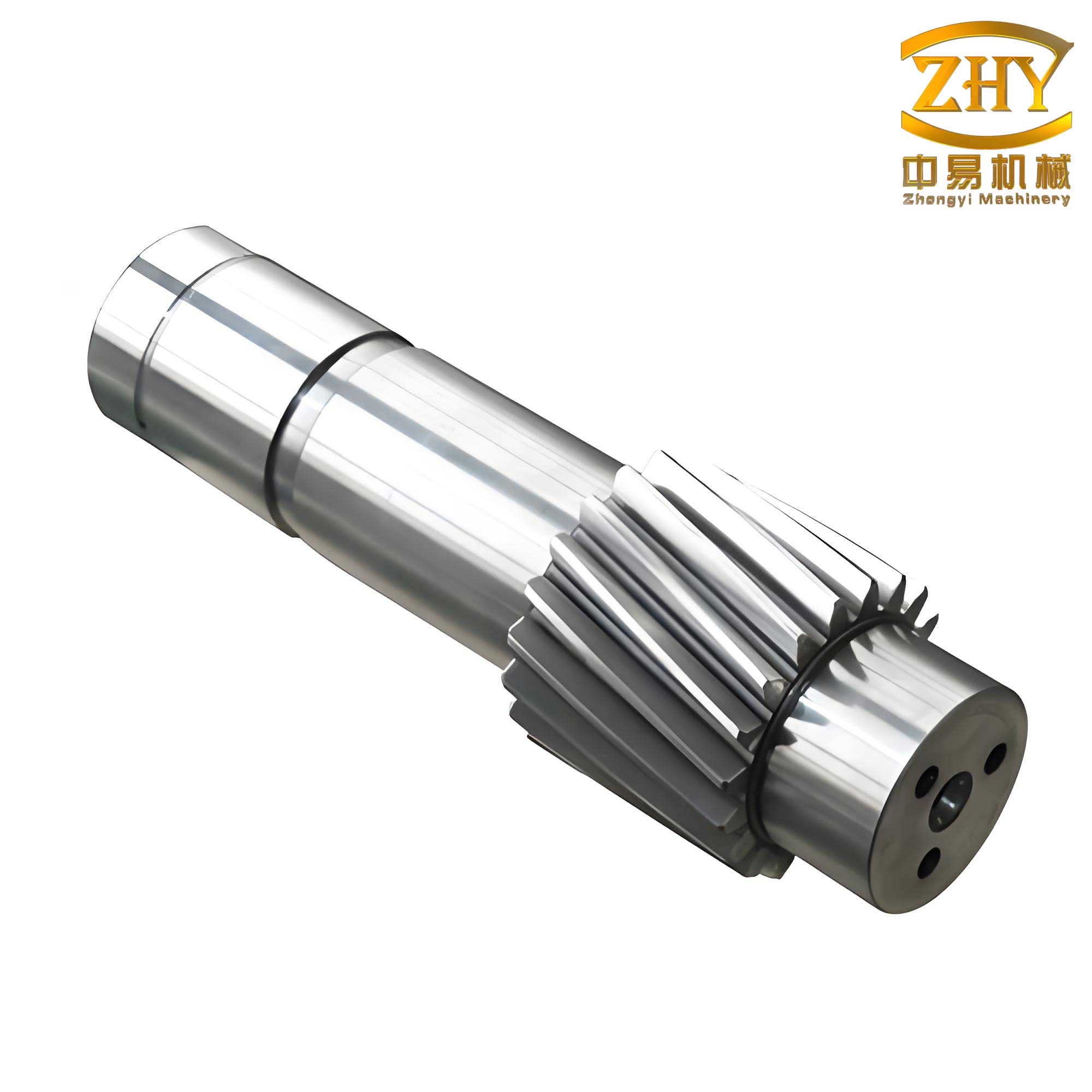
In manufacturing, gear shafts often fail to meet dynamic balance requirements, leading to scrap. Primary causes include design and工艺 issues. To enhance balance quality, several guidelines should be followed: a) In casting, avoid using坯料 with defects like porosity; b) In design, specify tight tolerances for flatness, parallelism, positional accuracy, and perpendicularity to maintain ideal gear shaft geometry; c) In machining, minimize repositioning by processing multiple features in one setup; d) In surface treatments and heat treatment, ensure uniformity to prevent asymmetrical material removal or distortion. For gear shafts, these steps are critical because even minor asymmetries can cause significant unbalance at high speeds.
Gear shafts are classified as rigid rotors, meaning their平衡 can be achieved at moderate speeds without needing to approach operational RPMs. However, the balancing process must minimize external干扰, such as vibrations from bearings or drive systems, to allow the balancing machine to accurately detect the true unbalance. Advanced balancing machines use sensitive sensors and algorithms to isolate and correct unbalance in gear shafts efficiently.
In assembly contexts, the unbalance of individual components like gear shafts and attached parts combines vectorially. If the unbalance vectors are in phase, the assembly may exhibit amplified unbalance; if out of phase, the net unbalance may be reduced. Hence, balancing individual gear shafts alone is insufficient; the fully assembled unit must also be balanced. This is particularly relevant for gear shaft assemblies in turbines, pumps, and航空 engines, where imbalance can lead to catastrophic failures.
Modern dynamic balancing practices often employ a two-step approach for gear shafts: first, temporary balance masses (e.g., adhesive clay) are added to one side during testing to determine the required correction; second, based on calculations, equivalent weight is permanently removed from the opposite side. This hybrid method accelerates the balancing process, as it avoids trial-and-error removal, thereby improving efficiency while maintaining precision. For gear shafts, this technique balances the benefits of both addition and removal methods.
To further elaborate on the impact of unbalance in gear shafts, let’s explore the relationship between unbalance, vibrational forces, and system longevity. The centrifugal force due to unbalance can be expressed in terms of the unbalance amount U and angular velocity $\omega$ as $F = U \omega^2$. This force induces vibrations that propagate through bearings and supports, accelerating wear. For a gear shaft operating at 30,000 rpm ($\omega \approx 3141.6$ rad/s), even a small unbalance of 5 g·mm generates a centrifugal force of approximately:
$$F = 5 \times 10^{-3} \text{kg} \cdot \text{mm} \times (3141.6)^2 \approx 49.3 \text{N}$$
This repetitive force can cause fatigue in gear shaft components over time. Therefore, maintaining low unbalance is essential for durability. The balancing quality grade G provides a standardized measure. For example, G6.3 implies a specific unbalance limit where the product $e_{\text{per}} \cdot \omega$ does not exceed 6.3 mm/s. This grade is suitable for many industrial gear shafts, while G2.5 might be used for精密 applications like medical devices or high-speed spindles.
Another consideration is the distribution of unbalance along the gear shaft axis. For long gear shafts, dynamic balancing must account for multiple modes of vibration, but for typical rigid rotors, two-plane correction suffices. The correction masses in planes are calculated using influence coefficient methods or modal balancing. The goal is to reduce vibrations at supports to acceptable levels. In practice, for gear shafts, the correction planes are often chosen near the ends or at prominent features like flanges.
Let’s examine a detailed calculation for a gear shaft assembly with varying masses and speeds. Suppose we have a family of gear shafts used in different applications. Table 2 summarizes permissible unbalance for different masses and grades at a fixed speed of 20,000 rpm, common in automotive transmissions.
| Gear Shaft Mass m (kg) | G2.5 $U_{\text{per}}$ (g·mm) | G6.3 $U_{\text{per}}$ (g·mm) | G16 $U_{\text{per}}$ (g·mm) |
|---|---|---|---|
| 1.0 | 1.19 | 3.00 | 7.64 |
| 2.0 | 2.38 | 6.00 | 15.27 |
| 5.0 | 5.96 | 15.01 | 38.18 |
These values underscore that heavier gear shafts allow larger absolute unbalance for the same G grade, but the specific unbalance (per unit mass) remains constant. For critical gear shafts, designers must select appropriate grades based on operational dynamics. Additionally, the cumulative effect of multiple gear shafts in a system should be evaluated, as unbalance in one gear shaft can excite resonances in others.
In my experience, achieving optimal balance for gear shafts requires attention to several factors beyond basic calculations. First, the balancing machine must be calibrated regularly to ensure accuracy. Second, environmental conditions like temperature and humidity can affect measurements, especially for gear shafts with thermal expansion concerns. Third, the mounting method of the gear shaft on the balancing arbor must replicate actual operating conditions to avoid false unbalance readings. For instance, a gear shaft clamped in a chuck may exhibit different unbalance compared to when it is mounted on its actual bearings.
Furthermore, the material and construction of gear shafts influence balancing. Forged gear shafts generally have better homogeneity than cast ones, reducing inherent unbalance. Composite gear shafts, used in advanced applications, pose unique challenges due to anisotropic properties. In all cases, the balancing process should be integrated into the manufacturing workflow, with checks after key stages like heat treatment or coating.
To illustrate the vector addition principle in gear shaft assemblies, consider two components with unbalance vectors $\mathbf{U}_1 = 10 \angle 0^\circ$ g·mm and $\mathbf{U}_2 = 8 \angle 180^\circ$ g·mm. If assembled with angles aligned, the net unbalance is $10 + 8 = 18$ g·mm; if opposed, it is $10 – 8 = 2$ g·mm. Thus, by controlling angular orientation during assembly, balance can be improved without correction. This is particularly useful for modular gear shaft systems where components are interchangeable.
In high-volume production, statistical methods are employed to monitor the dynamic balance of gear shafts. Control charts track unbalance measurements, and trends are analyzed to identify process deviations. For example, if a batch of gear shafts consistently shows high unbalance, it may indicate tool wear in machining or variability in material density. Corrective actions can then be taken to improve yield.
Looking ahead, advancements in balancing technology, such as laser balancing and online monitoring systems, are enhancing the precision and efficiency of gear shaft balancing. Laser systems allow for non-contact material removal, enabling fine corrections without damaging gear shaft surfaces. Online systems use sensors to monitor unbalance during operation, allowing for real-time adjustments in some applications. These innovations are making gear shafts more reliable in demanding environments.
In conclusion, dynamic balancing is a critical aspect of gear shaft design and manufacturing. As rigid rotors, gear shafts can be balanced at moderate speeds, but care must be taken to eliminate干扰 for accurate results. The vector nature of unbalance necessitates balancing both individual components and assemblies, as unbalance vectors can combine in ways that either exacerbate or mitigate overall imbalance. Modern practices often combine temporary weight addition with permanent removal to streamline the process. By adhering to stringent design, material, and工艺 controls, and by selecting appropriate balancing grades, the dynamic balance of gear shafts can be optimized, leading to enhanced performance, reduced vibrations, and extended service life in diverse mechanical systems.