
The reliable and continuous operation of shearers is paramount in modern longwall coal mining. As one of the primary pieces of equipment on the fully mechanized mining face, any downtime of the shearer directly translates to significant production losses. Within the complex assembly of a shearer’s cutting unit, the rocker arm gearbox is a critical power transmission component, responsible for transferring the immense torque from the motor to the cutting drum. However, operational data consistently indicates that the rocker arm gearbox is among the most failure-prone subsystems. In particular, the gears and bearings on the intermediate shaft assembly, a core component within the gearbox, exhibit the highest failure rates. These failures, manifesting as gear tooth pitting, spalling, breakage, and bearing seizure, frequently lead to unplanned maintenance shutdowns, severely impacting the overall reliability and productivity of the mining operation.
This analysis focuses on the structural characteristics and mechanical behavior of these critical gear shafts. The harsh and complex underground environment—characterized by heavy shock loads, particulate contamination, and variable operating conditions—places extreme demands on the gearbox components. Therefore, a detailed investigation into the stress state, deformation, and dynamic characteristics of the gear shafts is essential. The goal is to identify the root causes of premature failure, establish a theoretical foundation for design optimization, and propose practical measures to enhance the structural integrity and service life of the gear shafts, thereby contributing to the goal of reliable shearer operation.
Structural Overview of the Shearer Rocker Arm Gearbox and Gear Shafts
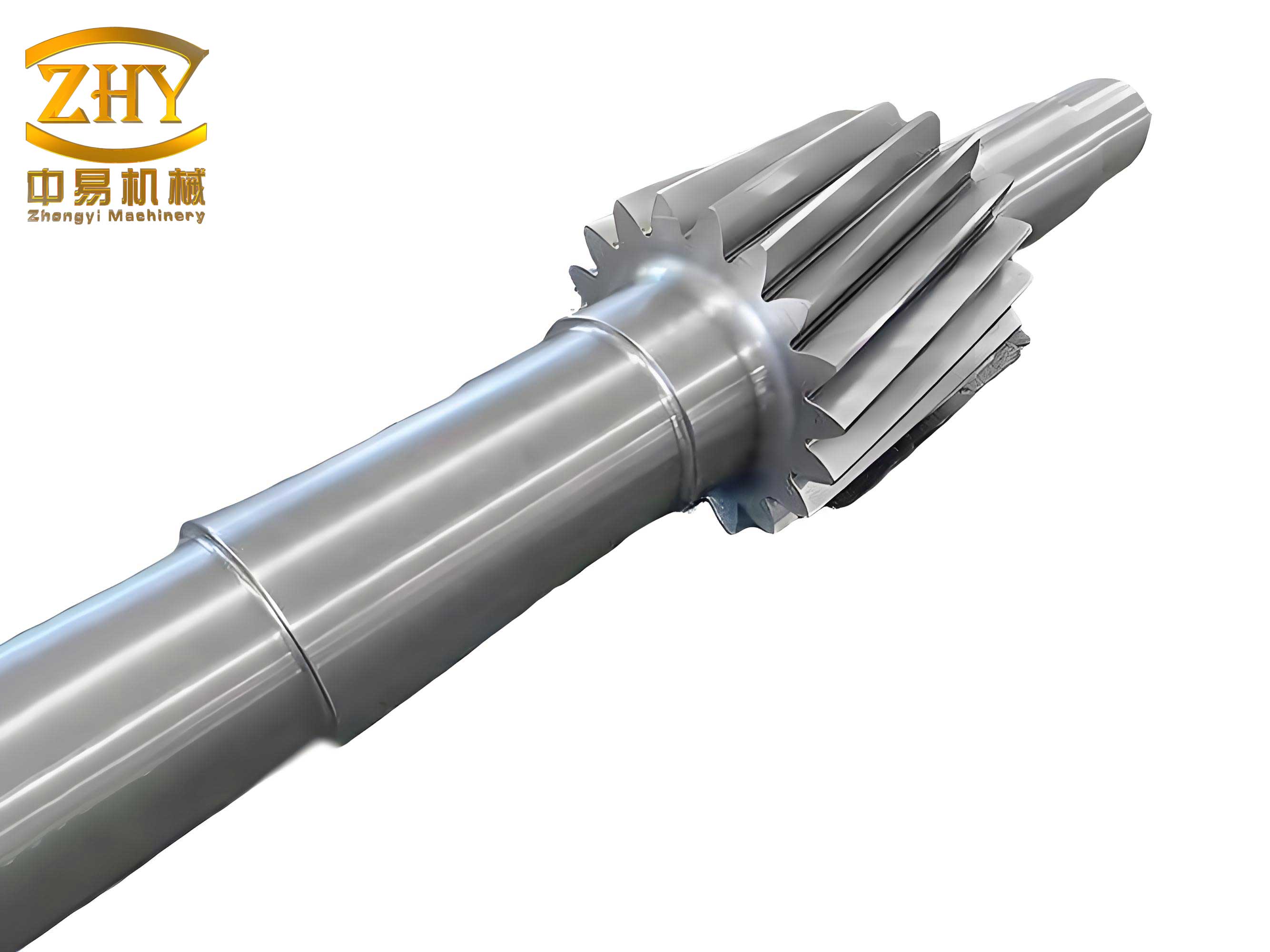
The rocker arm gearbox is a multi-stage speed reducer with a complex layout designed to provide high torque at the cutting drum. Its key characteristics include a motor input shaft connected to a hydraulic brake, idler gears for power transmission without speed change, a heavily loaded traction shaft for secondary reduction, a central gear set (comprising a large gear and a sun gear) linking to a planetary reducer, and a final two-stage planetary reduction system with floating elements for load sharing. Within this arrangement, the intermediate shaft assembly, often referred to as the “second shaft,” is a particularly vulnerable point. This assembly typically consists of a shaft integrated with one or more gear stages and is supported by bearings. The specific configuration of these gear shafts—their dimensions, material, heat treatment, and the geometry of the gear teeth—directly dictates their load-bearing capacity and fatigue life.
Mechanical and Load Analysis of Gear Shafts
To understand the failure mechanisms, a fundamental mechanical analysis of the gear shafts is necessary. The shafts are subjected to combined loading: torsion from the transmitted torque and bending from the gear mesh forces. The forces acting on the gear teeth are resolved into tangential (Ft) and radial (Fr) components acting at the midpoint of the face width. These forces, along with bearing reaction forces, create a complex stress state within the shaft.
The basic gear force calculations are given by:
$$F_t = \frac{2T}{d}$$
$$F_r = F_t \cdot \tan(\alpha)$$
Where \( T \) is the transmitted torque (N·mm), \( d \) is the pitch diameter (mm), and \( \alpha \) is the pressure angle (typically 20°). For an intermediate gear shaft transmitting a torque of \( 4.082 \times 10^6 \) N·mm, with a gear pitch diameter of 272 mm and a pinion diameter of 207 mm, the forces are significant: \( F_{t,gear} = 30,123 \) N, \( F_{r,gear} = 10,884 \) N, \( F_{t,pinion} = 39,456 \) N, \( F_{r,pinion} = 14,268 \) N.
The bending moments and torsional shear stresses are combined using an appropriate failure theory (e.g., Distortion Energy Theory) to calculate equivalent von Mises stress for static strength assessment. Furthermore, gear teeth are subject to contact (Hertzian) stress at the meshing point and bending stress at the tooth root. The tooth root bending stress, crucial for fatigue life prediction, can be estimated using the Lewis formula, modified with contemporary factors (ISO 6336):
$$\sigma_F = \frac{F_t}{b \cdot m_n} \cdot Y_F \cdot Y_S \cdot Y_\beta \cdot K_A \cdot K_V \cdot K_{F\beta} \cdot K_{F\alpha}$$
Where \( b \) is face width, \( m_n \) is normal module, \( Y_F \) is tooth form factor, \( Y_S \) is stress correction factor, \( Y_\beta \) is helix angle factor, and the \( K \)-factors account for application, dynamic load, face load distribution, and transverse load distribution, respectively. The cyclical nature of these stresses as each tooth engages leads to fatigue-driven failures like pitting and tooth breakage.
Finite Element Analysis (FEA) of Gear Shaft Structure
While analytical methods provide valuable insights, Finite Element Analysis (FEA) offers a more comprehensive view of the stress and deformation in complex gear shaft assemblies. A 3D model of the intermediate shaft assembly is created, simplifying non-critical features like small fillets, chamfers, and bolt holes to facilitate efficient meshing without compromising result accuracy in critical areas like gear tooth roots and bearing fillets.
Static Structural Analysis
The model is assigned material properties (e.g., high-grade alloy steel with E = 210 GPa, ν = 0.3, ρ = 7850 kg/m³), meshed with solid tetrahedral elements, and subjected to boundary conditions that simulate real mounting (constraints at bearing locations) and loading (applied forces calculated above). The static analysis reveals:
- Deformation: Maximum deformation is typically minimal but must be checked to ensure it does not adversely affect gear mesh alignment.
- Stress Concentration: The highest stresses consistently appear at the root fillet of the gear teeth on the shaft, confirming this as the critical location for bending fatigue initiation. When the shaft is analyzed as part of a full assembly (with supporting bearings and housings), the overall stiffness reduces the calculated localized stress. Analyzing the gear shaft in isolation under the same loads yields significantly higher stress values, underscoring the profound influence of system stiffness on stress magnitude and distribution.
This highlights a crucial design principle: both strength and stiffness must be concurrently evaluated during the design phase. A design optimized solely for strength with insufficient stiffness may still fail due to misalignment-induced overloads.
| Component | Max. Deformation (mm) | Max. Von Mises Stress (MPa) | Critical Location |
|---|---|---|---|
| Gear Shaft in Full Assembly | 0.015 | 10.3 | Pinion Tooth Root |
| Isolated Gear Shaft | 0.102 | 56.4 | Pinion Tooth Root |
| Isolated Gear | 0.089 | 139.0 | Gear Tooth Root |
Modal Analysis
To avoid resonance, which can dramatically accelerate fatigue failure, a modal analysis determines the natural frequencies of the gear shaft. The analysis computes the free-vibration frequencies without damping.
The equation of motion for an undamped multi-degree-of-freedom system is:
$$[M]\{\ddot{x}\} + [K]\{x\} = \{0\}$$
Assuming harmonic motion \( \{x\} = \{\phi\} e^{i \omega t} \), this leads to the eigenvalue problem:
$$([K] – \omega^2 [M])\{\phi\} = \{0\}$$
Where \( [M] \) is the mass matrix, \( [K] \) is the stiffness matrix, \( \omega \) is the circular natural frequency, and \( \{\phi\} \) is the mode shape vector. Solving this yields the natural frequencies \( f_n = \omega_n / 2\pi \).
The first eight natural frequencies for a typical intermediate gear shaft might be as follows. These frequencies must be compared to the shaft’s rotational frequency (running speed) and its harmonics (especially gear mesh frequency) to ensure sufficient separation margins and avoid resonance.
| Mode Number | Natural Frequency (Hz) | Mode Shape Description (Typical) |
|---|---|---|
| 1 | 584.8 | First Bending |
| 2 | 625.3 | Bending (orthogonal to Mode 1) |
| 3 | 692.6 | Second Bending / Torsional |
| 4 | 735.4 | Combined Bending & Torsion |
| 5 | 906.5 | Third Bending |
| 6 | 1162.8 | Axial / Complex Shape |
| 7 | 1467.4 | Higher Order Bending |
| 8 | 1702.1 | Complex Combined Mode |
Given that the operational speed of such gear shafts is typically below 100 Hz, and the primary excitation frequency (gear mesh frequency) is also below the first natural frequency listed, the risk of resonance under normal operation is low. However, this analysis is vital for new designs or when operational speeds are increased.
Comprehensive Measures to Enhance Gear Shaft Performance
Based on the failure analysis and FEA results, a multi-faceted approach is required to improve the reliability of rocker arm gear shafts. The measures span the entire lifecycle from design to maintenance.
| Phase | Specific Measures | Objective |
|---|---|---|
| Design & Manufacturing | Optimize gear macro-geometry (profile shift, pressure angle) and micro-geometry (tip/root relief, lead crowning) to reduce stress concentration and improve load distribution. | Minimize root bending stress and contact stress. |
| Select superior materials (e.g., carburizing steels like AISI 4320, 9310) and implement precise heat treatment processes (case hardening) to achieve a hard, wear-resistant surface with a tough, ductile core. | Enhance surface durability and core resistance to shock loads. | |
| Implement advanced manufacturing techniques like precision grinding for gears and superfinishing (e.g., honing) for bearing surfaces on the gear shafts. | Reduce surface roughness, improve fatigue strength, and ensure precise geometry. | |
| Incorporate generous fillet radii at stress-concentration points and optimize shaft diameters based on stiffness requirements from FEA. | Reduce stress peaks and prevent stiffness-related failures. | |
| Assembly & Quality Control | Strictly control gear backlash, bearing preload, and shaft alignment during assembly using laser alignment tools. | Ensure even load distribution across gear teeth and optimal bearing life. |
| Implement rigorous cleaning procedures and contamination control to prevent abrasive particles from entering the gearbox during assembly. | Prevent premature wear of gears and bearings on the gear shafts. | |
| Use torque-controlled tightening for all fasteners related to bearing housings and gear connections. | Ensure consistent and correct clamping forces to avoid distortion. | |
| Operation & Predictive Maintenance | Implement routine oil analysis to monitor wear debris, viscosity, and contamination levels. | Detect early signs of component wear (gears, bearings) and lubricant degradation. |
| Deploy continuous vibration monitoring systems with analysis of frequency spectra to track the health of gear shafts (e.g., detecting increasing amplitudes at gear mesh frequency or sidebands). | Enable condition-based maintenance and forecast failures before they occur. | |
| Conduct regular thermographic inspections to identify abnormal heating in bearing housings near the gear shafts. | Detect lubrication failure, excessive friction, or misalignment. |
Synthesis and Conclusions
The intermediate gear shafts in a shearer rocker arm represent a critical reliability bottleneck. Mechanical analysis confirms they are subjected to high cyclical bending and contact stresses, with the tooth root fillet being the most vulnerable point for fatigue crack initiation. Finite Element Analysis provides a powerful tool to visualize this stress state and demonstrates the significant role of overall system stiffness in moderating the stress levels experienced by individual gear shafts. A design focusing solely on material strength while neglecting stiffness can lead to premature failure. Modal analysis further ensures the dynamic characteristics of the gear shafts are compatible with the operating environment, avoiding resonant conditions.
Addressing the challenge of gear shaft reliability requires a systemic approach. It is not sufficient to focus on a single aspect like material quality. Lasting improvement stems from synergizing advanced design (optimized geometry, material science), precision manufacturing and assembly, and a proactive, data-driven maintenance philosophy centered on oil analysis, vibration monitoring, and thermography. By integrating these measures, the structural performance and operational lifespan of the gear shafts can be substantially enhanced. This contributes directly to reducing unplanned downtime of the shearer, increasing longwall face productivity, and achieving the fundamental goal of reliable and efficient coal extraction.