
In the field of mechanical power transmission, the relentless drive for higher performance, miniaturization, and efficiency has pushed the boundaries of traditional design paradigms. One such frontier is the development and application of gear shafts with exceptionally low numbers of teeth. My research focuses on addressing a critical analytical challenge associated with these innovative gear shafts: the precise calculation of their polar moment of inertia, a fundamental property governing torsional stiffness and strength.
Gear shafts integrating pinions with tooth counts ranging from 1 to 7 offer remarkable advantages, primarily achieving very high single-stage reduction ratios within an exceptionally compact envelope. This makes them ideal candidates for applications where space and weight are at a premium. However, this radical miniaturization of the pinion comes with significant analytical consequences. In a conventional gear shaft, the root diameter of the geared section is typically larger than the diameters of the adjoining plain shaft sections. Therefore, for standard strength and stiffness evaluations, engineers often conservatively approximate the entire component as a shaft with the smallest diameter present. This simplification, while safe for standard designs, becomes untenable for gear shafts with very low tooth counts.
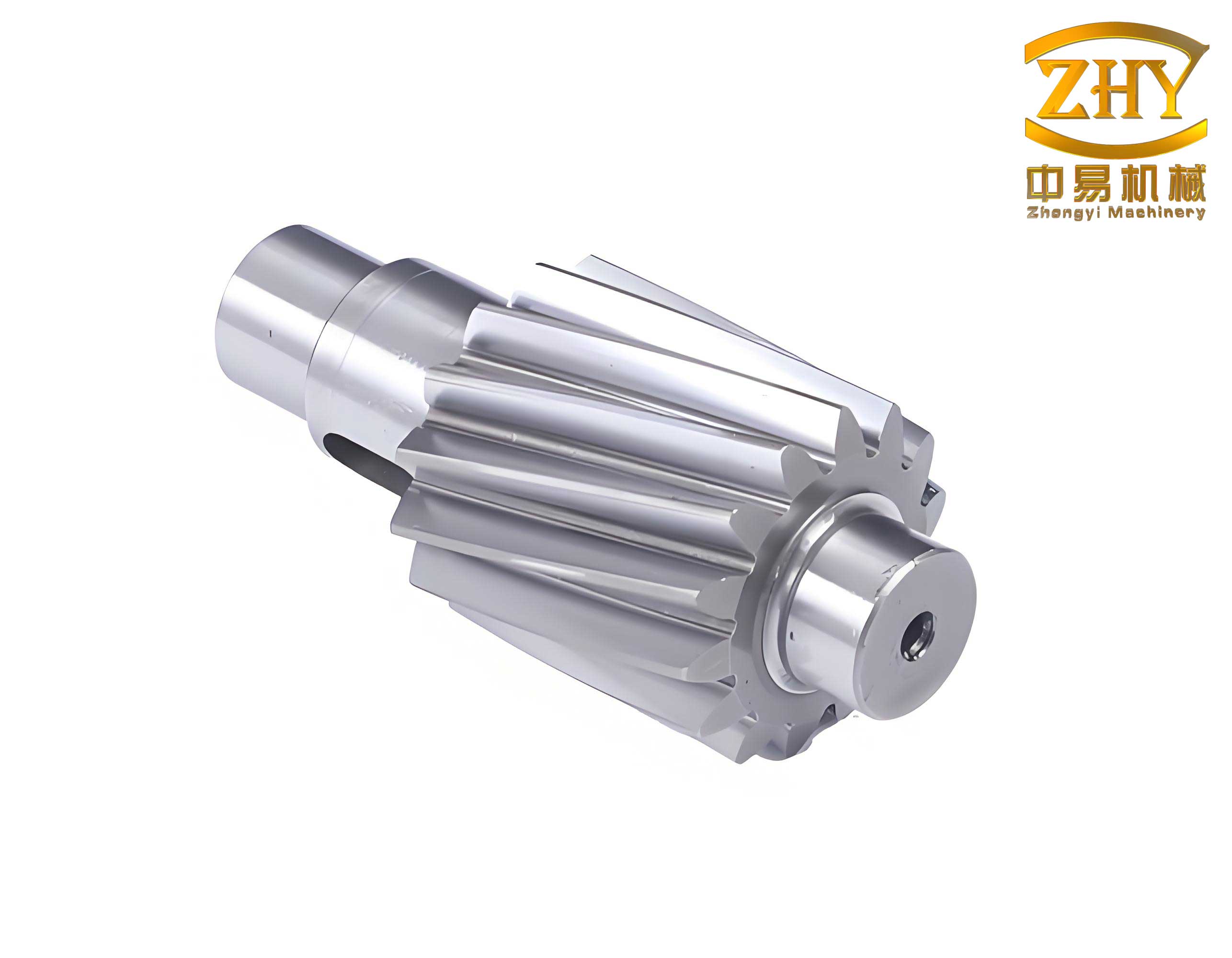
The defining feature of these low-tooth-count gear shafts is their slender geometry. With a very small root diameter and a significant length-to-diameter ratio, they classify as slender shafts. Ignoring the contribution of the tooth body’s cross-sectional geometry to the overall polar moment of inertia leads to a gross underestimation of its true torsional stiffness. This inaccurate calculation can result in overly conservative designs that forfeit the potential weight savings or, conversely, in unanticipated failures due to excessive deflection. Therefore, developing a precise method to calculate the polar moment of inertia for these non-standard cross-sections is paramount for reliable design and optimization. The core of my proposed method is the application of the superposition principle, breaking down the complex gear tooth profile into geometrically definable segments, calculating the inertial contribution of each, and summing them for the total.
Structural and Geometric Foundation of Low-Tooth-Count Gear Shafts
To establish the calculation framework, we must first define the unique geometry of the gear shafts in question. These components are typically machined as integral units, where the pinion is not a separate element mounted on a shaft but is carved directly from the shaft stock. The teeth are generated using modified hobbing processes, often requiring specialized machine setup and fixturing to achieve the aggressive tooth profiles. The geometric parameters deviate significantly from standard gears, employing substantial profile shifts (both radial and tangential) to avoid undercutting and to ensure a functional tooth form. A representative set of parameters for such a gear shaft is summarized in the table below.
| Parameter | Symbol | Value |
|---|---|---|
| Number of Teeth | $$z$$ | 2 |
| Normal Module | $$m_n$$ | 1.5 mm |
| Normal Pressure Angle | $$\alpha_n$$ | 20° |
| Helix Angle | $$\beta$$ | 23.5405° |
| Radial Shift Coefficient | $$x_t$$ | 0.949 |
| Tangential Shift Coefficient | $$x_r$$ | 0.3 |
| Root Diameter | $$d_f$$ | 3.377 mm |
| Tip Diameter | $$d_a$$ | 8.262 mm |
The cross-section of these gear shafts is complex and non-circular. Due to symmetry, analyzing one-half of a single tooth space is sufficient. This half-tooth cross-sectional area can be decomposed into four distinct regions, as illustrated in the accompanying figure and described below. This decomposition is the foundational step for applying the superposition method to calculate the polar moment of inertia for the complete gear shafts.
- Root Circle Area (Region ①): The central, solid circular area defined by the root diameter $$d_f$$.
- Fillet Transition Area (Region ②): The area between the root circle and the trochoidal fillet curve that connects the root to the active flank.
- Involute Flank Area (Region ③): The area between the root circle (or fillet end point) and the involute profile of the active tooth flank, extending to the tip circle.
- Tip Circle Area (Region ④): The area of the tooth tip bounded by the tip diameter $$d_a$$ within the angular span of the tooth tip.
The total polar moment of inertia $$I_p$$ for the gear shaft over one tooth pitch is the sum of the contribution from the root circle plus $$z$$ times the sum of contributions from regions ②, ③, and ④ associated with a single tooth.
$$
I_p = I_{p1} + z \cdot (I_{p2} + I_{p3} + I_{p4})
$$
where $$I_{p1}$$, $$I_{p2}$$, $$I_{p3}$$, and $$I_{p4}$$ correspond to the polar moments of inertia for regions ① through ④, respectively. The following sections detail the calculation for each component, which is the crux of accurately analyzing these specialized gear shafts.
Component-Wise Calculation of Inertia Contributions
1. Root Circle Contribution ($$I_{p1}$$)
This component is straightforward. For a solid circular cross-section of radius $$r_f = d_f/2$$, the polar moment of inertia is a standard result. In polar coordinates $$(\rho, \theta)$$, with the area element $$dA = \rho \, d\rho \, d\theta$$, we have:
$$
I_{p1} = \int_A \rho^2 dA = \int_0^{2\pi} \int_0^{r_f} \rho^3 d\rho \, d\theta = \frac{\pi r_f^4}{2} = \frac{\pi d_f^4}{32}
$$
This term represents the baseline inertia of the gear shafts at their smallest diameter.
2. Fillet Transition Contribution ($$I_{p2}$$)
This is the most mathematically intricate part of analyzing these gear shafts. The fillet is typically a trochoid generated by the tip of the cutting tool (e.g., a hob). Its geometry depends on the tool tip radius $$\rho$$ and the machine-tool settings. The equations for the trochoidal fillet path relative to the gear center in a Cartesian coordinate system can be expressed with parameters derived from the gear data:
Let $$x_c = (h_{an}^* + c_n^* – x_n)m_n – \rho$$ and $$y_c = \frac{1}{4}\pi m_t + h_{at}^* m_t \tan\alpha_n + \rho \cos\alpha_n$$, where $$m_t$$ is the transverse module. The fillet curve coordinates are then given by a parametric form involving an angle parameter $$\phi$$ and the tool geometry angle $$\gamma$$.
The polar radius $$r_1(\theta)$$ to a point on this fillet can be derived. The limits of integration are from the angle $$\theta_j$$, where the fillet meets the involute, to the angle $$\theta_b$$, where the fillet meets the root circle (i.e., where $$r_1(\theta_b) = r_f$$). The contribution for one fillet is:
$$
\frac{I_{p2}}{2} = \int_{\theta_j}^{\theta_b} \int_{r_f}^{r_1(\theta)} \rho^3 d\rho \, d\theta = \int_{\theta_j}^{\theta_b} \left( \frac{r_1^4(\theta)}{4} – \frac{r_f^4}{4} \right) d\theta
$$
Therefore,
$$
I_{p2} = 2 \left[ \int_{\theta_j}^{\theta_b} \frac{r_1^4(\theta)}{4} d\theta – \frac{r_f^4}{4} (\theta_b – \theta_j) \right]
$$
The integral $$\int r_1^4(\theta) d\theta$$, after substituting the full expression for $$r_1(\theta)$$, resolves into a combination of polynomial, trigonometric, and logarithmic terms in $$\theta$$, evaluated between $$\theta_b$$ and $$\theta_j$$. The exact closed-form result is extensive but essential for the precise characterization of gear shafts.
3. Involute Flank Contribution ($$I_{p3}$$)
The active tooth profile of the gear shafts is an involute. In polar coordinates, the equation of an involute relative to its base circle of radius $$r_b$$ is elegantly simple:
$$
r_k(\alpha_k) = \frac{r_b}{\cos \alpha_k}, \quad \theta_k(\alpha_k) = \tan \alpha_k – \alpha_k
$$
where $$\alpha_k$$ is the transverse pressure angle at the point in question. The integration for region ③ proceeds from the point J (fillet end, pressure angle $$\alpha_j$$) to the tooth tip A (pressure angle $$\alpha_a$$). The polar radius on the involute is $$r_k$$, and the root circle radius $$r_f$$ forms the inner bound of the area strip. For one side of the tooth:
$$
\frac{I_{p3}}{2} = \int_{\theta_j}^{\theta_a} \int_{r_f}^{r_k(\theta)} \rho^3 d\rho \, d\theta = \int_{\theta_j}^{\theta_a} \left( \frac{r_k^4(\theta)}{4} – \frac{r_f^4}{4} \right) d\theta
$$
Changing the variable of integration to $$\alpha_k$$ using $$d\theta_k = \tan^2 \alpha_k \, d\alpha_k$$, and noting $$r_k^4 = r_b^4 / \cos^4 \alpha_k$$, we get:
$$
I_{p3} = 2 \cdot \frac{1}{4} \int_{\alpha_j}^{\alpha_a} \left( \frac{r_b^4}{\cos^4 \alpha_k} – r_f^4 \right) \tan^2 \alpha_k \, d\alpha_k
$$
Solving this integral yields a compact formula:
$$
I_{p3} = \frac{r_b^4}{2} \left[ \frac{\tan^5 \alpha_a – \tan^5 \alpha_j}{5} + \frac{\tan^3 \alpha_a – \tan^3 \alpha_j}{3} \right] – \frac{r_f^4}{2} \left[ (\tan \alpha_a – \alpha_a) – (\tan \alpha_j – \alpha_j) \right]
$$
This formulation is crucial for accurately modeling the stiffening effect provided by the involute portion of the teeth on the overall gear shafts.
4. Tip Circle Contribution ($$I_{p4}$$)
The tip of the tooth is a circular arc of radius $$r_a = d_a/2$$, spanning an angular width $$\theta_a$$. The inner boundary of this region is the involute curve at the tip, but for the area moment calculation, it is sufficiently accurate to approximate the inner boundary as the root circle $$r_f$$ over this small angle. The angular half-width $$\theta_a$$ is determined by the tooth tip thickness $$S_a$$: $$\theta_a = S_a / (2 r_a)$$, where $$S_a$$ can be calculated from the gear geometry. The contribution is:
$$
\frac{I_{p4}}{2} = \int_{0}^{\theta_a} \int_{r_f}^{r_a} \rho^3 d\rho \, d\theta = \frac{1}{4}(r_a^4 – r_f^4) \theta_a
$$
Hence,
$$
I_{p4} = \frac{1}{2}(r_a^4 – r_f^4) \theta_a
$$
While often small, this term completes the geometric model of the tooth profile for the gear shafts.
Total Polar Moment of Inertia for Low-Tooth-Count Gear Shafts
Combining all components according to the superposition principle, the total polar moment of inertia for a gear shaft with $$z$$ teeth is given by:
$$
I_p = \frac{\pi d_f^4}{32} + z \cdot \left( I_{p2} + I_{p3} + I_{p4} \right)
$$
Substituting the derived expressions, the final working formula becomes a comprehensive function of the gear shaft’s fundamental parameters:
$$
I_p = \frac{\pi d_f^4}{32} + z \cdot \left\{
\frac{1}{2} \left[ \int_{\theta_j}^{\theta_b} r_1^4(\theta) d\theta – r_f^4 (\theta_b – \theta_j) \right] \; + \;
\frac{r_b^4}{2} \left( \frac{\tan^5 \alpha_a – \tan^5 \alpha_j}{5} + \frac{\tan^3 \alpha_a – \tan^3 \alpha_j}{3} \right) – \frac{r_f^4}{2} \left[ (\tan \alpha_a – \alpha_a) – (\tan \alpha_j – \alpha_j) \right] \; + \;
\frac{1}{2}(r_a^4 – r_f^4) \theta_a
\right\}
$$
Where the integral for $$I_{p2}$$ is evaluated using the specific trochoidal fillet equation. This result provides the precise geometric inertia required for advanced mechanical analysis of gear shafts.
Discussion and Implications for Design of Gear Shafts
The development and application of this precise calculation methodology have profound implications for the design and analysis of gear shafts with low tooth counts. The table below contrasts the key aspects of the traditional approximate method versus the new precise method proposed here.
| Aspect | Traditional Approximate Method | New Precise Superposition Method |
|---|---|---|
| Model Basis | Considers only the smallest shaft cross-section (root circle). | Decomposes the full tooth profile geometry into calculable segments. |
| Calculated $$I_p$$ | $$I_{p,\text{approx}} = \pi d_f^4 / 32$$ | $$I_{p,\text{precise}} = I_{p1} + z(I_{p2}+I_{p3}+I_{p4})$$ |
| Accuracy | Significant underestimation for slender, low-tooth-count gear shafts. | High accuracy, capturing the true structural contribution of the teeth. |
| Design Outcome | Overly conservative (heavy) or non-conservative (prone to failure). | Enables optimized, reliable, and lightweight design of gear shafts. |
| Primary Use | Standard gear shafts with large root diameters. | Essential for modern, compact gear shafts with very low tooth counts. |
The precise value of $$I_p$$ directly influences two critical performance metrics for gear shafts:
- Torsional Stiffness ($$k_t$$): The resistance to angular twist under torque is proportional to the polar moment of inertia and the shear modulus $$G$$.
$$ k_t = \frac{G \cdot I_p}{L} $$
where $$L$$ is the effective length. A higher, accurate $$I_p$$ predicts greater stiffness, which is vital for positioning accuracy and dynamic response. - Torsional Shear Stress ($$\tau$$): Under an applied torque $$T$$, the maximum shear stress is inversely proportional to $$I_p$$.
$$ \tau_{max} = \frac{T \cdot r_{max}}{I_p} $$
where $$r_{max}$$ is the maximum radial distance to the outer fiber (often $$r_a$$). An underestimated $$I_p$$ leads to a gross overestimation of stress, forcing unnecessarily large designs. The accurate calculation allows for stress prediction that reflects the true load-bearing capacity of the gear shafts’ complex shape.
Furthermore, this methodology forms the foundation for systematic design optimization. Engineers can now treat geometric parameters like profile shift coefficients ($$x_t, x_r$$), tool tip radius ($$\rho$$), and pressure angle ($$\alpha_n$$) as variables to maximize the polar moment of inertia—and thus the stiffness—for a given envelope or weight constraint. This leads to truly optimized gear shafts that fully exploit the material and spatial allowances.
Conclusion
The accurate determination of the polar moment of inertia is a cornerstone in the mechanical analysis of any rotating shaft, and it becomes critically nuanced for the innovative class of gear shafts with very low tooth counts. The traditional simplification of using the root diameter alone is inadequate and misleading for these slender, high-ratio components. The superposition method presented here, which meticulously accounts for the inertial contribution of the root circle, trochoidal fillet, involute flank, and tooth tip, provides the necessary precision. By deriving and integrating the geometric formulas for each segment, this approach yields a comprehensive analytical model for $$I_p$$. This advancement is not merely a theoretical exercise; it is an essential enabler. It provides the reliable data needed for valid torsional stiffness and stress analysis, which in turn facilitates the confident design, optimization, and successful application of high-performance, compact gear shafts in advanced mechanical systems. The methodology underscores the principle that mastering the details of geometry is key to unlocking the potential of groundbreaking mechanical elements like low-tooth-count gear shafts.