
In the manufacturing of engine components, gear shafts play a critical role in ensuring durability and reliability. During production, I encountered an issue where some gear shafts exhibited low hardness after high-frequency quenching, failing to meet technical specifications. This problem directly impacted the quality of the final product, prompting an in-depth investigation into the heat treatment processes. My goal was to identify the root cause and implement effective solutions to enhance the consistency and performance of these gear shafts.
The gear shafts in question are made from 20 steel and require carburizing to achieve a surface carbon content suitable for subsequent high-frequency quenching. The technical specifications include a carburized layer depth of 0.8 to 1.2 mm and a surface hardness of HRC 58-64 after high-frequency quenching in specific diameter regions. The original production流程 involved forging, normalizing, machining, carburizing with slow cooling, shot blasting, high-frequency quenching, further machining, and assembly. However, inconsistencies in hardness after high-frequency quenching were observed, leading to concerns about the carburizing step’s effectiveness.
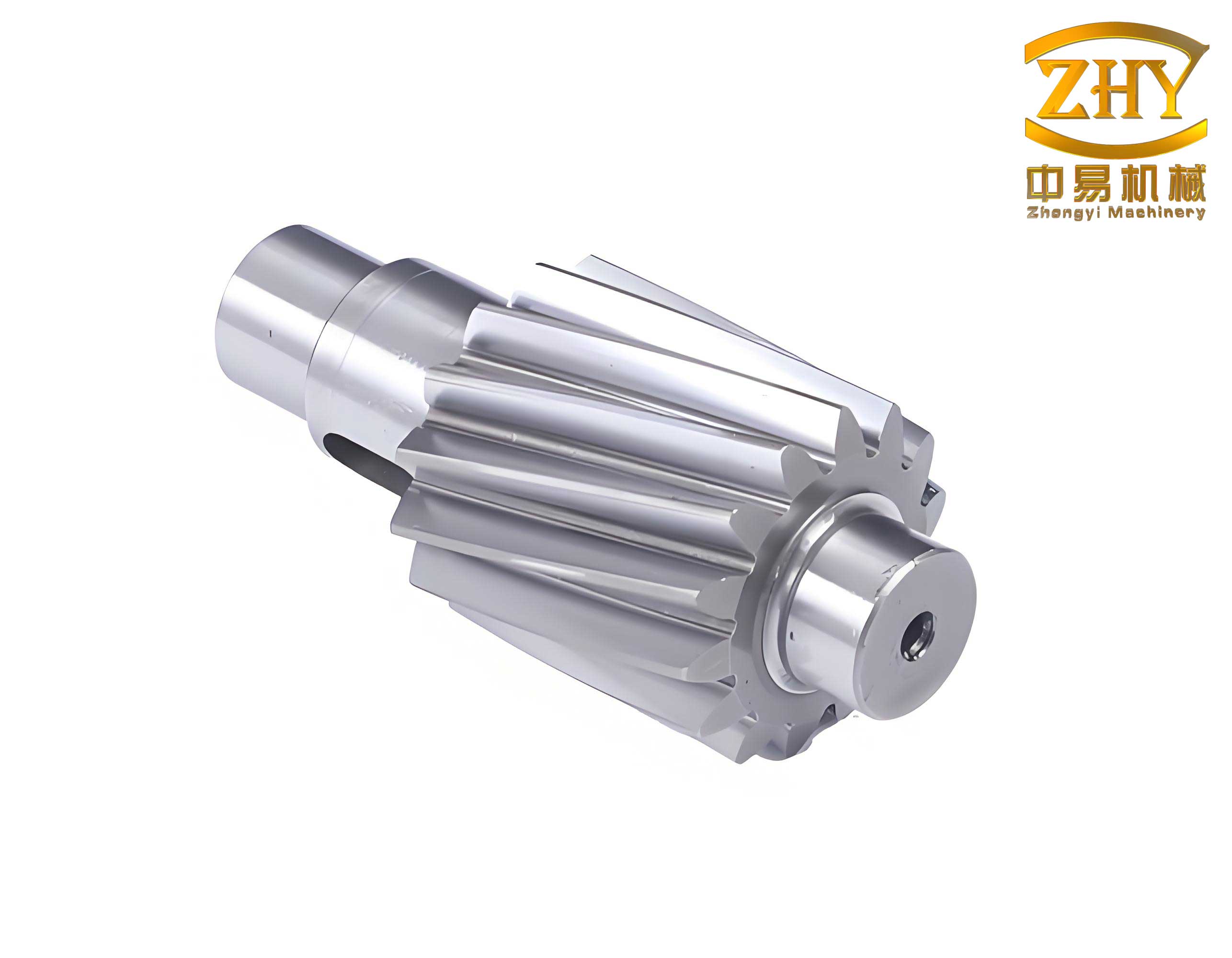
To understand the problem, I first analyzed the interaction between carburizing and high-frequency quenching. High-frequency quenching relies on electromagnetic induction to heat the surface of steel parts, typically used for medium-carbon steels or carburized low-carbon steels. For gear shafts made of 20 steel, carburizing is essential to increase surface carbon content to approximately 0.7-1.0%, enabling high hardness after quenching. If the carburized layer is non-uniform or absent, the surface carbon content falls below the eutectoid composition, resulting in insufficient hardness during high-frequency quenching. This relationship can be expressed using a formula linking hardness to carbon content: $$HRC = \alpha \cdot C\% + \beta$$ where $\alpha$ and $\beta$ are material-specific constants, and $C\%$ is the surface carbon percentage. For gear shafts, a carbon content below 0.7% often leads to hardness values under HRC 58.
I conducted a series of experiments to verify this hypothesis. Initial tests involved cutting and examining gear shafts that showed low hardness after high-frequency quenching. Metallographic analysis revealed that these parts lacked a proper eutectoid layer, with carburized depths as low as 0 mm or only 0.6 mm, compared to the required 0.8-1.2 mm. To systematically study this, I sampled gear shafts from different positions within the carburizing furnace and measured their hardness after carburizing (HAC), carburized layer depth, and high-frequency quenching hardness (HFQH). The results are summarized in Table 1.
| Sample ID | HAC (HRC) | Carburized Depth (mm) | HFQH (HRC) | Metallographic Structure |
|---|---|---|---|---|
| 1 | 14-18 | 0.5-0.6 / 1.0 | 59, 61, 65 | Uniform martensite |
| 2 | 8-10 | 0 / 1.0 | 53, 44 | Martensite + ferrite |
| 3 | 6-8 | 0 / 1.0 | 42, 50 | Martensite + ferrite |
| 4 | ≤0 | No layer | 25, 30 | Ferrite |
| 5 | 6-9 | 0 / 0.6 | 52, 35 | Martensite + ferrite |
| 6 | 16-22 | 0.7-0.8 / 1.10 | 60, 65, 63 | Uniform martensite |
The data clearly indicate that when the carburized depth meets specifications, HAC values exceed HRC 14, and HFQH is within the required range. Conversely, insufficient carburized depth correlates with low HAC and subpar HFQH. This confirmed that the issue stemmed from uneven carburizing, likely due to poor atmosphere circulation within the furnace. In traditional setups, gear shafts were tightly packed in carburizing pots, hindering gas flow and creating zones with low carbon potential, especially in central areas. This non-uniformity caused some gear shafts to receive inadequate carburizing, affecting their final hardness.
Based on this analysis, I proposed a modified loading method to improve atmosphere uniformity. The original method (Loading Mode 1) involved densely packing gear shafts in pots without any spacing, leading to poor circulation. The new method (Loading Mode 2) utilized wire mesh to create layers within the pots, separating gear shafts into three tiers and reducing the load from 550 to 480-500 pieces per pot. This design aimed to enhance gas penetration and ensure consistent carburizing across all gear shafts. The improvement can be modeled using Fick’s law of diffusion, where the carburizing depth $d$ is given by: $$d = 2 \cdot \sqrt{D \cdot t}$$ Here, $D$ is the diffusion coefficient, which depends on temperature and atmosphere composition, and $t$ is time. By improving atmosphere circulation, $D$ becomes more uniform, leading to consistent $d$ values across all gear shafts.
To validate this approach, I conducted comparative experiments using both loading modes in multiple furnace runs. For each run, I measured HAC from various positions in the pots (top, middle, bottom), checked carburized depth, and performed high-frequency quenching tests. The results are detailed in Table 2, which compares the two loading modes for gear shafts.
| Furnace ID | Equipment | Loading Mode | Load Quantity | Carburized Depth (Test Bar, mm) | Position in Pot | HAC (HRC) | Carburized Depth (Part, mm) | HFQH (HRC) | Remarks |
|---|---|---|---|---|---|---|---|---|---|
| 01 | Furnace 3 | Mode 2 (Layered) | 480 | 0.8 / 1.3 | Top pot: Top | 21, 25 | 0.8 / 1.25 | 59, 63 | Qualified |
| Top pot: Middle | 19, 22 | 59, 64 | Qualified | ||||||
| Top pot: Bottom | 20, 24 | 60, 62 | Qualified | ||||||
| Bottom pot: Top | 23, 26 | 58, 63 | Qualified | ||||||
| Bottom pot: Middle | 23, 21 | 59, 62 | Qualified | ||||||
| Bottom pot: Bottom | 25, 20 | 59, 60 | Qualified | ||||||
| 02 | Furnace 4 | Mode 2 (Layered) | 480 | 0.7 / 1.05 | Top pot: Top | 19, 21 | 0.7 / 1.10 | 60, 63 | Qualified |
| Top pot: Middle | 20, 18 | 61, 64 | Qualified | ||||||
| Top pot: Bottom | 18, 20 | 60, 62 | Qualified | ||||||
| Bottom pot: Top | 20, 24 | 60, 62 | Qualified | ||||||
| Bottom pot: Middle | 18, 22 | 59, 61 | Qualified | ||||||
| Bottom pot: Bottom | 19, 22 | 60, 63 | Qualified | ||||||
| 03 | Furnace 3 | Mode 1 (Non-layered) | 550 | 0.7 / 1.15 | Top pot: Top | 19, 21 | 0.7 / 1.10 | 59, 62 | Qualified |
| Top pot: Middle | 14, 11 | 0 / 0.9 | 53, 46 | Low hardness | |||||
| Top pot: Bottom | 22, 17 | 59, 61 | Qualified | ||||||
| Bottom pot: Top | 20, 18 | 60, 62 | Qualified | ||||||
| Bottom pot: Middle | 5, 8 | 0 | 32, 45 | Low hardness | |||||
| Bottom pot: Bottom | 10, 13 | 46, 53 | Low hardness | ||||||
| 04 | Furnace 4 | Mode 2 (Layered) | 500 | 0.6 / 1.1 | Top pot: Top | 21, 23 | 0.6 / 1.15 | 59, 64 | Qualified |
| Top pot: Middle | 22, 20 | 60, 64 | Qualified | ||||||
| Top pot: Bottom | 19, 24 | 61, 63 | Qualified | ||||||
| Bottom pot: Top | 27, 23 | 59, 62 | Qualified | ||||||
| Bottom pot: Middle | 24, 22 | 59, 61 | Qualified | ||||||
| Bottom pot: Bottom | 20, 24 | 60, 62 | Qualified |
The data show that Loading Mode 1 resulted in low hardness in central pot positions, with HAC values around HRC 10 and non-uniform carburized depths, leading to failed high-frequency quenching. In contrast, Loading Mode 2 produced consistent HAC above HRC 14 across all positions, with合格 carburized depths and HFQH within specifications. This demonstrates that layering gear shafts with wire mesh significantly improves atmosphere circulation, ensuring uniform carburizing. To further confirm reproducibility, additional tests were conducted, as shown in Table 3 for gear shafts.
| Furnace ID | Equipment | Loading Mode | Load Quantity | Carburized Depth (Test Bar, mm) | Position in Pot | HAC (HRC) | Carburized Depth (Part, mm) | HFQH (HRC) | Remarks |
|---|---|---|---|---|---|---|---|---|---|
| 05 | Furnace 3 | Mode 2 (Layered) | 500 | 0.65 / 1.05 | Top pot: Top | 24, 20 | 0.65 / 1.05 | 59, 64 | Qualified |
| Top pot: Middle | 22, 23 | 60, 62 | Qualified | ||||||
| Top pot: Bottom | 22, 19 | 58, 63 | Qualified | ||||||
| Bottom pot: Top | 22, 23 | 59, 60 | Qualified | ||||||
| Bottom pot: Middle | 21, 20 | 61, 62 | Qualified | ||||||
| Bottom pot: Bottom | 24, 25 | 58, 63 | Qualified | ||||||
| 06 | Furnace 4 | Mode 2 (Layered) | 500 | 0.80 / 1.20 | Top pot: Top | 22, 23 | 0.80 / 1.15 | 60, 63 | Qualified |
| Top pot: Middle | 25, 27 | 60, 61 | Qualified | ||||||
| Top pot: Bottom | 21, 23 | 59, 61 | Qualified | ||||||
| Bottom pot: Top | 22, 27 | 60, 61 | Qualified | ||||||
| Bottom pot: Middle | 24, 21 | 59, 64 | Qualified | ||||||
| Bottom pot: Bottom | 27, 21 | 60, 63 | Qualified |
These results confirm that the layered loading mode is highly reproducible and effective for producing gear shafts with consistent quality. The improvement can be quantified using a statistical model for hardness distribution. Let $H_i$ represent the hardness of gear shaft $i$, and $\sigma_H$ be the standard deviation of hardness across a batch. For traditional loading, $\sigma_H$ is high due to non-uniform carburizing, whereas for layered loading, $\sigma_H$ decreases significantly, indicating better process control. This can be expressed as: $$\sigma_H = \sqrt{\frac{1}{N} \sum_{i=1}^{N} (H_i – \bar{H})^2}$$ where $N$ is the number of gear shafts, and $\bar{H}$ is the mean hardness. In practice, for gear shafts processed with layered loading, $\sigma_H$ falls below 2 HRC, ensuring that nearly all parts meet the HRC 58-64 requirement.
Beyond experimental data, I explored the theoretical underpinnings of carburizing for gear shafts. The carburizing process involves carbon diffusion into the steel surface, governed by temperature, time, and atmosphere carbon potential. The carbon potential $C_p$ in the furnace atmosphere must be maintained above the steel’s surface carbon content to drive diffusion. For gear shafts made of 20 steel, the target surface carbon after carburizing is around 0.8%, which requires a $C_p$ of approximately 1.0% at typical carburizing temperatures (e.g., 930°C). The relationship between carburized depth $d$ and time $t$ can be refined using the error function solution to Fick’s second law: $$C(x,t) = C_s – (C_s – C_0) \cdot \text{erf}\left(\frac{x}{2\sqrt{Dt}}\right)$$ where $C(x,t)$ is the carbon concentration at depth $x$ and time $t$, $C_s$ is the surface carbon concentration, $C_0$ is the initial carbon concentration (0.2% for 20 steel), and $\text{erf}$ is the error function. For gear shafts, achieving $d$ = 1.0 mm requires careful control of $D$ and $t$, with $D$ dependent on temperature $T$ via the Arrhenius equation: $$D = D_0 \exp\left(-\frac{Q}{RT}\right)$$ Here, $D_0$ is a pre-exponential factor, $Q$ is activation energy, $R$ is the gas constant, and $T$ is absolute temperature. By optimizing furnace atmosphere circulation, $C_s$ becomes uniform across all gear shafts, leading to consistent $d$ values.
Furthermore, the high-frequency quenching process for gear shafts involves rapid heating and cooling to form martensite. The hardness after quenching depends on the carbon content and cooling rate. For gear shafts with adequate carburizing, the martensite formation can be described using the Koistinen-Marburger equation for martensite fraction $f_m$: $$f_m = 1 – \exp(-\alpha (M_s – T))$$ where $\alpha$ is a constant, $M_s$ is the martensite start temperature, and $T$ is the quenching temperature. $M_s$ decreases with increasing carbon content, so gear shafts with higher surface carbon achieve full martensite formation, resulting in high hardness. In contrast, low carbon content leads to mixed structures of martensite and ferrite, reducing hardness.
To implement these insights, I adjusted the production process for gear shafts. The modified流程 now includes: forging → normalizing → machining → carburizing with layered loading and slow cooling → shot blasting → high-frequency quenching → machining → assembly. Additionally, I introduced a hardness check after carburizing as a quality control measure. By measuring HAC, we can quickly assess carburizing uniformity without destructive testing. If HAC is below HRC 14, the batch is flagged for review, preventing defective gear shafts from proceeding to high-frequency quenching. This method has proven effective in ongoing production, with recent batches showing 100%合格 hardness values for gear shafts.
In summary, this study highlights the importance of atmosphere uniformity in carburizing for gear shafts. Uneven gas circulation in traditional loading methods causes inconsistent carburized depths, leading to low hardness after high-frequency quenching. By adopting a layered loading approach with wire mesh, atmosphere circulation improves, ensuring uniform carburizing across all gear shafts. The hardness method for judging carburizing quality is a practical tool that can be extended to other similar components. These improvements not only enhance the performance and reliability of gear shafts but also reduce waste and increase production efficiency. Future work could explore advanced furnace designs or real-time monitoring systems to further optimize the heat treatment of gear shafts.