
In my extensive career within heavy industry maintenance, I have encountered countless instances where critical components such as gear shafts suffer from severe wear, leading to costly downtime and production losses. Gear shafts are the backbone of many mechanical systems, transmitting torque and motion in machinery ranging from rolling mills to automotive assemblies. Their failure, often due to abrasive wear, fatigue, or improper lubrication, can bring entire production lines to a halt. One of the most effective and economical solutions we have consistently applied is thermal spray technology, a process that deposits protective coatings onto worn surfaces, effectively restoring gear shafts to their original dimensions and enhancing their performance. This article delves into our first-hand experience and methodologies, emphasizing the restoration of gear shafts through thermal spray techniques, supported by technical data, formulas, and comparative analyses.
The fundamental challenge with gear shafts is that wear typically occurs at specific high-stress locations, such as bearing journals or splined sections. In one notable case, a gear shaft from a rolling mill drive system exhibited significant wear at two bearing positions. The wear depths were substantial, compromising the fit with bearing inner rings and necessitating immediate intervention. Traditional methods like welding or replacement were considered, but thermal spray offered a superior alternative due to its minimal heat input, which prevents distortion, and its ability to apply a wide range of coating materials tailored to specific wear resistance requirements.
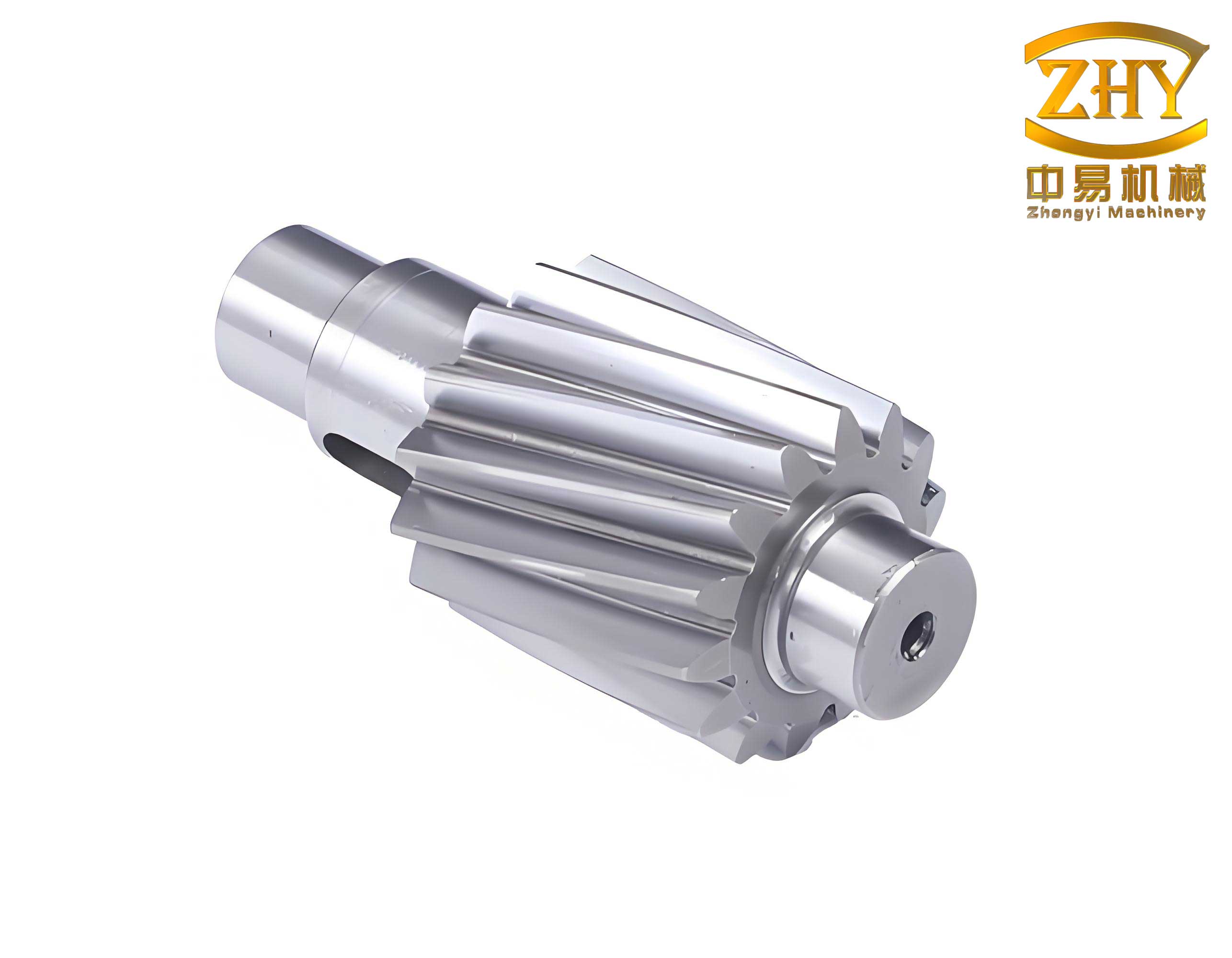
Thermal spray involves heating coating materials—in powder, wire, or rod form—to a molten or semi-molten state and accelerating them onto a prepared substrate. The process can be described using basic heat transfer and fluid dynamics principles. For instance, the particle velocity and temperature during spraying are critical for coating adhesion and density. We often model the particle impact using the following equation for kinetic energy transfer: $$ E_k = \frac{1}{2} m_p v_p^2 $$ where \( m_p \) is the particle mass and \( v_p \) is its velocity upon impact. The resulting coating bond strength, \( \sigma_b \), can be approximated by: $$ \sigma_b = C \cdot \rho \cdot v_p \cdot T_p $$ where \( C \) is a material constant, \( \rho \) is density, and \( T_p \) is particle temperature. This ensures that the restored gear shafts achieve durable surfaces.
Our restoration procedure for gear shafts begins with a thorough assessment of wear. We measure wear volumes using precision instruments, and for analytical purposes, wear rates can be calculated using Archard’s wear equation: $$ V = K \frac{W \cdot s}{H} $$ where \( V \) is wear volume, \( K \) is a wear coefficient, \( W \) is normal load, \( s \) is sliding distance, and \( H \) is material hardness. For the gear shaft in question, the wear volumes at locations A and B were quantified, leading to the design of a tailored coating system.
| Wear Location | Original Diameter (mm) | Worn Diameter (mm) | Wear Depth (mm) | Required Coating Thickness (mm) |
|---|---|---|---|---|
| Bearing Journal A | 120.00 | 119.50 | 0.50 | 1.00 |
| Bearing Journal B | 100.00 | 99.20 | 0.80 | 1.50 |
Prior to spraying, the gear shaft is meticulously prepared. We machine the worn areas to create a uniform surface, often turning them to a diameter slightly undersized to accommodate the coating thickness. In this case, we turned the sections to diameters of 118 mm and 98 mm, respectively, with a rough thread pattern to enhance coating adhesion. Sensitive areas, such as adjacent splines, are protected using masking compounds. The shaft is then mounted on a lathe, which rotates at a controlled speed—typically between 100 to 200 rpm—to ensure even coating deposition. Preheating is crucial to remove moisture and reduce thermal stresses; we use a spray gun to heat the gear shaft to approximately 100–150°C, monitored with a semiconductor point thermometer.
The coating materials selected are pivotal for the success of restoring gear shafts. We often employ nickel-based alloys for their excellent wear and corrosion resistance. For instance, a bond coat of Ni-5%Al powder is applied first to promote adhesion, followed by a top coat of NiCrBSi powder for superior hardness. The chemical composition of these powders is detailed below:
| Powder Type | Ni (%) | Cr (%) | B (%) | Si (%) | Al (%) | Fe (%) | Others (%) |
|---|---|---|---|---|---|---|---|
| Ni-5%Al (Bond Coat) | 94.5 | — | — | — | 5.0 | 0.5 | Traces |
| NiCrBSi (Top Coat) | Balance | 15.0 | 3.5 | 4.5 | — | 5.0 | Mo, C |
Spraying parameters are optimized based on the gear shaft material and desired coating properties. The coating thickness, \( t \), can be estimated using the formula: $$ t = \frac{\dot{m} \cdot \eta}{\rho \cdot A \cdot v} $$ where \( \dot{m} \) is powder feed rate, \( \eta \) is deposition efficiency, \( \rho \) is coating density, \( A \) is surface area, and \( v \) is traverse speed. In practice, we maintain interpass temperatures around 150°C to avoid cracking. The spray distance is kept at 150–200 mm, with a gun velocity of 500 mm/s. After spraying, the gear shaft is allowed to cool slowly to room temperature, then machined to final dimensions—turning and grinding to achieve precise tolerances, typically within ±0.02 mm.
| Parameter | Value Range | Units |
|---|---|---|
| Preheat Temperature | 100–150 | °C |
| Spray Distance | 150–200 | mm |
| Powder Feed Rate | 30–50 | g/min |
| Gun Traverse Speed | 400–600 | mm/s |
| Substrate Rotation Speed | 100–200 | rpm |
| Coating Thickness per Pass | 0.05–0.10 | mm |
The economic benefits of thermal spray restoration for gear shafts are profound. Compared to replacing a new gear shaft, which can cost tens of thousands of dollars and require long lead times, our repair process is both cost-effective and rapid. In the case described, the total material cost for powders was under $100, and labor, including preparation, spraying, and machining, amounted to less than $200. The entire repair was completed within a day, minimizing downtime. We have consistently observed that restored gear shafts perform reliably for extended periods—in this instance, over 18 months of continuous operation without issues—demonstrating the durability of the coating.
| Aspect | Thermal Spray Repair | New Gear Shaft Purchase |
|---|---|---|
| Material Cost | $80–$150 | $5,000–$20,000 |
| Labor Cost | $100–$300 | Included in purchase |
| Time Required | 8–24 hours | Weeks to months |
| Downtime Impact | Minimal | Significant |
| Expected Service Life | 2–5 years | 3–10 years |
Beyond this single case, we have applied thermal spray technology to a variety of gear shafts across different industries. For example, in marine applications, gear shafts exposed to saline environments are coated with chromium oxides for corrosion resistance. The wear resistance of such coatings can be quantified using the specific wear rate, \( k \), derived from: $$ k = \frac{V}{F_n \cdot L} $$ where \( V \) is wear volume, \( F_n \) is normal force, and \( L \) is sliding distance. Our data shows that thermal spray coatings reduce \( k \) by up to 70% compared to uncoated gear shafts.
Another critical aspect is the mechanical properties of the restored gear shafts. We conduct hardness tests using the Vickers scale, often finding that coatings achieve hardness values of 600–800 HV, which is substantially higher than the base material of gear shafts, typically around 200–300 HV. This enhances resistance to abrasive wear. The residual stresses in coatings, which affect fatigue life, can be modeled using Stoney’s equation for thin films: $$ \sigma_r = \frac{E_s t_s^2}{6(1-\nu_s) t_c} \cdot \kappa $$ where \( \sigma_r \) is residual stress, \( E_s \) is substrate modulus, \( t_s \) and \( t_c \) are substrate and coating thicknesses, \( \nu_s \) is Poisson’s ratio, and \( \kappa \) is curvature. By controlling spray parameters, we minimize tensile stresses that could lead to cracking in gear shafts.
In rolling mill applications, like the one referenced, gear shafts are subject to extreme loads and thermal cycles. Here, we have explored advanced materials such as copper-containing nodular cast iron for rolls, but for gear shafts, nickel-based alloys remain predominant. The synergy between coating and substrate is vital; we often use finite element analysis (FEA) to simulate stress distributions in restored gear shafts under operational loads. The von Mises stress, \( \sigma_{vm} \), is calculated via: $$ \sigma_{vm} = \sqrt{ \frac{(\sigma_1 – \sigma_2)^2 + (\sigma_2 – \sigma_3)^2 + (\sigma_3 – \sigma_1)^2 }{2} } $$ ensuring that stresses remain below yield limits.
Quality assurance is integral to our process. We perform non-destructive testing (NDT) on restored gear shafts, including ultrasonic testing to detect interfacial defects and coating porosity. The porosity percentage, \( P \), can be estimated from image analysis or using the formula: $$ P = \left(1 – \frac{\rho_c}{\rho_t}\right) \times 100\% $$ where \( \rho_c \) is measured coating density and \( \rho_t \) is theoretical density. We aim for porosity below 5% to ensure optimal performance of gear shafts in service.
Looking forward, innovations in thermal spray, such as high-velocity oxy-fuel (HVOF) and cold spraying, offer even better coating densities and bond strengths for gear shafts. HVOF, for instance, produces coatings with less than 1% porosity, ideal for high-pressure environments. We are experimenting with composite powders containing carbides for extreme wear resistance on gear shafts used in mining equipment.
In conclusion, thermal spray technology is a versatile and economical method for restoring gear shafts, extending their service life, and reducing operational costs. Our first-hand experiences confirm that with proper design, material selection, and process control, gear shafts can be returned to service quickly and reliably. The key lies in understanding the wear mechanisms, applying tailored coatings, and validating results through rigorous testing. As industries strive for sustainability and efficiency, the repair of critical components like gear shafts will continue to gain prominence, with thermal spray at its core.
To summarize the technical insights, here is a comparative formula for wear life extension of gear shafts post-restoration. The extended life, \( L_e \), can be expressed as: $$ L_e = L_0 \cdot \left( \frac{H_c}{H_0} \right)^n $$ where \( L_0 \) is original life, \( H_c \) is coating hardness, \( H_0 \) is substrate hardness, and \( n \) is an exponent typically around 2 for abrasive wear. This demonstrates the profound impact of coating hardness on the longevity of gear shafts.
Throughout this discussion, the term “gear shafts” has been emphasized to underscore their centrality in industrial maintenance. Whether in steel mills, power generation, or transportation, the ability to restore gear shafts efficiently is a testament to advanced manufacturing techniques. We encourage engineers and maintenance teams to adopt thermal spray for gear shafts, leveraging its benefits for enhanced productivity and cost savings.