
Throughout my career as a seasoned mechanical engineer, I have consistently observed that the longevity and efficiency of equipment hinge on meticulous installation and vigilant maintenance. In this extensive discourse, I will distill insights from two pivotal domains: submersible pump systems and the critical role of gear shafts in power transmission. By weaving together personal anecdotes, technical specifications, and analytical frameworks, I aim to furnish a comprehensive resource that underscores the importance of precision in engineering practices. I will employ tables for concise summarization and formulas for deeper understanding, all while emphasizing the ubiquitous significance of gear shafts across mechanical applications.
My journey began with submersible pumps, which are indispensable for deep-water extraction in agricultural and industrial settings. These units operate while fully submerged, placing immense stress on electrical insulation and mechanical seals. A single oversight during installation can precipitate rapid deterioration or complete failure. Below, I delineate the pre-operation protocols I have honed over years of fieldwork.
| Inspection Item | Detailed Procedure | Technical Standard/Threshold | Relevance to Gear Shafts (Analogy) |
|---|---|---|---|
| Circuit Integrity | Verify all electrical connections are secure and correctly phased. Implement overcurrent protection; if using a knife-switch, employ rated fuses without substitution. | Overcurrent device must trip within 150% of rated current. Ensure no loose terminals. | Just as secure electrical connections prevent arcing, proper fits in gear shafts avoid fretting and misalignment. |
| Grounding Verification | Connect the motor frame to a low-resistance earth ground using conductors sized per local codes. | Ground resistance ≤ 25 Ω (typical for industrial systems). | Grounding safeguards against shock, akin to how robust gear shafts ensure stable torque transmission. |
| Insulation Resistance Test | Submerge motor and cable assembly in clean water for 24 hours to simulate worst-case moisture ingress. Then, measure insulation resistance (IR) using a 500V or 1000V megohmmeter. | IR ≥ 5 MΩ at 25°C. The decay can be modeled: $$R_{ins}(t) = R_0 e^{-\alpha t}$$ where \(R_0\) is initial IR, \(\alpha\) is degradation rate. | Insulation breakdown parallels wear in gear shafts; both degrade over time and require monitoring. |
| Rotation Direction Check | For wet-type pumps, fill motor cavity with deionized water. Prime the pump volute. Momentarily energize (≤1 sec) to observe impeller rotation. | Confirm clockwise or per manufacturer’s spec. Reverse rotation reduces flow rate \(Q\) by up to 30%, increasing current \(I\): $$I \propto \frac{Q}{η}$$ where η is efficiency. | Correct rotation ensures axial loads are balanced, similar to proper alignment of gear shafts in a drivetrain. |
| Submersion Positioning | Install pump vertically using corrosion-resistant brackets. Ensure it is ≥3 m above well bottom and 1–2 m below dynamic water level. | Avoid sediment ingress; maintain laminar inflow. The pressure head \(H\) is given by: $$H = \frac{P}{\rho g} + z$$ where \(P\) is pressure, \(\rho\) density, \(g\) gravity, \(z\) elevation. | Stable positioning prevents lateral forces on the pump shaft, echoing the need for precise bearing supports in gear shafts. |
During operation, continuous monitoring is paramount. I recall instances where neglecting real-time data led to costly downtime. The following table encapsulates my operational guidelines.
| Operational Phase | Action | Technical Rationale | Mathematical Expression |
|---|---|---|---|
| Startup Sequence | Start with discharge valve closed; open gradually after motor reaches rated speed. Monitor pressure gauge and ammeter. | Reduces starting torque and inrush current. The torque \(T\) vs. speed \(N\) curve: $$T = T_{start} e^{-kN} + T_{steady}$$ where \(k\) is a constant. | Gradual loading mimics the controlled engagement of gear shafts to avoid shock loads. |
| Performance Monitoring | Shutdown if line voltage \(V < 340\) V or current \(I > 1.2 I_{rated}\). Use power analysis: $$P_{input} = \sqrt{3} V I \cos \phi$$ for three-phase systems. | Undervoltage increases slip and heating; overcurrent indicates mechanical binding or electrical fault. | Similar to monitoring torque on gear shafts: $$\tau = F_t \cdot r$$ where \(\tau\) is torque, \(F_t\) tangential force, \(r\) pitch radius. |
| Insulation Health | Measure hot-state IR weekly using a megohmmeter. Shutdown if \(R_{ins} < 0.5\) MΩ. | Moisture or thermal aging reduces IR. The leakage current \(I_{leak}\): $$I_{leak} = \frac{V}{R_{ins}}$$ poses shock risk. | Regular checks mirror vibration analysis for gear shafts to detect incipient failures. |
| Water Quality Management | Ensure well water sand content ≤0.2% by weight. Use settling tanks if needed. Pump efficiency η relates to head \(H\) and flow \(Q\): $$η = \frac{\rho g Q H}{P_{input}}$$ | Abrasives erode seals and impellers, akin to particulate wear on gear shaft surfaces. | Filtration systems protect components, just as lubrication regimes preserve gear shafts. |
| Start-Stop Discipline | Avoid frequent cycling; allow ≥5 minutes after shutdown for water column to stabilize before restarting. | Prevents water hammer and reduces thermal cycling stress on windings. | This thermal stress \(\sigma_{thermal}\) is: $$\sigma_{thermal} = E \alpha \Delta T$$ where \(E\) is modulus, \(\alpha\) expansion coefficient, \(\Delta T\) temperature change. |
| Safety Protocols | Install ground-fault circuit interrupters (GFCIs) and avoid personnel contact with water near discharge during operation. | GFCIs trip at leakage currents >5 mA. The risk voltage \(V_{risk} = I_{leak} \cdot R_{body}\). | Safety parallels guarding rotating gear shafts to prevent entanglement hazards. |
Transitioning to another critical episode, I once diagnosed a perplexing fault in a diesel engine powering an air compressor. Post-overhaul, the engine exhibited severe power loss under load after approximately 100 service hours. My initial focus on fuel delivery systems yielded no clues, prompting a deeper mechanical inspection. The culprit was an intermediate gear shaft that had axially displaced due to inadequate interference fit with the engine block. This gear shaft, integral to the governor mechanism, had shifted 3.5 mm, altering the clearance between the governor pushrod and adjustment screw. Consequently, the governor engaged prematurely, curtailing fuel supply under load. Replacing the gear shaft with one machined to proper specifications restored full performance. This incident cemented my appreciation for gear shafts as linchpins in mechanical systems.
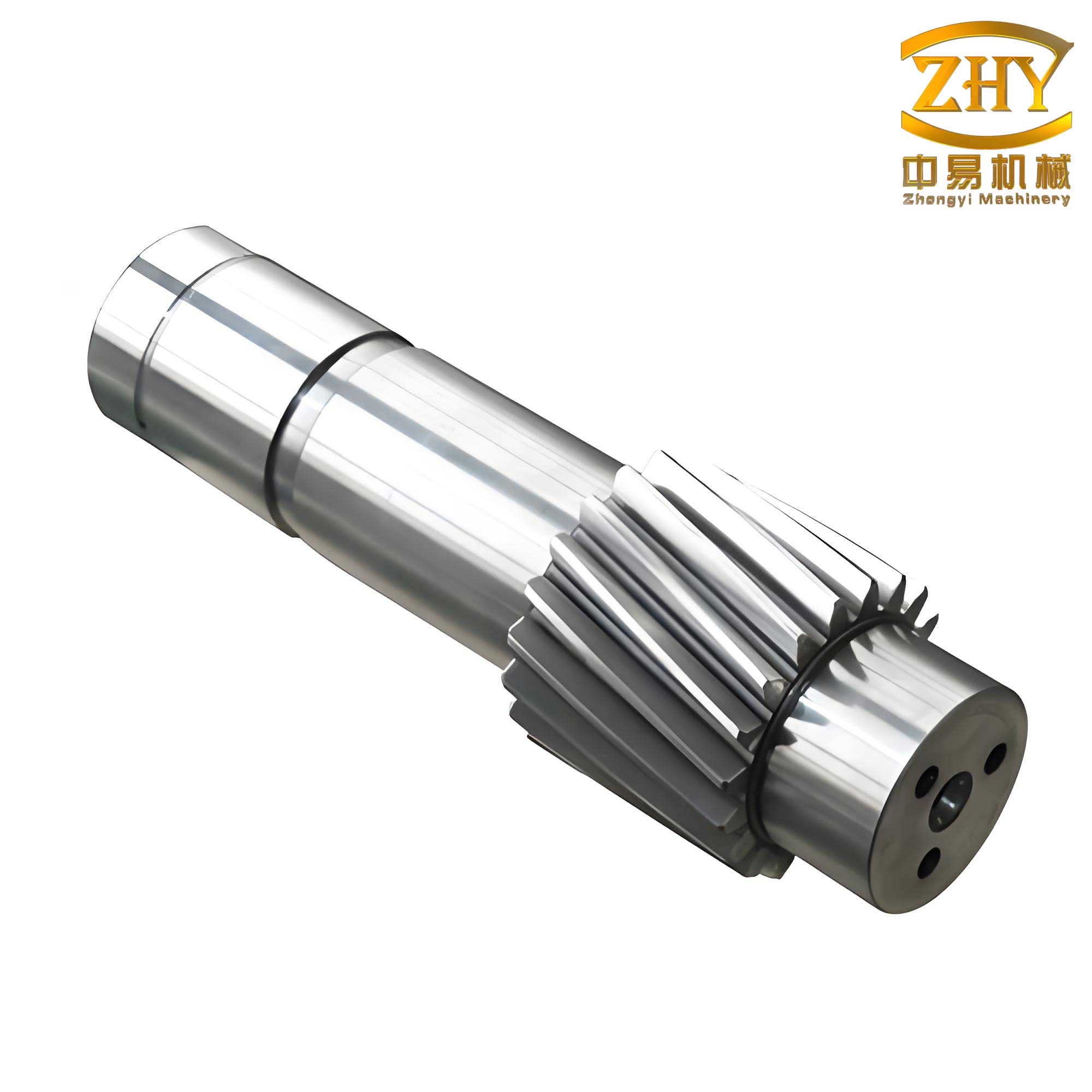
The image above illustrates a typical gear shaft assembly, highlighting the precision required in its manufacture and installation. In my practice, I have generalized the lessons from such cases into principles applicable to all gear shafts. For instance, the fit between a gear shaft and its housing must balance rigidity with allowable thermal expansion. The interference fit \(\delta\) can be derived from Lame’s equations for thick-walled cylinders: $$\delta = \frac{p d}{E} \left( \frac{d_o^2 + d^2}{d_o^2 – d^2} + \nu \right)$$ where \(p\) is contact pressure, \(d\) shaft diameter, \(d_o\) housing outer diameter, \(E\) Young’s modulus, \(\nu\) Poisson’s ratio. Excessive clearance invites fretting wear, while excessive interference risks hoop stresses exceeding yield strength: $$\sigma_h = \frac{p d}{2t}$$ for thin-walled approximations, with \(t\) as wall thickness.
To further elucidate, consider the torque transmission capability of gear shafts, which is fundamental to their design. The transmitted torque \(T\) relates to the tangential force \(F_t\) and pitch radius \(r\): $$T = F_t \cdot r = \frac{P}{\omega}$$ where \(P\) is power and \(\omega\) angular velocity. For splined or keyed gear shafts, the shear stress \(\tau\) on keys must be checked: $$\tau = \frac{2T}{d w L}$$ where \(d\) is shaft diameter, \(w\) key width, \(L\) key length. Fatigue life prediction for gear shafts involves S-N curves: $$N = \left( \frac{\sigma_a}{S_f’} \right)^{-b}$$ where \(N\) is cycles to failure, \(\sigma_a\) alternating stress, \(S_f’\) endurance limit, \(b\) exponent. These formulas underscore the analytical rigor needed to maintain gear shafts.
Expanding on maintenance, I have developed a proactive schedule for gear shafts in rotating machinery. The table below synthesizes this approach.
| Maintenance Activity | Frequency | Parameters Measured | Formulas and Tolerances |
|---|---|---|---|
| Dimensional Inspection | Quarterly | Diameter, runout, surface roughness | Allowable runout ≤ 0.05 mm per meter. Wear depth \(\Delta d\): $$\Delta d = k \cdot N^{0.5}$$ where \(k\) is wear coefficient, \(N\) operating cycles. |
| Lubrication Analysis | Monthly | Viscosity, contamination level, additive depletion | Oil film thickness \(h\) in journal bearings: $$h = c (1 – \epsilon \cos \theta)$$ where \(c\) radial clearance, \(\epsilon\) eccentricity ratio, \(\theta\) angle. |
| Vibration Monitoring | Continuous via sensors | Amplitude, frequency spectra, phase | Critical speed \(N_{cr}\): $$N_{cr} = \frac{1}{2\pi} \sqrt{\frac{k}{m}}$$ where \(k\) stiffness, \(m\) mass. Alert at vibration velocity > 4.5 mm/s RMS. |
| Thermographic Survey | Bi-annually | Surface temperature distribution | Heat generation \(Q\) from friction: $$Q = \mu F_n v$$ where \(\mu\) friction coefficient, \(F_n\) normal force, \(v\) sliding velocity. |
| Fit Integrity Check | During overhaul | Interference fit pressure, axial movement | Required press-fit force \(F_{press}\): $$F_{press} = \pi d L \mu p$$ where \(L\) engagement length, \(\mu\) coefficient of friction. |
In reflecting on these protocols, I recognize that gear shafts exemplify the synergy between design and maintenance. For example, in centrifugal pumps, the pump shaft—a type of gear shaft—must resist bending from hydraulic unbalance. The deflection \(y\) at mid-span under uniform load \(w\) is: $$y = \frac{5 w L^4}{384 E I}$$ where \(L\) is span length, \(I\) area moment of inertia. Excessive deflection misaligns seals, leading to leakage. Similarly, in internal combustion engines, gear shafts in timing systems dictate valve timing precision; a few microns of wear can degrade emissions and performance. Thus, whether in submersible pumps or diesel engines, gear shafts are ubiquitous determinants of reliability.
To integrate these concepts, I often employ failure mode and effects analysis (FMEA) for systems incorporating gear shafts. The risk priority number (RPN) is: $$RPN = S \times O \times D$$ where \(S\) is severity, \(O\) occurrence, \(D\) detectability. For gear shafts, typical failure modes include fatigue fracture, adhesive wear, and corrosion pitting. Mitigation strategies involve material selection (e.g., carburized steel for hardness), surface treatments (e.g., nitriding), and real-time condition monitoring. The cost of neglect is quantified by downtime cost \(C_{dt}\): $$C_{dt} = T_{down} \times R_{production}$$ where \(T_{down}\) is outage duration, \(R_{production}\) revenue rate per hour.
Furthermore, the installation of gear shafts demands meticulous alignment. Using laser alignment tools, I ensure parallel and angular misalignment are within 0.05 mm and 0.1 mrad, respectively. The resulting bearing load \(F_{bearing}\) due to misalignment \(\delta\) is: $$F_{bearing} = k \delta$$ where \(k\) is bearing stiffness. This load accelerates wear, reducing the service life \(L_{10}\) calculated via: $$L_{10} = \left( \frac{C}{P} \right)^p$$ where \(C\) is dynamic load rating, \(P\) equivalent load, \(p\) exponent (3 for ball bearings). Such precision is equally vital when installing submersible pumps, where misalignment between motor and pump shafts causes vibration and seal failure.
In conclusion, my experiences with submersible pumps and gear shafts have taught me that technical excellence stems from adherence to fundamental principles: rigorous pre-operation inspection, continuous operational monitoring, and proactive maintenance. Gear shafts, in particular, serve as a metaphor for interconnectedness in mechanical systems; their performance cascades through entire assemblies. By applying the tables and formulas presented here, engineers can preempt failures, optimize efficiency, and extend equipment lifespan. Remember, whether dealing with the silent submersion of a pump or the relentless rotation of a gear shaft, attention to detail is the cornerstone of engineering success.