
In the pursuit of high-performance power transmission systems, particularly those requiring large reduction ratios, compact design, and high load capacity, screw gear mechanisms have consistently been a focal point of engineering innovation. My exploration into advanced screw gear designs led me to investigate a specific variant known as quasi dual-lead screw gear transmission. This approach represents a pragmatic engineering solution developed to circumvent the manufacturing complexities inherent in its theoretical predecessor, the dual-lead line-contact offset worm drive. The core of my work involves a rigorous analysis of the engineering approximations made in this method and the consequent tooth flank errors, establishing a framework for their calculation, minimization, and validation through practical application.
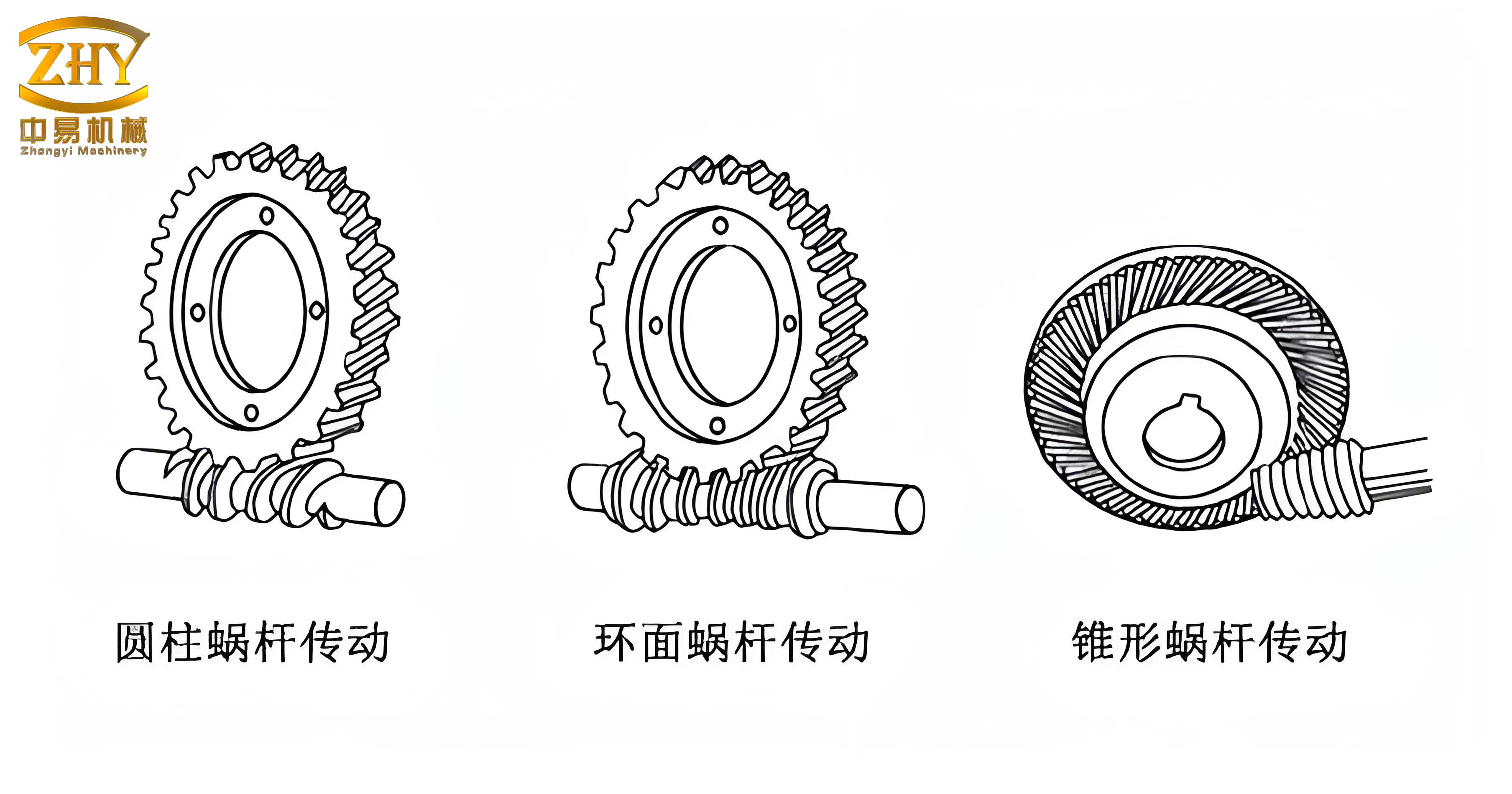
The foundational principle of the dual-lead line-contact offset worm drive is elegant: both flanks of the worm are involute helicoids, generated from distinct base cylinders with different base helix angles. This design yields a theoretical line contact with the worm wheel, offering superior load distribution and performance characteristics typical of spiroid gearing, such as multiple tooth engagement and high torque capacity. However, this theoretical perfection demands specialized tooling. The worm requires dedicated cutting tools with straight-edged blades positioned precisely in the tangent planes of its two base cylinders. Similarly, the worm wheel necessitates a custom-made hob, mirroring the exact geometry of the worm. For small-batch or prototype production, this requirement poses significant economic and logistical challenges, increasing cost and lead time.
To address this practical bottleneck, I proposed the concept of the quasi dual-lead screw gear transmission. The fundamental idea is an engineering substitution: replace the theoretically perfect involute helicoid flanks of the dual-lead worm with Archimedean spiral surfaces. This single alteration dramatically simplifies manufacturing. The worm, now effectively an Archimedes worm with two different leads (hence “quasi dual-lead”), can be machined on a standard lathe using traditional thread-cutting techniques with a trapezoidal tool bit. Correspondingly, based on the principle of conjugate gear generation, the worm wheel can be cut using a standard, off-the-shelf involute gear hob of the appropriate module, mounted in a novel configuration on a conventional gear hobbing machine. This pair constitutes the quasi dual-lead screw gear set, aiming to retain the functional advantages of the offset spiroid drive while utilizing commonplace machining processes.
The transition from an involute helicoid to an Archimedean spiral surface inevitably introduces deviations from the ideal tooth form. My primary task was to model, quantify, and analyze these deviations. For the worm, the error source is purely geometric. Consider the right-hand flank of the original dual-lead worm, defined as an involute helicoid generated from a base cylinder of radius $$r_{b1}$$ and base helix angle $$\beta_{b1}$$. Its surface can be described by the family of lines (L) lying in the tangent plane Q to the base cylinder. The Archimedean spiral surface $$\Sigma_1$$ proposed as its substitute is generated by a straight line (L’) that intersects the worm axis and makes a fixed lead angle $$\tilde{\beta}_{b1}$$ with the transverse plane. Its parametric equations in coordinate system *O-xyz* (with z along the worm axis) are:
$$
\begin{aligned}
x &= t \cos\tilde{\beta}_{b1} \cos\eta \\
y &= t \cos\tilde{\beta}_{b1} \sin\eta \\
z &= t \sin\tilde{\beta}_{b1} + \frac{P}{2\pi}\eta
\end{aligned}
$$
where $$t$$ and $$\eta$$ are parameters, and $$P$$ is the axial lead for this flank. The critical analysis occurs in the theoretical tangent plane Q (where $$y = r_{b2}$$, with $$r_{b2}$$ being related to the worm wheel geometry). The intersection of the Archimedean surface $$\Sigma_1$$ with plane Q yields a space curve $$\Gamma_1$$. The equation of $$\Gamma_1$$ is derived by substituting the condition into the surface equations:
$$
z = r_{b2} \cdot \tan\beta_{b1} \cdot \arctan\left(\frac{r_{b2}}{x}\right) + \frac{\tan\tilde{\beta}_{b1}}{\sin\left(\arctan(r_{b2}/x)\right)} \cdot r_{b2}, \quad x \in (q \cdot r_{b2}, n \cdot r_{b2})
$$
The parameters $$q$$ and $$n$$ define the active region of contact on the tooth flank. The ideal line (L) in plane Q is perfectly straight. The approximating curve $$\Gamma_1$$, however, is not. The core of the approximation is to find a straight line $$L_2$$ within plane Q that best fits curve $$\Gamma_1$$ over the contact interval. The quality of this fit defines the tooth form error, which I characterized using two distinct metrics.
The first metric is the slope error $$\Delta k$$. By selecting two strategic points $$(x_1, z_1)$$ and $$(x_2, z_2)$$ on $$\Gamma_1$$, a secant line $$L_2$$ is defined. Its slope is calculated as:
$$
\tan\hat{\beta}_{b1} = \frac{z_1 – z_2}{x_1 – x_2}
$$
The slope error is the absolute difference between this secant’s slope and the ideal involute’s base helix angle tangent:
$$
\Delta k = | \tan\hat{\beta}_{b1} – \tan\beta_{b1} |
$$
The second, more critical metric is the deviation error $$\Delta$$. This represents the maximum normal distance between the best-fit secant line $$L_2$$ and the curve $$\Gamma_1$$ within the contact zone. It is calculated as:
$$
\Delta = \frac{1}{2} \max_{x \in (q \cdot r_{b2}, n \cdot r_{b2})} \left| (Z – z) \cos\hat{\beta}_{b1} \right|
$$
Here, $$Z$$ is the z-coordinate on the line $$L_2$$ corresponding to a given x, and $$z$$ is the z-coordinate on the curve $$\Gamma_1$$. The factor of 1/2 accounts for the error being shared between the two mating surfaces in a conjugate pair. An identical analysis is performed for the left-hand flank (inner engagement side), yielding corresponding errors $$\Delta k’$$ and $$\Delta’$$. For the quasi dual-lead screw gear to be a viable approximation, these error values, particularly $$\Delta$$ and $$\Delta’$$, must be minimized to a level acceptable for the application—typically on the order of micrometers. The parameters $$\tilde{\beta}_{b1}$$, $$\tilde{\beta}’_{b1}$$, $$P$$, and $$P’$$ of the Archimedean surfaces are not free; they are the key design variables iteratively adjusted to minimize these fitting errors.
The machining process for the worm wheel in this quasi dual-lead screw gear system leverages the principle of conjugation. Since the worm is now an Archimedes-type screw, its theoretical conjugate is generated by the envelope of its family of positions relative to the wheel. In practice, this is achieved by using a standard involute gear hob. The setup is non-standard, however. As illustrated in the accompanying figure, the hob axis is not parallel to the wheel axis but is offset by the designated center distance and tilted by an angle $$\theta$$ equal to the worm’s taper angle. The hob is positioned at the end face of the wheel blank, not its side. The geometry dictates that the effective pressure angle of the generated tooth flank relates to the hob’s standard pressure angle $$\alpha$$ and the tilt angle: $$\beta_{b1} \approx \alpha – \theta$$. Crucially, because the hob is a standard tool and the worm is a standard Archimedes form, no theoretical error is introduced during the worm wheel generation process. All geometric error is confined to the substitution of the worm’s tooth flanks.
The design of a quasi dual-lead screw gear set therefore follows a structured process aimed at error control:
- Define Requirements: Specify the transmission ratio $$i$$, output torque, center distance $$a$$, and offset distance $$E$$.
- Preliminary Worm Geometry: Determine the reference diameters, taper angle $$\theta$$, and the theoretical base cylinder parameters $$r_{b1}, r’_{b1}, \beta_{b1}, \beta’_{b1}$$ for the ideal dual-lead involute worm.
- Approximation Optimization: For each flank, solve for the Archimedean lead angle $$\tilde{\beta}_{b}$$ and lead $$P$$ that minimize the deviation error $$\Delta$$ and slope error $$\Delta k$$ over the defined contact zone $$[q, n]$$. This is an iterative computational process.
- Worm Wheel Tooling Setup: Select a standard gear hob with module $$m$$ equal to the axial module of the worm. Calculate the required hob tilt and offset position based on the final worm geometry.
To validate this methodology, I designed, manufactured, and tested two distinct quasi dual-lead screw gear pairs. The key parameters and calculated errors are summarized below:
| Parameter | Instance 1 (High Ratio) | Instance 2 (Very High Ratio) |
|---|---|---|
| Transmission Ratio (i) | 70 | 410 |
| Worm Teeth (Starts) | 1 | 1 |
| Wheel Teeth | 70 | 410 |
| Center Distance (mm) | 85 | 120 |
| Axial Module (mm) | 2 | 0.5 |
| Wheel Face Width (mm) | 45 | 50 |
| Calculated Outer Flank Error $$\Delta$$ (µm) | ~8.2 | ~3.7 |
| Calculated Inner Flank Error $$\Delta’$$ (µm) | ~7.5 | ~3.1 |
| Slope Errors $$\Delta k, \Delta k’$$ | < 0.01 | < 0.01 |
The manufacturing was conducted using standard workshop equipment. The worms were turned from steel bar stock on a lathe. The worm wheels were hobbed from steel blanks on a standard gear hobbing machine, using a commercially available involute hob, mounted with the specified offset and tilt. Post-machining, a critical step was implemented: running-in and lapping of the mated worm and wheel pair. This process serves to marginally correct the microscopic form errors, improve surface finish, and establish an optimal contact pattern, thereby enhancing performance and reducing operational noise.
The transmission tests on these prototypes confirmed the fundamental validity of the quasi dual-lead screw gear concept. Both assemblies operated smoothly, with no indication of binding or uneven motion, confirming that the approximate tooth forms were functionally conjugate. The expected characteristics of spiroid-type screw gears—multiple-tooth contact, compactness for the achieved ratio, and inherent smoothness—were clearly observed. The tests empirically verified that the engineering approximation errors, while analytically present, were practically manageable and did not impede the core functionality of the drive.
In conclusion, my analysis and experimental work establish the quasi dual-lead screw gear transmission as a robust and practical engineering solution. The key findings are:
- The substitution of involute helicoid flanks with optimized Archimedean spiral surfaces is a theoretically sound and practically viable approximation for creating a functional dual-lead screw gear.
- The tooth flank error arising from this approximation can be accurately modeled and controlled through parametric optimization, keeping it within acceptable limits for many industrial applications.
- The primary advantage lies in dramatically simplified manufacturing, utilizing standard machine tools (lathe, hobbing machine) and standard cutting tools (trapezoidal bit, gear hob), making the technology accessible for low-volume production.
- The resulting screw gear pair retains the beneficial kinematic and load-bearing traits of its more theoretically perfect, but harder-to-make, dual-lead offset counterpart, including near-line contact under load.
Future work could focus on dynamic load analysis, efficiency measurement under various torque conditions, and the development of automated optimization software to swiftly generate machining parameters for given performance specifications. The quasi dual-lead principle thus opens a pragmatic pathway for exploiting high-performance screw gear mechanics in scenarios where cost-effective manufacturability is paramount.