
In my extensive experience with high-precision machining, the mechanical double swivel head, often referred to as a fork-type milling head or five-axis head, represents a pinnacle of engineering for complex spatial surface processing. This component enables the integration of spindle rotation with continuous A and C-axis swivel motions, combined with the linear movements of the X, Y, and Z axes, to achieve true five-coordinate machining. The transmission for the A and C axes in such heads is predominantly realized through screw gear mechanisms, specifically worm and wheel drives, which provide the high torque necessary for heavy-duty cutting in industries like shipbuilding, mining, and locomotive manufacturing. However, a persistent challenge in these screw gear systems is backlash—the undesirable clearance between the worm screw and the wheel teeth—which degrades positional accuracy, repeatability, and overall machining quality. In this article, I will delve into an advanced backlash elimination structure for screw gears in mechanical double swivel heads, exploring its design principles, mathematical modeling, and practical applications, with a focus on ensuring precision and longevity.
The screw gear, in the context of double swivel heads, typically involves a worm (the screw) driving a worm wheel. This arrangement offers high reduction ratios and self-locking capabilities but is prone to wear and increased backlash over time due to friction and thermal effects. For a high-precision five-axis machine, even minimal backlash can lead to significant errors in contouring and surface finish. Traditional designs often struggle with this issue, leading to frequent adjustments or replacements. The backlash elimination structure I have worked with addresses this by incorporating a split-worm design, which allows for continuous adjustment of the meshing clearance. This innovative approach ensures that the screw gear transmission maintains optimal contact, thereby preserving the high resolution and repeatability required for advanced machining tasks.
To understand the importance of backlash control, consider the key parameters of a typical mechanical double swivel head with screw gear drives. The following table summarizes the specifications that demand precise screw gear performance:
| Parameter | Value | Importance for Screw Gear |
|---|---|---|
| Spindle Power | 28 / 43 kW | High power necessitates robust screw gear torque capacity. |
| Max Spindle Speed | 5,600 rpm | Indirectly affects screw gear via thermal expansion and vibration. |
| Max Spindle Torque | 638 / 971 N·m | Screw gear must transmit high torque without deformation. |
| A/C Axis Speed | 25°/s | Screw gear must enable smooth motion at varying speeds. |
| A/C Axis Resolution | 0.001° | Extremely fine resolution requires minimal screw gear backlash. |
| A/C Drive Torque | 7,000 N·m | Screw gear system must handle high driving torques. |
| A/C Clamping Torque | 20,000 N·m | Screw gear may be involved in locking mechanisms. |
As seen from the table, the resolution of the A and C axes is 0.001°, which is exceptionally fine. Any backlash in the screw gear transmission would directly compromise this resolution, leading to positioning errors. Therefore, the design of the screw gear backlash elimination structure is paramount. The core idea is to use a split-worm assembly consisting of two primary components: a sleeve worm and a core shaft worm. These are axially adjustable relative to each other, allowing for precise control of the engagement depth with the worm wheel. This adjustability compensates for wear over time, ensuring consistent performance.
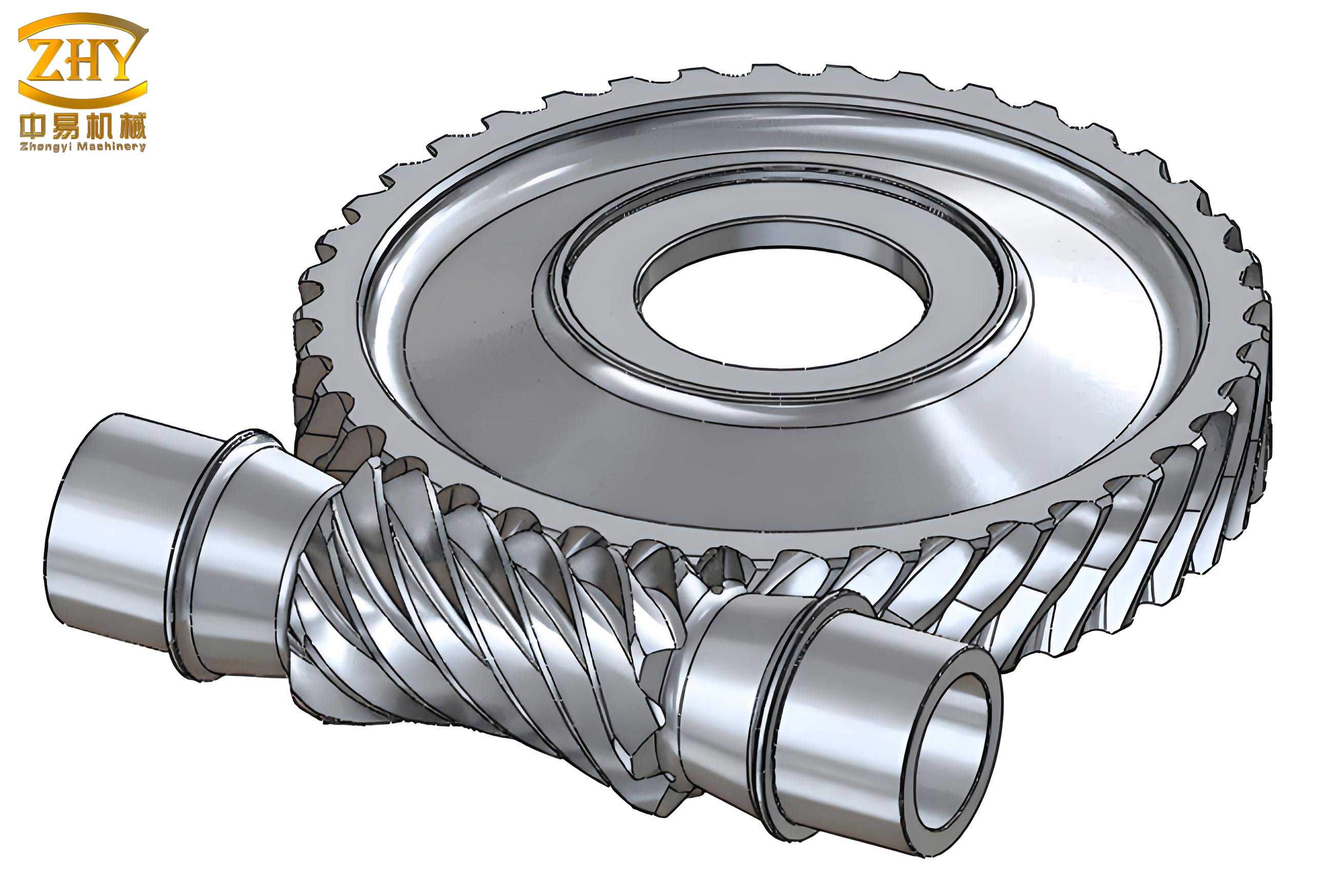
The mathematical modeling of screw gear backlash elimination involves analyzing the geometry, forces, and kinematics. For a standard worm and wheel set, the lead angle \(\lambda\) of the worm is critical, given by:
$$ \lambda = \tan^{-1}\left(\frac{L}{\pi d}\right) $$
where \(L\) is the lead of the worm and \(d\) is the pitch diameter. The transmission ratio \(i\) for a screw gear is:
$$ i = \frac{N_w}{N_g} $$
with \(N_w\) as the number of worm threads and \(N_g\) as the number of wheel teeth. Backlash \(\beta\) in the screw gear system can be defined as the angular clearance between the worm and wheel teeth, which translates to a linear displacement \(\delta\) at the pitch circle:
$$ \delta = \beta \cdot r_p $$
where \(r_p\) is the pitch radius of the worm wheel. To eliminate backlash, the split-worm design allows for an axial adjustment \(\Delta x\) of one worm segment relative to the other. This adjustment changes the effective meshing position, reducing \(\delta\). The relationship between axial adjustment and backlash reduction can be derived from the worm geometry. For a single-start worm, the axial advance per revolution is equal to the lead. Thus, a small axial shift \(\Delta x\) results in an angular correction \(\Delta \theta\) at the wheel:
$$ \Delta \theta = \frac{\Delta x}{L} \cdot 360^\circ $$
In practice, the required \(\Delta x\) to compensate for wear-induced backlash \(\beta\) can be approximated by:
$$ \Delta x \approx \frac{\beta \cdot r_p}{\tan(\lambda)} $$
This formula highlights the importance of the lead angle in the screw gear backlash adjustment sensitivity. A smaller \(\lambda\) requires larger axial adjustments for the same backlash correction, which influences the design of the adjustment mechanism.
The force analysis in a screw gear system is also crucial for ensuring that the backlash elimination structure does not introduce excessive friction or wear. The tangential force \(F_t\) on the worm wheel is related to the transmitted torque \(T\):
$$ F_t = \frac{T}{r_p} $$
The axial force \(F_a\) on the worm depends on the pressure angle \(\alpha\) and lead angle \(\lambda\):
$$ F_a = F_t \cdot \frac{\sin(\alpha)}{\cos(\lambda) \cos(\alpha)} $$
In the split-worm design, the adjustment mechanism must withstand these forces without deflecting. Typically, a locking expansion sleeve is used to secure the adjusted position. The sleeve applies a radial clamping force \(F_c\) that generates sufficient friction to prevent axial movement under load. The required clamping force can be estimated from the axial force and the coefficient of friction \(\mu\):
$$ F_c \geq \frac{F_a}{\mu} $$
This ensures that the screw gear remains stable during operation. The following table summarizes key geometric and force parameters for a typical screw gear in a double swivel head:
| Parameter | Symbol | Typical Value | Role in Backlash Elimination |
|---|---|---|---|
| Worm Lead | \(L\) | 10 mm | Determines axial adjustment sensitivity. |
| Pitch Diameter | \(d\) | 50 mm | Affects torque capacity and backlash translation. |
| Lead Angle | \(\lambda\) | 5° | Influences efficiency and adjustment range. |
| Pressure Angle | \(\alpha\) | 20° | Impacts tooth contact and force distribution. |
| Number of Worm Threads | \(N_w\) | 1 | Single-start for high reduction ratio. |
| Number of Wheel Teeth | \(N_g\) | 60 | Provides transmission ratio of 60:1. |
| Coefficient of Friction | \(\mu\) | 0.1 | Critical for locking mechanism design. |
The practical implementation of the screw gear backlash elimination structure involves precise manufacturing and assembly. The split-worm consists of a sleeve worm and a core shaft worm, both made from hardened steel to resist wear. The sleeve worm has an internal bore that accommodates the core shaft worm, with a keyway or spline to transmit torque while allowing axial adjustment. Between them, adjustment shims of varying thickness are inserted to set the initial preload and compensate for wear. The assembly is then locked using an expansion sleeve that contracts radially when tightened, gripping both worm components securely. This design allows for field adjustments without disassembling the entire head, significantly reducing maintenance downtime.
To quantify the benefits of this screw gear backlash elimination, consider the dynamic performance of the A and C axes. The repeatability of positioning is directly influenced by the residual backlash. With the split-worm adjustment, backlash can be reduced to near zero. The error in angular position \(\Delta \phi\) due to backlash can be modeled as:
$$ \Delta \phi = \frac{\beta}{i} $$
where \(\beta\) is the angular backlash at the worm wheel. For a target repeatability of ±0.001°, the maximum allowable \(\beta\) is extremely small. By adjusting the screw gear assembly, \(\beta\) can be minimized below this threshold. Additionally, the stiffness of the screw gear transmission is enhanced, as preload reduces tooth separation under load. The torsional stiffness \(K_t\) of the worm and wheel set can be approximated by:
$$ K_t = \frac{T}{\theta} $$
where \(\theta\) is the angular deflection under torque \(T\). With backlash eliminated, \(\theta\) decreases, increasing \(K_t\) and improving the dynamic response of the axis.
Another aspect to consider is thermal effects. During operation, the screw gear generates heat due to friction, leading to thermal expansion that can alter backlash. The coefficient of thermal expansion \(\alpha_t\) for steel is approximately \(11 \times 10^{-6} \, \text{K}^{-1}\). For a worm length of 100 mm, a temperature rise of \(\Delta T = 30^\circ\text{C}\) results in an expansion \(\Delta L_t\):
$$ \Delta L_t = \alpha_t \cdot L_0 \cdot \Delta T = 11 \times 10^{-6} \times 100 \times 30 = 0.033 \, \text{mm} $$
This expansion can cause increased backlash if not compensated. The split-worm design allows for periodic adjustments to account for such changes, ensuring consistent performance across operating temperatures. In contrast, fixed screw gear assemblies would suffer from degraded accuracy over time.
The application of this screw gear backlash elimination structure extends beyond double swivel heads to other precision machinery requiring high torque and fine resolution. For instance, in rotary tables, tilting axes, and robotic joints, screw gear drives are common, and backlash control is equally critical. The design principles discussed here—split-worm adjustment, preload via shims, and secure locking—can be adapted to various sizes and load conditions. The key is to maintain the alignment and concentricity of the worm components to avoid introducing eccentric errors, which could negate the benefits of backlash reduction.
In terms of manufacturing, the screw gear components require high precision. The worm threads are typically ground after heat treatment to achieve a surface finish better than 0.4 µm Ra, reducing friction and wear. The worm wheel is often made from bronze or similar materials to provide a compliant yet durable mating surface. The tooth profile must conform to the worm geometry accurately. The following table outlines typical tolerances for screw gear components in a high-precision double swivel head:
| Component | Tolerance | Measurement |
|---|---|---|
| Worm Pitch Diameter | ±0.005 mm | Ensures proper meshing clearance. |
| Worm Lead Error | ±0.002 mm/100 mm | Critical for motion accuracy. |
| Wheel Tooth Profile | ±0.003 mm | Affects contact pattern and stress. |
| Adjustment Shim Thickness | ±0.001 mm | Enables fine backlash control. |
| Expansion Sleeve Bore | H6 fit | Provides precise clamping without slip. |
From a design optimization perspective, the screw gear backlash elimination structure can be analyzed using finite element analysis (FEA) to simulate stresses and deformations under load. The contact pressure between the worm and wheel teeth should be distributed evenly to avoid localized wear. The maximum contact pressure \(p_{\text{max}}\) can be estimated using Hertzian contact theory for cylindrical surfaces:
$$ p_{\text{max}} = \sqrt{\frac{F_n E^*}{\pi R^*}} $$
where \(F_n\) is the normal force, \(E^*\) is the equivalent Young’s modulus, and \(R^*\) is the equivalent radius of curvature. For a screw gear, the geometry is complex, but FEA helps in optimizing tooth profiles and preload settings to minimize \(p_{\text{max}}\) and extend service life.
In practice, the adjustment procedure for the screw gear backlash involves measuring the current backlash using a dial indicator or laser interferometer, then calculating the required shim change. For example, if the measured backlash is 0.005° at the wheel, and the lead angle is 5°, the axial adjustment needed is:
$$ \Delta x = \frac{0.005^\circ \times \frac{\pi}{180^\circ} \times r_p}{\tan(5^\circ)} $$
Assuming \(r_p = 100 \, \text{mm}\), this yields \(\Delta x \approx 0.016 \, \text{mm}\). A shim of this thickness is added or removed to achieve zero backlash. This process underscores the importance of metrology in maintaining screw gear precision.
The screw gear backlash elimination structure also impacts the control system of the five-axis machine. With reduced backlash, the axis servo drives can operate with higher gain settings, improving tracking accuracy and reducing settling time. The control algorithm can be simplified as less compensation for backlash is required. However, it is essential to monitor the preload to avoid excessive friction, which could increase heat generation and motor load. Torque sensors or current monitoring can be used to detect changes in screw gear condition, enabling predictive maintenance.
Looking forward, advancements in materials and coatings could further enhance screw gear performance. For instance, using ceramic-coated worms or polymer-composite wheels can reduce friction and wear, extending adjustment intervals. Additionally, integrating smart sensors into the adjustment mechanism could allow for automated backlash compensation, creating self-adjusting screw gear systems. Such innovations would push the boundaries of precision in five-axis machining.
In conclusion, the screw gear backlash elimination structure based on a split-worm design is a critical enabler for high-precision mechanical double swivel heads. By allowing precise axial adjustment, it mitigates the effects of wear and thermal expansion, ensuring consistent accuracy and repeatability. The mathematical models and design considerations discussed here provide a framework for optimizing screw gear transmissions in demanding applications. As machining technology evolves, continued focus on screw gear refinement will be essential for achieving new levels of performance in multi-axis manufacturing.
To further illustrate the principles, let’s consider a detailed calculation example for a screw gear system in a double swivel head. Suppose we have a screw gear with the following parameters: worm lead \(L = 12 \, \text{mm}\), worm pitch diameter \(d = 60 \, \text{mm}\), wheel pitch radius \(r_p = 150 \, \text{mm}\), pressure angle \(\alpha = 20^\circ\), and transmission ratio \(i = 50\). The initial backlash measured at the wheel is \(\beta = 0.01^\circ\). We want to determine the axial adjustment \(\Delta x\) needed to reduce backlash to zero. First, compute the lead angle \(\lambda\):
$$ \lambda = \tan^{-1}\left(\frac{12}{\pi \times 60}\right) = \tan^{-1}\left(\frac{12}{188.5}\right) \approx 3.64^\circ $$
Then, convert backlash to radians: \(\beta_{\text{rad}} = 0.01^\circ \times \frac{\pi}{180^\circ} = 1.745 \times 10^{-4} \, \text{rad}\). The linear backlash at the pitch circle is \(\delta = \beta_{\text{rad}} \times r_p = 1.745 \times 10^{-4} \times 150 = 0.0262 \, \text{mm}\). Using the adjustment formula:
$$ \Delta x = \frac{\delta}{\tan(\lambda)} = \frac{0.0262}{\tan(3.64^\circ)} = \frac{0.0262}{0.0636} \approx 0.412 \, \text{mm} $$
Thus, an axial adjustment of approximately 0.41 mm is required. This would be achieved by replacing the existing adjustment shim with one that is 0.41 mm thinner. After adjustment, the screw gear should exhibit near-zero backlash, significantly improving the axis resolution.
Moreover, the force calculations ensure the locking mechanism is adequate. Assuming the transmitted torque is \(T = 5000 \, \text{N·m}\), the tangential force is \(F_t = T / r_p = 5000 / 0.15 = 33333 \, \text{N}\). The axial force on the worm is:
$$ F_a = F_t \cdot \frac{\sin(20^\circ)}{\cos(3.64^\circ) \cos(20^\circ)} = 33333 \times \frac{0.342}{0.998 \times 0.94} \approx 12100 \, \text{N} $$
With a coefficient of friction \(\mu = 0.1\) for steel-on-steel, the required clamping force is \(F_c \geq F_a / \mu = 12100 / 0.1 = 121000 \, \text{N}\). The expansion sleeve must be designed to provide this force without permanent deformation. This example highlights the interdependence of geometric parameters, forces, and adjustments in screw gear systems.
In summary, the screw gear backlash elimination structure is a sophisticated solution to a perennial problem in precision machinery. Through careful design, mathematical analysis, and precise manufacturing, it enables mechanical double swivel heads to achieve the high performance demanded by modern industries. As I have explored in this article, the integration of split-worm adjustments, robust locking mechanisms, and thorough modeling ensures that screw gear transmissions remain accurate and reliable over extended periods. This focus on screw gear excellence is what drives advancements in multi-axis machining capabilities.