
In my investigation of advanced transmission technologies, I focus on the electromechanical integrated screw gear drive, a novel system that combines traditional screw gear mechanisms with electromagnetic actuation and control. This integration offers significant advantages over conventional mechanical gears, such as non-contact torque transmission, reduced friction, minimal lubrication requirements, low noise, and overload self-protection. The screw gear system, particularly in electromagnetic configurations, exhibits compact structure, controllable output torque and speed, and fast response, making it suitable for applications in aerospace, medical devices, and automotive engineering. However, the periodic variation in meshing pole numbers during operation introduces time-dependent electromagnetic meshing stiffness, leading to parameter vibration—a critical dynamic issue that can induce resonance and affect system performance. In this paper, I explore the parameter vibration response of such systems, deriving mathematical models and analyzing free vibration, main resonance, and combination resonance behaviors to provide insights for design optimization.
The core of the screw gear transmission system lies in its ability to generate rotational motion through magnetic interactions. Typically, it consists of an electromagnetic screw gear (or worm) with three-phase AC windings and a gear wheel (or worm wheel) equipped with permanent magnets. When AC current flows through the screw gear coils, a rotating magnetic field is produced, which drives the gear wheel via magnetic forces, enabling torque output. The meshing between the screw gear and gear wheel involves alternating periods of single and double pole pairs, resulting in a periodic variation in electromagnetic meshing stiffness. This time-varying stiffness acts as an internal excitation, making the system’s dynamics inherently parametrically excited. I begin by establishing a dynamic model to capture this behavior, focusing on the screw gear’s role in the overall electromechanical coupling.
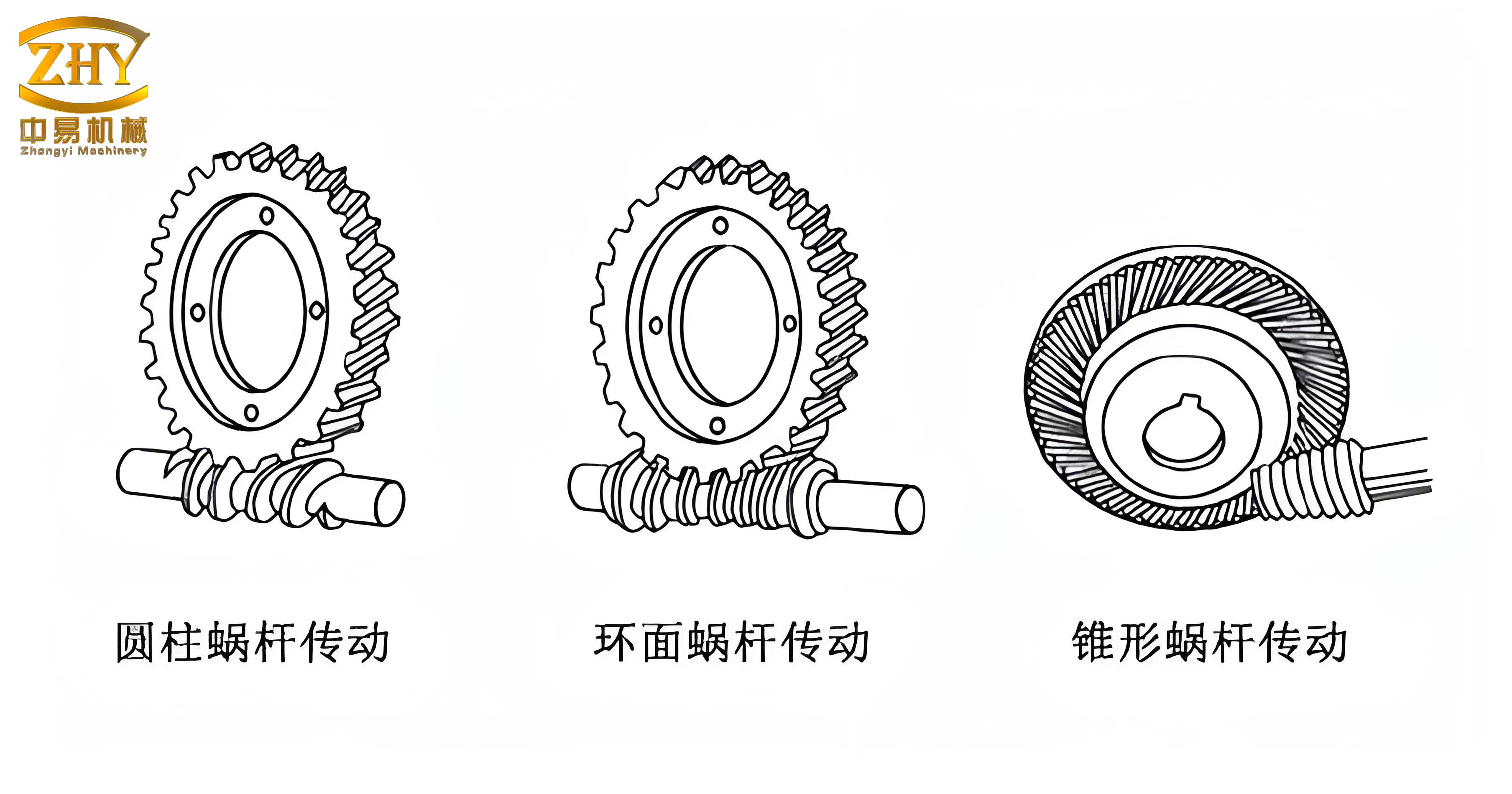
To model the system, I consider a lumped-parameter approach where the gear wheel’s torsional motion is represented by a linear displacement x around its axis. The electromagnetic meshing stiffness, denoted as k(t), is key to the parameter vibration. For a screw gear system with, say, 8 permanent magnet teeth on the gear wheel and an 80° wrap angle on the screw gear, the meshing alternates between 1 and 2 pole pairs per cycle. Let Tp be the meshing period, ωp the gear wheel angular velocity, and z the number of teeth. The meshing stiffness function can be expressed as a piecewise constant over time, but for analysis, I expand it into a Fourier series to handle its periodic nature. The average meshing stiffness k̄ and time-varying component Δk(t) are derived as follows:
$$ k(t) = \bar{k} + \Delta k(t) $$
where k̄ is the average stiffness over one meshing cycle, calculated based on the electromagnetic properties. For the screw gear, the stiffness during single-pole meshing, kp1, depends on factors like current intensity Is, average inductance L1, and geometric parameters. Specifically:
$$ k_{p1} = K \frac{I_s^2 z^2 L_1}{2r^2} \cos(z\theta + \phi_v / (3n_1 p)) \bigg|_{\theta=\theta_0} $$
Here, K is a constant related to the screw gear’s wrap angle φv, r is the gear wheel radius, θ0 is the static rotation angle, n1 is the number of phases, and p is the pole number. The time-varying stiffness is periodic with period Tp = 2π/(zωp). Using Fourier series expansion in complex form:
$$ k(t) = \sum_{n=-\infty}^{+\infty} k_n e^{i(2n\pi t / T_p)} $$
The coefficients kn are computed by integrating over the meshing cycle. For n = 0, the average stiffness is:
$$ k_0 = \frac{1}{T_p} \left( \int_{-(2-\epsilon_p)T_p/2}^{(2-\epsilon_p)T_p/2} k_{p1} \, dt + \int_{(2-\epsilon_p)T_p/2}^{\epsilon_p T_p/2} k_{p2} \, dt \right) = \epsilon_p k_{p1} $$
where εp is the contact ratio, and kp2 = 2kp1 for double-pole meshing. For n ≠ 0:
$$ k_n = -\frac{k_{p1}}{n\pi} \sin\left(\frac{2n\pi}{9}\right) $$
Thus, the stiffness can be rewritten as:
$$ k(t) = k_0 – \frac{k_{p1}}{\pi} \sum_{n=1}^{\infty} \frac{1}{n} \sin\left(\frac{2n\pi}{9}\right) \left( e^{i(n\omega_p t)} + e^{-i(n\omega_p t)} \right) $$
This representation highlights the screw gear’s influence through harmonic components. The system’s equation of motion, considering damping c and external torque excitation ΔT cos ωt, is:
$$ m\ddot{x} + c\dot{x} + k(t)x = \frac{\Delta T \cos \omega t}{r} $$
where m is the gear wheel mass. By substituting k(t) and introducing a small parameter ε to scale the time-varying part, I obtain a linear time-varying differential equation suitable for perturbation analysis. Defining ω0 = √(k̄/m) as the natural frequency and ζ0 = c/(2ω0) as the damping ratio, the equation becomes:
$$ \ddot{x} + 2\zeta_0 \omega_0 \dot{x} + \omega_0^2 \left[ 1 – \varepsilon \sum_{n=1}^{\infty} b_n \left( e^{i(n\omega_p t)} + e^{-i(n\omega_p t)} \right) \right] x = \frac{T’}{mr} $$
with bn = an/a1, an = (kp1 sin(2nπ/9))/(nπ ω02), and T’ representing the torque amplitude. This formulation sets the stage for studying parameter vibration in screw gear systems.
To analyze the free vibration response, I consider the unforced case (ΔT = 0). The differential equation simplifies to:
$$ \ddot{x} + 2\varepsilon \zeta \omega_0 \dot{x} + \omega_0^2 \left[ 1 – \varepsilon \sum_{n=1}^{\infty} b_n \left( e^{i(n\omega_p t)} + e^{-i(n\omega_p t)} \right) \right] x = 0 $$
where ζ = εζ0 balances damping effects. I employ the method of multiple scales to seek an approximate analytical solution. Introducing time scales T0 = t and T1 = εt, the solution is expanded as:
$$ x = x_0(T_0, T_1) + \varepsilon x_1(T_0, T_1) + \varepsilon^2 x_2(T_0, T_1) + \cdots $$
Substituting into the equation and equating coefficients of like powers of ε, I derive a series of linear equations. For O(1):
$$ D_0^2 x_0 + \omega_0^2 x_0 = 0 $$
where D0 denotes partial derivative with respect to T0. The solution is:
$$ x_0 = A(T_1) e^{i\omega_0 T_0} + \text{c.c.} $$
with c.c. denoting complex conjugate. For O(ε):
$$ D_0^2 x_1 + \omega_0^2 x_1 = -2D_0D_1 x_0 – 2\zeta \omega_0 D_0 x_0 + \omega_0^2 x_0 \sum_{n=1}^{\infty} b_n \left( e^{i(n\omega_p T_0)} + e^{-i(n\omega_p T_0)} \right) $$
Eliminating secular terms yields the condition for A(T1):
$$ -2i\omega_0 \frac{dA}{dT_1} – 2i\zeta \omega_0^2 A = 0 $$
Solving this gives A = E0 e^{-ζω0T1}, where E0 is the initial displacement determined from static torque conditions: E0 = T/(k̄ r), with T as the rated torque. The first-order correction x1 is then found, leading to the approximate free vibration response:
$$ x = E_0 e^{-\zeta \omega_0 T_1} e^{i\omega_0 T_0} – \frac{\varepsilon \omega_0^2 E_0}{2} e^{-\zeta \omega_0 T_1} \sum_{n=1}^{\infty} b_n \left[ \frac{e^{i(\omega_0 + n\omega_p) T_0}}{n\omega_p (n\omega_p + 2\omega_0)} + \frac{e^{i(\omega_0 – n\omega_p) T_0}}{n\omega_p (n\omega_p – 2\omega_0)} \right] + \text{c.c.} $$
This solution reveals that free vibration in a screw gear system is not purely harmonic; it includes the natural frequency ω0 and combination frequencies |ω0 ± nωp|, unlike constant-coefficient linear systems. The damping causes amplitude decay over time. To illustrate, I provide a numerical example with parameters typical for screw gear drives, as summarized in Table 1.
| Parameter | Symbol | Value |
|---|---|---|
| Number of gear teeth | z | 8 |
| Gear wheel mass | m | 10 kg |
| Damping coefficient | c | 0.1 N·s/m |
| Rated torque | T | 200 N·m |
| Gear radius | r | 0.15 m |
| Screw gear wrap angle | φv | 80° |
| Current intensity | Is | 100 A |
| Average inductance | L1 | 1.0 × 10⁻³ H |
| Meshing frequency | ωp | 160 rad/s |
| Torque fluctuation amplitude | ΔT | 5 N·m |
Using the first three terms of the series (n = 1,2,3), the time-domain response shows damped oscillations, while the frequency-domain spectrum confirms components at ω0 and ω0 ± nωp. This richness in frequency content predisposes the screw gear system to various resonance phenomena, which I explore next.
For forced vibration, I consider external torque fluctuations ΔT cos ωt. The equation becomes:
$$ \ddot{x} + 2\varepsilon \zeta \omega_0 \dot{x} + \omega_0^2 \left[ 1 – \varepsilon \sum_{n=1}^{\infty} b_n \left( e^{i(n\omega_p t)} + e^{-i(n\omega_p t)} \right) \right] x = \frac{\Delta T}{2mr} \left( e^{i\omega t} + e^{-i\omega t} \right) $$
I analyze two resonance cases: main resonance (ω ≈ ω0) and combination resonance (ω ≈ ω0 ± nωp). Starting with main resonance, I introduce a detuning parameter σ1 such that ω = ω0 + εσ1. Applying the multiple scales method again, the zeroth-order solution includes the forcing term. Eliminating secular terms leads to an equation for A(T1):
$$ -2i\omega_0 \frac{dA}{dT_1} – 2i\zeta \omega_0^2 A + \frac{T’}{2mr} e^{i\sigma_1 T_1} = 0 $$
Solving for steady-state response, I obtain:
$$ A = \frac{T’ \cos(\sigma_1 T_1 + \theta)}{2\omega_0^2 \sqrt{\sigma_1^2 + \omega_0^2 \zeta^2}} $$
where sin θ = ω0ζ/√(σ12 + ω02ζ2) and cos θ = σ1/√(σ12 + ω02ζ2). The first-order approximation for x is then:
$$ x = \frac{T’ \cos(\omega t + \theta)}{2m\omega_0^2 \sqrt{\sigma_1^2 + \omega_0^2 \zeta^2}} + \varepsilon \frac{T’ \cos(\sigma_1 T_1 + \theta)}{2 \sqrt{\sigma_1^2 + \omega_0^2 \zeta^2}} \sum_{n=1}^{\infty} b_n \left[ -\frac{e^{i(\omega_0 + n\omega_p) t}}{n\omega_p (n\omega_p + 2\omega_0)} + \frac{e^{i(\omega_0 – n\omega_p) t}}{n\omega_p (2\omega_0 – n\omega_p)} \right] + \cdots $$
For the screw gear system with parameters from Table 1 and ω = 685 rad/s (close to ω0), the time-domain response exhibits beating phenomena, and the frequency spectrum shows peaks at the excitation frequency ω and combination frequencies ω0 ± nωp. Notably, the dominant frequency is ω (the excitation frequency), but combination harmonics are present with amplitudes decreasing as n increases. This contrasts with linear systems, where only the excitation frequency appears. The presence of multiple harmonics is due to energy transfer through the screw gear’s time-varying stiffness, which excites meshing-related frequencies during strong resonance.
Combination resonance occurs when the excitation frequency ω approaches ω0 – ωp (or ω0 + nωp). I focus on ω = ω0 – ωp + εσ2, where σ2 is a detuning parameter. The multiple scales analysis proceeds similarly, but now the forcing term interacts with the stiffness variation at n=1. The zeroth-order solution is:
$$ x_0 = A e^{i\omega_0 T_0} + B e^{i\omega T_0} + \text{c.c.} $$
with B = T’/[rm(ω02 – ω2)]. Eliminating secular terms gives:
$$ -2i \frac{dA}{dT_1} – 2i\zeta \omega_0 A + \omega_0 b_n B e^{i\sigma_2 T_1} = 0 $$
For steady state, the solution is:
$$ A = \frac{2\omega_0 B b_n [\sin(\theta + \sigma_2 T_1) + \sin \omega_0 t]}{\sqrt{\sigma_2^2 + \omega_0^2 \zeta^2}} $$
The overall response includes terms at ω and ω0, but the dominant frequency in the resonance is ω0, not ω. Using parameters from Table 1 with ω = 448 rad/s (near ω0 – ωp), the time-domain shows significant oscillations, and the frequency spectrum peaks at ω0, with negligible contributions from ω and combination harmonics. This indicates that in combination resonance for screw gear systems, the system’s natural frequency governs the response, while the excitation frequency plays a minor role. To generalize, I examine the effect of damping and harmonic order on combination resonance amplitude. The resonance amplitude for the n-th combination can be expressed as:
$$ A_{\text{res}, n} \propto \frac{b_n}{\sqrt{\sigma_n^2 + \omega_0^2 \zeta^2}} $$
Since bn decays with n (as sin(2nπ/9)/(nπ)), the amplitude decreases as harmonic order increases. Table 2 summarizes this trend for the first few harmonics, based on the screw gear example.
| Harmonic Order n | Coefficient bn | Relative Amplitude |
|---|---|---|
| 1 | 1.000 | 1.000 |
| 2 | 0.342 | 0.342 |
| 3 | 0.133 | 0.133 |
| 4 | 0.064 | 0.064 |
| 5 | 0.035 | 0.035 |
This decay is attributed to the diminishing influence of higher-order stiffness harmonics in the screw gear meshing. Additionally, damping reduces resonance amplitudes, as shown in frequency response curves for different ζ values. For instance, with ζ = 0.01, 0.05, and 0.1, the peak amplitude at combination resonance decreases significantly, highlighting the importance of damping in screw gear design to mitigate vibrations.
In discussing these results, I emphasize the unique dynamics of screw gear systems. The parameter vibration arising from time-varying electromagnetic meshing stiffness introduces combination frequencies that enrich the system’s response. Compared to conventional gears, screw gears in electromechanical integrations exhibit more complex resonance behaviors, necessitating careful analysis during design. The screw gear’s geometry and electromagnetic parameters directly affect stiffness coefficients, thereby influencing vibration characteristics. For example, increasing the wrap angle φv alters K in the stiffness formula, which can shift resonance conditions. Similarly, optimizing current intensity Is can control stiffness magnitude, offering a lever for dynamic tuning.
To further illustrate, I derive general formulas for critical frequencies in screw gear systems. The natural frequency is:
$$ \omega_0 = \sqrt{\frac{\bar{k}}{m}} = \sqrt{\frac{16 k_{p1}}{9m}} $$
The meshing frequency is ωp = z Ω, where Ω is the gear wheel rotational speed. Combination resonance frequencies are ω0 ± nωp, with n = 1,2,3,… The condition for main resonance is ω ≈ ω0, and for combination resonance, ω ≈ ω0 ± nωp. These relations help in predicting resonance zones during operation. In practical screw gear applications, it is advisable to avoid operating near these frequencies or to incorporate damping mechanisms to suppress amplitudes.
In conclusion, my analysis of the electromechanical integrated screw gear transmission system reveals intricate parameter vibration responses due to periodic meshing stiffness variations. The free vibration includes combination frequencies beyond the natural frequency, setting the stage for multiple resonance types. Main resonance in screw gear systems involves the excitation frequency as dominant, but with significant combination harmonics that decrease with order. Combination resonance, however, is governed by the system’s natural frequency, with excitation frequency effects being minimal. The resonance amplitudes decay as harmonic order increases, due to the screw gear’s stiffness characteristics. These findings underscore the importance of considering parameter vibration in screw gear design, especially for high-performance applications where dynamics impact reliability and noise. Future work could explore nonlinear effects or control strategies to enhance screw gear system stability. Through this study, I aim to contribute to the advancement of screw gear technologies, leveraging their electromechanical integration for superior transmission performance.
To summarize key equations for quick reference, I list them below:
- Time-varying stiffness: $$ k(t) = k_0 – \frac{k_{p1}}{\pi} \sum_{n=1}^{\infty} \frac{1}{n} \sin\left(\frac{2n\pi}{9}\right) \left( e^{i(n\omega_p t)} + e^{-i(n\omega_p t)} \right) $$
- Equation of motion: $$ m\ddot{x} + c\dot{x} + k(t)x = \frac{\Delta T \cos \omega t}{r} $$
- Free vibration solution: $$ x = E_0 e^{-\zeta \omega_0 T_1} e^{i\omega_0 T_0} – \frac{\varepsilon \omega_0^2 E_0}{2} e^{-\zeta \omega_0 T_1} \sum_{n=1}^{\infty} b_n \left[ \frac{e^{i(\omega_0 + n\omega_p) T_0}}{n\omega_p (n\omega_p + 2\omega_0)} + \frac{e^{i(\omega_0 – n\omega_p) T_0}}{n\omega_p (n\omega_p – 2\omega_0)} \right] + \text{c.c.} $$
- Main resonance amplitude: $$ A = \frac{T’ \cos(\sigma_1 T_1 + \theta)}{2\omega_0^2 \sqrt{\sigma_1^2 + \omega_0^2 \zeta^2}} $$
- Combination resonance relation: $$ \omega = \omega_0 – \omega_p + \varepsilon \sigma_2 $$
These formulas encapsulate the dynamic essence of screw gear systems, guiding engineers in analysis and design. The repeated emphasis on screw gear throughout this paper highlights its central role in enabling these complex vibrational behaviors, driving innovation in electromechanical transmission solutions.