
In my years of experience working with power transmission systems, I have frequently encountered the need to measure and inspect screw gears, specifically the Archimedean cylindrical type. These screw gears, commonly referred to as worm gears, are pivotal components in machinery where large speed reduction ratios and compact design are required, such as in metallurgical, mining, and lifting equipment. The Archimedean screw gear is characterized by its linear tooth profile in the axial section, which distinguishes it from other worm gear types. Accurate measurement of these screw gears is crucial during maintenance, repair, or reverse engineering processes, as wear or damage can lead to system failure. This article delves into a comprehensive, first-person perspective on the measurement techniques for Archimedean cylindrical screw gears, emphasizing practical methodologies, formulas, and tabular summaries to ensure precision.
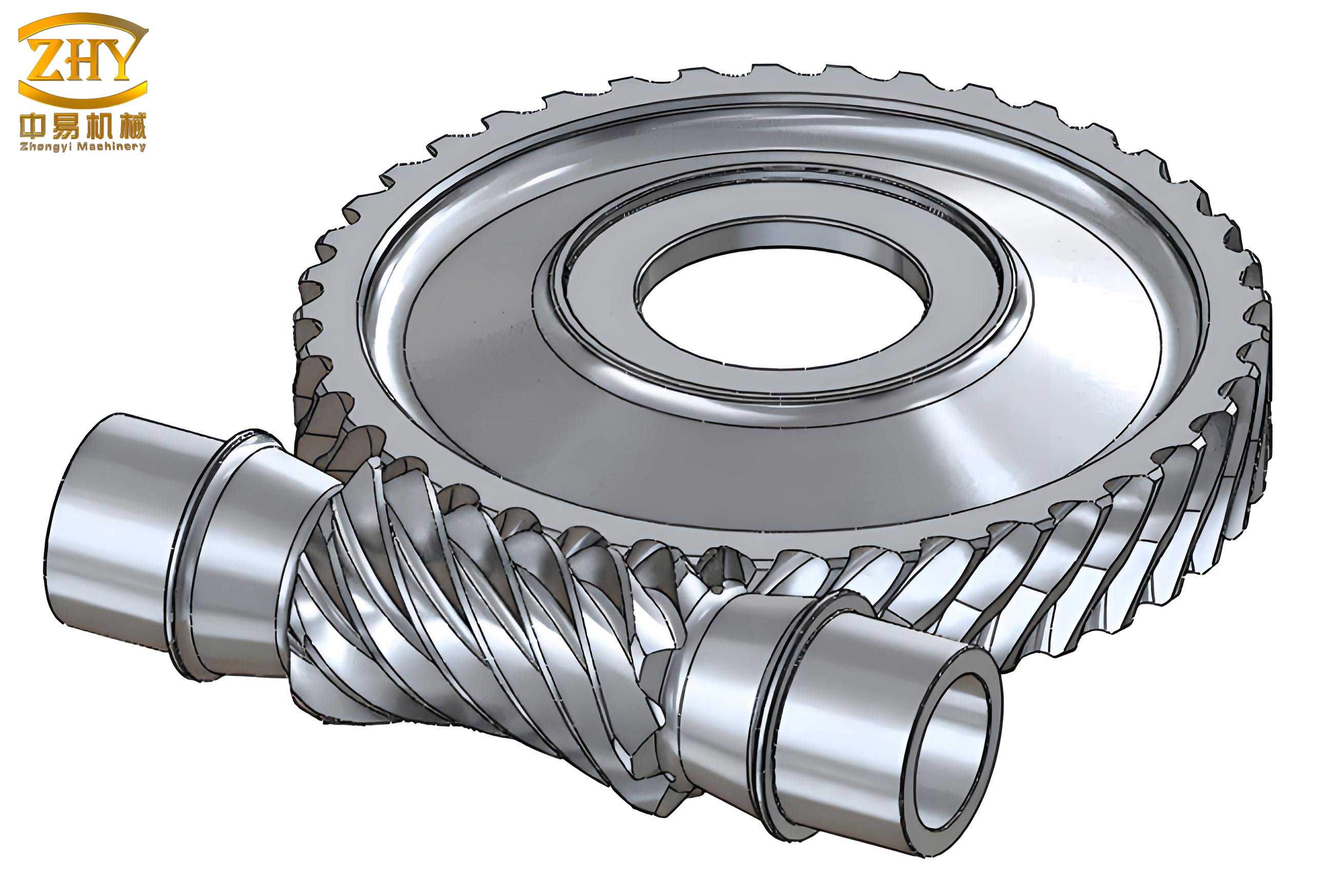
The fundamental principle behind measuring an Archimedean screw gear lies in its geometric properties. As a screw gear, it consists of a worm (the screw) and a worm wheel, meshing to transmit motion between non-intersecting, perpendicular shafts. I always begin by visually inspecting the screw gear set to understand its configuration and any apparent wear. The Archimedean profile is key; its axial tooth flank is a straight line, making it relatively simpler to measure compared to involute or other complex profiles. This linearity allows for the use of basic tools like steel rulers and angle gauges, though for higher accuracy, coordinate measuring machines (CMMs) or specialized gear testers may be employed. Throughout this discussion, I will refer to the worm as the screw gear element, reinforcing the importance of the screw gear concept in power transmission.
Let me first outline the measurement process for the worm, which is the driving screw gear in the pair. The steps involve identifying the gear type, measuring the tooth profile angle, determining the axial module, calculating the lead angle, and finding the pitch diameter. Each step is interconnected and relies on precise measurements.
Identification and Tooth Profile Angle Measurement
To confirm that a worm is indeed an Archimedean screw gear, I use a simple method: placing a steel rule or a straight edge against the tooth flank in the axial direction. If the rule makes full contact along the flank, the profile is linear, indicating an Archimedean screw gear. This is a critical first step because misidentification can lead to incorrect subsequent measurements. Once confirmed, I measure the tooth profile angle, denoted as $$ \alpha $$. For metric screw gears, this angle is typically $$ 20^\circ $$, while for inch-based systems (diametral pitch), it might be $$ 14.5^\circ $$ or $$ 20^\circ $$. I use an angle gauge or a universal bevel protractor for this purpose. According to standards like GB 10085-88 (similar to ISO standards), the axial pressure angle for Archimedean screw gears is standardized at $$ \alpha = 20^\circ $$. However, in practice, I have encountered non-standard angles, so direct measurement is essential. The formula for the tooth profile angle in the axial plane is constant for this screw gear type.
Axial Module and Lead Angle Determination
The axial module, $$ m_x $$, is a fundamental parameter for screw gears. I measure it by determining the axial pitch, $$ p_x $$, which is the distance between corresponding points on adjacent teeth along the axis. To improve accuracy, I measure over multiple pitches, say $$ n $$ pitches, and calculate the average axial pitch. The axial module is then given by:
$$ m_x = \frac{p_x}{\pi} = \frac{\sum_{i=1}^{n} p_{x_i}}{n \pi} $$
where $$ p_{x_i} $$ are individual pitch measurements. If the computed value does not align with standard metric modules, I convert it to diametral pitch, $$ P_d $$, using $$ P_d = \frac{25.4}{m_x} $$, recognizing that this screw gear might be designed in inch units.
Next, I measure the worm’s outside diameter, $$ d_{a1} $$, using a micrometer or caliper. With the number of worm starts (threads), $$ z_1 $$, known—often by visual count—I calculate the lead angle, $$ \gamma $$, using the formula:
$$ \tan \gamma = \frac{m_x z_1}{d_{a1} – 2 m_x} $$
This lead angle is crucial as it affects the screw gear’s efficiency and meshing condition. The pitch diameter of the worm, $$ d_1 $$, can then be derived:
$$ d_1 = \frac{m_x z_1}{\tan \gamma} $$
In standard screw gear design, the diameter factor or quotient, $$ q $$, is often used, where $$ q = \frac{d_1}{m_x} $$, but in measurement, I rely on direct computation from measured values. To summarize these steps, I have found tabular representation helpful:
| Step | Parameter | Tool/Method | Formula/Note |
|---|---|---|---|
| 1 | Type Identification | Steel rule axial contact check | Linear profile confirms Archimedean screw gear |
| 2 | Tooth Profile Angle (α) | Angle gauge or protractor | Typically $$ 20^\circ $$ for metric screw gears |
| 3 | Axial Module (m_x) | Measure axial pitch over n teeth | $$ m_x = \frac{p_x}{\pi} $$; average for accuracy |
| 4 | Lead Angle (γ) | Calculate from m_x, z_1, and d_{a1} | $$ \tan \gamma = \frac{m_x z_1}{d_{a1} – 2 m_x} $$ |
| 5 | Pitch Diameter (d_1) | Derived from lead angle | $$ d_1 = \frac{m_x z_1}{\tan \gamma} $$ |
Moving on to the worm wheel, which is the driven element of the screw gear pair, its measurement often involves verifying the center distance and determining any profile shift (modification) that might have been applied during manufacturing. The worm wheel’s parameters are interdependent with the worm’s, emphasizing the integrated nature of screw gear systems.
Worm Wheel Measurement and Center Distance
I typically measure the center distance, $$ a $$, between the worm and worm wheel axes using precision height gauges on a surface plate or a CMM. This measured center distance, $$ a_{\text{meas}} $$, is compared with the theoretical value calculated from the worm’s pitch diameter, $$ d_1 $$, and the worm wheel’s pitch diameter, $$ d_2 $$. The worm wheel’s pitch diameter is given by $$ d_2 = m_x z_2 $$, where $$ z_2 $$ is the number of teeth on the worm wheel. The theoretical center distance for a non-modified screw gear pair is:
$$ a_{\text{theo}} = \frac{d_1 + d_2}{2} = \frac{m_x}{2} \left( \frac{z_1}{\tan \gamma} + z_2 \right) $$
If $$ a_{\text{meas}} = a_{\text{theo}} $$, the screw gear set is standard without profile shift. However, in many practical scenarios, especially in repair work, I find that $$ a_{\text{meas}} \neq a_{\text{theo}} $$, indicating a modified screw gear design. This leads to the calculation of the profile shift coefficient, $$ x_2 $$, for the worm wheel:
$$ x_2 = \frac{a_{\text{meas}} – a_{\text{theo}}}{m_x} = \frac{2 a_{\text{meas}} – (d_1 + d_2)}{2 m_x} $$
Alternatively, using the measured center distance directly:
$$ x_2 = \frac{a_{\text{meas}}}{m_x} – \frac{1}{2} \left( \frac{z_1}{\tan \gamma} + z_2 \right) $$
This profile shift affects the tooth thickness and backlash, so it must be accounted for in remanufacturing. Additionally, the worm wheel’s helical angle, $$ \beta $$, is equal to the worm’s lead angle, $$ \gamma $$, and they share the same hand of helix. Verification of this angle can be done using a sine bar or optical comparator, but often, I infer it from the worm’s lead angle measurement. To encapsulate the worm wheel measurement process:
| Parameter | Symbol | Measurement Method | Formula |
|---|---|---|---|
| Center Distance | $$ a $$ | Height gauge on surface plate | Direct measurement $$ a_{\text{meas}} $$ |
| Theoretical Center Distance | $$ a_{\text{theo}} $$ | Calculation from worm data | $$ a_{\text{theo}} = \frac{d_1 + d_2}{2} $$ |
| Profile Shift Coefficient | $$ x_2 $$ | Derived from center distance difference | $$ x_2 = \frac{a_{\text{meas}} – a_{\text{theo}}}{m_x} $$ |
| Wheel Pitch Diameter | $$ d_2 $$ | Calculated or measured directly | $$ d_2 = m_x z_2 $$ |
| Helical Angle | $$ \beta $$ | Assumed equal to worm lead angle γ | $$ \beta = \gamma $$ |
To illustrate these measurement techniques in a real-world context, I recall an instance involving a screw gear pair from a sawing machine. The worm had two starts ($$ z_1 = 2 $$), and the worm wheel had 40 teeth ($$ z_2 = 40 $$). Using a $$ 20^\circ $$ tooth profile gauge, I confirmed the axial profile was linear, identifying it as an Archimedean screw gear. Measuring over 5 axial pitches yielded a total distance of 62.8 mm, giving an axial pitch $$ p_x = 12.56 $$ mm and axial module $$ m_x = 4.0 $$ mm (since $$ m_x = p_x / \pi \approx 12.56 / 3.1416 = 4.0 $$). The worm’s outside diameter was measured as $$ d_{a1} = 72 $$ mm. Calculating the lead angle:
$$ \tan \gamma = \frac{m_x z_1}{d_{a1} – 2 m_x} = \frac{4 \times 2}{72 – 8} = \frac{8}{64} = 0.125 $$
Thus, $$ \gamma = \arctan(0.125) \approx 7.125^\circ $$. The worm pitch diameter was $$ d_1 = \frac{m_x z_1}{\tan \gamma} = \frac{8}{0.125} = 64 $$ mm. For the worm wheel, the theoretical pitch diameter is $$ d_2 = m_x z_2 = 4 \times 40 = 160 $$ mm. The theoretical center distance would be $$ a_{\text{theo}} = (64 + 160)/2 = 112 $$ mm. However, actual measurement on the surface plate gave $$ a_{\text{meas}} = 116 $$ mm, indicating a profile shift. The profile shift coefficient was calculated as:
$$ x_2 = \frac{a_{\text{meas}} – a_{\text{theo}}}{m_x} = \frac{116 – 112}{4} = 1.0 $$
This positive shift meant the worm wheel teeth were offset outward, a common modification to adjust backlash or center distance in screw gear sets. This example underscores the practical application of the formulas and methods described.
Advanced Considerations in Screw Gear Measurement
Beyond basic parameters, I often delve into finer aspects of screw gear measurement to ensure longevity and performance. One key area is the assessment of wear and surface roughness. For screw gears, especially in high-load applications, flank wear can alter the tooth profile, affecting meshing. I use profilometers or even replication techniques to examine surface conditions. Another aspect is backlash measurement, which is critical for precision applications. Backlash in a screw gear pair can be measured by fixing the worm and applying a torque to the wheel, measuring the angular movement, or using feeler gauges between teeth. The formula for backlash adjustment involves the profile shift and center distance variations.
Moreover, the alignment of the screw gear set is paramount. Misalignment can lead to increased wear and noise. I check for parallel misalignment and angular misalignment between the worm and wheel shafts using dial indicators and precision levels. The tolerances for these alignments are often specified in standards, but in the field, I rely on experience-based thresholds, typically within 0.05 mm over the face width for parallel misalignment.
In terms of measurement uncertainty, I consider factors like tool calibration, environmental conditions, and operator skill. For instance, when measuring the axial pitch, thermal expansion can affect readings if the screw gear is warm from operation. I always allow components to acclimate to room temperature. Additionally, when using formulas, rounding errors can accumulate; thus, I maintain high precision in calculations, often using software tools to compute parameters like $$ \gamma $$ with multiple decimal places.
To further elaborate on screw gear geometry, let me present a consolidated table of essential formulas that I frequently use in my work. This table serves as a quick reference for key parameters of Archimedean cylindrical screw gears.
| Parameter | Symbol | Formula | Notes |
|---|---|---|---|
| Axial Pitch | $$ p_x $$ | $$ p_x = \pi m_x $$ | Measured directly over multiple teeth |
| Lead | $$ L $$ | $$ L = p_x z_1 = \pi m_x z_1 $$ | Distance worm advances in one revolution |
| Lead Angle | $$ \gamma $$ | $$ \tan \gamma = \frac{L}{\pi d_1} = \frac{m_x z_1}{d_1} $$ | Also $$ \gamma = \arctan\left(\frac{m_x z_1}{d_{a1} – 2 m_x}\right) $$ |
| Pitch Diameter (Worm) | $$ d_1 $$ | $$ d_1 = \frac{m_x z_1}{\tan \gamma} = q m_x $$ | q is diameter factor; non-standard values exist |
| Pitch Diameter (Wheel) | $$ d_2 $$ | $$ d_2 = m_x z_2 $$ | Based on axial module and tooth count |
| Center Distance (Standard) | $$ a $$ | $$ a = \frac{d_1 + d_2}{2} = \frac{m_x}{2}(q + z_2) $$ | For non-modified screw gears |
| Center Distance (Modified) | $$ a’ $$ | $$ a’ = a + m_x x_2 = \frac{m_x}{2}(q + z_2 + 2x_2) $$ | With profile shift coefficient x_2 |
| Tooth Depth | $$ h $$ | $$ h = 2.2 m_x $$ (approx.) | May vary with design standards |
| Outside Diameter (Worm) | $$ d_{a1} $$ | $$ d_{a1} = d_1 + 2 m_x $$ | For standard full-depth teeth |
| Root Diameter (Worm) | $$ d_{f1} $$ | $$ d_{f1} = d_1 – 2.4 m_x $$ | Approximate, depending on root clearance |
In addition to these formulas, I often consider the efficiency of the screw gear pair, which is influenced by the lead angle and friction coefficients. The efficiency, $$ \eta $$, can be estimated using:
$$ \eta = \frac{\tan \gamma}{\tan(\gamma + \phi)} $$
where $$ \phi $$ is the friction angle, dependent on lubrication and material. For steep lead angles, efficiency improves, but self-locking capability may reduce—a critical design trade-off in screw gear applications like hoists.
When dealing with worn screw gears, measurement becomes challenging. I sometimes employ reverse engineering techniques using 3D scanning to capture the exact tooth form. This allows for reconstruction of the original parameters or identification of deviations. For example, if the axial profile is no longer perfectly linear due to wear, I might approximate it as linear over the unworn sections or use curve-fitting algorithms to deduce the original geometry.
Another practical tip I have developed is to verify measurements by checking consistency across multiple teeth or sections. For the worm, I measure the axial pitch at several locations along the circumference to account for any pitch errors or eccentricity. Similarly, for the worm wheel, I measure the tooth thickness at various points using gear tooth calipers or span measurements. The tooth thickness, $$ s $$, in the axial plane for the worm can be derived from the axial pitch and profile angle:
$$ s = \frac{p_x}{2} = \frac{\pi m_x}{2} $$
but wear often reduces this, so actual measurement is necessary.
Furthermore, I emphasize the importance of documenting all measurements in a structured report. This includes sketches, photographed evidence, and tabulated data. Such documentation is invaluable for remanufacturing or procuring replacement screw gears. In my reports, I always highlight the screw gear type—Archimedean cylindrical—and specify all derived parameters like module, lead angle, and profile shift.
To enhance understanding, let me discuss a hypothetical but detailed measurement scenario for a screw gear pair in a conveyor system. Assume the screw gear has been in service for years, showing signs of pitting and wear. I start by cleaning the components to remove debris and grease. Using a CMM, I probe the worm’s teeth to generate point clouds. From these points, I fit a straight line in the axial section to confirm the Archimedean profile. The CMM software calculates the average axial pitch and profile angle automatically. Suppose the results are: $$ \alpha = 19.8^\circ $$ (slight deviation from standard), $$ m_x = 3.5 $$ mm, $$ z_1 = 1 $$ (single-start), and $$ d_{a1} = 50 $$ mm. Then:
$$ \tan \gamma = \frac{3.5 \times 1}{50 – 7} = \frac{3.5}{43} \approx 0.0814 $$, so $$ \gamma \approx 4.66^\circ $$.
$$ d_1 = \frac{3.5}{\tan \gamma} \approx \frac{3.5}{0.0814} \approx 43.0 $$ mm.
For the worm wheel, with $$ z_2 = 30 $$, theoretical $$ d_2 = 3.5 \times 30 = 105 $$ mm. Measured center distance is 75 mm, which is less than theoretical $$ (43+105)/2 = 74 $$ mm? Wait, recalc: theoretical center distance = (43 + 105)/2 = 74 mm, but measured is 75 mm, so there might be a slight profile shift or measurement error. This discrepancy prompts me to repeat measurements or consider backlash effects. In such cases, I might measure the worm wheel’s tooth thickness directly to infer shift.
This iterative process is common in screw gear measurement, where initial calculations guide further inspections. I often use statistical methods, like taking multiple readings and averaging, to reduce uncertainty. For instance, when measuring the axial pitch, I might take 10 readings along the worm and compute the mean and standard deviation to ensure reliability.
In terms of tools, beyond basic hand tools, I leverage modern equipment like laser trackers for large screw gears or optical projectors for small ones. However, the fundamental principles remain rooted in the geometry of the Archimedean screw gear. I also consult international standards, such as ISO 1328 for cylindrical gears (though screw gears have specific standards like ISO 10828), to compare measured tolerances against acceptable limits.
Finally, I want to stress the interdisciplinary knowledge required for effective screw gear measurement. Understanding metallurgy helps in assessing wear patterns, while knowledge of tribology aids in evaluating surface conditions. As a practitioner, I continuously update my skills through training and collaboration with engineers. The screw gear, though a classic mechanical component, presents ever-evolving challenges in measurement and maintenance.
In conclusion, measuring Archimedean cylindrical screw gears is a meticulous yet rewarding task that ensures the reliability of power transmission systems. By following systematic steps—identifying the gear type, measuring key parameters like tooth profile angle, axial module, lead angle, and center distance, and accounting for profile shifts—I can accurately characterize any screw gear pair. The use of formulas, such as those for lead angle and profile shift coefficient, combined with tabular summaries, streamlines the process. Whether dealing with standard or modified designs, the principles outlined here provide a robust framework. As screw gears continue to be integral in industry, precise measurement remains the cornerstone of their maintenance and optimization, underscoring the enduring importance of this screw gear technology in mechanical engineering.