
In modern manufacturing, the machining of eccentric components such as eccentric shafts and sleeves is a common yet challenging task. Traditional methods often rely on fixed setups or adjustable fixtures with limited versatility, which can be inefficient for small-batch production with varying dimensions. As an engineer engaged in mechanical design, I have explored numerous approaches to improve flexibility and precision in eccentric machining. Existing solutions, such as double-cylinder positioning or dual-eccentric wheel fixtures with spacer blocks, suffer from limitations like fixed eccentric ranges or the need for custom parts for each adjustment. To address these issues, our team developed an innovative fixture that utilizes screw gear driving for stepless eccentric adjustment. This design not only enhances adaptability but also simplifies operations, making it suitable for diverse applications. In this article, I will delve into the principles, calculations, and applications of this screw gear-based fixture, emphasizing its advantages through detailed analyses, formulas, and tables. The screw gear mechanism, central to our design, enables smooth and continuous adjustment, a feature that sets it apart from conventional methods. Throughout this discussion, I aim to provide a comprehensive guide that underscores the significance of screw gear technology in advancing fixture design.
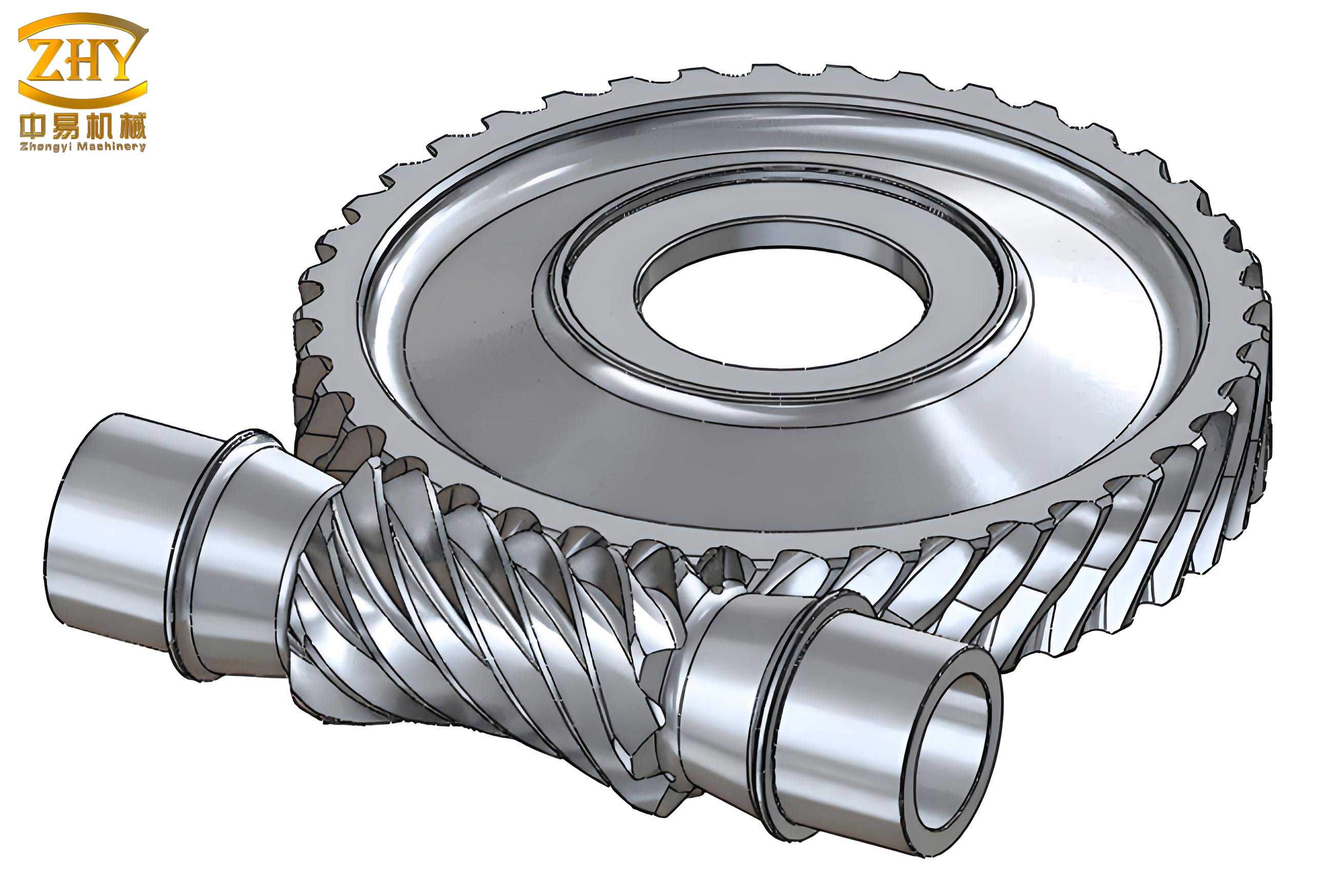
The core of our fixture lies in its use of screw gear driving, which allows for precise and infinite control over eccentricity. The screw gear, often referred to as a worm and worm gear system, is renowned for its high reduction ratio and self-locking capability, making it ideal for applications requiring fine adjustments. In our context, the screw gear translates rotational motion into precise angular displacement of eccentric wheels, thereby modulating the workpiece position relative to the machine tool’s axis. This mechanism eliminates the need for interchangeable spacers, offering a seamless solution for machining parts with different eccentricities. The screw gear’s inherent durability and reliability further ensure long-term performance in industrial environments. By integrating screw gear driving, we have created a fixture that not only meets the demands of multi-variant production but also reduces setup times, enhancing overall productivity. As I explain the working principles, it will become evident how the screw gear transforms traditional eccentric machining into a more dynamic and efficient process.
The working principle of our stepless-adjusted eccentric fixture is illustrated in Figure 1, which shows a schematic of the screw gear-driven system. As the primary positioning elements, two eccentric wheels are rigidly attached to shafts that are fixed to screw gears (worm gears). These assemblies are hinged to the fixture body at points O1 and O2, allowing them to rotate freely. The screw gear, driven by a worm shaft, transmits motion to the eccentric wheels, causing them to pivot around their hinge axes. This rotation alters the contact points between the eccentric wheels and the workpiece, which is typically a cylindrical part requiring eccentric machining. By adjusting the angle of rotation, denoted as α, the distance from the workpiece center to a reference plane changes continuously, thereby varying the eccentricity. The screw gear’s design ensures that α can be varied over a full 360° range, enabling infinite adjustments without discrete steps. This contrasts sharply with methods using spacer blocks, which only allow finite changes. The screw gear mechanism also provides bidirectional control; rotating the worm in opposite directions yields different configurations for the same eccentric distance, accommodating workpieces with varying diameters. This flexibility is a key advantage of incorporating screw gear technology into the fixture.
To understand the positional extremes, consider the two limit scenarios shown in Figure 2. In the minimum eccentric position (Figure 2b), the workpiece center aligns with the machine’s rotational axis, resulting in zero eccentricity. Here, the eccentric wheels contact the workpiece at their closest points to the hinge centers. Conversely, in the maximum eccentric position (Figure 2a), the workpiece is offset to its fullest extent, achieved by rotating the screw gear to an optimal angle. The transition between these states is governed by the screw gear’s motion, which smoothly adjusts the eccentric wheels’ orientation. This dynamic adjustment capability is what makes our fixture universally applicable; it can handle a wide range of eccentricities and workpiece sizes without requiring physical modifications. However, the complexity of the screw gear system introduces challenges, such as the need for precise manufacturing and potential backlash. Despite this, the benefits of stepless control outweigh these drawbacks, especially in environments where versatility is paramount. The screw gear’s role in this process cannot be overstated—it serves as the heart of the fixture, enabling precise and repeatable adjustments that are essential for high-quality machining.
The design calculations for determining eccentricity are crucial for optimizing the fixture’s performance. Based on geometric analysis, we derived formulas that relate the screw gear rotation angle α to the resulting eccentric distance e. Let’s define the key parameters: R is the radius of each eccentric wheel, R_h is the distance from the hinge center to the eccentric wheel’s geometric center (i.e., the eccentricity of the wheel itself), r is the radius of the workpiece, W is the distance between the two hinge centers O1 and O2, and α_0 is the initial angle between the reference plane and the line passing through the hinge center and the eccentric wheel’s center when the workpiece is in the lower limit position (eccentricity e = 0). The reference plane is arbitrarily chosen for analysis but does not affect the final results. From Figure 3, when e = 0, the distance M from the workpiece center to the reference plane is given by:
$$ M = (R – R_h + r) \sin \alpha_0 $$
This equation establishes the baseline position. Now, when the screw gear is rotated, causing the eccentric wheels to pivot by an angle α (measured from the initial position), the new distance H from the workpiece center to the reference plane can be expressed as shown in Figure 4. Using geometric relationships, we derive:
$$ H = \sqrt{(R + r)^2 – \left[ R_h \cos(\alpha + \alpha_0) + \frac{W}{2} \right]^2} – R_h \sin(\alpha + \alpha_0) $$
The eccentricity e is then the difference between H and M:
$$ e = H – M = \sqrt{(R + r)^2 – \left[ R_h \cos(\alpha + \alpha_0) + \frac{W}{2} \right]^2} – R_h \sin(\alpha + \alpha_0) – (R – R_h + r) \sin \alpha_0 $$
In this formula, R, r, R_h, α_0, and W are constants determined during fixture design, while α is the variable controlled by the screw gear. By adjusting α through the screw gear drive, we can achieve any desired eccentricity e within the allowable range. This relationship highlights the stepless nature of the adjustment; as α varies continuously, so does e, without any steps or gaps. To facilitate practical use, we can tabulate values of e for different α, providing a quick reference for operators. Table 1 summarizes an example calculation for a typical setup, demonstrating how the screw gear rotation influences eccentricity.
| Screw Gear Rotation Angle α (degrees) | Calculated Eccentricity e (mm) | Workpiece Radius r (mm) |
|---|---|---|
| 0 | 0.00 | 25 |
| 30 | 2.15 | 25 |
| 60 | 4.78 | 25 |
| 90 | 6.93 | 25 |
| 120 | 8.21 | 25 |
| 150 | 8.45 | 25 |
| 180 | 7.50 | 25 |
The table above assumes R = 50 mm, R_h = 20 mm, W = 100 mm, and α_0 = 10°. These values are illustrative; actual parameters may vary based on specific applications. The screw gear’s transmission ratio i links the worm rotation to α; if the worm is turned by an angle θ, then α = θ / i. This ratio amplifies control precision, allowing fine adjustments through minor turns of the worm. For instance, with a high ratio i, even large rotations of the worm yield small changes in α, enabling micrometer-level eccentricity adjustments. This precision is a direct benefit of the screw gear system, which transforms coarse inputs into fine outputs. Moreover, the formula for e can be differentiated to find the sensitivity of eccentricity to angle changes, which is useful for optimizing the screw gear design. The derivative de/dα provides insight into how quickly e varies with α, aiding in selection of appropriate gear ratios for stable control.
Beyond basic calculations, we can explore the fixture’s adaptability through parametric studies. Table 2 compares the maximum achievable eccentricity for different workpiece radii r, keeping other parameters constant. This demonstrates the screw gear fixture’s ability to accommodate varying part sizes, a key advantage over fixed methods.
| Workpiece Radius r (mm) | Maximum Eccentricity e_max (mm) | Required α for e_max (degrees) |
|---|---|---|
| 20 | 10.2 | 140 |
| 25 | 8.5 | 150 |
| 30 | 7.1 | 160 |
| 35 | 5.8 | 170 |
The data shows that as r increases, the maximum eccentricity decreases due to geometric constraints, but the screw gear still allows full utilization of the available range. This versatility is essential for workshops handling diverse orders. Additionally, the screw gear mechanism can be analyzed for mechanical efficiency. The torque required to drive the worm depends on friction and load conditions, which we can model using standard gear equations. For a screw gear with lead angle λ and coefficient of friction μ, the efficiency η is approximately:
$$ \eta = \frac{\tan \lambda}{\tan(\lambda + \phi)} $$
where φ = arctan(μ) is the friction angle. This efficiency impacts the ease of adjustment; higher efficiency means less effort is needed to turn the worm, enhancing user convenience. In our fixture, we typically use screw gears with moderate lead angles to balance efficiency and self-locking properties, ensuring that the setting remains stable during machining. The self-locking feature, inherent in screw gears when λ is small, prevents back-driving, which is crucial for maintaining eccentricity under cutting forces. However, if quick adjustments are needed, a non-locking design with higher efficiency might be preferred, though it may require a separate locking mechanism. This trade-off highlights the importance of selecting the right screw gear specifications for the intended application.
The applications of our screw gear-based eccentric fixture are vast, spanning industries such as automotive, aerospace, and general machinery. In automotive manufacturing, for example, eccentric camshafts require precise offsets for valve timing; our fixture allows rapid setup changes between different cam profiles. Similarly, in aerospace, components like turbine disks with eccentric mounting holes can be machined efficiently using this system. The screw gear’s stepless adjustment capability makes it ideal for prototyping and small-batch production, where flexibility outweighs the cost of dedicated fixtures. Compared to traditional methods, our design reduces inventory of spacers and adapters, lowering overall costs. Table 3 summarizes the advantages and disadvantages of various eccentric machining methods, emphasizing the unique benefits of the screw gear approach.
| Method | Adjustability | Precision | Setup Time | Cost |
|---|---|---|---|---|
| Double-Cylinder Positioning | Fixed | High | Low | Low |
| Spacer Block Fixtures | Discrete | Medium | Medium | Medium |
| Screw Gear Fixture (Our Design) | Stepless | High | Low | High Initial, Low Operational |
As seen, the screw gear fixture excels in adjustability and precision, though it involves higher initial investment due to the complex screw gear components. However, over time, the savings from reduced setup times and increased versatility justify this cost. In practice, we have implemented this fixture in our workshop, observing significant improvements in productivity. For instance, machining a batch of eccentric sleeves with varying offsets previously took hours due to manual spacer changes; with the screw gear system, adjustments are made in minutes via a simple crank handle. The screw gear’s robustness also ensures consistent performance over thousands of cycles, with minimal wear thanks to proper lubrication. To further enhance reliability, we recommend incorporating a locking device, such as a clamp or set screw, to secure the worm shaft after adjustment. This prevents unintended shifts during heavy machining, addressing a potential weakness of purely gear-driven systems. The integration of such features makes the screw gear fixture a comprehensive solution for modern manufacturing challenges.
Looking at the broader context, the screw gear technology used in this fixture aligns with trends toward automation and Industry 4.0. By adding sensors to measure α or e, the system can be integrated into digital control networks, allowing for automated adjustments based on CAD models. This digital twin approach could revolutionize eccentric machining, reducing human error and further speeding up processes. The screw gear, as a precise motion control element, is key to this evolution. Its ability to provide repeatable angular positioning makes it suitable for closed-loop systems, where feedback from encoders ensures accuracy. We envision future versions of our fixture incorporating smart screw gears with embedded sensors, enabling real-time monitoring and adjustment. This would push the boundaries of what’s possible in flexible manufacturing, making the screw gear an indispensable component in advanced tooling.
In conclusion, the stepless-adjusted eccentric fixture leveraging screw gear driving represents a significant advancement in machining technology. Its ability to provide infinite eccentricity adjustments, coupled with adaptability to different workpiece sizes, addresses critical gaps in traditional methods. Through detailed geometric analysis, we have derived formulas that enable precise control, and tables that summarize key relationships, aiding in practical implementation. While the screw gear system adds complexity, its benefits in terms of versatility, precision, and ease of use make it a valuable investment for industries engaged in multi-variant production. As manufacturing continues to evolve toward greater flexibility, such innovations will play a pivotal role. I encourage engineers and machinists to explore screw gear-based solutions for their eccentric machining needs, as they offer a robust path to improved efficiency and quality. The screw gear, with its timeless principles of motion transmission, proves once again its relevance in modern engineering, driving progress one rotation at a time.
To further illustrate the mathematical foundations, let’s consider additional formulas that govern the screw gear fixture’s behavior. The relationship between the worm rotation angle θ and the eccentric wheel angle α is linear if the screw gear has a constant transmission ratio i:
$$ \alpha = \frac{\theta}{i} $$
Substituting into the eccentricity equation, we get e as a function of θ:
$$ e(\theta) = \sqrt{(R + r)^2 – \left[ R_h \cos\left(\frac{\theta}{i} + \alpha_0\right) + \frac{W}{2} \right]^2} – R_h \sin\left(\frac{\theta}{i} + \alpha_0\right) – (R – R_h + r) \sin \alpha_0 $$
This expression allows direct calculation of eccentricity based on worm input, simplifying operator guidelines. For practical purposes, we can linearize this around a working point if the range of θ is small, but the full nonlinear form captures the entire adjustment range. Additionally, the force analysis involves calculating the torque on the worm due to machining forces. If the cutting force exerts a radial load F on the workpiece, the resulting moment on the eccentric wheels can be estimated, and the screw gear must withstand this load without slipping. The self-locking condition ensures stability, but for high-force applications, a brake might be added. The screw gear’s design parameters, such as module and pressure angle, should be selected based on these loads. Table 4 provides typical values for a medium-duty screw gear used in our fixture, showcasing how specifications align with performance requirements.
| Parameter | Value | Unit |
|---|---|---|
| Module | 2 | mm |
| Number of Worm Threads | 1 | – |
| Number of Gear Teeth | 40 | – |
| Transmission Ratio i | 40 | – |
| Lead Angle λ | 4.5 | degrees |
| Efficiency η | 0.35 | – |
The efficiency value indicates that about 35% of the input torque is converted to output motion, with the rest lost to friction—a trade-off for self-locking. This efficiency is acceptable for manual adjustments, but if powered drives are used, a more efficient screw gear design might be chosen. Ultimately, the screw gear fixture embodies a harmonious blend of mechanical ingenuity and practical utility, proving that even age-old concepts like the screw gear can be reinvented to solve contemporary problems. As I reflect on this project, it is clear that the screw gear’s role extends beyond mere motion transfer; it enables a level of control and adaptability that is essential for the future of manufacturing. Through continued innovation, we can further harness the potential of screw gear systems, driving advancements in fixture design and beyond.