
In my extensive experience with mechanical systems, the proper lubrication of screw gears is paramount to ensuring efficiency, longevity, and reliability. Screw gears, consisting of a worm (screw) and a worm wheel, are widely used in various industrial applications due to their ability to provide high reduction ratios and compact design. However, the sliding contact between the teeth of the screw gear set generates significant friction and heat, making the choice and use of specialized oils critical. This article delves into the empirical methods for selecting screw gear oils, their application techniques, and key considerations to prevent failures, all from a first-hand perspective. I will emphasize the importance of tailored lubrication strategies for screw gears, supported by formulas and tables to guide practitioners.
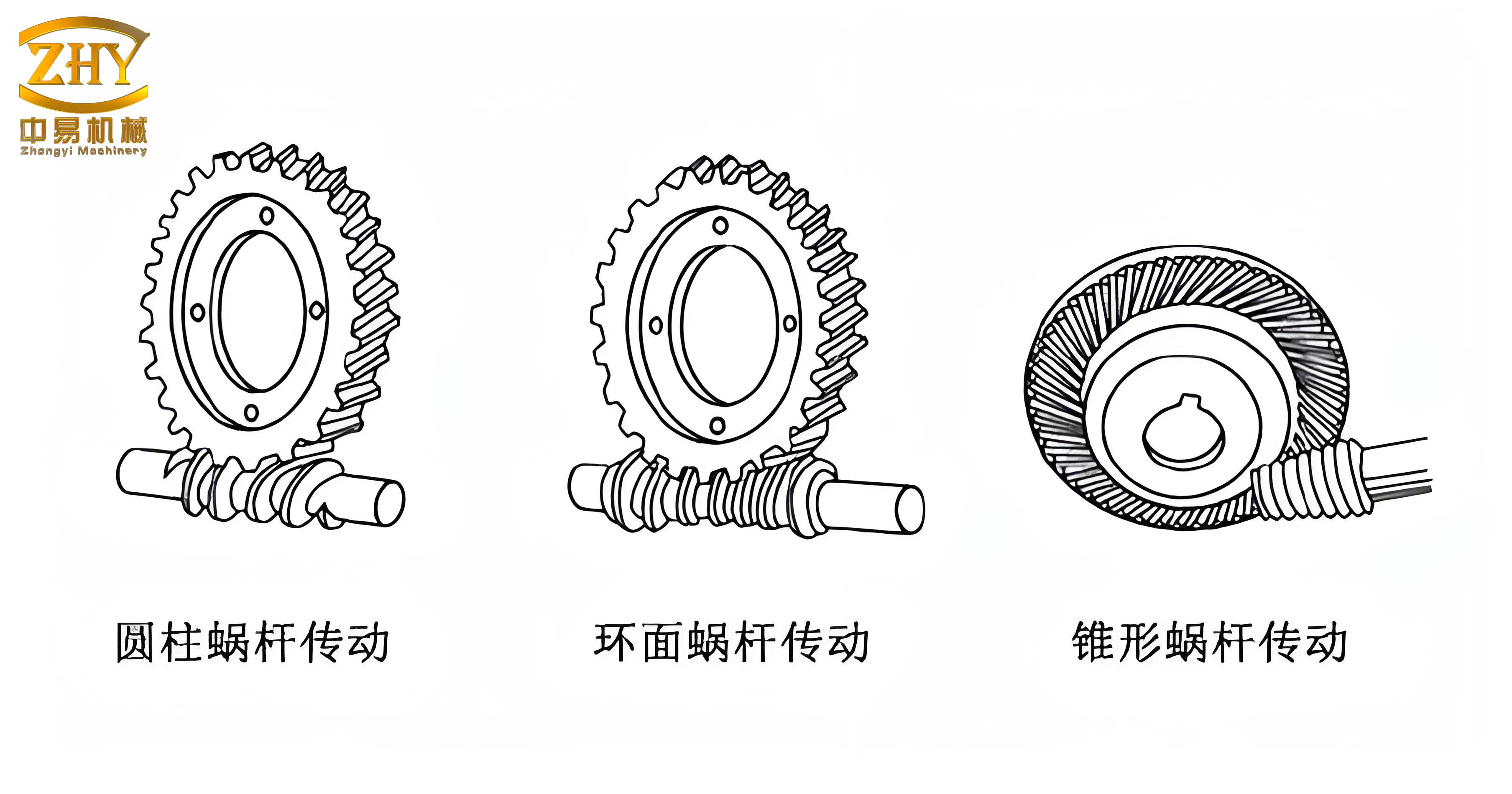
The selection of oil for screw gears hinges on several factors, including the lubrication method, operating conditions, and load characteristics. Screw gears operate under predominantly sliding motion, which differs from the rolling contact in other gear types. This sliding action, especially along the tooth width direction, necessitates oils with specific viscosity and additive packages to form protective films and minimize wear. I often begin by assessing the lubrication method based on the relative sliding velocity or the rotational speed of the screw gear. For screw gears with a sliding velocity greater than 2 m/s, circulating spray lubrication is recommended, as it ensures adequate oil supply and cooling. Conversely, for sliding velocities below 2 m/s, oil bath lubrication suffices. Alternatively, if the worm speed exceeds 500 rpm, circulating spray lubrication is preferable; below 500 rpm, oil bath lubrication can be employed. This decision is crucial because improper lubrication can lead to overheating and premature failure of the screw gear system.
To quantify the relative sliding velocity in screw gears, I rely on a practical formula that considers the worm’s parameters. The relative sliding velocity, denoted as $V_s$, is calculated along the tooth width direction and serves as a key input for oil selection. The formula is:
$$V_s = \frac{\pi \cdot m \cdot z_1 \cdot n_1}{60 \times 1000} \quad \text{[m/s]}$$
where $m$ is the axial module of the worm in millimeters, $z_1$ is the number of worm starts (head count), and $n_1$ is the rotational speed of the worm in revolutions per minute (rpm). This equation accounts for the geometric and kinematic aspects of the screw gear, providing a reliable estimate of the sliding speed. In some contexts, the worm characteristic coefficient $q$ (defined as the pitch diameter divided by the module) may also be considered, but for simplicity, the above formula is widely used. Once $V_s$ is determined, it guides the viscosity selection for the screw gear oil, as higher sliding velocities typically require lower viscosities to reduce drag and heat generation.
Based on empirical data, I have compiled a table that correlates the relative sliding velocity with the recommended oil viscosity for screw gears under oil bath lubrication. This table serves as a quick reference for engineers and maintenance personnel dealing with screw gear systems.
| Relative Sliding Velocity $V_s$ (m/s) | Recommended Kinematic Viscosity at 40°C (cSt) | Notes |
|---|---|---|
| $V_s < 0.5$ | 680 – 1000 | High viscosity for low-speed, high-torque screw gears |
| $0.5 \leq V_s < 1.0$ | 460 – 680 | Moderate viscosity for general-purpose screw gears |
| $1.0 \leq V_s < 2.5$ | 320 – 460 | Balanced viscosity for medium-speed applications |
| $2.5 \leq V_s < 5.0$ | 220 – 320 | Lower viscosity for higher sliding speeds |
| $V_s \geq 5.0$ | 150 – 220 | Low viscosity for high-speed screw gears, often with spray lubrication |
For screw gears operating under more demanding conditions, such as those with elevated temperatures or heavy loads, the viscosity may need adjustment. I often refer to typical analysis data of specialized screw gear oils, which include properties like viscosity index, pour point, and anti-wear additives. While specific brand names are avoided here, these oils are formulated to enhance the performance of screw gears by reducing friction and protecting against scuffing. For instance, a typical screw gear oil might have a viscosity grade of ISO VG 460, with a viscosity index above 90 and additives like sulfur-phosphorus compounds for extreme pressure (EP) protection. However, caution is advised: certain additives, such as those containing active sulfur or chlorine, can accelerate pitting in bronze worm wheels commonly used in screw gears. Therefore, selecting an oil specifically designed for screw gears is essential to avoid chemical incompatibilities.
Beyond viscosity, the oil quality grade must align with the load conditions of the screw gear. I estimate the load severity using a parameter $K$, which represents the load intensity in kilograms per square centimeter. For screw gears, $K$ is approximated as:
$$K = \frac{F_t}{b \cdot m} \quad \text{[kg/cm}^2\text{]}$$
where $F_t$ is the tangential force at the pitch circle in kilograms-force, $b$ is the face width of the worm wheel in centimeters, and $m$ is the module in centimeters. Based on $K$, screw gears are classified as light-duty ($K < 50$ kg/cm²), medium-duty ($50 \leq K < 100$ kg/cm²), or heavy-duty ($K \geq 100$ kg/cm²). For light to medium loads, pure mineral oils may suffice for screw gears. However, for shock-loaded medium-duty or heavy-duty screw gears, oils with additive packages—such as those containing anti-wear, EP, or friction modifiers—are imperative. These additives form protective layers on the screw gear surfaces, preventing metal-to-metal contact and reducing wear. In my practice, I have observed that screw gears operating under high loads benefit significantly from fortified oils, which extend service life and minimize downtime.
The application of screw gear oils involves two primary methods: oil bath lubrication and pressure spray lubrication. Each method has specific guidelines to ensure optimal performance. For oil bath lubrication, the oil level is critical. When the worm is positioned above the wheel in a screw gear set, the oil level should be maintained just below the centerline of the worm to prevent excessive churning and heat buildup. Conversely, when the worm is below the wheel, the oil level can range from one tooth height to the centerline of the wheel, with deeper immersion for lower speeds and shallower for higher speeds. This configuration aids in splash lubrication, where oil is flung onto the screw gear teeth and bearings. In some screw gear designs, scrapers are used to direct oil to the worm wheel bearings, enhancing lubrication efficiency.
For screw gears with high sliding velocities (typically $V_s > 2$ m/s), pressure spray lubrication is necessary. The oil flow rate $Q$ in liters per second can be estimated using an empirical formula based on the center distance $a$ of the screw gear set in millimeters and the peripheral speed $v$ in meters per second:
$$Q = 0.001 \cdot a \cdot v \quad \text{[L/s]}$$
Additionally, the spray pressure $P$ in kilograms-force per square centimeter should be set according to the peripheral speed:
$$P = 0.5 + 0.1 \cdot v \quad \text{[kgf/cm}^2\text{]}$$
For example, a screw gear with a center distance of 200 mm and a peripheral speed of 3 m/s would require an oil flow rate of $Q = 0.001 \times 200 \times 3 = 0.6$ L/s and a spray pressure of $P = 0.5 + 0.1 \times 3 = 0.8$ kgf/cm². This ensures adequate oil delivery to the screw gear mesh, cooling the teeth and flushing away wear debris. In my installations, I have found that maintaining these parameters prevents dry running and reduces the risk of thermal failure in screw gears.
Heat generation is a major concern in screw gear systems due to the sliding friction. Under normal operation, a screw gearbox reaches thermal equilibrium where the heat generated from tooth friction, bearing losses, and oil churning equals the heat dissipated to the environment. The temperature rise $\Delta T$ in degrees Celsius can be approximated using the following heat balance equation:
$$\Delta T = \frac{P_{\text{in}} \cdot (1 – \eta)}{k \cdot A} \quad \text{[°C]}$$
where $P_{\text{in}}$ is the input power to the worm in kilowatts, $\eta$ is the overall efficiency of the screw gear system, $k$ is the heat transfer coefficient in kW/(m²·°C), and $A$ is the surface area of the gearbox in square meters. The efficiency $\eta$ depends on the number of worm starts and the lubrication condition; for a single-start screw gear, $\eta$ is around 0.7–0.8, while for multi-start screw gears, it can exceed 0.9. The heat transfer coefficient $k$ typically ranges from 0.015 to 0.025 kW/(m²·°C) for natural convection. If the calculated $\Delta T$ exceeds 50°C, it indicates inadequate cooling, which can lead to localized high temperatures on the screw gear teeth, causing lubrication breakdown, scuffing, or even seizure. To mitigate this, I recommend installing cooling fans or incorporating serpentine cooling pipes in the oil sump. Merely changing the oil viscosity is insufficient to address such thermal issues in screw gears; enhanced heat dissipation is key.
The selection of oil for screw gears must be approached with caution due to material compatibility. Often, screw gears use a steel worm paired with a bronze or copper-alloy wheel. Certain additives in industrial oils, such as sulfur or chlorine-based EP agents, can chemically attack bronze surfaces, promoting pitting and accelerated wear. Therefore, I always advocate for oils specifically formulated for screw gears, which contain mild EP additives or friction modifiers compatible with non-ferrous materials. For instance, polyalkylene glycol (PAG)-based oils or synthetic esters offer excellent lubricity and thermal stability for screw gears without causing corrosion. In one case, switching to a dedicated screw gear oil reduced wear rates by over 30% in a heavily loaded system, underscoring the importance of tailored lubrication.
To further illustrate the properties of ideal screw gear oils, I have compiled a table of typical characteristics based on industry standards. This table can serve as a benchmark when evaluating oil options for screw gear applications.
| Property | Test Method | Typical Range | Significance for Screw Gears |
|---|---|---|---|
| Kinematic Viscosity at 40°C | ASTM D445 | 220–680 cSt | Ensures film strength under sliding conditions in screw gears |
| Viscosity Index | ASTM D2270 | >90 | Maintains viscosity across temperature variations in screw gear operation |
| Pour Point | ASTM D97 | < -15°C | Facilitates cold-start performance for screw gears in low-temperature environments |
| Flash Point | ASTM D92 | >200°C | Indicates thermal stability and safety for high-temperature screw gear applications |
| Copper Strip Corrosion | ASTM D130 | Rating 1a or better | Ensures compatibility with bronze worm wheels in screw gears |
| Four-Ball Wear Scar Diameter | ASTM D4172 | < 0.5 mm | Demonstrates anti-wear properties for screw gear tooth protection |
| Friction Coefficient | Specialized test | 0.05–0.10 | Reduces sliding friction in screw gears, improving efficiency |
In addition to oil selection, monitoring and maintenance practices are vital for screw gear systems. I regularly analyze oil samples from screw gearboxes to check for viscosity changes, contamination, or wear metal content. For instance, an increase in iron or copper particles may indicate abnormal wear in the screw gear components. Using oil analysis, I can schedule proactive maintenance before failures occur. Moreover, ensuring proper sealing prevents oil leakage and contamination, which is common in screw gear applications due to their vertical or horizontal orientations. In my view, a holistic approach—combining correct oil selection, appropriate application methods, and diligent monitoring—maximizes the performance and lifespan of screw gears.
Beyond lubrication, other factors influence screw gear reliability. Alignment and mounting precision are critical; misalignment can cause uneven load distribution and accelerated wear in screw gears. I often use laser alignment tools to verify the positioning of worm and wheel shafts, aiming for tolerances within 0.05 mm. Furthermore, the design of the screw gear itself, such as the pressure angle and lead angle, affects lubrication efficiency. For example, a higher lead angle in the screw gear can reduce sliding velocity and improve oil entrainment. In redesign projects, I have optimized screw gear geometries to enhance lubricant film formation, resulting in quieter operation and lower temperatures.
To address wear and damage in screw gears, repair techniques like the use of wear-resistant adhesives (often called “wear-resistant adhesives”) have gained popularity. These adhesives, typically two-component epoxy-based systems filled with ceramic or metallic particles, can rebuild worn tooth surfaces on screw gears without disassembly. While not a substitute for proper lubrication, they offer a cost-effective solution for extending the service life of damaged screw gears. However, I caution that such repairs should be followed by re-lubrication with suitable oils to ensure continued performance. The synergy between adhesive repairs and optimized lubrication can revive otherwise failing screw gear systems.
In conclusion, the selection and use of oils for screw gears are multifaceted processes that require careful consideration of operating conditions, load dynamics, and material compatibility. From my firsthand experience, adhering to empirical guidelines—such as those based on sliding velocity and load parameters—significantly enhances the reliability of screw gears. The formulas and tables provided here offer practical tools for engineers. Remember, screw gears are unique in their sliding action, and thus demand specialized lubrication strategies. By choosing the right oil, applying it correctly, and implementing cooling measures when needed, you can prevent common failures like scuffing, pitting, and thermal overload in screw gears. Ultimately, a proactive approach to screw gear lubrication not only boosts efficiency but also reduces maintenance costs and downtime in industrial operations.
As technology advances, new developments in synthetic oils and additive chemistry continue to improve screw gear lubrication. I encourage ongoing education and collaboration within the industry to share best practices for screw gear maintenance. Whether you are dealing with high-speed screw gears in automotive applications or heavy-duty screw gears in mining equipment, the principles outlined here remain applicable. Let us prioritize the health of our screw gear systems through informed lubrication choices, ensuring they run smoothly for years to come.