
In my extensive experience designing precision drive systems for heavy-duty machine tools, the hydrostatic screw gear and rack transmission stands out as a uniquely effective solution. This transmission mechanism converts rotary motion into linear displacement with exceptional accuracy and stability. The fundamental principle involves separating the mating surfaces of the screw gear and the rack with a high-stiffness, vibration-damping oil film. This film is paramount; it virtually eliminates wear on the transmission components, ensures that all teeth of the screw gear engage with the rack teeth (thereby averaging out manufacturing errors), and significantly improves transmission efficiency. Furthermore, this configuration offers excellent load-carrying rigidity and favorable operational characteristics, effectively mitigating low-speed creep. Consequently, its application is critical in heavy-duty machine tools, CNC systems, high-precision machining centers, programmable machines, and other demanding precision machinery.
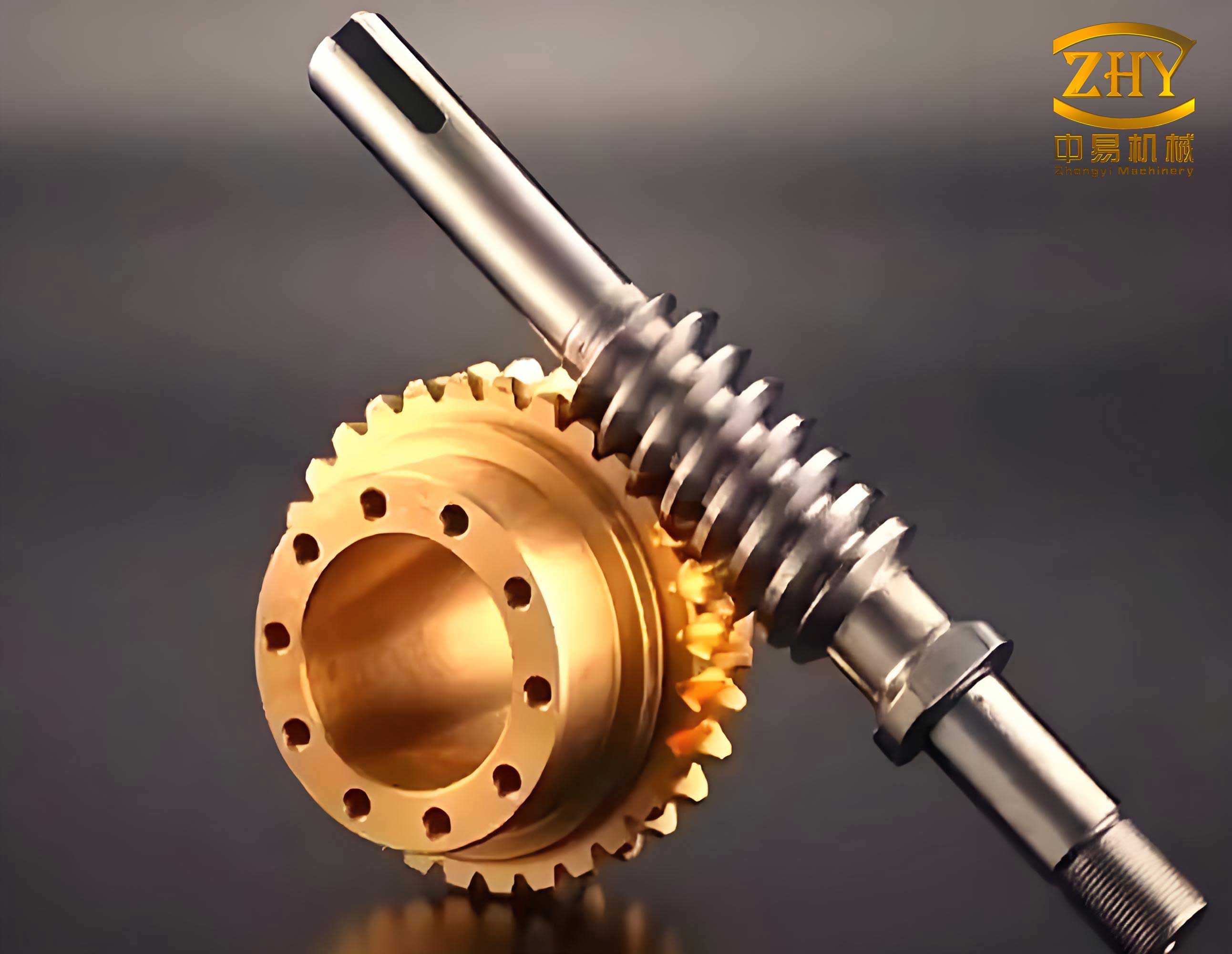
I. Structural Configuration of the Hydrostatic Screw Gear and Rack Pair
The hydrostatic screw gear and rack transmission exhibits remarkably high stiffness. A key design aspect is the judicious selection of the tooth flank semi-angle, which minimizes relative displacement of the screw gear under load. During operation, only the teeth within a specific engagement zone, defined by a wrap angle $\alpha$, are actively pressurized. This necessitates a dedicated oil distribution system to ensure a continuous supply of pressurized oil to the load-bearing recesses within this zone, to pre-fill and vent the screw gear’s oil passages before they enter the engagement area, and to address the issue of radial unbalanced oil pressure on the screw gear.
Oil distribution can be classified as either radial or axial. Furthermore, the hydrostatic recesses can be machined either onto the screw gear or onto the rack teeth. A prevalent and effective design employs axial oil distribution with the recesses located on the rack. In this configuration, pressurized hydrostatic oil enters an annular distribution chamber on an end-mounted distribution plate connected to the screw gear. Within the engagement wrap angle $\alpha$, the oil flows into the rotating screw gear’s axial passages and then into the load-bearing recesses on both flanks of the engaged teeth. Oil escapes through the flank clearances. Oil overflowing from the annular chamber feeds into the screw gear’s axial passages outside the engagement zone via filling grooves on the distribution plate, ensuring they are pre-filled and vented for smooth operation.
Whether the recesses are on the screw gear or the rack, each tooth flank typically features one recess. When comparing both designs for the same wrap angle $\alpha$, the effective bearing area utilization differs. Generally, placing the recesses on the rack offers approximately 20% greater load capacity. Therefore, machining the recesses onto the rack is preferable from a performance standpoint臧, though it complicates the manufacturing of the rack component. The recesses are usually positioned at the pitch diameter of the rack, with dimensions as outlined below.
| Parameter | Typical Value / Description |
|---|---|
| Recess Width ($b_p$) | $0.6t$ to $0.8t$ (where $t$ is the pitch) |
| Recess Depth ($h_p$) | $(0.3 \text{ to } 0.5) \times 10^{-3}$ m |
| Recess Ends | Closed to preserve sealing land integrity |
| Tooth Flank Semi-angle ($\beta$) | Commonly $20^\circ$ or $22.5^\circ$ to reduce radial force |
| Engagement Wrap Angle ($\alpha$) | Typically $\leq 90^\circ$ to $100^\circ$ |
| Screw Gear Tooth Height | Approx. $1.2$ to $1.5$ times the pitch |
| Number of Screw Gear Threads | Usually not exceeding $4$ to $10$ |
To further minimize radial displacement caused by any remaining unbalanced force, high-stiffness bearings are essential for supporting the screw gear shaft.
II. Precision Requirements for the Hydrostatic Screw Gear and Rack
In a hydrostatic pair, the teeth surfaces never physically contact; they are perpetually separated by the oil film. Since the stiffness of this film is inversely proportional to its thickness, a larger clearance simplifies manufacturing but reduces system stiffness and drastically increases oil flow requirements. Conversely, an excessively small clearance imposes impractical manufacturing tolerances. A practical design compromise sets the nominal oil film thickness $h_0$ within the range of $15$ to $30 \mu m$.
To maintain this film thickness across the entire engagement length and prevent metal-to-metal contact, the required gear accuracy is significantly tighter than for a conventional screw gear and rack pair. The allowable pitch error and lead error must be fractions of the oil film thickness itself.
| Error Type | Allowable Value (Relative to Film Thickness $h_0$) | Approximate Absolute Value for $h_0 = 20\mu m$ |
|---|---|---|
| Single Pitch Error ($\Delta t$) | $\leq \frac{1}{4} h_0$ | $\leq 5 \mu m$ |
| Accumulated Lead Error over $n$ teeth ($\Delta T_n$) | $\leq \frac{1}{2} h_0$ | $\leq 10 \mu m$ |
| Tooth Flank Angle Error ($\Delta \beta$) | $\leq 1’$ to $2’$ (arc-minutes) | – |
Machining a hydrostatic screw gear and rack to these standards is more challenging than producing a standard precision gear pair. The screw gear is often longer, and its lead error profile must be matched to the rack’s accumulated error profile. If the standard tolerance for accumulated lead error is $\pm \Delta \Sigma$, meeting just this standard is insufficient for a hydrostatic system. Consider a screw gear with an error of $+\Delta \Sigma$ and a rack with an error of $-\Delta \Sigma$; both are within standard tolerance, yet their relative error is $2\Delta \Sigma$, which could exceed the allowable $h_0/2$ and cause contact. Therefore, the precision reserve must be much larger, often necessitating accuracy levels equivalent to or surpassing the highest standard grades.
Furthermore, in applications where multiple rack segments are joined to form a long axis, it is crucial to ensure not only high alignment accuracy during assembly but also strict consistency in the basic parameters and precision of all rack segments used on a single machine.
III. Selection of Key Parameters for the Hydrostatic System
The hydrostatic system for the screw gear and rack can be either a constant-flow (direct) system or a constant-pressure system with flow control. Constant-pressure systems require appropriate restrictors, such as capillary tubes, orifices, or double diaphragm feedback restrictors.
The analysis begins with the load model. Under no load ($W=0$), the pressures in the recesses on both flanks are equal to the supply pressure $P_{s0}$, and the clearances on both sides are equal to $h_0$. When a load $W$ is applied, the clearances change to $h_1$ and $h_2$, creating a pressure difference $\Delta P = P_1 – P_2$ that balances the load. (Here, subscript $1$ denotes the loaded flank, and $2$ denotes the unloaded flank).
The fundamental parameters—effective bearing area $A_e$ and oil flow rate $Q$—are calculated as follows:
$$ A_e = K_c \cdot z \cdot (r_2^2 – r_1^2) \cdot \frac{\sin \beta}{\cos \lambda} $$
$$ Q = \frac{P_{s0} \cdot h_0^3}{6 \mu \ln(r_2/r_1)} \cdot z \cdot \pi \cdot (r_1 + r_2) \cdot \frac{\tan \beta}{\cos \lambda} \cdot \psi_\alpha $$
Where:
$K_c$ = Utilization coefficient for effective recess area (different for recess-on-rack vs. recess-on-screw),
$z$ = Number of screw gear threads (starts),
$r_1, r_2$ = Inner and outer radii of the sealing land,
$\beta$ = Tooth flank semi-angle,
$\lambda$ = Lead angle of the screw gear helix,
$\mu$ = Dynamic viscosity of the oil,
$\psi_\alpha$ = $\frac{1}{\pi}(\alpha + \sin \alpha)$, the expanded engagement angle factor.
1. Dual-Pump (Constant Flow) Supply System
This system uses two identical pumps, each supplying one side of the gear mesh. The load capacity is primarily limited by the maximum allowable pressure $P_{s\ max}$ and the maximum permissible change in film thickness $\varepsilon_{max} = \frac{h_0 – h_{1 min}}{h_0}$. The load capacity $W$ and related parameters are:
$$ W = A_e \cdot P_{s\ max} \cdot \bar{W} $$
$$ \bar{W} = \frac{1 – \bar{h_1}^2}{1 + \bar{h_1}^2} \quad \text{where} \quad \bar{h_1} = \frac{h_1}{h_0} = 1 – \varepsilon_{max} $$
The radial force $F_r$ generated due to the tooth angle is:
$$ F_r = A_e \cdot P_{s\ max} \cdot \bar{F_r} $$
$$ \bar{F_r} = \frac{2 \tan \beta}{1 + \bar{h_1}^2} $$
This force causes a radial displacement $\delta_{r0}$ of the screw gear. The oil film stiffness $J$ is a critical performance metric:
$$ J = \frac{dW}{d(\varepsilon h_0)} = \frac{2 A_e P_{s0}}{h_0} \cdot \bar{J} $$
$$ \bar{J} = \frac{2\bar{h_1}}{(1+\bar{h_1}^2)^2} $$
Analysis shows that optimal stiffness for a given flow occurs when $\bar{h_1} \approx 0.6$, i.e., $\varepsilon_{max} \approx 0.4$.
2. Single-Pump Supply with Diaphragm Flow Divider (Feedback Restrictor)
This system uses a single pump and a flow divider incorporating a flexible diaphragm and two nozzles. Under no load, the diaphragm centers itself, delivering equal flow to both flanks. Under load $W$, pressure increases on the loaded side ($P_1$) and decreases on the other ($P_2$). This pressure differential across the diaphragm causes it to deflect, thereby increasing flow to the loaded side and decreasing flow to the unloaded side, providing inherent feedback and higher system stiffness. The system’s behavior depends on the dimensionless parameter $K$:
$$ K = \frac{2 A_e}{C_{d0}} \cdot \frac{k_d \delta_0}{P_{s0} A_d} $$
Where:
$C_{d0}$ = Flow coefficient of the divider nozzles,
$k_d$ = Diaphragm stiffness,
$\delta_0$ = Initial nozzle-diaphragm gap at no load,
$A_d$ = Diaphragm area.
The load characteristic $\bar{W}$ for this system is also a function of $\bar{h_1}$, but its form is modified by the divider’s feedback. The relationship is often determined graphically or via more complex coupled equations. Compared to a dual-pump system, the diaphragm divider can provide up to twice the oil film stiffness for the same oil flow. However, if the diaphragm stiffness $k_d$ is too low, the system may become prone to self-excited vibration. A stability criterion typically requires $K \geq 2$.
3. Constant-Pressure Supply with Fixed Restrictors
Systems using capillary tubes or orifices as fixed restrictors are simpler and very reliable. They can provide sufficiently high stiffness for many heavy-duty machine tool applications and are widely used. The design involves sizing the restrictor (resistance $R_f$) in series with the variable resistance of the film gap ($R_h$) to optimize stiffness at the designed operating point. The stiffness for a symmetric double-sided pad with fixed restrictors is:
$$ J_{fixed} = \frac{3 A_e P_s}{h_0} \cdot \frac{1}{(1 + \frac{R_f}{R_{h0}})^2} $$
Where $R_{h0}$ is the hydraulic resistance of the gap at the nominal clearance $h_0$. Maximum stiffness is achieved when $R_f = R_{h0}$.
| Supply System Type | Key Characteristics | Typical Stiffness Relation | Primary Application Consideration |
|---|---|---|---|
| Dual-Pump (Constant Flow) | Simple control, load capacity limited by pump pressure. Radial force present. | $J \propto \frac{2A_e P_s}{h_0}$ | Where simplicity and reliability are paramount, and very high stiffness is not the sole critical factor. |
| Diaphragm Flow Divider | Higher stiffness per unit flow, self-regulating. Risk of vibration if poorly tuned. | $J_{divider} \approx (1.5 \text{ to } 2.5) \times J_{dual-pump}$ | When high static stiffness and good dynamic performance from a single pump are required. |
| Fixed Restrictor | Very simple, robust, no moving parts. Stiffness is optimal only at design point. | $J_{fixed} \leq \frac{3A_e P_s}{h_0}$ (max when $R_f=R_{h0}$) | Heavy-duty applications where extreme robustness and proven reliability are key. |
The actual stiffness of the transmission assembly is often lower than the calculated oil film stiffness due to additional compliances, such as radial deflection of the screw gear in its bearings and local tooth deformation. Accurate modeling must account for these factors. The choice among these hydrostatic systems ultimately depends on the specific application requirements regarding performance, complexity, cost, and reliability.
Finally, it is important to note that the calculations and parameter selections discussed here apply primarily to hydrostatic racks manufactured entirely from metal. While racks with a metal substrate coated with a polymer layer are also used, they generally cannot achieve the same geometric precision as all-metal racks. Therefore, hydraulic system parameters for coated racks often require adjustment, typically assuming a larger effective clearance. Although coated racks may have lower initial cost, the all-metal hydrostatic screw gear and rack offers superior long-term accuracy, stability, lifespan, and operational reliability, which are critical for high-performance machine tools.