
In my extensive experience with precision rotary tables and indexing mechanisms, the accuracy of division is fundamentally dependent on the manufacturing precision and the meshing clearance of the core screw gear pair. Over prolonged operation, the inevitable wear on the worm and worm wheel degrades performance. For a worn indexing assembly, the critical task is to meticulously survey the existing components, perform calculations to determine the original design parameters, and then execute a repair or replacement strategy. This often involves fabricating a new worm wheel with appropriate cutters and matching it with a newly machined worm, followed by precise clearance adjustment to restore the original indexing accuracy.
The principle of the double-lead screw gear differs significantly from that of a standard single-lead worm drive. In a double-lead worm, the left and right flanks of the thread possess different leads, while the lead on each individual flank remains constant along the worm’s length. This design results in a tooth thickness that uniformly increases or decreases from one end of the worm to the other, hence its alternative name: the variable tooth thickness worm. The primary advantage is that the meshing backlash of the screw gear pair can be eliminated or finely tuned by axially displacing the worm, without altering the center distance.
The meshing principle itself aligns with standard worm gear theory. The axial section of the worm acts as a basic rack, and the worm wheel is akin to a gear mating with that rack. Even though the two flanks have different pitches (and thus different effective modules), the consistency of pitch on each separate flank preserves correct meshing conditions. Axial adjustment of the worm therefore maintains proper contact.
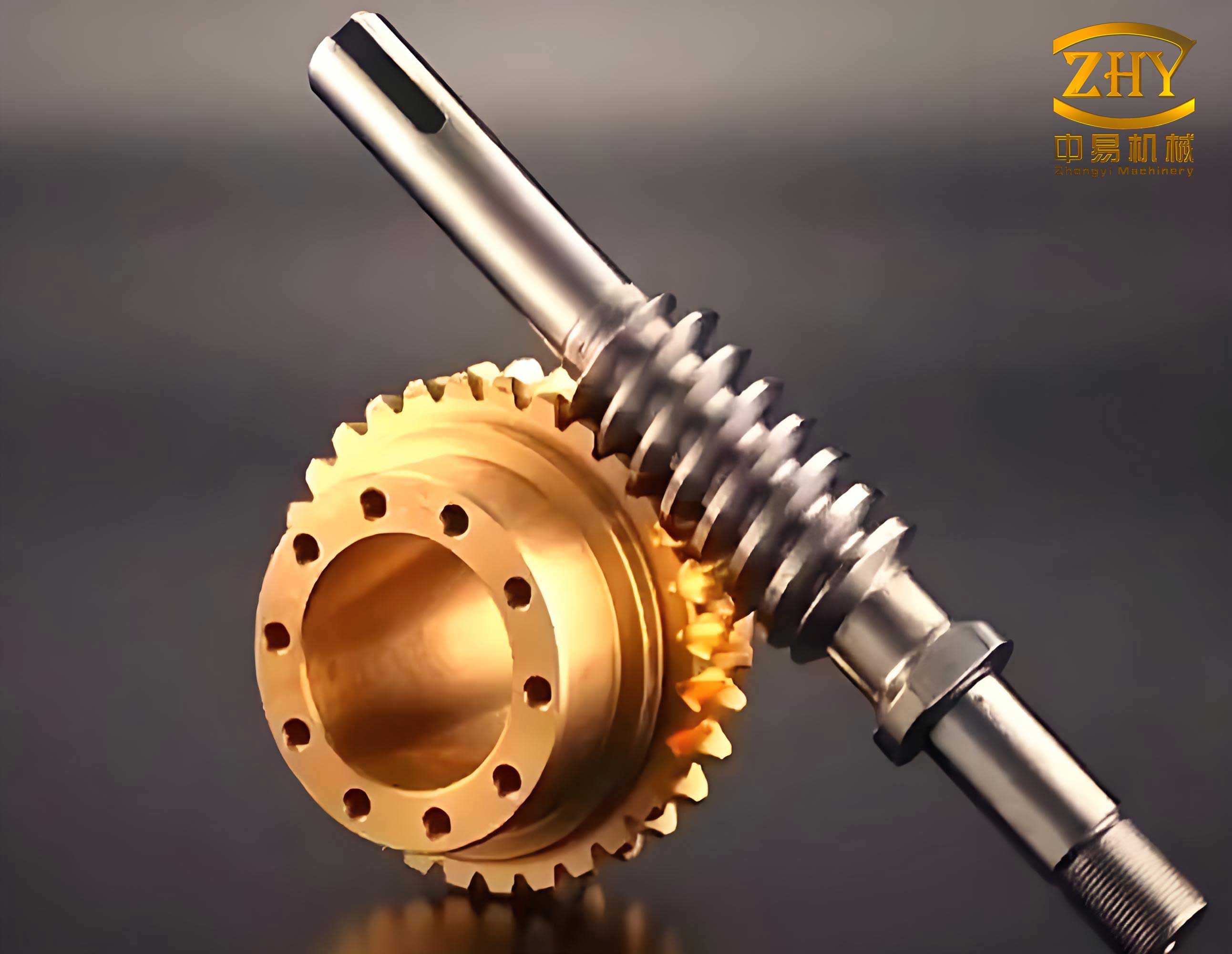
The adoption of double-lead screw gear systems in CNC rotary tables and indexing heads is driven by several compelling advantages:
1. Minimized Backlash: The backlash can be adjusted to remarkably small values, typically in the range of 0.01–0.015 mm. In contrast, conventional worm gears struggle to achieve less than 0.03–0.08 mm without risk of binding. This minimal play is crucial for high-precision angular positioning.
2. Superior Adjustment Method: Standard gears often require radial adjustment of the worm to set clearance, which unavoidably changes the center distance. This is theoretically undesirable as it can degrade tooth contact and accelerate wear. The double-lead system uses axial adjustment, preserving the optimal center distance.
3. Precise and Reliable Adjustment: Backlash adjustment is achieved by machining or installing precision spacers (adjusting rings), offering accurate, controllable, and stable setting. Radial adjustment in standard pairs is less precise and can introduce misalignment.
4. Relaxed Assembly Tolerances: The worm assembly is designed to be fixed, with the primary requirement being the alignment of its axis with the central plane of the worm wheel. The center distance tolerance can be slightly放宽, as the final meshing clearance is set via the axial spacer, a flexibility not available with ordinary screw gear pairs.
However, these benefits come with notable manufacturing complexities. The primary disadvantage lies in the more complicated machining process for the double-lead worm. Turning and grinding the left and right flanks require two different sets of change gears in the machine’s feed chain to generate the two distinct, often non-standard, lead values. Calculating these gear trains for non-integer leads can be tedious. Similarly, the hob used to cut the worm wheel must be specially designed with corresponding parameters for each flank to ensure correct mating geometry with the unique worm.
Survey, Measurement, and Parameter Determination Process
A practical case involved a 12-inch indexing table from a high-speed broaching machine, which had been in service for over two decades. A decline in the machining accuracy of titanium alloy components was traced back to excessive wear in the indexing mechanism’s screw gear assembly. Replacement parts were prohibitively expensive and had long lead times, making repair the only viable option. The first and most critical step was to reverse-engineer the worn components through careful survey and calculation to ascertain the original design parameters.
Initial inspection confirmed the worm had a single start (Z1=1) and the worm wheel had 60 teeth (Z2=60). The worm’s outside diameter (da1) measured approximately Ø59.28 mm, and the worm wheel’s throat diameter (da2) was Ø261.56 mm. Using a profile projector, the axial tooth form was confirmed to be straight, identifying it as an Archimedean (straight-sided) worm. The tooth profile angle (α) was measured as 14°30′ on both flanks.
The most crucial measurements were the axial pitches on the left and right flanks of the worm. This was performed using a pitch measurement instrument, recording the cumulative distance from a reference point for several teeth on each flank. The raw data is summarized below:
| Left Flank Cumulative Distance (mm) | Left Flank Pitch (mm) | Right Flank Cumulative Distance (mm) | Right Flank Pitch (mm) |
|---|---|---|---|
| 93.760 (Ref) | — | 92.473 (Ref) | — |
| 80.327 | 13.433 | 79.257 | 13.216 |
| 66.942 | 13.385 | 66.049 | 13.208 |
| 53.565 | 13.377 | 52.838 | 13.211 |
| 40.161 | 13.404 | 39.612 | 13.226 |
| 26.778 | 13.383 | 26.400 | 13.212 |
| 13.388 | 13.390 | 13.208 | 13.192 |
| Average Pitch: 13.395 mm | Average Pitch: 13.211 mm |
From these pitch measurements, the next step was to determine the fundamental design system: module, diametral pitch, or circular pitch. Calculations based on the worm wheel’s throat diameter yielded:
$$ m = \frac{d_{a2}}{Z_2 + 2} = \frac{261.56}{60 + 2} \approx 4.219 \text{ mm (Module)} $$
$$ DP = \frac{Z_2 + 2}{d_{a2}} \times 25.4 \approx 6.02 \text{ (Diametral Pitch)} $$
$$ CP = \frac{d_{a2}}{(Z_2 + 2)} \times \pi \approx 13.24 \text{ mm (Circular Pitch)} $$
The value closest to a standard was DP=6, corresponding to a module of m = 25.4 / 6 = 4.2333 mm. This was identified as the nominal module for the double-lead screw gear pair, serving as the reference for calculating common parameters like the nominal pitch diameter.
Based on the survey, the complete set of design parameters was calculated. It is essential to understand the distinction between nominal, left-flank, and right-flank parameters in a double-lead system.
| Parameter | Symbol | Value / Formula | Notes |
|---|---|---|---|
| Center Distance | a | 152.400 mm | Measured |
| Nominal Axial Pitch | Px_nom | π × m = π × 4.2333 ≈ 13.299 mm | Reference value |
| Nominal Module | m | 4.2333 mm | From DP=6 |
| Worm Diameter Factor | q | d1 / m | See below |
| Worm Nominal Pitch Diameter | d1 | 2a – da2 + 2m ≈ 50.800 mm | Calculated from geometry |
| Worm Outside Diameter | da1 | 59.28 mm | Measured |
| Left Flank Axial Pitch | Pxl | 13.395 mm | Measured average |
| Left Flank Module | ml | Pxl / π ≈ 4.262 mm | Derived |
| Right Flank Axial Pitch | Pxr | 13.211 mm | Measured average |
| Right Flank Module | mr | Pxr / π ≈ 4.205 mm | Derived |
The lead angles differ for each flank due to the different modules. They are calculated on the nominal pitch diameter (d1):
$$ \text{Left Flank Lead Angle: } \lambda_l = \arctan\left(\frac{P_{xl}}{\pi d_1}\right) = \arctan\left(\frac{m_l \cdot Z_1}{d_1}\right) = \arctan\left(\frac{4.262}{50.800}\right) \approx 4^\circ 48′ $$
$$ \text{Right Flank Lead Angle: } \lambda_r = \arctan\left(\frac{P_{xr}}{\pi d_1}\right) = \arctan\left(\frac{m_r \cdot Z_1}{d_1}\right) = \arctan\left(\frac{4.205}{50.800}\right) \approx 4^\circ 44′ $$
A key performance metric for a double-lead screw gear is the backlash adjustment sensitivity (η), which represents the amount of backlash eliminated per unit of axial worm movement. It can be approximated by the difference in the normal pitches of the two flanks. The normal pitch (Pn) is related to the axial pitch by the lead angle (λ): Pn = Px cos λ. For small lead angles, cos λ ≈ 1, so a simpler approximation is:
$$ \eta \approx \frac{|P_{xl} – P_{xr}|}{2} = \frac{|13.395 – 13.211|}{2} \approx 0.092 \text{ mm} $$
A more precise calculation considering the normal plane gives a slightly different value, but this approximation is useful for initial adjustment estimates. For the worm wheel, the pitch diameter is d2 = 2a – d1 = 254.000 mm. The nominal tooth thickness on the worm wheel’s reference circle is St2 = π m / 2 ≈ 6.650 mm.
The successful restoration of the indexing table hinged on this rigorous survey and calculation process. The worm wheel was refurbished by skiving or shaving its teeth to restore the profile, and a new matching double-lead worm was manufactured based on the calculated parameters. During assembly, the worm was axially positioned using precisely machined spacers to achieve the optimal, minimal backlash. This approach restored the table’s indexing error from over 40 arc-seconds to within 15 arc-seconds, solving the production issue at a fraction of the cost and time required for a new unit.
This case underscores several critical lessons for working with precision double-lead screw gear systems. Measurements must be taken from the least worn sections of the teeth, and multiple data points should be averaged to mitigate local wear effects. Identifying the correct design standard (module, DP, CP) is fundamental. One must remember that for a double-lead worm, the nominal module is a computational reference, while the actual cutting and meshing are governed by the two distinct flank modules. The relationship between axial movement and backlash reduction is a defining characteristic of this type of screw gear. Mastering these principles enables effective repair, replication, and maintenance of high-precision rotary equipment, ensuring their longevity and sustained accuracy in demanding applications like aerospace component machining, where such indexing mechanisms are indispensable.
The mathematical modeling of such a system can be extended further. For instance, the effective normal pressure angle on each flank, though designed to be equal, can be verified. The contact ratio and load distribution analysis for a double-lead screw gear is more complex than for a standard worm gear due to the asymmetric leads. The axial force generated during adjustment, and the resulting thrust bearing requirements, can be modeled. The stiffness of the meshing varies slightly with axial adjustment, a factor considered in ultra-precision systems. The wear pattern on a double-lead worm tends to be different, often showing more uniform wear across the active profile if adjusted periodically, compared to a fixed single-lead worm where wear localizes. Understanding these nuances is key for the life-cycle management of these sophisticated mechanical elements.