
In the field of mechanical transmission systems, the study of mismatched screw gear drives, particularly worm and gear pairs that are not conjugate, has traditionally relied on physical assembly and testing methods. Typically, this involves applying pigment to the worm, assembling the drive, and running it to observe the contact patterns on the gear tooth surface. These patterns indicate the meshing quality; if poor, the gear must be re-machined, and the process repeated. This trial-and-error approach demands numerous iterations, adjustments to machining and assembly parameters, and consumes substantial resources, time, and cost. To address these challenges, virtual simulation technology offers a transformative alternative. By creating a digital replica of the manufacturing and assembly process, researchers can observe, evaluate, and modify procedures in a virtual environment, validating feasibility without physical waste. This article presents a comprehensive virtual simulation system developed using Pro/E4.0’s robust parametric modeling and mechanism simulation capabilities, coupled with VC++6.0 for secondary development. The system meticulously emulates actual factory processes, enabling detailed analysis of tooth surface contact in mismatched screw gear drives through computer-generated contact spots and cross-sectional views. By adjusting machining parameters virtually, optimal meshing conditions can be achieved, guiding practical production with significant efficiency gains.
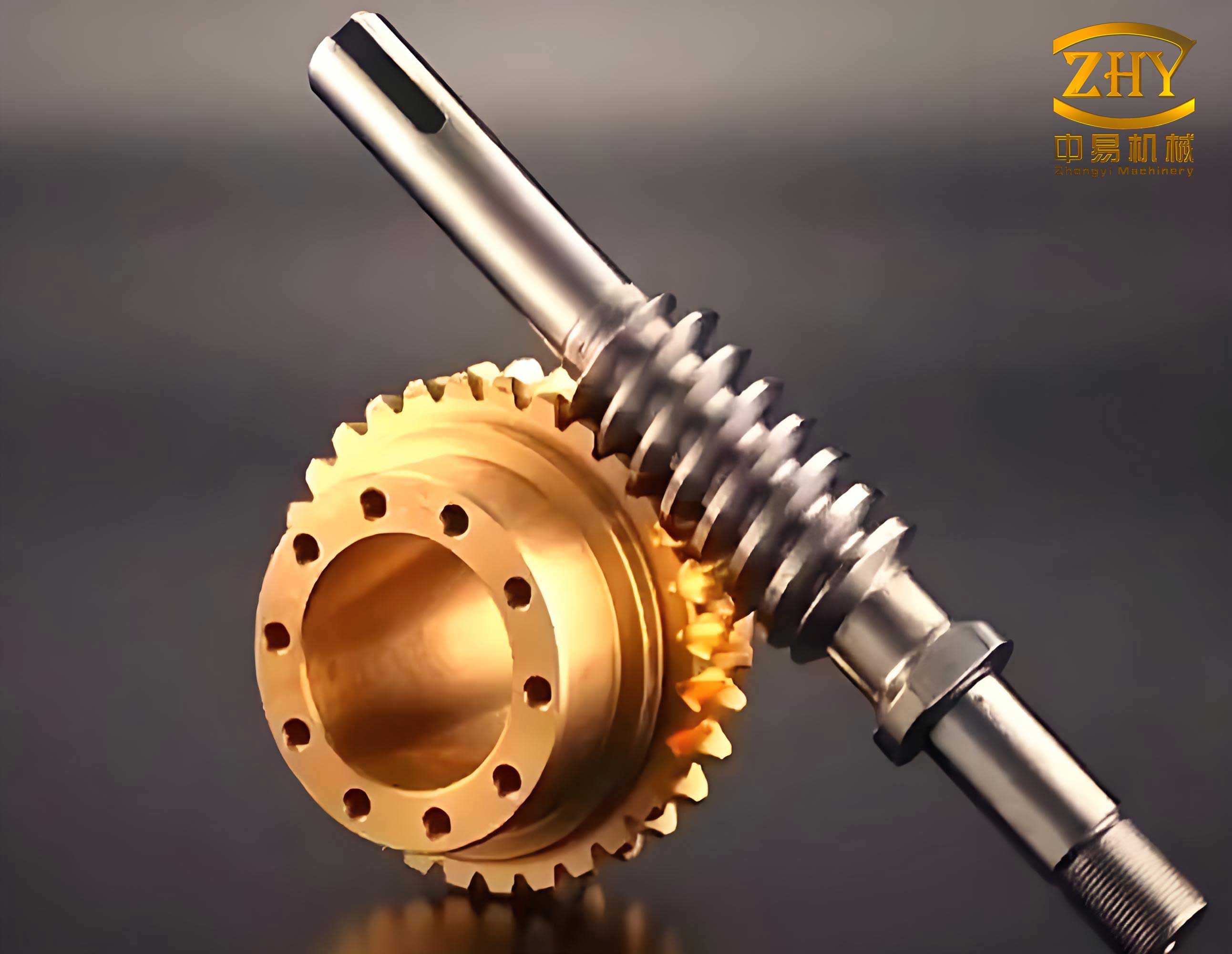
The core of this study revolves around understanding the meshing principles of mismatched screw gear drives. A screw gear drive typically consists of a worm (screw) and a gear wheel, where the worm has a helical thread that engages with the gear teeth. In mismatched or non-conjugate pairs, the tooth surfaces are not perfectly complementary, leading to complex contact conditions that affect performance, noise, and wear. The fundamental goal is to ensure that at the contact points, the relative velocity direction between the tooth surfaces facilitates the formation of a lubricating oil wedge. This requires maximizing the normal curvature in the direction of relative motion on both tooth surfaces. Mathematically, this involves analyzing the geometry and kinematics of the screw gear pair. For a given worm—here, a three-start conical enveloping worm—and a gear machined by a single-start normal straight-edged hob, key parameters must be derived from meshing theory. The hob’s lead angle, axial module, and axial pressure angle are critical for generating the gear tooth surface. The basic equations governing these parameters are as follows:
The lead angle of the hob, denoted as $\lambda_0$, is calculated from the worm’s parameters:
$$ \lambda_0 = \arcsin\left(\frac{m d_0}{\cos \lambda_1}\right) $$
where $m$ is the axial module of the worm, $d_0$ is the pitch diameter of the hob, and $\lambda_1$ is the lead angle of the worm. The axial module of the hob, $m_0$, relates to its geometry:
$$ m_0 = d_0 \tan \lambda_0 $$
The axial pressure angle of the hob, $\alpha_0$, must satisfy the meshing condition with the worm’s axial pressure angle $\alpha_1$:
$$ \tan \alpha_0 \cos \lambda_0 = \tan \alpha_1 \cos \lambda_1 $$
Using these equations, the parameters for the mismatched screw gear drive can be computed. For instance, in a practical case study, the worm is a left-handed three-start conical enveloping type with a pitch diameter of 13.5 mm, axial module of 1.25 mm, and lead angle of $15^\circ 31′ 27”$. The hob has a pitch diameter of 20 mm. Substituting values yields the hob’s lead angle, axial module, and pressure angle. These parameters are essential for designing the hob and setting up the virtual machining process. A summary of the derived parameters is presented in the table below, which encapsulates the geometric specifications for both the worm and the gear hob, crucial for subsequent modeling and simulation of the screw gear system.
| Component | Type | Number of Starts/Teeth | Axial Module (mm) | Pitch Diameter (mm) | Pressure Angle (°) | Lead Angle |
|---|---|---|---|---|---|---|
| Worm | Conical Enveloping | 3 | 1.25 | 13.5 | 20 | 15°31’27” |
| Hob | Normal Straight-Edged | 1 | 1.217 (actual) | 20 | 19.3046 | 3°29’19” |
| Gear | Machined by Hob | 36 | — | 45.0 | — | — |
To achieve optimal meshing in a mismatched screw gear drive, the tooth surfaces should have high normal curvature in the direction of relative motion, promoting oil wedge formation. This curvature condition can be expressed using differential geometry principles. For a point on the worm surface $\mathbf{r}_1(u,v)$ and gear surface $\mathbf{r}_2(s,t)$, the relative velocity $\mathbf{v}_{12}$ at the contact point must be considered. The normal curvature $\kappa_n$ in the direction of $\mathbf{v}_{12}$ is given by the second fundamental form of the surface. Maximizing $\kappa_n$ ensures better lubricant entrapment, reducing friction and wear. This theoretical foundation guides the virtual simulation, where adjustments to machining parameters aim to enhance this curvature property in the screw gear pair.
The virtual simulation methodology involves several steps: parametric modeling of the worm, parametric modeling of the hob, virtual machining of the gear, and assembly with motion simulation. Using Pro/E4.0, I developed parametric models for both the worm and hob by defining key geometric parameters as variables. For the three-start conical enveloping worm, parameters such as number of starts, axial module, pressure angle, lead angle, grinding wheel radius, and pitch diameter are input via a program. The worm blank is created through extrusion, and the tooth profile is generated using curve equations derived from the worm geometry. The axial profile and transition curves are defined mathematically. For instance, the worm’s helical surface can be described by parametric equations involving the lead and profile angles. A single helical tooth is formed by sweeping the profile along a helical path, and arraying this creates the full worm model. Similarly, for the single-start normal straight-edged hob, parameters like normal module, normal pressure angle, and lead angle are used to build a parametric model. The hob’s tooth profile is based on the gear’s required geometry, ensuring it can machine the three-start gear correctly. The virtual machining process mimics actual hobbing: the hob is positioned at a specific center distance and tilt angle relative to the gear blank, and through simulated cutting motions, the gear teeth are generated. This process highlights the flexibility of virtual simulation, allowing rapid iteration of machining parameters without physical waste.
In the virtual environment, the screw gear assembly is simulated using Pro/E’s Mechanism module. The worm and gear are assembled with appropriate constraints, and motion is applied to observe meshing behavior. To analyze contact patterns, I implemented a method to “paint” contact spots on the gear tooth surface, analogous to physical testing. Additionally, cross-sectional views are taken at contact points along the direction of relative velocity to examine the tooth profile geometry. By varying machining parameters—especially the hob tilt angle during gear cutting—different meshing conditions can be studied. The theoretical hob tilt angle, calculated as $\lambda_1 – \lambda_0$, is approximately $12.07^\circ$ for this screw gear set. However, deviations from this angle affect contact patterns. In the simulation, I explored cases with tilt angles of $9.3^\circ$, $12.07^\circ$, and $12.5^\circ$, while keeping the center distance fixed at 32.5 mm. For each case, contact spots and normal cross-sections are generated, providing visual insight into the meshing quality. The results show that at the theoretical tilt angle, contact occurs near the mid-height of the gear tooth, favoring oil wedge formation. At smaller or larger angles, contact shifts toward the edges or forms sharp contacts, which are detrimental. This demonstrates how virtual simulation enables precise adjustment of screw gear machining parameters to achieve optimal meshing.
The contact analysis for the mismatched screw gear drive reveals critical insights into meshing performance. At a hob tilt angle of $12.07^\circ$, the contact patches are centrally located on the gear tooth flank, as seen in the virtual simulation. This central contact promotes the formation of a hydrodynamic oil wedge because the relative motion of the worm carries lubricant into the engagement zone, reducing direct metal-to-metal contact. The normal cross-section at the contact point shows smooth, conforming profiles, indicating good curvature matching. In contrast, at a tilt angle of $9.3^\circ$, the contact patches appear near the tooth root or tip, leading to edge loading. The cross-sectional view reveals a mismatch in profiles, with sharp corners that could cause stress concentrations and increased wear. Similarly, at $12.5^\circ$, the contact shifts to the opposite edge, again resulting in poor lubrication conditions. These variations highlight the sensitivity of screw gear meshing to machining alignment. The virtual simulation allows quantifying these effects by analyzing the contact area size and location. For instance, the contact patch area can be estimated from the simulation data, and larger, centrally located patches correlate with better performance. This analysis underscores the importance of precise hob setup in manufacturing screw gear drives, and the virtual system provides a tool to determine the optimal parameters without physical trials.
To further elaborate, the mathematical modeling of tooth contact in screw gear drives involves complex geometry. The worm surface, being a conical enveloping type, can be represented by equations derived from the grinding process. Suppose the grinding wheel has a radius $R_g$ and is set at an angle $\gamma$. The worm surface coordinates $\mathbf{r}_1(u, \theta)$ are functions of the axial parameter $u$ and rotation angle $\theta$. For the gear surface generated by the hob, the coordinates $\mathbf{r}_2(\phi, \psi)$ depend on the hob rotation $\phi$ and gear rotation $\psi$. The meshing condition requires that at contact points, the surfaces are tangent, i.e., their normals are collinear. This leads to the meshing equation: $f(u, \theta, \phi) = 0$. Solving this equation numerically in the simulation yields the contact paths on the gear tooth. The relative curvature at contact points influences the pressure distribution and lubrication. The effective curvature radius $\rho_{eff}$ can be computed as:
$$ \frac{1}{\rho_{eff}} = \frac{1}{\rho_1} + \frac{1}{\rho_2} $$
where $\rho_1$ and $\rho_2$ are the principal radii of curvature for the worm and gear surfaces, respectively. Maximizing $\rho_{eff}$ in the direction of sliding reduces contact stress. The virtual simulation calculates these curvatures for different parameter sets, guiding design improvements. For example, by adjusting the hob’s pressure angle or the worm’s lead angle, the curvature mismatch can be minimized, enhancing the screw gear’s load capacity and efficiency.
The virtual simulation system also enables study of dynamic effects in screw gear drives. By incorporating mass properties and applying loads, the motion simulation can predict vibrations and noise. The contact force between teeth can be plotted over time, revealing fluctuations that indicate meshing imperfections. For the mismatched screw gear, dynamic analysis shows that optimal machining parameters reduce force variations, leading to smoother operation. This is crucial for applications requiring low noise and high precision. Additionally, thermal effects can be considered by modeling heat generation from friction at contact points. The virtual environment allows integrating thermal analysis to predict temperature rises and their impact on gear geometry and lubrication. Such comprehensive simulations are invaluable for advancing screw gear technology, especially in demanding industries like automotive and aerospace.
In terms of practical implementation, the parametric modeling approach using Pro/E and VC++ offers high flexibility. The user interface developed with VC++ allows input of key screw gear parameters through dialog boxes, automating the generation of 3D models. For instance, inputting the worm’s number of starts, module, and pressure angle instantly creates the worm model. Similarly, the hob parameters yield the hob model. This automation accelerates the design process and reduces errors. The virtual machining module simulates the hobbing process by calculating tool paths based on gear theory. The hob’s position and orientation are controlled by the center distance $a$ and tilt angle $\beta$. The gear tooth surface is generated as the envelope of the hob’s cutting edges. Mathematically, this is described by the equation of meshing between the hob and gear blank. The simulation solves this equation step-by-step, producing the gear geometry. This virtual machining is computationally intensive but provides accurate results without material cost. It also allows testing of non-standard configurations, such as using a single-start hob to cut a multi-start gear, which is common in mismatched screw gear production.
The benefits of virtual simulation for screw gear analysis extend beyond contact optimization. It facilitates educational and training purposes, allowing students and engineers to explore gear mechanics interactively. Moreover, it supports research into novel screw gear designs, such as those with modified tooth profiles for reduced backlash or improved efficiency. By simulating various lubricant conditions, the system can assess the impact on wear life. For example, varying the oil viscosity in the simulation changes the fluid film thickness between teeth, affecting contact patterns. This holistic approach makes virtual simulation a powerful tool for screw gear development.
To quantify the improvements achieved through virtual simulation, consider the reduction in physical trials. Traditionally, optimizing a mismatched screw gear drive might require 5-10 iterations of machining and testing, each taking days and costing significant resources. With virtual simulation, the same optimization can be done in hours, with no material waste. The table below summarizes key performance metrics comparison between traditional and virtual methods for screw gear development, highlighting efficiency gains.
| Aspect | Traditional Physical Testing | Virtual Simulation Approach |
|---|---|---|
| Time per iteration | 2-3 days | 1-2 hours |
| Cost per iteration | High (materials, labor) | Low (computational) |
| Resource consumption | Significant (metal, energy) | Negligible |
| Parameter adjustment ease | Difficult (requires re-machining) | Easy (software input) |
| Contact visualization | Indirect (paint spots) | Direct (computer graphics) |
In conclusion, the virtual simulation system for mismatched screw gear drives offers a robust platform for analyzing tooth contact and optimizing meshing conditions. By leveraging parametric modeling and motion simulation, it replicates real-world manufacturing and assembly processes, enabling detailed study of contact patterns and profile geometry. The key findings indicate that machining parameters, particularly the hob tilt angle, critically influence meshing quality. The theoretical tilt angle derived from meshing equations yields central contact patches that favor lubrication and reduce wear. Deviations from this angle lead to edge contacts, compromising performance. This virtual approach eliminates the need for repetitive physical trials, saving time, resources, and costs. It also enhances understanding of screw gear mechanics through mathematical analysis and visual feedback. Future work could integrate advanced finite element analysis for stress prediction and extend the simulation to other types of screw gear drives, such as double-enveloping or cylindrical worm gears. Overall, virtual simulation represents a significant advancement in screw gear technology, facilitating efficient design and production of high-performance transmission systems.
The mathematical framework underlying this simulation is rooted in gear theory and differential geometry. For screw gear drives, the geometry of the worm and gear surfaces determines the kinematic and contact characteristics. The worm surface, as a helical surface, can be expressed parametrically. Let the worm axis be the z-axis. The surface equation for a conical enveloping worm is:
$$ \mathbf{r}_1(u, \theta) = \begin{bmatrix} (r_0 + u \tan \gamma) \cos \theta \\ (r_0 + u \tan \gamma) \sin \theta \\ p \theta + u \end{bmatrix} $$
where $r_0$ is the base radius, $\gamma$ is the cone angle, $p$ is the helix parameter (lead per radian), $u$ is the axial parameter, and $\theta$ is the rotation angle. The gear surface generated by hobbling is derived from the envelope of the hob’s cutting edges. If the hob is modeled as a rack-type cutter, its surface equation is simpler. The meshing condition between hob and gear blank involves the relative velocity and surface normals. After gear generation, the contact analysis between worm and gear requires solving the meshing equation for the two surfaces in contact. This equation ensures that at the contact point, the normal vectors are perpendicular to the relative velocity vector:
$$ \mathbf{n} \cdot \mathbf{v}_{12} = 0 $$
where $\mathbf{n}$ is the common normal vector, and $\mathbf{v}_{12}$ is the relative velocity. Solving this numerically across the tooth surfaces yields the contact lines, which appear as spots under load. The simulation computes these lines for various positions, generating the contact pattern. Additionally, the curvature analysis involves calculating the principal curvatures $\kappa_1$ and $\kappa_2$ for both surfaces. The normal curvature in the direction of relative motion, $\kappa_n$, is given by Euler’s formula:
$$ \kappa_n = \kappa_1 \cos^2 \varphi + \kappa_2 \sin^2 \varphi $$
where $\varphi$ is the angle between the direction vector and the first principal direction. Maximizing $\kappa_n$ enhances oil wedge formation, as discussed. The virtual simulation automates these calculations, providing quantitative data to guide design adjustments. This mathematical rigor ensures that the virtual results are reliable and applicable to real screw gear systems.
Furthermore, the simulation system can be extended to include tolerance analysis. Manufacturing imperfections, such as errors in center distance or hob alignment, affect meshing. By introducing random variations in parameters within tolerance limits, the simulation can predict the statistical distribution of contact patterns, aiding in quality control. This Monte Carlo approach helps design robust screw gear drives that perform well despite manufacturing variances. For instance, if the center distance varies by ±0.1 mm, the simulation shows how contact patches shift, informing tolerance specifications. Such analyses are cumbersome physically but straightforward virtually, demonstrating the versatility of the system.
In summary, this article detailed a comprehensive virtual simulation methodology for mismatched screw gear drives, emphasizing contact analysis and optimization. Through parametric modeling, virtual machining, and motion simulation, the system enables in-depth study of meshing behavior without physical prototypes. The integration of mathematical models, tables, and formulas provides a solid foundation for understanding screw gear mechanics. The repeated focus on screw gear throughout the text underscores its importance in transmission design. The virtual approach not only saves resources but also accelerates innovation, making it an indispensable tool for engineers and researchers working with screw gear technology.