
In the field of mechanical power transmission, screw gear systems, particularly worm drives, play a crucial role due to their high reduction ratios and compact design. However, the lubrication performance of these screw gear mechanisms significantly influences their wear resistance, efficiency, and susceptibility to scuffing failures. This study focuses on the thermal elastohydrodynamic lubrication (TEHL) analysis of an inclined double-roller enveloping hourglass worm drive, a novel screw gear configuration designed to enhance lubrication and anti-scuffing capabilities. We aim to explore the lubricant film thickness distribution under non-Newtonian fluid conditions, specifically using the Ree-Eyring fluid model, to provide insights into optimizing the screw gear design for improved performance.
The inclined double-roller enveloping hourglass worm drive, a type of screw gear, consists of a steel worm and a worm wheel with circumferentially arranged rollers. Each half of the worm wheel features rollers that are offset from the mid-plane and inclined at an angle relative to the radial direction, allowing the rollers to rotate about their own axes. The worm’s left and right tooth surfaces mesh with the rollers of the two halves, respectively. A slight backlash exists between the single row of rollers and the worm tooth surface to ensure proper operation and lubrication, while an automatic backlash adjustment mechanism maintains continuous contact by adjusting the misalignment angle between the two worm wheel halves, eliminating transmission error. This screw gear design aims to reduce friction and improve load distribution.
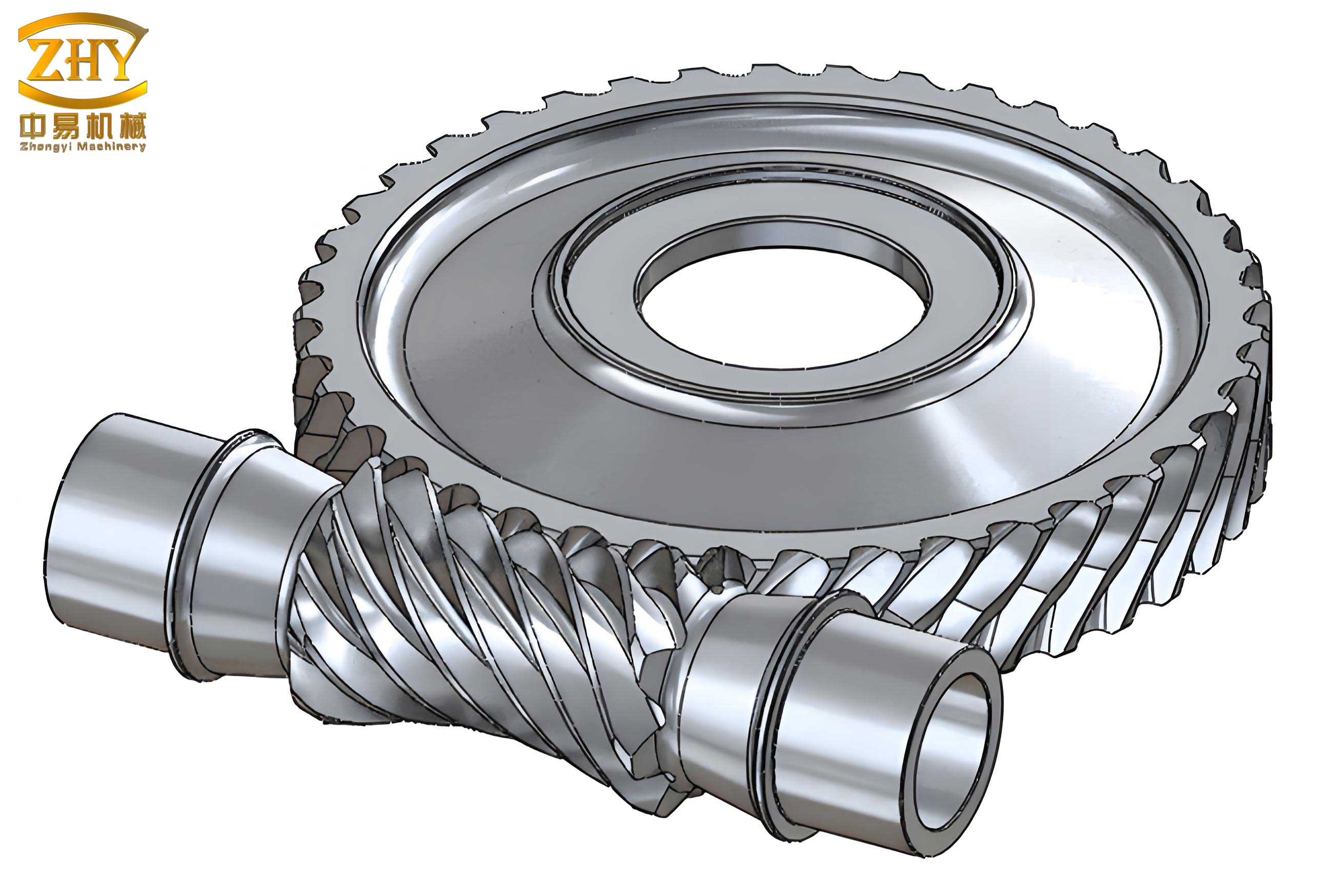
To analyze the lubrication characteristics of this screw gear system, we establish an elastohydrodynamic lubrication (EHL) model based on line contact theory. The meshing between the worm and rollers is simplified to a contact between a cylindrical roller and a plane, representing the equivalent geometry at any instantaneous contact point along the meshing line. This approach is valid due to the varying curvature and velocities along the contact line in screw gear transmissions. The equivalent radius of curvature \( R_{\sigma} \) at a contact point is derived from the induced normal curvature, and the entrainment velocity \( v_{jx} \) and slide-to-roll ratio \( S \) are calculated based on the velocity components along the contact normal direction. The load per unit length \( w \) is determined using simplified load distribution methods, accounting for multi-tooth engagement in the screw gear.
The mathematical model for TEHL analysis employs the Ree-Eyring fluid, which accounts for non-Newtonian behavior under high shear rates, common in screw gear contacts. The minimum film thickness formula for line contact TEHL, derived from numerical regression of full thermal solutions, is given by:
$$H_{\text{min}} = C C_U C_{WS} C_{RS} H_{\text{minso}}$$
where \( H_{\text{min}} \) is the dimensionless minimum film thickness, and \( H_{\text{minso}} \) is the corresponding isothermal minimum film thickness:
$$H_{\text{minso}} = 2.62 U^{0.7125} G^{0.53} W^{-0.16}$$
The thermal correction factors are defined as:
$$C_U = \frac{1}{1 + 2.2 \times 10^4 U^{0.5}}$$
$$C_{WS} = 1 – 1.037 \times 10^4 W^2 + 2.117 \times 10^4 W S$$
$$C_{RS} = e^{-0.041 S – 0.05 (1 + 5 R_z) (\ln R_z + 3)}$$
Here, \( U \), \( G \), and \( W \) are dimensionless parameters for speed, material, and load, respectively, defined as:
$$U = \frac{\eta_0 v_{jx}}{E’ R_{\sigma}}, \quad G = \alpha E’, \quad W = \frac{w}{E’ R_{\sigma}}$$
where \( \eta_0 \) is the ambient viscosity, \( \alpha \) is the pressure-viscosity coefficient, \( E’ \) is the equivalent elastic modulus, and \( R_{\sigma} \) is the equivalent radius of curvature. The slide-to-roll ratio \( S \) is computed as \( S = 2 (v_{\sigma}^{(2)} – v_{\sigma}^{(1)}) / (v_{\sigma}^{(2)} + v_{\sigma}^{(1)}) \), with \( v_{\sigma}^{(1)} \) and \( v_{\sigma}^{(2)} \) being the velocity projections along the contact normal for the worm and roller, respectively. The dimensional minimum film thickness \( h_{\text{min}} \) is obtained from \( h_{\text{min}} = H_{\text{min}} R_{\sigma} \).
For data processing, we normalize the parameters to generalize the analysis. The equivalent elastic modulus \( E’ \) is calculated using:
$$\frac{1}{E’} = \frac{1}{2} \left( \frac{1 – \mu_1^2}{E_1} + \frac{1 – \mu_2^2}{E_2} \right)$$
where \( \mu_1 \), \( E_1 \) and \( \mu_2 \), \( E_2 \) are the Poisson’s ratios and elastic moduli of the worm and roller materials, respectively. The load distribution along the contact line is discretized into points, assuming steady-state conditions for each point to apply the TEHL formulas. This simplification is justified as the screw gear transmission involves slowly varying parameters along the meshing line.
We analyze the lubrication performance over an entire meshing cycle for a screw gear with the following geometric and material parameters: worm number of starts \( z_1 = 1 \), worm wheel teeth number \( z_2 = 25 \), center distance \( A = 125 \, \text{mm} \), throat diameter coefficient \( k_1 = 0.4 \), roller radius \( R = 6.5 \, \text{mm} \), roller offset \( c_2 = 7 \, \text{mm} \), and inclination angle \( \gamma = 6^\circ \). The material properties are: worm Poisson’s ratio \( \mu_1 = 0.26 \), elastic modulus \( E_1 = 210 \, \text{GPa} \); roller Poisson’s ratio \( \mu_2 = 0.29 \), elastic modulus \( E_2 = 207 \, \text{GPa} \). The lubricant has a pressure-viscosity coefficient \( \alpha = 1.6 \times 10^{-8} \, \text{m}^2/\text{N} \) and ambient viscosity \( \eta_0 = 0.08 \, \text{Pa·s} \).
The distribution of the minimum film thickness, both isothermal and thermal, along the meshing line from engagement to disengagement is plotted against the worm wheel rotation angle \( \phi_2 \). The results indicate that the minimum film thickness decreases initially, reaches a minimum near the worm throat region, and then increases towards the disengagement point. This pattern highlights the throat area as a critical zone for lubrication failure in this screw gear system. The thermal effects reduce the film thickness compared to the isothermal case due to temperature rise from frictional heating, emphasizing the importance of TEHL analysis in screw gear design.
To further investigate the influence of design parameters on the lubrication performance of the screw gear, we conduct a sensitivity analysis on the TEHL minimum film thickness with respect to roller radius, roller offset, throat diameter coefficient, and inclination angle. The variations are summarized in the table below, which shows the impact of each parameter on the minimum film thickness at the throat region (where it is lowest) and overall trend.
| Parameter | Range | Effect on TEHL Minimum Film Thickness | Remarks for Screw Gear Design |
|---|---|---|---|
| Roller Radius (\( R \)) | 5.5 mm to 7.5 mm | Decreases with increasing \( R \), but rate of decrease diminishes. | Smaller rollers promote better lubrication; avoid excessively large rollers. |
| Roller Offset (\( c_2 \)) | 5 mm to 9 mm | Increases with increasing \( c_2 \), more pronounced near throat. | Larger offset improves film thickness; avoid too small offsets. |
| Throat Diameter Coefficient (\( k_1 \)) | 0.3 to 0.5 | Increases significantly with increasing \( k_1 \). | Higher \( k_1 \) enhances lubrication; crucial parameter for screw gear optimization. |
| Inclination Angle (\( \gamma \)) | 3° to 12° | Minor variations, within 0.3 μm range. | Negligible impact on lubrication; can be set based on other design constraints. |
The sensitivity analysis reveals that the roller radius and throat diameter coefficient have the most substantial impact on the TEHL minimum film thickness in this screw gear system. Specifically, a larger roller radius reduces the film thickness, making it harder to maintain a protective lubricant layer, while a larger throat diameter coefficient increases the film thickness, favoring better lubrication. The roller offset has a moderate effect, with larger offsets improving film thickness, especially in critical regions. The inclination angle shows minimal influence, indicating that it can be optimized for other performance metrics without compromising lubrication.
To delve deeper into the mathematical underpinnings, we derive the equivalent radius of curvature \( R_{\sigma} \) from the induced normal curvature \( k_{\sigma}^{(12)} \) of the screw gear mesh. For the inclined double-roller enveloping hourglass worm drive, the curvature relationship is given by:
$$R_{\sigma} = \frac{1}{k_{\sigma}^{(12)}}$$
where \( k_{\sigma}^{(12)} \) is computed based on the gear geometry and meshing theory. The entrainment velocity \( v_{jx} \) is expressed as:
$$v_{jx} = \frac{v_{\sigma}^{(1)} + v_{\sigma}^{(2)}}{2}$$
and the slide-to-roll ratio \( S \) as:
$$S = \frac{2(v_{\sigma}^{(2)} – v_{\sigma}^{(1)})}{v_{\sigma}^{(2)} + v_{\sigma}^{(1)}}$$
These velocities depend on the screw gear kinematics, including the worm rotation speed and the relative motion between the worm and rollers. For a given screw gear configuration, we can calculate these values at discrete points along the contact line to evaluate the local lubrication conditions.
The load per unit length \( w \) is estimated using a simplified method that assumes equal load sharing among simultaneously engaged tooth pairs in the screw gear, adjusted for the contact line length. This approach, while approximate, provides a reasonable basis for comparative analysis. The total transmitted torque is distributed based on the number of contact points and their positions, with the normal load at each point derived from the force equilibrium.
In addition to the TEHL analysis, we consider the effects of non-Newtonian fluid behavior using the Ree-Eyring model. The Ree-Eyring fluid characteristic time \( \tau_0 \) influences the shear-thinning response, which is relevant for high-pressure contacts in screw gear systems. The dimensionless parameters in the film thickness formula incorporate this through the regression coefficients derived from numerical solutions. This makes the analysis more accurate than Newtonian fluid assumptions, especially for screw gear applications where shear rates are high.
We also explore the implications of these findings for screw gear design and operation. For instance, to prevent scuffing and wear, it is essential to maintain a sufficient lubricant film thickness in the throat region of the worm. Based on our results, designers should prioritize smaller roller radii and larger throat diameter coefficients to enhance lubrication. Additionally, the roller offset should not be too small, as it contributes to film thickness improvement. These adjustments can significantly boost the efficiency and durability of screw gear transmissions.
Further, we discuss the limitations of our model. The assumption of steady-state conditions at each contact point may not fully capture transient effects in screw gear meshing, but it provides a good approximation for initial design evaluation. Future work could involve dynamic TEHL simulations to account for time-varying loads and speeds in screw gear systems. Moreover, experimental validation of the film thickness predictions would strengthen the conclusions.
To illustrate the computational process, we present a step-by-step example for calculating the TEHL minimum film thickness at a specific contact point in the screw gear. Suppose at a given worm wheel angle \( \phi_2 = 10^\circ \), we have the following values: equivalent radius \( R_{\sigma} = 15 \, \text{mm} \), entrainment velocity \( v_{jx} = 0.5 \, \text{m/s} \), load per unit length \( w = 500 \, \text{N/mm} \), and slide-to-roll ratio \( S = 0.8 \). Using the material and lubricant properties earlier, we compute:
$$E’ = \left[ \frac{1}{2} \left( \frac{1 – 0.26^2}{210 \times 10^9} + \frac{1 – 0.29^2}{207 \times 10^9} \right) \right]^{-1} \approx 2.08 \times 10^{11} \, \text{Pa}$$
$$U = \frac{0.08 \times 0.5}{2.08 \times 10^{11} \times 0.015} \approx 1.28 \times 10^{-11}$$
$$G = 1.6 \times 10^{-8} \times 2.08 \times 10^{11} \approx 3328$$
$$W = \frac{500 \times 10^3}{2.08 \times 10^{11} \times 0.015} \approx 1.60 \times 10^{-4}$$
Then, the isothermal minimum film thickness is:
$$H_{\text{minso}} = 2.62 \times (1.28 \times 10^{-11})^{0.7125} \times 3328^{0.53} \times (1.60 \times 10^{-4})^{-0.16} \approx 1.05 \times 10^{-4}$$
The thermal correction factors are:
$$C_U = \frac{1}{1 + 2.2 \times 10^4 \times (1.28 \times 10^{-11})^{0.5}} \approx 0.95$$
$$C_{WS} = 1 – 1.037 \times 10^4 \times (1.60 \times 10^{-4})^2 + 2.117 \times 10^4 \times (1.60 \times 10^{-4}) \times 0.8 \approx 1.002$$
$$C_{RS} = e^{-0.041 \times 0.8 – 0.05 (1 + 5 \times 0.015) (\ln 0.015 + 3)} \approx 0.92$$
Assuming \( C = 1 \) for simplification, the dimensionless TEHL minimum film thickness is:
$$H_{\text{min}} = 1 \times 0.95 \times 1.002 \times 0.92 \times 1.05 \times 10^{-4} \approx 9.2 \times 10^{-5}$$
Finally, the dimensional minimum film thickness is:
$$h_{\text{min}} = 9.2 \times 10^{-5} \times 0.015 \, \text{m} \approx 1.38 \, \mu \text{m}$$
This example demonstrates how the film thickness can be evaluated at any point in the screw gear mesh, aiding in identifying critical regions.
Moreover, we emphasize the importance of screw gear lubrication in industrial applications. Screw gear systems are widely used in robotics, automotive steering, and heavy machinery, where reliability and efficiency are paramount. By optimizing the design parameters based on TEHL analysis, manufacturers can produce screw gear drives that operate with lower friction, reduced wear, and longer service life. This not only saves maintenance costs but also enhances the performance of the overall mechanical system.
In conclusion, our thermal elastohydrodynamic lubrication analysis of the inclined double-roller enveloping hourglass worm drive, a specialized screw gear, provides valuable insights into its lubrication performance. Based on the Ree-Eyring fluid model, we find that the minimum film thickness varies along the meshing line, with the throat region being the most critical. Parameter sensitivity analysis indicates that roller radius and throat diameter coefficient have the greatest impact on film thickness, while inclination angle has minimal effect. To ensure good lubrication in this screw gear, it is recommended to avoid excessively large roller radii and too small roller offsets or throat diameter coefficients. These findings contribute to the design and optimization of screw gear transmissions for improved durability and efficiency. Future research could extend this work to include mixed lubrication regimes and experimental validation under dynamic operating conditions.