
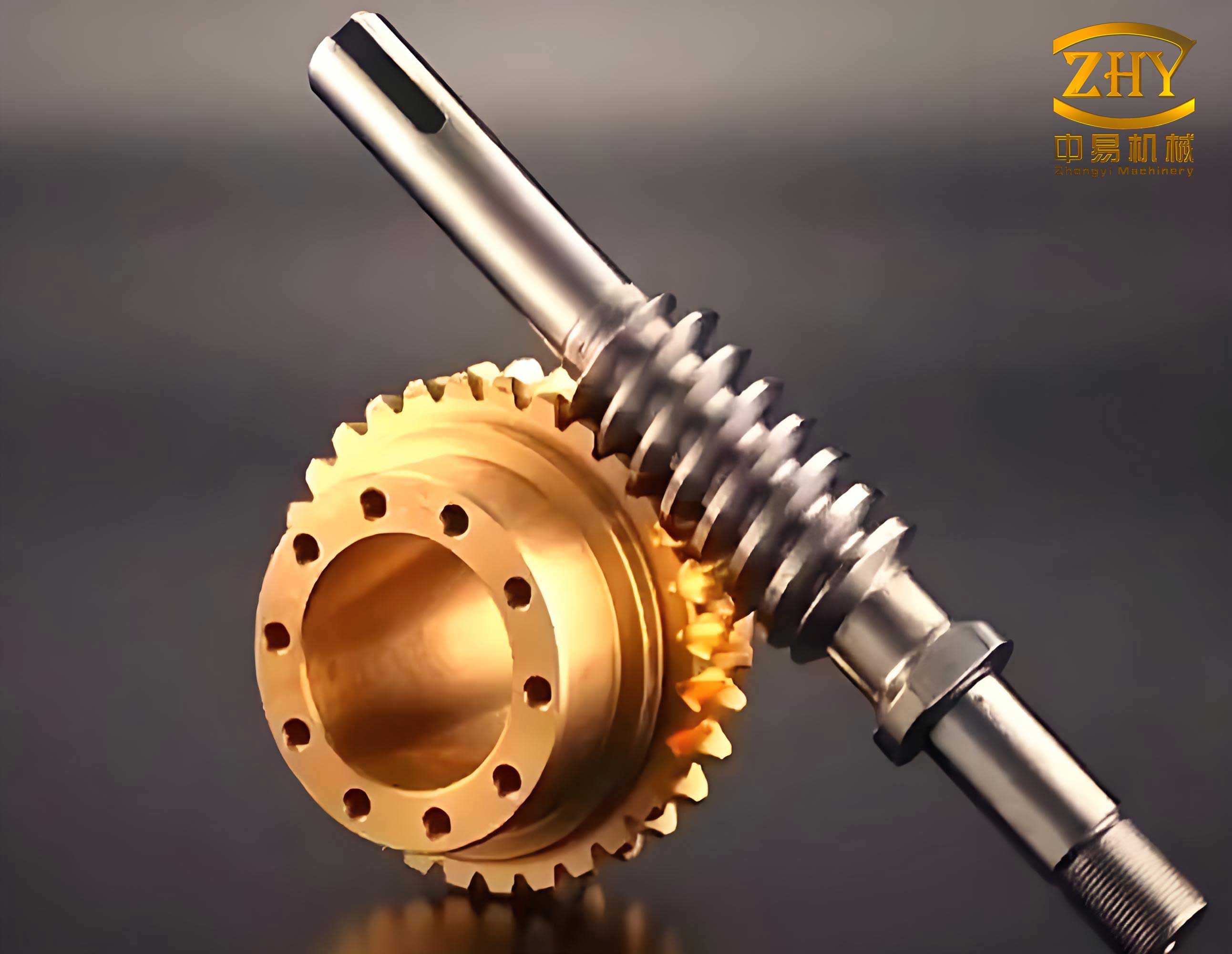
The pursuit of advanced power transmission solutions is a constant driver in modern mechanical engineering. Designers are perpetually challenged to create systems that deliver high torque within compact envelopes, all while achieving near-zero backlash, high precision, excellent stiffness, and superior reliability. Applications such as robotics, aerospace actuators, and precision machinery place a premium on these characteristics. Among various gear types, screw gears, particularly worm drives, have long been valued for their inherent ability to provide high reduction ratios, compactness, and smooth, quiet operation due to their line contact and sliding action. The quest to enhance these attributes has led to the exploration of novel geometries and meshing principles. This article delves into a specific, advanced variant: the planar enveloping internal meshing screw gear drive. This configuration aims to retain the classic advantages of enveloping worm drives while introducing unique benefits like potential multi-output capability and power-split functionality, making it a compelling subject for in-depth analysis. The core of its performance lies in the quality of tooth contact, which directly governs load capacity, stress distribution, and efficiency. Therefore, understanding how key design parameters influence the contact zone is fundamental to its successful design and application.
Fundamental Principles and Mathematical Foundation
The geometry of the planar enveloping internal meshing screw gear is defined by a generation process. A planar tool (the generating plane) performs a defined relative motion with respect to the worm wheel blank, enveloping the shape of the worm. In the internal meshing configuration, the worm wheel encircles the worm. To mathematically describe this geometry and its meshing action, we establish a series of coordinate systems based on gear meshing theory. The following systems are defined, facilitating the transformation of points between the moving components:
- S1(O1; i1, j1, k1): Static coordinate system fixed to the worm shaft.
- S1′(O1′; i1′, j1′, k1′): Moving coordinate system rigidly connected to the worm, rotating with angular velocity ω1 about k1′.
- S2(O2; i2, j2, k2): Static coordinate system fixed to the worm wheel shaft.
- S2′(O2′; i2′, j2′, k2′): Moving coordinate system rigidly connected to the worm wheel, rotating with angular velocity ω2 about k2′. The transmission ratio is i12 = ω1/ω2 = z2/z1, where z1 and z2 are the number of threads/starts on the worm and teeth on the worm wheel, respectively.
- S0(O0; i0, j0, k0): A coordinate system attached to the generating plane Σ. The j0 and k0 axes lie within this plane, and its origin O0 is located on a defined “main base circle” with radius r. In system S2′, its position vector is r0 = (0, r, 0).
- Sp(Op; e1, e2, n): A local coordinate system at the potential contact point P on the generating plane. Here, e1 is parallel to k0, e2 is parallel to j0, and n is the unit normal to the plane. The coordinates of P in S0 are given by rp = (0, u, v).
The worm wheel’s axis is installed at a specific angle, known as the installation or axial crossing angle, denoted by δF, relative to the worm’s axis. The generating plane itself is tilted by an angle β relative to the worm wheel’s axis. The central distance between the two axes is A. The fundamental coordinate transformation from the worm wheel system S2′ to the worm system S1′ is given by the matrix M2’1′:
$$ \mathbf{M_{2’1′}} = \mathbf{M_{1’1}} \cdot \mathbf{M_{12}} \cdot \mathbf{M_{22′}} = \begin{bmatrix} f_{11} & f_{12} & f_{13} & f_{14} \\ f_{21} & f_{22} & f_{23} & f_{24} \\ f_{31} & f_{32} & f_{33} & f_{34} \\ 0 & 0 & 0 & 1 \end{bmatrix} $$
Where the elements f_ij are functions of the angles φ1 (worm rotation), φ2 (worm wheel rotation), δF, and A. For instance:
$$ f_{11} = \cos φ_1 \cos φ_2 + \sin φ_1 \sin φ_2 \sin δ_F $$
$$ f_{12} = \sin δ_F \cos φ_2 \sin φ_1 – \cos φ_1 \sin φ_2 $$
$$ f_{13} = -\cos δ_F \sin φ_1 $$
$$ f_{14} = A \cos φ_1 $$
$$ f_{31} = \cos δ_F \sin φ_2 $$
$$ f_{33} = \sin δ_F $$
The condition for continuous contact between two gear surfaces is expressed by the meshing equation, which states that the relative velocity vector at the contact point must be perpendicular to the common surface normal. For our screw gear system, this equation Φ in the S0 system is derived as:
$$ Φ = \mathbf{v_{1’2′}^{(0)}} \cdot \mathbf{n^{(0)}} = 0 $$
Where n(0) = (0, 0, 1) is the normal to the generating plane in S0. The components of the relative velocity v1’2′ in S0 are complex functions of the geometric parameters and motion variables:
$$
\begin{aligned}
v_x^{(0)} &= \sin β [\cos δ_F \cos φ_2 (u + A \cos φ_2) + \cos δ_F \sin φ_2 (A \sin φ_2 + r \sin β)] + \cos β [(u + A \cos φ_2)(-i_{12} \sin δ_F) + \cos φ_2 \cos β \cos δ_F \sin φ_2 – A i_{12} \cos φ_2 + v \cos δ_F \cos φ_2] \\
v_y^{(0)} &= \sin φ_2 [A i_{12} – i_{12} \sin δ_F (A \sin φ_2 + r \sin β) + \cos β \cos δ_F \cos φ_2] – (A \sin φ_2 + r \sin β) \\
v_z^{(0)} &= \sin β [ (u + A \cos φ_2)(-i_{12} \sin δ_F) + \cos φ_2 \cos β \cos δ_F \sin φ_2 – A i_{12} \cos φ_2 + v \cos δ_F \cos φ_2] + \cos β [\cos δ_F \cos φ_2 (u + A \cos φ_2) + \cos δ_F \sin φ_2 (A \sin φ_2 + r \sin β)]
\end{aligned}
$$
Since n(0) = (0, 0, 1), the meshing equation simplifies to Φ = v_z^(0) = 0. The worm tooth surface is the locus of all contact lines generated as the worm and wheel rotate. A point on the worm surface in its moving system S1′ is found by transforming a point from the generating plane (in S0) through the wheel (S2′) and finally to the worm, while simultaneously satisfying the meshing equation:
$$ \mathbf{r_1^{(1′)}(u, φ_2)} = \mathbf{M_{2’1′}} \cdot \mathbf{M_{02′}} \cdot \mathbf{r_p^{(0)}} $$
$$ \text{Subject to: } Φ(u, v, φ_2) = v_z^{(0)} = 0 $$
$$ \text{and } φ_1 = i_{12} φ_2, \quad 0 < φ_2 < 2π $$
Similarly, the worm wheel tooth surface, which is simply the conjugate envelope of the generating plane, can be described in its system S2′:
$$ \mathbf{r_2^{(2′)}(u,v)} = u \mathbf{i_0} + (r – v \sin β) \mathbf{j_0} + (v \cos β) \mathbf{k_0} $$
$$ \text{where } Φ(u, v, φ_2) = 0 \text{ for a specific } φ_2 $$
Parametric Influence on the Contact Zone
The distribution and shape of the contact lines on the tooth flanks are critical indicators of the meshing performance for these screw gears. A well-distributed contact zone improves load sharing, reduces localized stress, enhances lubrication, and increases longevity. To analyze this, we project the spatial contact lines onto the worm wheel tooth surface for visualization. The radial and axial coordinates on the wheel tooth are:
$$ R = \sqrt{(x^{(2′)})^2 + (y^{(2′)})^2} $$
$$ Z = v \cos β $$
We define key dimensionless coefficients common in worm gear design: the worm pitch circle coefficient k1 = d1 / A (where d1 is the worm pitch diameter) and the main base circle coefficient kb = r / A. The effective face width B of the worm wheel tooth on the projection plane is related to the theoretical width b by B ≈ b / cos β. A systematic numerical analysis, solving the meshing equation and coordinate transformations for varying parameters, reveals their distinct influence.
1. Influence of Center Distance (A): The center distance primarily scales the gear set. Analysis for values from 100mm to 400mm, holding other parameters constant (i12=1/40, β=24°, δF=35°, k1=0.38, kb=0.56), shows that while the absolute size changes, the pattern of contact line distribution relative to the tooth profile remains consistent. The contact lines typically progress from the root towards the tip as meshing proceeds from entry to exit, with the longest lines occurring in the central region of the tooth. This suggests that center distance is a scaling factor rather than a primary modifier of contact quality for this type of screw gear.
2. Influence of Transmission Ratio (i12): The transmission ratio has a profound impact. The following table summarizes the study parameters and the observed trend.
| Parameter | Case 1 | Case 2 | Case 3 | Case 4 |
|---|---|---|---|---|
| Center Distance, A (mm) | 100 | 100 | 100 | 100 |
| Transmission Ratio, i12 | 1/10 | 1/20 | 1/30 | 1/40 |
| Generating Plane Angle, β (°) | 24 | 24 | 24 | 24 |
| Wheel Rotation, φ2 (°) | 90 | 90 | 90 | 90 |
| Axial Crossing Angle, δF (°) | 35 | 35 | 35 | 35 |
The analysis clearly indicates that larger transmission ratios (i.e., higher reduction ratios) result in longer and more uniformly distributed contact lines across the tooth face. This implies that screw gears designed with higher ratios inherently have a larger potential contact area, which theoretically translates to higher load-carrying capacity and improved meshing performance, a significant advantage for applications requiring substantial speed reduction.
3. Influence of Generating Plane Angle (β): The tilt of the generating plane is a crucial design parameter. The analysis, with parameters from the table below, shows a sensitive relationship.
| Parameter | Case 1 | Case 2 | Case 3 | Case 4 |
|---|---|---|---|---|
| Generating Plane Angle, β (°) | 10 | 20 | 30 | 40 |
| Center Distance, A (mm) | 100 | 100 | 100 | 100 |
| Transmission Ratio, i12 | 1/40 | 1/40 | 1/40 | 1/40 |
When β exceeds approximately 36°-40°, the contact zone deteriorates significantly. The contact lines cluster heavily towards one corner (e.g., the upper-left corner) of the worm wheel tooth, leaving a substantial portion of the flank unloaded. This leads to poor stress distribution and drastically reduced load capacity. Conversely, very small angles may lead to other geometric constraints. Therefore, for optimal performance in these internal meshing screw gears, the generating plane angle β should be selected within a moderate range, typically between 18° and 36°.
4. Influence of Worm Wheel Rotation (φ2): The parameter φ2 defines the specific angular position on the worm wheel used for defining the meshing action and effectively selects which portion of the full theoretical envelope forms the active tooth flank of the internal screw gear. The internal meshing characteristic is most pronounced not at the start of engagement (φ2 near 0°), but at a later phase. Analysis of different starting points for φ2 reveals a critical threshold.
| Parameter | Case 1 | Case 2 | Case 3 | Case 4 |
|---|---|---|---|---|
| Wheel Rotation, φ2 (°) | 70 | 80 | 90 | 100 |
| Center Distance, A (mm) | 100 | 100 | 100 | 100 |
| Transmission Ratio, i12 | 1/40 | 1/40 | 1/40 | 1/40 |
For values of φ2 less than 90°, the initial contact lines often fail to project onto a usable portion of the worm wheel tooth, indicating partial and inefficient tooth engagement. To achieve the characteristic internal wrapping form with good contact distribution, the active meshing zone for these screw gears should be defined starting from a worm wheel rotation angle in the range of 90° up to approximately 138°. Beyond 138°, the geometry tends to degenerate towards an end-face meshing type, losing the desired enveloping characteristic.
5. Influence of Axial Crossing Angle (δF): The installation angle δF between the worm and wheel axes is pivotal. The investigation, summarized below, shows its effect on contact pattern.
| Parameter | Case 1 | Case 2 | Case 3 | Case 4 |
|---|---|---|---|---|
| Axial Crossing Angle, δF (°) | 10 | 20 | 30 | 40 |
| Center Distance, A (mm) | 100 | 100 | 100 | 100 |
| Generating Plane Angle, β (°) | 24 | 24 | 24 | 24 |
For angles δF below 30°, the contact pattern is confined to a small region (e.g., the upper-left quadrant) of the tooth flank, which is undesirable. Furthermore, for a practical design where the worm wheel shaft is located outside the physical body of the worm, geometric interference limits the maximum usable angle to about 54°. Angles below 30° can also present assembly challenges. Consequently, the recommended optimal range for the axial crossing angle in planar enveloping internal meshing screw gears is between 30° and 54°.
6. Influence of Worm Pitch Circle and Main Base Circle Coefficients (k1, kb): The analysis was extended to the standard design coefficients k1 and kb, varied within their typical ranges (k1: 0.33-0.38, kb: 0.5-0.67). The results indicate that these parameters have a relatively minor influence on the overall distribution and pattern of the contact zone compared to i12, β, and δF. While they affect absolute dimensions and curvature, their impact on the fundamental quality of the contact pattern for these screw gears is secondary. This allows designers some flexibility in selecting these coefficients based on strength, stiffness, or manufacturing considerations without drastically compromising the meshing performance established by the primary angles.
Discussion and Synthesis for Optimal Screw Gear Design
The parametric study reveals a hierarchy of influence. The transmission ratio (i12), the generating plane angle (β), and the worm wheel rotation range (φ2) are the dominant factors shaping the contact zone in planar enveloping internal meshing screw gears. The axial crossing angle (δF) is also highly significant, while the center distance and the standard coefficients (k1, kb) play more secondary, scaling roles. A synthesis of the findings leads to the following design guidance for achieving a favorable contact pattern:
- Prioritize a higher transmission ratio within the application’s requirements to naturally extend the contact lines.
- Select the generating plane angle β between 18° and 36°.
- Define the active tooth flank from a worm wheel rotation φ2 starting between 90° and 138° to harness the true internal enveloping geometry.
- Set the axial crossing angle δF between 30° and 54° to balance good contact distribution with practicality and avoid interference.
This optimized contact behavior is foundational for achieving the potential benefits of this screw gear architecture. Furthermore, the internal meshing configuration opens unique possibilities. By employing two or more worm wheels meshing with the same worm—each potentially engaging slightly different flank sectors—it becomes feasible to create a system that inherently minimizes or eliminates backlash through pre-loading. This multi-output capability also enables power-splitting across several load paths, enhancing torque density and system reliability. The mathematical models and contact analysis provided here serve as the essential theoretical groundwork for designing, modeling, and ultimately manufacturing high-performance planar enveloping internal meshing screw gears for demanding mechanical applications.