
In the realm of precision machining, especially within five-axis machining centers, the double swivel head—often referred to as a fork-type milling head or five-axis head—plays a pivotal role. This component enables complex spatial rotations through A and C axes, complementing linear X, Y, and Z motions to achieve intricate five-coordinate machining. Historically, such technology was dominated by foreign manufacturers, but recent advancements have allowed domestic development to catch up, particularly in mechanical double swivel heads designed for heavy-duty cutting. A critical aspect of these heads is the transmission system for the A and C axes, which often relies on screw gears, specifically worm gear mechanisms, to provide high torque and precision. However, a significant challenge in screw gear systems is backlash—the undesirable clearance between mating gears that accumulates over time due to wear, leading to reduced accuracy and repeatability. In this article, I will delve into the anti-backlash structures employed in screw gears for mechanical double swivel heads, drawing from my extensive experience in designing and optimizing these systems for high-performance applications.
The mechanical double swivel head integrates multiple drive systems within a compact space: a main motor for spindle rotation, swing motors for A-axis motion, and a rotary motor for C-axis motion. The A and C axes typically utilize screw gear drives, where a worm (a screw-like gear) engages with a worm wheel to convert rotational motion into precise angular displacement. These screw gears must handle substantial loads—often up to 7,000 N·m of drive torque—while maintaining resolutions as fine as 0.001°. To achieve this, backlash must be minimized or eliminated. Traditional screw gear designs suffer from inherent friction and wear, causing gradual increases in clearance. This is unacceptable for high-precision machining, where even micron-level errors can compromise part quality. Therefore, innovative anti-backlash mechanisms are essential.
One effective anti-backlash solution I have implemented involves a split-worm design, which allows for adjustable axial clearance. This mechanism consists of two primary components: a sleeve worm and a core shaft worm, which together form the complete screw gear. The sleeve worm has an internal bore that accommodates the core shaft worm, and both are fixed together to create a continuous helical tooth profile that meshes with the worm wheel. At each end, bearings are installed, and adjustment shims are placed to control axial positioning. Over time, as wear occurs and backlash increases, the thickness of these shims can be modified to push the worm axially, thereby reducing the gap between the screw gear teeth and the worm wheel. This maintains optimal meshing conditions, ensuring smooth operation, low noise, and high transmission accuracy.
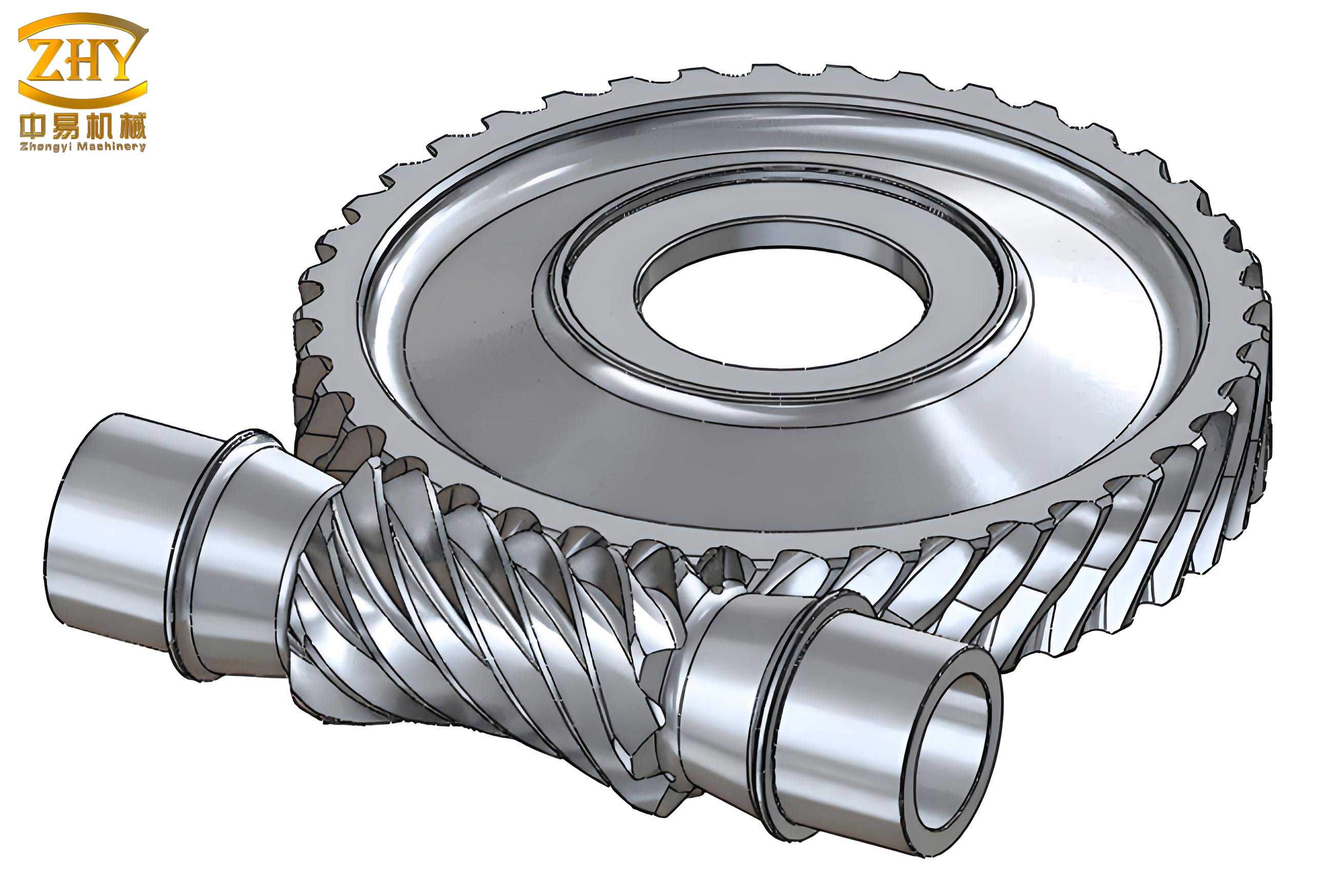
The principle behind this adjustability can be expressed mathematically. Consider the axial displacement $\Delta x$ required to compensate for wear-induced backlash $b$ in a screw gear system. For a worm with lead $L$ and pressure angle $\alpha$, the relationship between axial movement and angular backlash reduction is given by:
$$ \Delta x = \frac{b \cdot L}{2\pi \cdot \cos(\alpha)} $$
where $b$ is the measured backlash in radians, and $\cos(\alpha)$ accounts for the gear geometry. In practice, the adjustment shim thickness $t$ is set to equal $\Delta x$ to achieve zero backlash. This formula underscores the precision needed in designing screw gear systems, as even small wear can necessitate precise adjustments. For instance, in a double swivel head with a screw gear lead of 10 mm and a pressure angle of 20°, a backlash of 0.001 rad would require an axial adjustment of approximately:
$$ \Delta x = \frac{0.001 \times 0.01}{2\pi \cdot \cos(20^\circ)} \approx 1.7 \times 10^{-6} \, \text{m} $$
This minute adjustment highlights the need for high-quality materials and manufacturing tolerances in screw gears.
To further illustrate, let’s examine the key parameters of a typical mechanical double swivel head utilizing screw gears. The table below summarizes the specifications, emphasizing the role of screw gears in achieving high performance.
| Parameter | Value | Role of Screw Gears |
|---|---|---|
| Spindle Power | 28 / 43 kW | Screw gears transmit torque for A/C axes |
| Max Spindle Speed | 5,600 rpm | Independent of screw gear performance |
| Max Spindle Torque | 638 / 971 N·m | Complemented by high-torque screw gears |
| A/C Axis Speed | 25°/s | Screw gears enable precise angular motion |
| A/C Axis Resolution | 0.001° | Anti-backlash screw gears ensure accuracy |
| A/C Drive Torque | 7,000 N·m | Screw gears handle heavy loads |
| A/C Clamping Torque | 20,000 N·m | Screw gears contribute to locking mechanisms |
| Screw Gear Type | Worm and worm wheel | Key component for motion transmission |
The design of screw gears in such applications must account for multiple factors, including material selection, lubrication, and thermal expansion. For example, the wear resistance of screw gears can be enhanced by using hardened steel or bronze alloys. The contact stress between the worm and worm wheel is critical and can be calculated using Hertzian contact theory. For a screw gear pair, the maximum contact pressure $p_{\text{max}}$ is given by:
$$ p_{\text{max}} = \sqrt{\frac{F}{\pi \cdot b \cdot \left(\frac{1-\nu_1^2}{E_1} + \frac{1-\nu_2^2}{E_2}\right)}} $$
where $F$ is the normal load, $b$ is the face width of the gear, $\nu$ is Poisson’s ratio, and $E$ is the modulus of elasticity for the two materials. This stress must be kept below the material’s endurance limit to prevent premature failure. In my designs, I often use finite element analysis to optimize screw gear geometry, ensuring even load distribution and minimal backlash.
Another aspect of screw gear systems in double swivel heads is the integration with clamping mechanisms. The A and C axes often feature hydraulic or mechanical clamps to lock positions during heavy cuts, with torques up to 20,000 N·m. The screw gears must withstand these forces without deformation. The anti-backlash adjustment mechanism, such as the split-worm design, interacts with these clamps to maintain precision. For instance, when the clamp is engaged, it exerts a force that could slightly shift the screw gear; however, the adjustable shims allow for compensation, ensuring that backlash remains negligible even under load.
Beyond the double swivel head, screw gear principles apply to other precision tools, such as grinding fixtures for gear machining. In automotive gear production, a common process involves grinding the inner bore after heat treatment, using an elastic membrane disk fixture that locates the gear via its involute tooth profile. This fixture relies on precise centering to ensure the bore’s coaxiality with the gear teeth, indirectly relating to screw gear accuracy because the positioning rollers in the fixture mimic gear meshing. The fixture’s design involves calculating the membrane’s deformation to apply uniform clamping force, similar to how screw gears must evenly distribute loads. The clamping force $F_c$ can be derived from membrane theory:
$$ F_c = \frac{E \cdot t^3 \cdot \delta}{12(1-\nu^2) \cdot R^2} $$
where $E$ is the elastic modulus, $t$ is membrane thickness, $\delta$ is deflection, $\nu$ is Poisson’s ratio, and $R$ is the effective radius. This equation highlights the interplay between elasticity and precision, akin to screw gear adjustments.
To further explore screw gear performance, consider the efficiency of a worm drive, which is typically lower than other gear types due to sliding friction. The efficiency $\eta$ of a screw gear set can be approximated by:
$$ \eta = \frac{\tan(\lambda)}{\tan(\lambda + \phi)} $$
where $\lambda$ is the lead angle of the worm, and $\phi$ is the friction angle. For high-precision screw gears, minimizing friction is crucial to reduce wear and backlash. I often recommend using advanced lubricants with anti-wear additives, and in some cases, incorporating ceramic coatings on screw gear teeth to enhance durability. The table below compares different screw gear materials and their impact on backlash and efficiency.
| Material | Hardness (HRC) | Wear Rate (mm³/N·m) | Efficiency Gain | Backlash Control |
|---|---|---|---|---|
| Hardened Steel | 58-62 | 1.2 × 10⁻⁶ | High | Good |
| Bronze Alloy | 25-30 | 2.5 × 10⁻⁶ | Medium | Excellent |
| Ceramic-Coated Steel | 65+ | 0.8 × 10⁻⁶ | Very High | Outstanding |
| Polymer Composite | 15-20 | 5.0 × 10⁻⁶ | Low | Fair |
In practice, the choice of screw gear material depends on the application. For double swivel heads in heavy machining, hardened steel with bronze worm wheels is common due to its balance of strength and wear resistance. However, for high-speed applications, ceramic-coated screw gears offer superior performance, reducing backlash accumulation over time. The anti-backlash mechanism must be compatible with these materials; for instance, adjustment shims should be made of similar materials to avoid differential thermal expansion, which could introduce unwanted clearance.
The design process for screw gears in anti-backlash systems involves iterative calculations. One key formula is the backlash estimation based on wear volume. If the wear volume $V_w$ is known from material tests, the resulting backlash $b$ in linear terms can be estimated as:
$$ b = \frac{V_w}{A \cdot \mu} $$
where $A$ is the contact area, and $\mu$ is the coefficient of friction. This helps in predicting maintenance intervals for screw gear adjustments. In my projects, I use this to schedule shim replacements, ensuring continuous precision. Additionally, the stiffness of the screw gear assembly is critical. The torsional stiffness $k_t$ of a worm drive can be expressed as:
$$ k_t = \frac{G \cdot J}{L} $$
where $G$ is the shear modulus, $J$ is the polar moment of inertia, and $L$ is the effective length. Higher stiffness reduces deflection under load, minimizing dynamic backlash. For double swivel heads, I aim for $k_t$ values above 10⁵ N·m/rad to ensure stability during machining.
Another innovative approach I’ve explored is the use of dual screw gears with preload. This involves two opposing screw gears that apply preload to eliminate backlash entirely. The preload force $F_p$ is calculated to exceed the maximum operational force, ensuring no separation occurs. The required preload can be derived from:
$$ F_p = \frac{T}{r \cdot \eta} + F_{\text{ext}} $$
where $T$ is the torque, $r$ is the pitch radius, $\eta$ is efficiency, and $F_{\text{ext}}$ is external force. While this increases complexity, it offers near-zero backlash, ideal for ultra-precision screw gear systems in aerospace components.
Furthermore, the integration of sensors in screw gear systems allows for real-time backlash monitoring. Strain gauges or encoders can detect minute clearances, triggering automatic adjustments via servo-controlled shims. This adaptive control enhances the longevity of screw gears, especially in environments with variable loads. The feedback loop can be modeled using control theory, where the adjustment $\Delta x$ is a function of measured backlash $b_m$:
$$ \Delta x = K_p \cdot b_m + K_i \int b_m \, dt + K_d \frac{db_m}{dt} $$
where $K_p$, $K_i$, and $K_d$ are PID constants. Such smart screw gear systems represent the future of high-precision machining, reducing manual intervention and maintaining accuracy over extended periods.
In conclusion, screw gears are indispensable in mechanical double swivel heads and other precision machinery, where anti-backlash mechanisms are crucial for achieving sub-degree resolutions and high torque transmission. The split-worm design with adjustable shims provides a reliable solution, backed by mathematical models for wear compensation and stress analysis. Through material selection, lubrication, and innovative designs like dual preloaded screw gears, we can push the boundaries of accuracy. As technology advances, the integration of smart monitoring and adaptive controls will further enhance screw gear performance, enabling more efficient and precise manufacturing processes. My experience in designing these systems has shown that attention to detail—from formula-based calculations to practical adjustments—is key to mastering the art of screw gear engineering.