
As a researcher in the field of tribology and lubricant development, I have been deeply involved in addressing the challenges posed by modern machinery, particularly in high-speed and heavy-load applications. The advent of graphene, a two-dimensional carbon material discovered in 2004, has opened new avenues for enhancing lubricant performance. This material’s unique properties, such as high strength, excellent thermal conductivity, and low shear resistance, make it an ideal candidate for improving the lubrication of critical components like screw gears. Screw gears, commonly used in various industrial systems, are characterized by their compact design, high reduction ratios, and smooth operation. However, they often operate under severe conditions involving sliding friction, which can lead to significant wear, scuffing, and even failure. In this article, I will detail the development process of a graphene-enhanced lubricant specifically designed for screw gears, focusing on the selection of base oils and additives, performance evaluation, and practical applications. The goal is to create a lubricant that not only meets but exceeds the stringent requirements for screw gear systems, ensuring longevity and reliability.
The fundamental challenge in lubricating screw gears stems from their unique friction mechanism. Unlike other gear types, screw gears primarily experience sliding friction between the steel worm and copper gear surfaces. This sliding action generates substantial heat and pressure, necessitating lubricants with exceptional anti-wear, extreme pressure (EP), and oxidation resistance properties. Traditional lubricants often fall short, especially when containing sulfur-phosphorus EP additives that can corrode copper components. Therefore, the development of a specialized lubricant for screw gears requires careful consideration of material compatibility and performance under extreme conditions. Graphene, with its ability to form a protective, shear-friendly film on friction surfaces, offers a promising solution. My research aims to leverage this property by incorporating graphene into a tailored lubricant formulation, ensuring enhanced protection for screw gears in demanding environments.
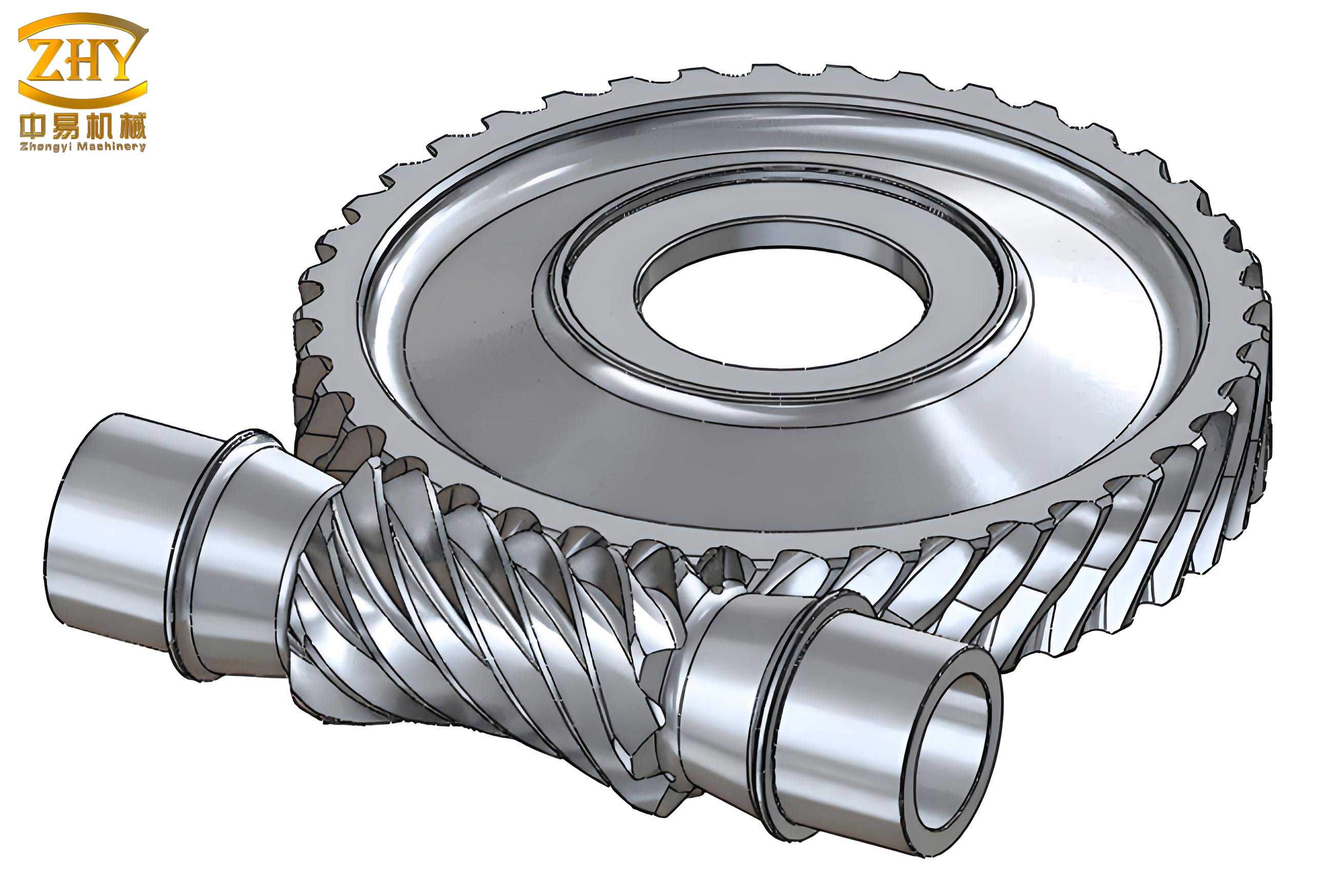
To understand the lubricant requirements for screw gears, it is essential to delve into the tribological principles governing their operation. The friction coefficient in sliding contacts can be described by the equation: $$ \mu = \frac{F_f}{F_n} $$ where $\mu$ is the friction coefficient, $F_f$ is the frictional force, and $F_n$ is the normal load. For screw gears, minimizing $\mu$ is crucial to reduce energy loss and wear. Additionally, the wear rate $W$ can be modeled using Archard’s equation: $$ W = k \frac{P}{H} $$ where $k$ is the wear coefficient, $P$ is the contact pressure, and $H$ is the hardness of the softer material (often copper in screw gears). By introducing graphene, which forms a low-shear film, the effective $k$ can be reduced, thereby extending the lifespan of screw gears. The viscosity-temperature relationship of the lubricant also plays a vital role, as screw gears operate across a range of temperatures. The Vogel-Fulcher-Tammann equation approximates this: $$ \eta = \eta_0 \exp\left(\frac{B}{T – T_0}\right) $$ where $\eta$ is the viscosity, $T$ is temperature, and $\eta_0$, $B$, and $T_0$ are constants. A high viscosity index indicates minimal viscosity change with temperature, which is desirable for screw gears to maintain lubrication under varying operational conditions.
The development process began with the selection of an appropriate base oil. Base oils constitute the primary component of any lubricant, influencing its viscosity, thermal stability, and compatibility with additives. For the target viscosity grade of L-CKE/P 320, I evaluated two candidate base oils: 500SN and 150BS. Their typical properties are summarized in Table 1.
| Property | 500SN | 150BS |
|---|---|---|
| Kinematic Viscosity at 40°C (mm²/s) | 95.1 | 483.1 |
| Kinematic Viscosity at 100°C (mm²/s) | 10.85 | 31.79 |
| Viscosity Index | 98 | 97 |
| Flash Point (Open Cup, °C) | 262 | 322 |
| Pour Point (°C) | -15 | -12.5 |
| Acid Value (mg KOH/g) | 0.01 | 0.01 |
Both oils exhibited good low-temperature performance and viscosity-temperature characteristics, with low acid values indicating minimal corrosiveness. By blending these oils, I achieved a base oil formulation suitable for the screw gear lubricant, providing a balance between fluidity at low temperatures and film strength at high temperatures. This blend is critical for screw gears, which often experience startup in cold conditions and high thermal loads during operation.
Next, I focused on additive selection, starting with extreme pressure (EP) agents. Given the steel-copper friction pairs in screw gears, active sulfur-based EP additives can cause copper corrosion, necessitating the use of non-active sulfur compounds. I screened three sulfur-containing EP additives: non-active sulfur agent A (sulfur content ≥10.0%), active sulfur agent B (sulfur content ≥15.0%, active sulfur ≥4.0%), and non-active sulfur agent C (sulfur content ≥10.0%). The evaluation results are presented in Table 2.
| Property | EP Agent A | EP Agent B | EP Agent C |
|---|---|---|---|
| Copper Strip Corrosion (100°C, 3 h) / Grade | 1a | 1a | 1a |
| Copper Strip Corrosion (121°C, 3 h) / Grade | 1a | 3c | 2a |
| Timken OK Value (N) | 267 | 312 | 223 |
| Four-Ball Wear Scar Diameter (mm) | 0.39 | 0.45 | 0.56 |
EP agent A demonstrated the best anti-copper corrosion performance, with acceptable Timken OK value and wear scar diameter. Thus, I selected it as the primary EP additive for the screw gear lubricant. This choice ensures that the lubricant can withstand high loads without damaging the copper components in screw gears.
To further enhance anti-wear performance, I incorporated graphene as an anti-wear additive. Graphene’s layered structure allows it to adhere to friction surfaces, forming a protective film that reduces direct metal-to-metal contact. I investigated the effect of graphene concentration (dispersed type) on wear performance, with results shown in Table 3. The wear scar diameter was measured using a four-ball tester under standard conditions, simulating the sliding friction in screw gears.
| Graphene Concentration (% Mass Fraction) | Four-Ball Wear Scar Diameter (mm) |
|---|---|
| 1.0 | 0.39 |
| 3.0 | 0.36 |
| 5.0 | 0.25 |
| 7.0 | 0.23 |
The data indicates that a 5.0% mass fraction of graphene significantly reduces wear scar diameter, offering optimal anti-wear protection for screw gears. Beyond this concentration, improvements are marginal, suggesting a saturation effect. The mechanism can be described by a modified wear equation: $$ W = k \frac{P}{H} – \Delta W_g $$ where $\Delta W_g$ represents the wear reduction due to graphene film formation. This additive is particularly beneficial for screw gears, where sliding friction dominates and wear resistance is paramount.
Rust and corrosion prevention is another critical aspect, especially for screw gears operating in humid or corrosive environments. I evaluated three rust inhibitors: dodecenyl succinic acid, a domestic dodecenyl succinate, and an imported dodecenyl succinate. The results, based on synthetic seawater immersion tests, are summarized in Table 4.
| Rust Inhibitor and Concentration (% Mass Fraction) | Liquid Phase Rust Test (Synthetic Seawater) |
|---|---|
| 0.03% Dodecenyl Succinic Acid | Rust Present |
| 0.10% Dodecenyl Succinic Acid | No Rust |
| 0.03% Domestic Dodecenyl Succinate | Rust Present |
| 0.10% Domestic Dodecenyl Succinate | No Rust |
| 0.03% Imported Dodecenyl Succinate | No Rust |
The imported dodecenyl succinate at 0.03% mass fraction provided adequate rust protection, making it suitable for the screw gear lubricant formulation. This ensures that the lubricant can safeguard screw gears against corrosion, extending their service life in challenging conditions.
Oxidation resistance is vital due to the high temperatures generated in screw gear systems. I assessed three composite antioxidants using the rotating oxygen bomb test, which measures oxidation induction time (OIT) at 150°C. Longer OIT indicates better thermal-oxidative stability. The results are presented in Table 5.
| Composite Antioxidant and Concentration (% Mass Fraction) | Oxidation Induction Time at 150°C (min) |
|---|---|
| 0.2% Alkyldiphenylamine/Hindered Phenol | 166 |
| 0.4% Alkyldiphenylamine/Hindered Phenol | 296 |
| 0.5% Alkyldiphenylamine/Hindered Phenol | 337 |
| 0.2% Aromatic Amine/Phenol Derivative | 169 |
| 0.4% Aromatic Amine/Phenol Derivative | 216 |
| 0.5% Aromatic Amine/Phenol Derivative | 232 |
| 0.5% Alkyldiphenylamine/2,6-Di-tert-butylphenol | 256 |
The alkyldiphenylamine/hindered phenol composite at 0.5% mass fraction yielded the highest OIT (337 min), ensuring prolonged lubricant life under oxidative stress in screw gears. The oxidation process can be modeled by the Arrhenius equation: $$ k_{ox} = A \exp\left(-\frac{E_a}{RT}\right) $$ where $k_{ox}$ is the oxidation rate constant, $A$ is the pre-exponential factor, $E_a$ is activation energy, $R$ is the gas constant, and $T$ is temperature. By incorporating effective antioxidants, $E_a$ is increased, slowing down oxidation and maintaining lubricant integrity for screw gears.
Based on these screenings, I finalized the formulation for the L-CKE/P 320 graphene-enhanced screw gear lubricant. It consists of a blend of 500SN and 150BS base oils, 10.0% mass fraction of non-active sulfur EP agent A (sulfur content ≥10.0%), 5.0% mass fraction of graphene anti-wear additive, 0.03% mass fraction of imported dodecenyl succinate rust inhibitor, and 0.5% mass fraction of alkyldiphenylamine/hindered phenol composite antioxidant. This formulation is designed to meet the specific needs of screw gears, providing a balance of EP, anti-wear, anti-corrosion, and antioxidant properties.
To evaluate the performance of the developed lubricant, I conducted comprehensive tests according to the SH/T0094—1991 standard for screw gear oils. The results are detailed in Table 6, comparing the lubricant’s properties against the standard requirements.
| Property | Standard Requirement | Typical Data |
|---|---|---|
| Kinematic Viscosity at 40°C (mm²/s) | 288–352 | 327.6 |
| Kinematic Viscosity at 100°C (mm²/s) | Report | 25.68 |
| Viscosity Index | ≥90 | 102 |
| Flash Point (Open Cup, °C) | ≥200 | 308 |
| Pour Point (°C) | ≤-12 | -12 |
| Copper Strip Corrosion (100°C, 3 h) / Grade | ≤1 | 1a |
| Water Content (%) | ≤Trace | None |
| Mechanical Impurities (%) | ≤0.02 | 0.01 |
| Sulfur Content (% Mass Fraction) | ≤1.25 | 1.01 |
| Acid Value (mg KOH/g) | ≤1.0 | 0.88 |
| Saponification Value (mg KOH/g) | ≤25.0 | 11.5 |
| Foam Characteristics (mL/mL) at 24°C | ≤75/0 | 0/0 |
| Foam Characteristics (mL/mL) at 93.5°C | ≤75/0 | 0/0 |
| Foam Characteristics (mL/mL) after 24°C | ≤75/0 | 0/0 |
| Demulsibility (82°C, 40 mL-37 mL-3 mL) / min | ≤60 | 10 |
| Liquid Phase Rust Test (Synthetic Seawater) | Pass | Pass |
| Composite Wear Value (N) | ≥392 | 582 |
All tested properties meet or exceed the standard requirements, confirming that the lubricant is suitable for screw gears. The high composite wear value and excellent anti-wear performance are attributed to the graphene additive, which enhances film formation on friction surfaces. This is particularly important for screw gears, where sliding friction can rapidly degrade conventional lubricants.
To validate real-world performance, the developed lubricant was trialed in screw gear reducers at a steel mill’s rolling mill. These screw gears operate under heavy loads and high sliding speeds, making them an ideal testbed. I monitored the lubricant’s properties over six months, with results summarized in Table 7. The data tracks key parameters such as viscosity, copper and iron wear metal content, and corrosion resistance, which are critical for screw gear health.
| Property | New Oil | 2 Months | 4 Months | 6 Months |
|---|---|---|---|---|
| Kinematic Viscosity at 40°C (mm²/s) | 216.6 | 312.2 | 310.9 | 312.2 |
| Kinematic Viscosity at 100°C (mm²/s) | 24.12 | 23.81 | 23.85 | 23.81 |
| Copper Strip Corrosion (100°C, 3 h) / Grade | 1a | 1a | 1a | 1a |
| Copper Strip Corrosion (121°C, 3 h) / Grade | 1a | 1a | 1a | 1a |
| Copper Content (μg/g) | 0.2 | 4.0 | 4.0 | 5.0 |
| Iron Content (μg/g) | 0 | 6.0 | 5.0 | 7.0 |
| Demulsibility (82°C, 40 mL-37 mL-3 mL) / min | 15 | 25 | 25 | 20 |
| Viscosity Index | 97 | 96 | 97 | 96 |
| Liquid Phase Rust Test (Synthetic Seawater) | Pass | Pass | Pass | Pass |
| Foam Characteristics (mL/mL) at 24°C | 0/0 | 0/0 | 0/0 | 0/0 |
| Foam Characteristics (mL/mL) at 93.5°C | 0/0 | 0/0 | 0/0 | 0/0 |
| Foam Characteristics (mL/mL) after 24°C | 0/0 | 0/0 | 0/0 | 0/0 |
| Sulfur Content (% Mass Fraction) | 1.01 | 0.98 | 0.99 | 0.98 |
The lubricant maintained stable viscosity and corrosion resistance over six months, with low wear metal contents indicating minimal degradation of screw gear components. The slight increase in copper and iron levels is within acceptable limits for screw gears under continuous operation. This demonstrates the lubricant’s durability and effectiveness in protecting screw gears from wear and corrosion, even in harsh industrial environments.
The success of this formulation can be attributed to the synergistic effects of its components. Graphene plays a pivotal role by forming a tribofilm on friction surfaces. The film’s shear strength can be approximated by: $$ \tau = \tau_0 + \alpha P $$ where $\tau$ is the shear stress, $\tau_0$ is the base shear strength, $\alpha$ is a pressure coefficient, and $P$ is contact pressure. Graphene reduces $\tau_0$, allowing easier sliding and lower friction in screw gears. Additionally, the non-active sulfur EP additive provides load-carrying capacity without corroding copper, while the antioxidants and rust inhibitors ensure long-term stability. This combination addresses the unique demands of screw gears, which rely on sliding friction for motion transmission and are prone to wear under high loads.
In conclusion, the development of this graphene-enhanced lubricant represents a significant advancement in screw gear lubrication. By carefully selecting base oils and additives, I have created a formulation that meets industry standards and performs reliably in real-world applications. The incorporation of graphene not only improves anti-wear properties but also enhances overall lubricant life, making it a cost-effective solution for screw gears in various sectors, from manufacturing to energy. Future work could explore optimizing graphene dispersion or testing under even more extreme conditions to further push the boundaries of screw gear performance. Ultimately, this research underscores the importance of tailored lubricant development for specialized mechanical systems like screw gears, ensuring efficiency and longevity in modern machinery.