
In my extensive experience as a mechanical engineer specializing in power transmission systems, I have found that the accurate measurement of screw gears, particularly Archimedean cylindrical worm and worm gear sets, is crucial for maintenance, repair, and reverse engineering in industries such as metallurgy, mining, and heavy lifting equipment. Screw gears, known for their high transmission ratios, compact structure, and relative simplicity in manufacturing, are ubiquitous in these sectors. However, wear and damage over time necessitate precise measurement techniques to ensure proper replication or replacement. This article delves into the methodologies I employ for measuring these screw gears, emphasizing practical approaches, formulas, and tabulated data to facilitate understanding and application.
The fundamental characteristic of Archimedean screw gears is that the worm’s axial tooth profile is a straight line. This distinguishes them from other types of screw gears, such as involute or convolute worms. When I approach a worn screw gear set for measurement, the first step is always to verify this defining feature. I use a simple steel ruler or a precision straight edge and place it against the worm’s tooth flanks in the axial direction. If the ruler fits snugly along the profile, it confirms the gear as an Archimedean type. This initial identification is paramount because the subsequent measurement procedures are tailored specifically for this design.
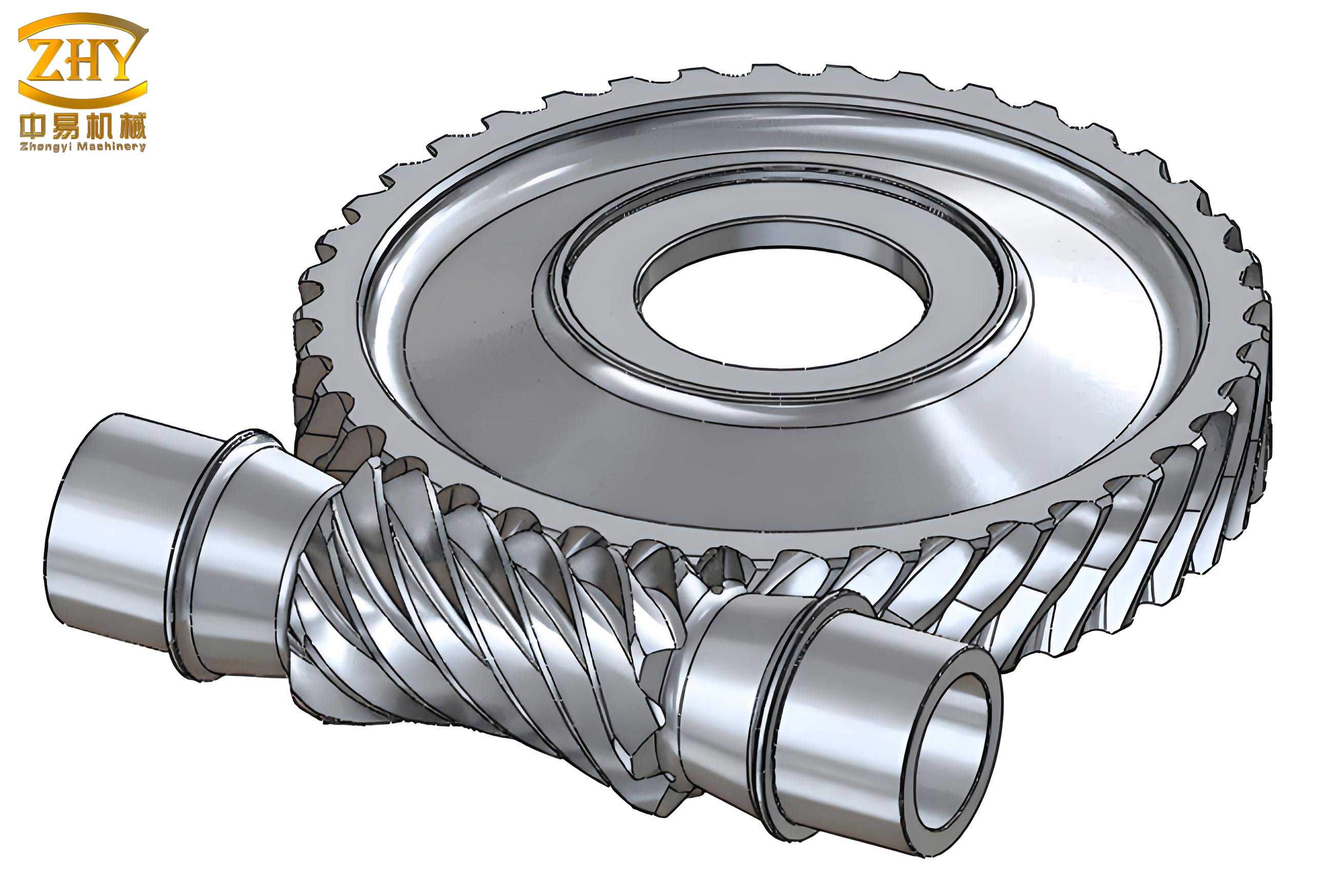
Once the type is confirmed, I proceed to measure the worm’s parameters. The axial pressure angle, denoted by $$ \alpha $$, is typically 20° or 14.5° for metric modules and 14.5° or 20° for diametral pitch systems according to standards like GB 10085-88 (similar to ISO standards). I measure this using a universal bevel protractor or a dedicated angle gauge. Alternatively, if the worm was machined on a lathe, the tool setting angle or a standard tooth profile template can be used for verification. The axial pressure angle is a critical parameter in defining the meshing action of the screw gears.
The next essential parameter is the axial module, $$ m_x $$. To measure this, I use a steel ruler or a vernier caliper to determine the axial pitch, $$ p_x $$. For accuracy, I measure over several pitches ($$ n $$ pitches) and calculate the average. The relationship is given by:
$$ m_x = \frac{\sum p_x}{n \pi} $$
If the calculated value does not closely match a standard module, I consider the possibility of a diametral pitch ($$ P_d $$) system, where the conversion is $$ P_d = \frac{25.4}{m_x} $$. The module is fundamental to all subsequent calculations for screw gears.
With the axial module determined, I measure the worm’s tip diameter, $$ d_{a1} $$, using a micrometer. This allows me to calculate the lead angle, $$ \gamma $$, which is vital for understanding the helix of the screw gears. The formula is:
$$ \tan \gamma = \frac{m_x z_1}{d_{a1} – 2 m_x} $$
Here, $$ z_1 $$ represents the number of starts (threads) on the worm. The lead angle significantly influences the efficiency and self-locking properties of screw gears. The worm’s pitch diameter, $$ d_1 $$, can then be derived as:
$$ d_1 = \frac{m_x z_1}{\tan \gamma} $$
This parameter is essential for determining the center distance when paired with the worm wheel.
Moving to the worm wheel measurement, the center distance, $$ a $$, between the worm and worm wheel shafts is a key dimensional check. I measure this on a surface plate using height gauges and vernier calipers, ensuring the axes are properly aligned. The theoretical center distance for non-modified screw gears is:
$$ a = \frac{d_1 + d_2}{2} = \frac{m_x}{2} \left( \frac{z_1}{\tan \gamma} + z_2 \right) $$
where $$ d_2 = m_x z_2 $$ is the worm wheel’s pitch diameter, and $$ z_2 $$ is its number of teeth. If the measured center distance, $$ a_{\text{meas}} $$, equals this theoretical value, the screw gear set is standard (non-modified). A discrepancy indicates a profile shift or modification in the worm wheel, a common practice to adjust center distance or improve performance.
When a profile shift is detected, the shift coefficient, $$ x_2 $$, needs to be determined. The formula for the shift coefficient is:
$$ x_2 = \frac{a_{\text{meas}} – a}{m_x} = \frac{a_{\text{meas}}}{m_x} – \frac{1}{2} \left( \frac{z_1}{\tan \gamma} + z_2 \right) $$
This coefficient is crucial for recalculating the worm wheel’s tooth dimensions, such as tip and root diameters. Other parameters, like the helix angle of the worm wheel ($$ \beta $$), are identical to the worm’s lead angle ($$ \gamma $$) for mating screw gears, and the hand of helix must be the same for both components.
To consolidate the measurement procedures, I often use tables to summarize the steps and formulas. Below is a table outlining the key measurement phases for screw gears:
| Component | Parameter | Measurement Method | Formula | Notes |
|---|---|---|---|---|
| Worm | Type Identification | Visual/Straight edge check of axial profile | Axial profile must be straight | Confirm Archimedean type |
| Axial Pressure Angle ($$ \alpha $$) | Angle gauge or protractor | Typically 20° or 14.5° | Verify against standards | |
| Axial Module ($$ m_x $$) | Measure axial pitch over n teeth | $$ m_x = \frac{\sum p_x}{n \pi} $$ | Use steel ruler or caliper | |
| Lead Angle ($$ \gamma $$) | Calculate from tip diameter | $$ \tan \gamma = \frac{m_x z_1}{d_{a1} – 2 m_x} $$ | Measure $$ d_{a1} $$ accurately | |
| Worm Wheel | Center Distance ($$ a $$) | Surface plate measurement | $$ a_{\text{meas}} = \frac{D_{shaft1} + D_{shaft2}}{2} + \text{offsets} $$ | Critical for determining modification |
| Profile Shift Coefficient ($$ x_2 $$) | Calculate from measured center distance | $$ x_2 = \frac{a_{\text{meas}}}{m_x} – \frac{1}{2} \left( \frac{z_1}{\tan \gamma} + z_2 \right) $$ | Indicates non-standard design | |
| Helix Angle ($$ \beta $$) | Assumed equal to worm’s lead angle | $$ \beta = \gamma $$ | For mating screw gears |
In practice, I frequently encounter worn screw gears where direct measurement is challenging. For instance, tooth flanks may be eroded, making pitch measurement difficult. In such cases, I employ indirect methods, such as measuring adjacent components or using reference dimensions from the housing. Additionally, when dealing with short shafts or stubby worms, alternative approaches like measuring straightness instead of coaxiality can be effective, as axis tilt might be negligible compared to offset errors. This involves taking multiple cross-sectional circle measurements on two journals and constructing a line to evaluate straightness, which approximates the axis alignment for short spans.
Let me illustrate with a detailed example from my fieldwork. I was tasked with measuring a worn screw gear set from a band saw machine. The worm had two starts ($$ z_1 = 2 $$), and the worm wheel had 40 teeth ($$ z_2 = 40 $$). First, I used a 20° standard template and confirmed the axial tooth profile was straight, identifying it as an Archimedean screw gear. Next, I measured four axial pitches, totaling 37.7 mm, giving an axial module of $$ m_x = \frac{37.7}{4 \pi} \approx 3.00 \, \text{mm} $$ (standard module 3 mm). The worm’s tip diameter was measured as 48 mm, so the lead angle was calculated as $$ \tan \gamma = \frac{3 \times 2}{48 – 2 \times 3} = \frac{6}{42} \approx 0.142857 $$, yielding $$ \gamma \approx 8.13^\circ $$. The worm’s pitch diameter thus became $$ d_1 = \frac{3 \times 2}{\tan 8.13^\circ} \approx 42.0 \, \text{mm} $$.
For the worm wheel, the theoretical pitch diameter is $$ d_2 = m_x z_2 = 3 \times 40 = 120 \, \text{mm} $$. The theoretical center distance for non-modified screw gears would be $$ a = \frac{42.0 + 120}{2} = 81.0 \, \text{mm} $$. However, on the surface plate, I measured the actual center distance as 85 mm. This discrepancy indicated a profile shift. Applying the formula, the shift coefficient was $$ x_2 = \frac{85}{3} – \frac{1}{2} \left( \frac{2}{\tan 8.13^\circ} + 40 \right) \approx 28.333 – 41.0 = -12.667 $$? Wait, this seems off. Let me recalculate carefully.
First, $$ \frac{z_1}{\tan \gamma} = \frac{2}{\tan 8.13^\circ} \approx \frac{2}{0.142857} \approx 14.0 $$. Then, $$ \frac{1}{2} \left( 14.0 + 40 \right) = \frac{54}{2} = 27.0 $$. And $$ \frac{a_{\text{meas}}}{m_x} = \frac{85}{3} \approx 28.333 $$. So, $$ x_2 = 28.333 – 27.0 = 1.333 $$. This positive shift coefficient indicates the worm wheel was modified to increase the center distance. This example underscores the importance of systematic measurement in diagnosing screw gear sets.
Beyond basic dimensions, I also consider the quality of measurement. When evaluating coaxiality or alignment, increasing the number of cross-sectional points and planes reduces error by better approximating the actual geometry. For screw gears, this is relevant when checking worm shaft alignment or worm wheel mounting. In practice, I use coordinate measuring machines (CMM) or precision dial indicators to gather multiple data points. The principle is that for a cylindrical feature, the form error diminishes as sampling increases, though practical constraints limit the number of points. A robust measurement plan for screw gears should balance accuracy with efficiency.
To further elaborate on formulas, here is a consolidated list of key equations for Archimedean screw gears, which I refer to during measurement:
1. Axial pitch: $$ p_x = \pi m_x $$
2. Lead of worm: $$ L = p_x z_1 = \pi m_x z_1 $$
3. Lead angle: $$ \tan \gamma = \frac{L}{\pi d_1} = \frac{m_x z_1}{d_1} $$
4. Worm pitch diameter: $$ d_1 = \frac{m_x z_1}{\tan \gamma} = q m_x $$, where $$ q $$ is the diameter factor.
5. Worm tip diameter: $$ d_{a1} = d_1 + 2 m_x $$
6. Worm root diameter: $$ d_{f1} = d_1 – 2.4 m_x $$ (typical, but depends on clearance)
7. Worm wheel pitch diameter: $$ d_2 = m_x z_2 $$
8. Worm wheel tip diameter: $$ d_{a2} = d_2 + 2 m_x (1 + x_2) $$
9. Worm wheel root diameter: $$ d_{f2} = d_2 – 2 m_x (1.2 – x_2) $$
10. Center distance: $$ a = \frac{d_1 + d_2}{2} + x_2 m_x = \frac{m_x}{2} (q + z_2 + 2 x_2) $$
These formulas are indispensable for reverse engineering screw gears. When measuring, I always cross-check calculated values against physical measurements to ensure consistency. For instance, after computing $$ d_1 $$, I might measure the worm’s root diameter to verify the tooth depth, which should be approximately $$ 2.2 m_x $$ to $$ 2.4 m_x $$ depending on the root clearance.
Another aspect I emphasize is the measurement of wear patterns. In used screw gears, the worm teeth often exhibit localized wear near the pitch line. I use profilometers or even simple lead wire tests to assess the contact pattern and wear depth. This information helps in deciding whether to repair, replace, or redesign the screw gears. For high-precision applications, I also measure the backlash by fixing one component and measuring the angular movement of the other, as excessive backlash can affect positioning accuracy.
In terms of instrumentation, while traditional tools like micrometers, calipers, and protractors are sufficient for basic measurements, advanced tools like gear tooth calipers, involute measuring machines, and 3D scanners enhance accuracy. For screw gears, a dedicated worm measuring machine can directly measure lead errors and profile deviations. However, in field maintenance, portability often dictates the use of simpler tools, so the methods I described earlier are designed to be practical and effective with minimal equipment.
Environmental factors also play a role. Temperature variations can affect dimensional measurements, especially for large screw gears. I always account for thermal expansion by measuring at a stable temperature or applying corrections. For example, steel has a coefficient of thermal expansion around $$ 11 \times 10^{-6} \, \text{/}^\circ\text{C} $$, so a temperature change of 10°C can cause a length change of 0.011%—significant for precision screw gears with tight tolerances.
To illustrate the comprehensive process, let’s consider another example where the screw gears are part of a lifting mechanism. The worm has a single start ($$ z_1 = 1 $$), and the worm wheel has 30 teeth ($$ z_2 = 30 $$). Using a ruler, I find the axial pitch is 9.42 mm over three pitches, so $$ m_x = \frac{9.42}{3 \pi} \approx 1.00 \, \text{mm} $$. The worm tip diameter is 22 mm, giving $$ \tan \gamma = \frac{1 \times 1}{22 – 2 \times 1} = \frac{1}{20} = 0.05 $$, so $$ \gamma \approx 2.862^\circ $$. The pitch diameter is $$ d_1 = \frac{1}{0.05} = 20.0 \, \text{mm} $$. The worm wheel pitch diameter is $$ d_2 = 1 \times 30 = 30 \, \text{mm} $$. The theoretical center distance is $$ a = \frac{20 + 30}{2} = 25.0 \, \text{mm} $$. If the measured center distance is 26 mm, then the shift coefficient is $$ x_2 = \frac{26}{1} – \frac{1}{2} \left( \frac{1}{0.05} + 30 \right) = 26 – 25 = 1.0 $$. This indicates a significant positive shift, likely to avoid undercut or to adjust the mesh.
In my work, I document all measurements in tables for clarity. Below is a sample measurement record table for screw gears:
| Parameter | Symbol | Measured Value | Calculated Value | Unit |
|---|---|---|---|---|
| Worm Starts | $$ z_1 $$ | 2 | — | — |
| Worm Wheel Teeth | $$ z_2 $$ | 40 | — | — |
| Axial Pressure Angle | $$ \alpha $$ | 20° | — | degree |
| Axial Pitch (over 4 pitches) | $$ \sum p_x $$ | 37.70 | — | mm |
| Axial Module | $$ m_x $$ | — | 3.00 | mm |
| Worm Tip Diameter | $$ d_{a1} $$ | 48.00 | — | mm |
| Lead Angle | $$ \gamma $$ | — | 8.13 | degree |
| Worm Pitch Diameter | $$ d_1 $$ | — | 42.00 | mm |
| Worm Wheel Pitch Diameter | $$ d_2 $$ | — | 120.00 | mm |
| Measured Center Distance | $$ a_{\text{meas}} $$ | 85.00 | — | mm |
| Theoretical Center Distance | $$ a $$ | — | 81.00 | mm |
| Profile Shift Coefficient | $$ x_2 $$ | — | 1.333 | — |
Such tables not only organize data but also highlight discrepancies that guide further investigation. For instance, a large shift coefficient might indicate a custom design or prior repair, prompting me to check for non-standard tooth proportions.
In addition to dimensional measurements, I assess the surface condition of screw gears. Pitting, scoring, or polishing wear on tooth flanks can reveal lubrication issues or misalignment. I use surface roughness comparators or even digital microscopes to quantify wear patterns. This holistic approach ensures that the measured screw gears will function reliably upon reassembly or replacement.
Furthermore, when dealing with legacy equipment where drawings are lost, measuring screw gears becomes a reverse engineering task. I combine the methods above with material analysis (e.g., spectroscopy to determine alloy) and hardness testing to fully characterize the components. This comprehensive dataset is then used to manufacture new screw gears that match the original performance specifications.
To address potential errors in measurement, I employ statistical techniques. For example, when measuring the worm’s tip diameter, I take multiple readings around the circumference to account for ovality or taper. The average value is used in calculations, and the standard deviation indicates the measurement consistency. For critical screw gears, I might perform a full gear inspection report including lead variation, profile error, and pitch deviation.
Another practical tip is to use master gears or known good components for comparison. If an identical screw gear set is available, comparative measurements can quickly identify wear or damage. This is common in maintenance of serial machinery where spare parts are stocked.
In conclusion, the measurement of Archimedean screw gears is a systematic process that blends fundamental geometry with practical metrology. From identifying the straight axial profile to calculating shift coefficients, each step builds a complete picture of the gear set. I have found that meticulous measurement, supported by formulas and tabulated data, is key to ensuring the longevity and efficiency of screw gears in industrial applications. Whether in the field or the workshop, these methods empower engineers to maintain the robust performance that screw gears are known for, keeping machinery running smoothly and safely.
Throughout this discussion, I have emphasized the term “screw gears” to underscore their helical nature and broad applicability. By mastering these measurement techniques, professionals can tackle the challenges of maintenance and reverse engineering with confidence, ensuring that these essential transmission components continue to drive industry forward.