
In my extensive work with textile machinery, particularly in silk weaving, I have encountered a persistent issue: the phenomenon of excessive let-off of warp yarns after increasing loom speeds. This problem is intrinsically linked to the transmission characteristics of screw gears within the let-off mechanism. Typically, in a standard screw gear pair, whether for motion or power transmission, the screw (or worm) drives the gear (or worm wheel). However, in the let-off mechanism of a silk loom, the power source is not located on the screw shaft but on the gear shaft. Were it not for the self-locking action of the screw, the gear would drive the screw to rotate, leading to slack in the warp tension. The core of understanding and solving this issue lies in a deep analysis of screw gears.
During the weaving process, the tension in the warp sheet is generally around 20 kilograms. This translates to a tension moment acting on the loom beam core, which is the gear shaft, of approximately 2000 kilogram-centimeters (calculated for a medium-weight fabric with 20 kg warp tension and a beam diameter of 100 mm). The fact that such a significant power source does not cause continuous rotation of the screw is due to the self-locking nature of the screw gear. The driving moment is insufficient to overcome the frictional moment between the helical teeth of the screw and the gear teeth, in addition to the frictional moment present between the screw shaft and its bearings. Therefore, without an additional driving moment applied to the screw, it will not rotate spontaneously. During let-off, a driving moment is imparted to the screw by a ratchet wheel.
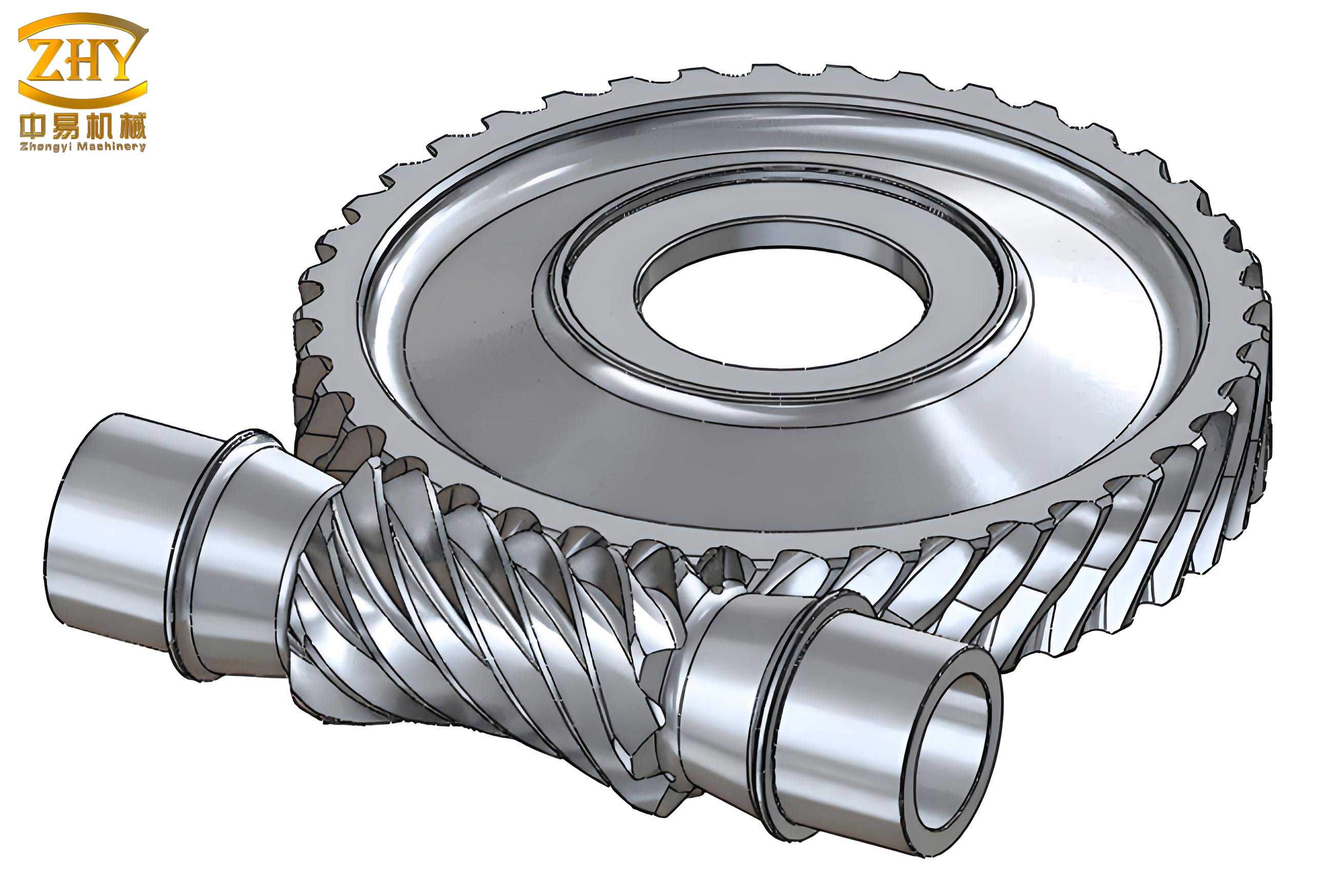
The behavior of screw gears in this context can be precisely modeled. When the screw is the driving member transmitting power to the gear, the moment required to turn the screw shaft is given by:
$$ M = F_n \cdot r \cdot \tan(\lambda – \phi) $$
Where:
\( F_n \) is the normal force acting on the screw teeth,
\( \lambda \) is the lead angle of the screw,
\( \phi \) is the friction angle between the screw and gear tooth surfaces (approximately 6° when both are cast iron),
\( r \) is the pitch radius of the screw (in mm).
In the self-locking screw gear pair of the silk loom let-off mechanism, the frictional moment that must be overcome to initiate screw rotation is actually:
$$ M’ = F_n \cdot r \cdot \tan(\lambda + \phi) $$
This formula highlights the critical role of the lead angle \( \lambda \). Let \( M_f \) represent the frictional moment between the screw shaft and its bearings. The total resistance moment \( T \) against screw rotation is then:
$$ T = M’ + M_f $$
During let-off, the ratchet drives the screw at a certain angular velocity, imparting kinetic energy to the screw-ratchet system. When the ratchet reaches its limit position, let-off should cease. However, the kinetic energy of the system must be dissipated by the resistance moment \( T \) until it is completely exhausted, at which point the screw shaft stops rotating. This is the so-called stopping or coasting process. During this coasting, the screw continues to rotate slightly, resulting in the undesirable over-let-off of warp yarn. Clearly, for a given amount of kinetic energy, a smaller resistance moment \( T \) leads to a longer coasting time and consequently a greater amount of excess warp let-off. Since \( M_f \) is generally not large, a brake disc is typically installed on the screw shaft in silk looms to increase the frictional resistance moment, aiming to shorten the coasting time to a point where over-let-off is negligible. The total resistance moment then becomes:
$$ T’ = M’ + M_f + M_b $$
Where \( M_b \) is the frictional moment from the brake disc.
As loom speed increases, the angular velocity of the screw shaft during let-off also increases, granting it greater kinetic energy. With the resistance moment \( T’ \) remaining constant, the coasting time prolongs, effectively extending the let-off duration and making the over-let-off defect prominent again. This analysis underscores the dynamic challenges faced by screw gears in high-speed applications.
To formulate effective solutions, we must delve deeper into the parameters affecting \( T’ \). From the equation \( M’ = F_n \cdot r \cdot \tan(\lambda + \phi) \), we see that increasing \( M’ \) directly increases the resistance. This can be approached by:
- Further reducing the lead angle \( \lambda \) of the screw, which increases the value of \( \tan(\lambda + \phi) \).
- Increasing the pressure on the existing brake disc to raise \( M_b \).
- Installing an additional brake disc, effectively doubling \( M_b \).
The relationship between kinetic energy \( E_k \), resistance moment \( T \), and coasting angle \( \theta \) can be expressed as:
$$ E_k = \frac{1}{2} I \omega^2 = T \cdot \theta $$
Where \( I \) is the moment of inertia of the rotating parts and \( \omega \) is the angular velocity. The coasting time \( t \) is related to the angular deceleration \( \alpha = T / I \):
$$ t = \frac{\omega}{\alpha} = \frac{I \omega}{T} $$
This clearly shows that for a fixed \( I \) and \( \omega \), increasing \( T \) reduces \( t \). Alternatively, reducing the kinetic energy itself by lowering \( \omega \) is also effective. This can be achieved by modifying the drive to the ratchet, for instance, by driving it from the center shaft instead of a faster-moving component, which could halve the screw’s angular velocity.
The design and selection of screw gears are paramount. The performance of these gears depends on material pairing, lubrication, and geometric precision. The following table summarizes key parameters influencing the frictional behavior and self-locking capability of screw gears in let-off mechanisms:
| Parameter | Symbol | Typical Range/Value | Effect on Resistance Moment & Self-Locking |
|---|---|---|---|
| Lead Angle | \( \lambda \) | 3° – 10° (often under 5° for self-locking) | Decreasing \( \lambda \) sharply increases \( \tan(\lambda+\phi) \), enhancing self-locking and \( M’ \). |
| Friction Angle | \( \phi \) | ~5°-7° (depends on material & lubrication) | Larger \( \phi \) increases \( M’ \). Using materials with higher friction coefficients can be beneficial but affects efficiency. |
| Normal Force | \( F_n \) | Derived from warp tension and gear ratio | Higher warp tension increases \( F_n \), thus increasing \( M’ \). This is a process variable. |
| Pitch Radius of Screw | \( r \) | Design-dependent | Larger \( r \) increases \( M’ \) linearly. |
| Number of Brake Discs | N/A | 1 or 2 | Directly scales the brake frictional moment \( M_b \). |
| Screw Shaft Bearing Friction | \( M_f \) | Relatively small, design-dependent | Can be optimized with bearing type and preload, but contribution is minor compared to \( M’ \) and \( M_b \). |
The interplay of these factors dictates the performance of screw gears in this application. For existing machinery, replacing the screw gear pair to reduce \( \lambda \) is often impractical due to cost and mechanical constraints. Therefore, measures 2 and 3 (increasing brake action) and reducing the ratchet’s drive speed are more feasible retrofits. In fact, some advanced looms, like the Tsudakoma ZW-type silk loom, incorporate dual brake discs on the screw shaft for this precise reason.
The kinematic and dynamic analysis of screw gears extends beyond simple static moments. The transmission efficiency \( \eta \) when the screw is driving is:
$$ \eta = \frac{\tan \lambda}{\tan(\lambda + \phi)} $$
For self-locking conditions where \( \lambda \le \phi \), efficiency drops below 50%, and motion reversal (gear driving screw) becomes impossible without an external force, which is the desired state in our let-off mechanism when the ratchet is not active. However, during active let-off, we are forcing motion, and the coasting problem relates to the system’s dynamics post-drive disengagement.
Let’s model the complete stopping process. The equation of motion after the ratchet drive disengages is:
$$ I \frac{d^2\theta}{dt^2} = -T $$
Where \( T \) is the total constant resisting moment (assuming Coulomb friction). Solving this with initial conditions \( \theta(0)=0 \), \( \dot{\theta}(0)=\omega_0 \) gives:
$$ \dot{\theta}(t) = \omega_0 – \frac{T}{I}t $$
$$ \theta(t) = \omega_0 t – \frac{1}{2}\frac{T}{I}t^2 $$
The stopping time \( t_s \) is when \( \dot{\theta}(t_s)=0 \):
$$ t_s = \frac{I \omega_0}{T} $$
And the total coasting angle \( \theta_s \) is:
$$ \theta_s = \frac{I \omega_0^2}{2T} $$
This coasting angle \( \theta_s \) directly correlates to the amount of over-let-off. Therefore, to minimize \( \theta_s \), we must maximize \( T \) or minimize \( I \omega_0^2 \). In practice, \( I \) is relatively fixed, so the focus is on increasing \( T \) (via screw gear design and braking) or reducing \( \omega_0 \) (via drive train modification).
The significance of screw gears in this mechanism cannot be overstated. Their inherent self-locking property provides the essential braking function to maintain warp tension. However, this same property, coupled with system dynamics, leads to the coasting issue at high speeds. A comparative analysis of mitigation strategies is useful:
| Strategy | Mechanism of Action | Impact on Resistance Moment \( T’ \) | Practical Implementation Complexity | Estimated Effect on Coasting Angle \( \theta_s \) |
|---|---|---|---|---|
| Reduce Screw Lead Angle (\( \lambda \)) | Increases \( M’ = F_n r \tan(\lambda+\phi) \) | Significant increase if \( \lambda \) is small | High (requires new screw gear pair, possible redesign) | Can reduce \( \theta_s \) substantially, but may affect let-off resolution. |
| Increase Brake Disc Pressure | Increases \( M_b \) linearly with pressure | Moderate increase | Low to Medium (adjustment of spring or brake mechanism) | Proportional reduction in \( \theta_s \). |
| Add Second Brake Disc | Approximately doubles \( M_b \) | Large increase | Medium (requires shaft modification, extra components) | Can nearly halve \( \theta_s \) if \( M_b \) was a major component. |
| Reduce Ratchet Drive Speed (\( \omega_0 \)) | Reduces initial kinetic energy \( \frac{1}{2}I\omega_0^2 \) | No change to \( T’ \), but reduces numerator in \( \theta_s \) formula | Medium (modification of drive linkage or gears) | Reduces \( \theta_s \) quadratically with reduction in \( \omega_0 \). e.g., halving \( \omega_0 \) quarters \( \theta_s \). |
| Optimize Bearing Friction (\( M_f \)) | Minor contribution to \( T’ \) | Small increase | Low (use of different bearings, lubrication) | Negligible effect on \( \theta_s \) typically. |
In my design considerations, a holistic approach is best. For new loom designs, specifying screw gears with a carefully calculated, minimal lead angle \( \lambda \) is advisable from the outset. This foundational choice maximizes the inherent resistance from the screw gears themselves. The lead angle should satisfy the self-locking condition \( \lambda < \phi \) with a sufficient margin, but not so small as to make manufacturing difficult or reduce the let-off adjustment sensitivity excessively. A common design criterion is:
$$ \lambda \leq \arctan(\mu) \approx \phi $$
Where \( \mu \) is the coefficient of friction. For steel-on-bronze pairs common in precision screw gears, \( \mu \) might be 0.05-0.1, corresponding to \( \phi \) of about 3°-6°. For our application with possible dry or semi-lubricated conditions in textile environments, a conservative \( \lambda \) of 2°-4° might be specified.
The geometry of screw gears is complex. The normal force \( F_n \) is related to the tangential force on the gear \( F_t \) by:
$$ F_n = \frac{F_t}{\cos \phi_n \cos \lambda – \mu \sin \lambda} $$
Where \( \phi_n \) is the normal pressure angle. For simpler analysis, we often use the approximation in the earlier formulas. The precise calculation of the friction moment \( M’ \) involves integrating forces over the contact area, which is why empirical data and testing are crucial.
Another perspective is to consider the power flow. In the standard driving mode (screw input, gear output), the efficiency is low. In our let-off mechanism’s passive state, power attempts to flow from gear to screw but is blocked. The blocking torque, or holding torque, is essentially \( M’ \). This holding torque must exceed the torque induced by the warp tension on the gear shaft for the system to be stable. The condition is:
$$ M’_{\text{available}} \geq \tau_{\text{warp}} / i $$
Where \( \tau_{\text{warp}} \) is the warp tension moment on the beam (gear shaft) and \( i \) is the gear ratio from screw to gear. Since \( i \) is usually large in let-off mechanisms for fine control, the reflected torque on the screw is small, which is why self-locking is often easily achieved under static conditions. The dynamic coasting problem is separate, relating to the dissipation of stored rotational energy.
Material selection for screw gears plays a role in the friction angle \( \phi \). While the original text mentioned cast iron, modern looms might use steel screws paired with phosphor bronze gears for better wear resistance and a consistent friction coefficient. The friction angle can be expressed as:
$$ \phi = \arctan(\mu_{\text{eff}}) $$
Where \( \mu_{\text{eff}} \) is the effective coefficient of friction, which depends on materials, surface finish, lubrication, and sliding velocity. A table for common pairings is informative:
| Screw Material | Gear Material | Typical Dry \( \mu \) | Typical Lubricated \( \mu \) | Notes for Let-off Mechanisms |
|---|---|---|---|---|
| Hardened Steel | Phosphor Bronze | 0.10-0.15 | 0.05-0.10 | Good wear life, consistent performance. |
| Cast Iron | Cast Iron | 0.15-0.20 | 0.08-0.12 | Higher friction, good for self-locking, but may wear faster. |
| Stainless Steel | Nylon/Bronze Composite | 0.20-0.30 (vs nylon) | 0.10-0.15 | Lightweight, low inertia, but friction may vary with humidity/temp. |
In practice, lubrication is often minimal in these mechanisms to maintain a high and predictable friction, but this must be balanced against wear. The choice affects the design value for \( \phi \).
To achieve the required article length and depth, let’s explore further mathematical modeling. The kinetic energy of the rotating screw shaft assembly with a brake disc can be expressed as:
$$ E_k = \frac{1}{2} I_s \omega_s^2 + \frac{1}{2} I_b \omega_b^2 $$
Since the brake disc is fixed on the shaft, \( \omega_b = \omega_s = \omega \), and \( I = I_s + I_b \). The moment of inertia for a solid cylinder (simplifying the screw and disc) is \( I = \frac{1}{2} m r^2 \). Designing for a lower inertia \( I \) helps reduce \( E_k \) for a given \( \omega \), but this may conflict with strength requirements. The brake disc’s contribution to \( M_b \) is typically \( M_b = \mu_b F_b R_b \), where \( \mu_b \) is the coefficient of friction of the brake lining, \( F_b \) is the normal braking force, and \( R_b \) is the effective radius of the brake disc.
Combining all, the total resistance moment \( T’ \) is:
$$ T’ = F_n r \tan(\lambda + \phi) + \mu_f F_f r_f + n \cdot (\mu_b F_b R_b) $$
Here, \( \mu_f \) and \( F_f \) and \( r_f \) pertain to the shaft bearing friction, and \( n \) is the number of brake discs (1 or 2). Optimizing this equation is the key to solving the over-let-off problem. In high-speed looms, \( \omega \) might increase by 20-50%, so \( E_k \) increases by 44-125% (since \( E_k \propto \omega^2 \)). To maintain the same coasting angle \( \theta_s \), \( T’ \) must increase proportionally to \( \omega^2 \). If \( \omega \) doubles, \( T’ \) must quadruple. This is challenging, which is why a multi-pronged approach is necessary.
Let’s consider a numerical example to illustrate. Assume initial parameters for a traditional loom:
\( I = 0.001 \, \text{kg} \cdot \text{m}^2 \) (moment of inertia),
\( \omega_0 = 10 \, \text{rad/s} \),
\( T’ = 0.05 \, \text{N} \cdot \text{m} \).
Then, \( t_s = I \omega_0 / T’ = 0.001*10/0.05 = 0.2 \, \text{s} \), and \( \theta_s = I \omega_0^2 / (2T’) = 0.001*100/(0.1) = 1 \, \text{rad} \). This 1 radian of extra rotation might correspond to several millimeters of warp let-off, which could be significant.
Now, if speed increases so \( \omega_0′ = 15 \, \text{rad/s} \) (50% increase), with \( T’ \) unchanged, \( \theta_s’ = 0.001*(225)/(0.1) = 2.25 \, \text{rad} \), more than doubling the over-let-off. To bring \( \theta_s’ \) back to 1 rad, we need \( T” = I (\omega_0′)^2 / (2 \theta_s) = 0.001*225/(2*1) = 0.1125 \, \text{N} \cdot \text{m} \), more than doubling the original \( T’ \). This increase might be achieved by combining a slight increase in brake force and adding a second brake disc.
The design of the screw gears themselves is a fascinating topic. The screw, often single-start for high reduction ratios and self-locking, has a lead \( p \) related to its lead angle \( \lambda \) and pitch diameter \( d \) by:
$$ \tan \lambda = \frac{p}{\pi d} $$
For a given module or diametral pitch, the gear tooth geometry must match the screw thread. The contact between screw and gear teeth is theoretically line contact, but in practice, it’s a complex pattern affected by alignment and load. The wear of these screw gears directly impacts the friction characteristics over time, necessitating periodic adjustment of the brake system to compensate.
In modernizing older looms, the most practical retrofit is often the addition of a second brake disc. This modification directly targets \( M_b \) in the resistance moment equation. The design calculation for the required brake force would be:
$$ F_b = \frac{ \Delta T }{ \mu_b R_b } $$
Where \( \Delta T \) is the required increase in total resistance moment. This approach preserves the existing screw gears, which are often costly to replace and may involve complex disassembly.
Another innovative approach is to use a different type of self-locking mechanism altogether, such as a harmonic drive or a steep lead ball screw with a brake. However, the screw gear system remains popular due to its simplicity, robustness, and high reduction ratio in a compact space. The reliability of screw gears in such demanding cyclic applications is a testament to their fundamental engineering value.
Throughout this discussion, the centrality of screw gears is evident. Their geometric parameters define the baseline resistance. Their material pairing influences the friction. Their interaction with the braking system determines the dynamic response. In every aspect of analyzing and solving the over-let-off problem, we return to the properties of the screw gears. Therefore, a profound understanding of screw gear mechanics is indispensable for any textile machinery engineer aiming to optimize let-off performance, especially in high-speed weaving.
To conclude, the essence of the let-off mechanism’s behavior under high speed is a dynamic interplay between the kinetic energy imparted to the screw shaft and the total resistance moment opposing its rotation, a resistance moment fundamentally anchored by the self-locking action of the screw gears. By rigorously applying principles of mechanics to the screw gear pair, modeling the stopping process, and evaluating practical design modifications, we can effectively mitigate the issue of excessive warp let-off. Whether through enhancing the inherent friction of the screw gears, augmenting external braking, or reducing the input speed, each strategy revolves around manipulating the parameters that govern the behavior of these critical screw gears. Future developments may see integrated sensor-controlled braking systems, but the core transmission will likely continue to rely on the timeless principle of the self-locking screw gear.